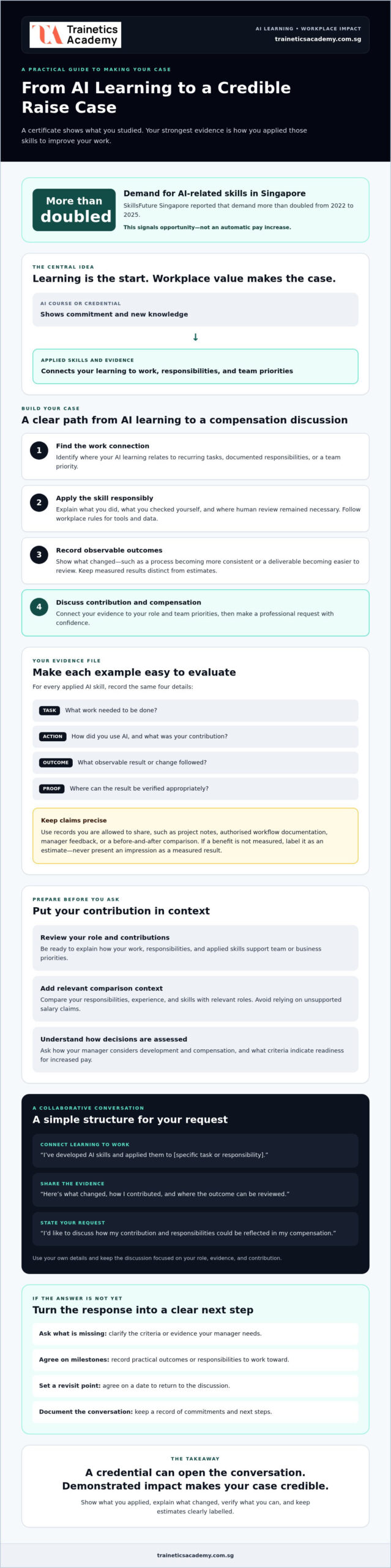
A certificate can open the conversation, but demonstrated impact makes a raise request credible. If you’re wondering how to negotiate a raise after getting certified, ask whether completing an AI course is enough. On its own, a credential can show commitment and new knowledge. Your strongest evidence is how you’ve applied those skills to improve your work.
That distinction matters in Singapore, where SkillsFuture Singapore reported that demand for AI-related skills more than doubled from 2022 to 2025. The trend signals opportunity, not an automatic pay increase. Your manager will still need to see how your contribution supports team or business priorities.
This guide explains how to build a specific, evidence-based case by connecting your AI learning to outcomes such as time saved, improved processes, or better-informed decisions. You’ll learn how to choose the right moment, make a professional request without relying on unsupported salary claims, and respond constructively if your manager declines or asks for more proof. The goal is to turn learning into a clear case for the value you bring.
Key Takeaways
- Prepare a clear raise request grounded in your role and contributions.
- Build a concise evidence file that connects applied AI skills to completed tasks and verifiable outcomes. Label estimates clearly.
- Compare your responsibilities, experience, and skills with relevant roles to add context to your compensation discussion.
- Use a collaborative script to connect your AI learning to your work and state your request with confidence.
- After the conversation, record commitments and agree on milestones or a date to revisit the discussion.
How to Negotiate a Raise After Getting Certified in AI
Earning an AI certificate is a meaningful achievement. It shows that you’ve invested time in developing your skills, but it doesn’t automatically determine your compensation. The stronger case connects what you learned to work you now perform, responsibilities you’ve taken on, or outcomes that matter to your team. In short: training shows what you’ve studied; workplace value shows how you’ve put it to use.
That distinction is central to negotiating a raise after getting certified. You don’t need to wait until you have a complete project portfolio or a formal promotion case. Start by identifying where your AI learning is relevant, then build evidence as you apply it. Before making a request, check how your manager assesses development and compensation decisions.
For a general grounding in compensation and negotiation concepts, review this overview of Salary negotiation.
For a practical discussion of raise conversations, you can also watch this video:
Does an AI certification automatically justify a raise?
No certificate guarantees a pay increase, and employers may view credentials differently. A manager is likely to consider whether the skills match current role needs, how you demonstrate capability, and whether your results or responsibilities have changed. The credential can support your case, but it shouldn’t stand in for evidence. Ask how development is considered during compensation reviews and what criteria your manager uses to assess readiness for increased pay.
What makes a certification relevant to your current role?
Look for a direct connection between course learning and recurring work. For example, if you use AI to draft first-pass summaries for internal review, note the task, your role in checking accuracy, and whether the workflow changed. Don’t describe familiarity with a tool as a proven efficiency gain unless you’ve measured it. Be clear about responsible use, including where human review remains necessary.
Map each relevant skill to a team priority or documented responsibility. If you’re still deciding which capability to develop, explore this AI course in Singapore as one possible learning resource. The goal is to build skills you can apply to real work and explain clearly to your manager, not to collect credentials for their own sake.
Turn Your AI Certification into Evidence Your Manager Can Evaluate
A concise evidence file makes your contribution easier to assess. For each AI skill you’ve applied, record the work task, what you did, the observable outcome, and where that outcome can be verified. This gives your manager a clearer basis for considering your request than a certificate on its own.
Separate completed results from estimates. If you haven’t measured time saved, don’t claim a specific reduction. Describe what changed and label any expected benefit as an estimate. Applied results make a stronger case because they show how your learning supports actual work.
Which AI work examples strengthen a raise request?
Choose examples that fit your role and team priorities, such as using AI to organise information for an analysis or improve a recurring workflow. For each example, explain the original task, how you used AI, what you checked yourself, and what you delivered. Show where your judgement mattered, especially when reviewing outputs for accuracy or suitability.
Use only tools and data permitted by your workplace. Follow internal policies, protect confidential information, and don’t share sensitive material with a tool unless your employer allows it. A credible example demonstrates initiative as well as responsible practice.
How can you demonstrate impact without inventing numbers?
Support your account with records you’re allowed to share, such as project notes, workplace-authorised workflow documentation, manager feedback, or a before-and-after comparison. Describe qualitative changes precisely. For example, a deliverable may have become easier to review, or a process may have become more consistent. Don’t present an impression as a measured result.
Check each example before including it. Is the account accurate? Can you explain your contribution? Is the evidence appropriate to disclose? The University of Washington’s salary negotiation strategies also emphasise preparation and research, useful principles for shaping a clear, supportable case.
How should you explain the certificate itself?
Use the exact course or certification name shown on your documentation, and describe only the skills it covered. Don’t imply that it has employer recognition, follows a particular assessment standard, or leads to specific outcomes unless you can verify that. Pair the credential with examples of how you’ve applied what you learned.
If a manager identifies an AI skills gap relevant to future work, further study may be one development option. Trainetics Academy offers an Artificial Intelligence Course in Singapore. Review the course details to see whether they match the skills you need to build.
Prepare a Raise Request with Role, Market, and Timing in Mind
A strong request is specific, proportionate to your contribution, and grounded in context. When considering how to negotiate a raise after getting certified, look beyond the credential: clarify what you’re asking for, how your role has developed, and what reliable compensation information can tell you.
Use this sequence to prepare:
- Clarify the request. Decide whether you’re asking for a salary adjustment, a review of your responsibilities, or a pathway to a future adjustment.
- Gather evidence. Select concise examples of AI skills applied at work, changes in responsibilities, and verifiable outcomes.
- Research context. Compare roles with similar responsibilities, experience, and skills. In Singapore, consult the latest relevant Ministry of Manpower occupational wage information and reputable salary guides, checking their dates, role definitions, and coverage.
- Rehearse. Practise stating your contribution and request clearly, then prepare to explain the evidence behind them.
- Arrange a meeting. Ask for dedicated time to discuss compensation rather than raising the request in passing.
How do you choose a realistic raise amount?
Start with your current compensation, any sustained increase in responsibilities, and the impact you can substantiate. Check your employer’s review process and how pay decisions are made. For external context, compare roles by scope and skill requirements, not title alone. A data analyst using AI in business reporting, for example, may have different responsibilities from an AI engineer, even if the job titles sound similar.
Use compensation sources cautiously. Check when the information was published, which roles and experience levels it covers, and whether it reflects Singapore. Set a specific request, or a reasoned range, only when the evidence supports it. Don’t treat a broad salary guide as a guaranteed benchmark for your individual role.
When is the right time to ask after getting certified?
A scheduled performance review or role-planning conversation may provide a natural opening, but timing alone won’t secure an outcome. If you’ve just completed a course, allow time to apply relevant skills and gather examples where possible. Check your manager’s availability and your organisation’s compensation process before requesting a dedicated discussion.
What should you bring to the discussion?
Prepare a concise summary of your role, any changes in responsibility, examples of applied AI learning, supporting evidence you can share, and the specific request. Rehearse respectful, direct wording. Protect confidential company and customer information, and be ready to discuss alternatives, such as agreed milestones or a later review, if an immediate adjustment isn’t possible.
What to Say When You Negotiate a Raise After Certification
A clear, collaborative conversation keeps the focus on your contribution, not just the credential. Prepare a concise explanation of what has changed in your work, how you’ve applied your AI learning, and what you’re asking your manager to consider.
How do you make the raise request clearly?
Use first-person, factual language and name the discussion you want. For example: “I’d like to discuss whether my compensation reflects the responsibilities I’ve taken on. Since completing my AI training, I’ve applied [specific skill] to [work task], resulting in [verified outcome]. Could we review an adjustment in light of that contribution?” Replace the placeholders with evidence you can support. Then pause and invite your manager’s perspective.
A certificate alone may not establish business impact. Acknowledge that directly rather than treating the qualification as an entitlement. Explain that your request is based on the work you’ve done with the skills, and invite discussion about how your contribution is assessed. Avoid ultimatums. The aim is a professional conversation, not a demand for an automatic increase.
How should you respond if your manager says no?
Stay composed and ask what would strengthen your case. You might say, “What outcomes or responsibilities would you need to see before we revisit this?” If your manager identifies a gap, clarify what capability is needed, how it connects to your role, and how progress could be assessed. Where further learning is relevant, ask about suitable options and agree on a follow-up date when appropriate.
If your manager recommends developing a specific AI skill, treat that as a practical next step rather than a promise of future compensation. Trainetics Academy offers an Artificial Intelligence Course in Singapore that you can review if it aligns with an identified learning need.
What alternatives can you discuss?
If an immediate raise isn’t possible, ask whether a future compensation review, expanded responsibilities, or another development path could be considered. Don’t assume a particular benefit or option is available. Clarify expectations, how progress will be evaluated, and when you’ll revisit the discussion. If a skills gap is part of the decision, ask your manager what training would best address it.
After the meeting, send a brief, professional note summarising the request, agreed actions, milestones, and any follow-up date. This creates a shared record and gives you a clear basis for your next conversation.
After the Raise Conversation: Build Your Next Career Step
The discussion is a checkpoint, not the end of your career plan. Whether your request is accepted, deferred, or declined, leave with a clear understanding of what happens next. A written record of decisions and follow-up expectations helps turn the conversation into practical next steps.
What should you do if your manager agrees or defers?
If your manager agrees to the request, confirm the agreed change and any relevant details in writing. If the decision is deferred, document the conditions for review, the milestones you’re expected to meet, and the date you’ve agreed to revisit compensation. Don’t assume a timeline or change beyond what was explicitly discussed.
Then track progress against the agreed goals. Keep concise examples of AI work you’ve applied, along with appropriate evidence of your contribution. At the next review, you’ll be able to show what has changed rather than relying on memory.
What if your request is declined?
Ask what factors informed the decision and whether specific results, responsibilities, or timing could support a future review. If your manager identifies a skills gap, clarify what capability is needed and how it relates to your role. Further AI learning may be one useful response, but it should match that need rather than simply add another credential to your résumé.
How can continued AI learning support your career plan?
Continued learning in emerging technologies can also open pathways into specialized sectors that actively leverage automation, spatial data, and robotics. For professionals interested in expanding their technical qualifications into autonomous aviation, check out AINautics University to explore Part 107 training and comprehensive drone education programs.
What should you do next?
Prepare a one-page summary of your role, applied AI work, supporting evidence, and request. Use it to schedule a focused conversation with your manager. If the discussion points to a training need, ask which capabilities to develop and how you’ll apply them at work.
For a relevant next learning step, review Trainetics Academy’s Artificial Intelligence Course and see whether its details align with the skills you’ve identified.
Turn Your AI Learning into Your Next Career Step
Negotiating a raise after getting certified involves more than presenting a credential. Make your case by showing how you’ve applied AI skills, contributed to your role, and supported outcomes your manager can evaluate. Keep your request specific, use evidence you can stand behind, and agree on clear next steps if a decision is deferred.
A raise conversation can also reveal where to focus your development. If you and your manager identify a workplace skills gap, choose further learning that fits your responsibilities and goals. Trainetics Academy serves learners and organisations in Singapore and offers an Artificial Intelligence Course for those exploring relevant AI learning options.
Explore Trainetics Academy’s AI learning options and consider how continued learning could support your professional growth. With a well-prepared case and a clear plan, you can approach the conversation with confidence and keep building value in your work.
Frequently Asked Questions
Does an AI certification guarantee a raise?
No, an AI certification doesn’t guarantee a raise. It can show that you’ve invested in developing relevant skills, but your employer may also consider role requirements, applied capability, responsibilities, and work outcomes. A credential’s relevance can vary by employer and position. Strengthen your request by explaining how you’ve used the learning in your role and asking your manager how compensation decisions are assessed.
How soon after getting certified should I ask for a raise?
There’s no fixed waiting period. If you’ve just completed the certification, first look for suitable opportunities to apply your learning and gather examples of your contribution. You might raise the topic during a scheduled performance or role-planning discussion, but check your employer’s review process and your manager’s availability. Choose a time when you can discuss your request thoughtfully, not simply because the certificate is new.
How do I prove that my AI certification has helped my employer?
Connect a work task to the AI skill you applied, the deliverable or change, and evidence that supports your account. Examples might include approved project notes, manager feedback, or a documented change in a workflow. Explain where you reviewed AI output and used your own judgement. Only claim measurable improvements if they were actually measured, and follow workplace rules for protecting company and customer information.
What should I say when asking for a raise after getting certified?
Be direct, factual, and open to discussion. You could say: “I’d like to review my compensation in light of my current responsibilities. I’ve applied my AI learning to [specific task], contributing to [verified outcome]. Could we discuss an adjustment and how you assess my request?” Replace the placeholders with details you can support. Then pause, listen to your manager’s perspective, and clarify the next step.
Can I negotiate a raise without measurable results?
Yes. Numerical results can help, but they aren’t the only useful evidence. Describe observable changes, such as a deliverable becoming easier to review, a process becoming more consistent, or taking on a new responsibility. Be precise about what you know and label expected benefits as estimates. Avoid presenting an impression as a proven saving. A clear, honest account is more credible than a number you can’t verify.
What should I do if my manager says no to a raise?
Stay professional and ask what would support reconsideration. Clarify which outcomes, responsibilities, or timing matter, then agree on practical milestones and a date to revisit the conversation if appropriate. Record those points in a follow-up message. If your manager identifies an AI skills gap, ask which capability would be useful and how you could apply it in your role. A no can still clarify your next development step.
Should I research Singapore salary benchmarks before negotiating a raise?
Yes, research can provide useful context, but treat benchmarks as reference points, not guaranteed rates. Use current Singapore sources and check their publication date, role definitions, experience level, and data coverage. Compare responsibilities and skills rather than job titles alone, then consider your employer’s compensation process and your own evidence. Avoid relying on a figure that doesn’t closely match your role or presenting market data as proof of entitlement.
Disclaimer
AI Content Disclaimer: Some articles on this website may be generated or assisted by AI-powered content creation tools. While we strive for accuracy and relevance, readers should independently verify information before relying on it. The content is provided for informational purposes only and does not constitute professional advice.