A ChatGPT workshop Singapore professionals choose should be judged by the skills they can apply to real tasks, not by how many features a trainer can demonstrate. A few clever prompts may be interesting, but they won’t necessarily help you draft clearer content, organise information or assess an AI-generated response. The practical question is whether a workshop gives you a repeatable way to use the tool thoughtfully in your day-to-day work.
This guide explains what practical ChatGPT learning can help you practise, how to compare instructor-led and self-directed formats, and how to decide whether individual or team learning better fits your needs. You’ll also see why it matters to understand both the potential value and the limitations of generated responses. Trainetics Academy offers interactive AI courses for individuals and organisations, delivered in physical and virtual formats. Use the guidance below to identify a learning route that connects your goals with relevant work.
Key Takeaways
- Assess workshop content by whether it helps you practise applying ChatGPT to realistic work tasks.
- Look for opportunities to refine instructions and evaluate generated responses, not just watch demonstrations.
- Compare guided learning and self-directed study based on the structure, practice and feedback you need.
- Use your goals and recurring tasks to decide whether a ChatGPT workshop Singapore option suits you or your team.
- Explore Trainetics Academy’s interactive AI courses as a structured learning route for individual or organisational development.
Why a ChatGPT Workshop in Singapore Should Focus on Work Outcomes
Trying ChatGPT for a quick rewrite is straightforward. Using it consistently at work takes more care. A single request may produce a useful draft, but you still need to define the task, provide relevant context, judge the response and revise it where necessary. Without that process, using the tool can remain an occasional experiment rather than a considered part of your workflow.
A practical ChatGPT workshop Singapore learners can benefit from should be assessed by what participants can apply after training, not by the number of features shown. Tool familiarity means knowing where to enter a request. Repeatable capability means knowing how to frame the request, set useful boundaries and assess whether the result meets the task’s requirements.
For example, a Singapore-based operations professional might use generative AI to organise a draft procedure, while a team lead could explore how to structure a meeting summary. These are practice scenarios, not promises of faster work or better results. Think carefully about what information is appropriate to enter, and review the output before relying on it. For broader background on the tool’s development and capabilities, consult ChatGPT Wikipedia.
What should a ChatGPT workshop help you do?
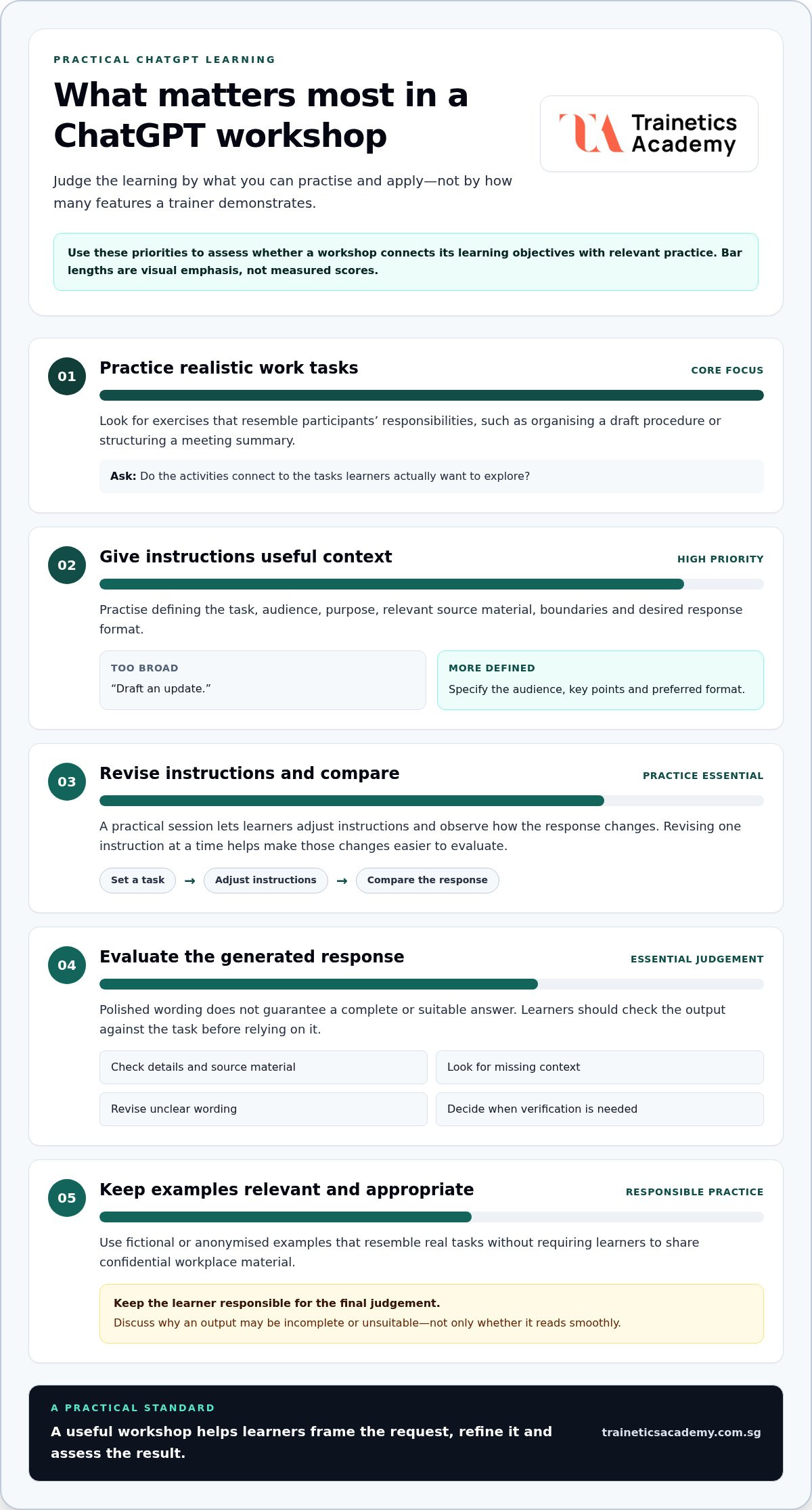
Useful learning objectives describe capabilities rather than guaranteed career outcomes. Participants might practise breaking a request into clear instructions, adding context about its audience and purpose, and specifying the response format they need. “Draft an update” gives little direction. Adding the intended audience, key points and preferred format gives ChatGPT a more defined task.
Practice should also include reviewing the response. Generated text can sound polished without being complete or suitable for its purpose. Check details, look for missing context, revise unclear wording and decide when independent verification is needed. The goal is informed use, not automatic acceptance.
Who benefits from structured ChatGPT training?
Professionals who have tried generative AI but lack a reliable method may value guided practice. Instead of collecting isolated prompt ideas, they can explore how to adapt instructions to a task and assess the result against clear criteria. This approach can apply across roles, from preparing a first draft of a client communication to organising points for an internal briefing.
Teams can use structured AI learning to discuss common tasks and develop a shared starting point for applying the tool. Examples may differ across departments: a finance team and a customer service team will have different needs. Individuals and teams can assess relevance by identifying suitable work examples and deciding which parts are appropriate for practice. Trainetics Academy offers interactive AI learning for individual and organisational development, with physical and virtual formats. Its AI course offering provides a broader route for building practical AI capability without assuming that every course centres on ChatGPT.
What to Look for in ChatGPT Workshop Content and Practice
A useful workshop gives learners a chance to test ideas against tasks that resemble their responsibilities. Rather than treating a prompt formula as a complete solution, participants can explore how a request changes when they specify its purpose, audience, source material and desired format. For example, they might ask ChatGPT to turn fictional policy notes into a plain-language FAQ, then compare the draft with the original notes for omissions or changes in meaning.
When assessing a ChatGPT workshop in Singapore, look for a clear connection between its learning objectives and practice activities. Learners should have opportunities to revise instructions and judge whether a response meets the task’s requirements. Feedback can help explain why a broad request produced a generic answer, while guided exercises offer a structured way to test improvements. These are useful criteria for assessing workshop content, rather than claims about the specific modules of any provider’s course.
How hands-on exercises support practical AI learning
Task-based practice makes prompting ideas easier to evaluate. A learner could provide fictional product details and ask for a short internal briefing for a specified audience. They can then check whether the draft stays within the source material, includes the relevant points and uses an appropriate tone. Revising one instruction at a time helps show which changes affect the response. Reviewing the result keeps the learner responsible for the final judgement.
Exercises should reflect communication tasks participants recognise without requiring them to share confidential workplace material. Fictional or anonymised examples let learners practise clarifying a goal, narrowing the scope and checking the result. A strong exercise makes room to discuss why an output may be incomplete or unsuitable, not just whether it reads smoothly.
How to judge whether workshop content fits your goals
Start with the capabilities you want to develop and the responsibilities they relate to. Someone seeking a foundation in generative AI may need practice framing requests and evaluating responses. A learner pursuing specialised technical training has a different objective. Keeping these needs distinct makes it easier to assess whether the content matches your current level and intended application. For broader context on professional AI learning in Singapore, explore this AI course in Singapore guide.
- Relevance: Do the exercises reflect the kinds of tasks learners want to explore?
- Revision: Can participants adjust instructions and observe how the response changes?
- Evaluation: Do learners practise checking source fidelity, relevance and tone?
- Scope: Does the content match participants’ experience and distinguish foundational use from technical study?
If your goal extends beyond ChatGPT to comparing tools for different business needs, the AI productivity tools guide provides broader context. You can also consider how ChatGPT practice fits within a wider AI course offering when planning professional development.
ChatGPT Workshop or Self-Directed Learning: Which Format Fits?
The best learning format depends on how you build skills and what support helps you follow through. A guided workshop follows a planned sequence and creates opportunities to discuss questions. Self-directed learning gives you more control over pace, but you need to choose what to practise and assess your own progress. Your goals, experience and learning habits should guide the choice.
If you’re weighing a ChatGPT workshop Singapore learners can attend against independent exploration, consider whether you’ll benefit more from a set structure or a flexible plan. Teams should also consider whether shared examples and discussion support their learning objectives. If colleagues need a common vocabulary for assessing AI-generated work, learning together can provide a useful basis for discussion.
| Format | Strongest use case | Key trade-off |
|---|---|---|
| Instructor-led workshop | Learners who value guided progression, discussion and supported practice | Follows a planned sequence, with less control over pacing |
| Self-directed learning | Learners who prefer flexibility and can set their own practice goals | Requires personal discipline and independent review, with less immediate feedback |
| Combined approach | Learners who want an initial structure followed by independent exploration | Requires time and initiative to continue learning after guided sessions |
When instructor-led learning may be a better fit
A guided sequence can help learners work through unfamiliar concepts in a deliberate order. Participants can raise questions, hear how others interpret a task and discuss why different instructions may produce different responses. Interactive exercises also create room to pause and reflect on what an output does and does not address.
This format may suit a team with varied experience, especially when discussion across roles is part of the objective. Colleagues can compare how they assess the same example and identify where their responsibilities call for different judgements. The discussion can establish shared reference points without requiring everyone to use ChatGPT in the same way.
When self-directed ChatGPT learning may suit you
Independent exploration can suit learners who prefer to work at their own pace, revisit resources and choose examples connected to their responsibilities. To make progress, set a specific practice goal, try an approach, review the response and note what you would adjust. Without a routine, it can be harder to build on an experiment or identify what you’ve learned.
Self-study can complement guided learning: use a structured session to establish a direction, then continue exploring suitable examples independently. Choose a balance that supports your learning habits and leaves enough opportunity to reflect. For a wider perspective on professional AI study, compare the approaches in this AI course in Singapore guide.
How to Decide Whether a ChatGPT Workshop Suits Your Singapore Team
Before choosing a learning route, clarify what participants need to practise and how they may apply it. A ChatGPT workshop Singapore learners consider is more likely to fit when its level and format align with real tasks, rather than general interest in AI alone. Start with individual goals or shared workplace needs, then use those priorities to guide your decision.
How individual learners can set useful workshop goals
Before training, choose one or two recurring tasks to consider, such as organising research notes or drafting a presentation outline. Set a focused objective, like learning to make instructions more precise or improving how you assess generated responses. After the session, decide when you’ll practise again and how you’ll reflect on what the output gets right or misses.
How organisations can frame team learning needs
For a team, identify a shared workflow participants can discuss without using sensitive information. The aim might be to explore how AI could support an early-stage draft or to develop a common approach to reviewing generated text. Clarify what participants should understand or practise, and consider whether their roles call for a shared foundation or different learning objectives.
Use this decision process to make the learning need concrete:
- 1. Define the tasks. Identify recurring activities people want to approach differently. Note where individual responsibilities overlap and where they diverge.
- 2. Establish learner level. Consider whether participants are new to generative AI, have explored it independently or want to deepen an existing practice.
- 3. Set learning outcomes. Name skills participants can work on, such as clarifying a request, refining instructions or reviewing an answer. Focus on learning rather than assumed business results.
- 4. Select a suitable format. Decide whether participants would benefit most from a guided sequence, discussion or independent exploration. Consider how they learn best and what will help them continue practising afterward.
For an individual, writing down a recurring task and a specific learning objective can make it easier to judge whether a workshop is relevant. For a team, discuss the intended learning outcomes before settling on a format. This helps distinguish shared learning needs from role-specific goals and gives participants a clear basis for evaluating their practice.
As you shape those objectives, Trainetics Academy’s AI course information can help you consider a structured professional learning route alongside your team’s priorities. Use your task list and desired outcomes to decide what kind of AI development makes sense as a next step.
Take the Next Step with AI Training at Trainetics Academy
Choosing a learning route is easier when you know what you want to develop. Prioritise clear objectives, practice connected to relevant work and a format that supports your learning habits. A ChatGPT workshop Singapore learners consider should fit those needs, whether you want to build your own skills or establish shared learning goals across a team.
What learners can expect from a structured AI learning route
Professional AI learning can move from core concepts to practical application. Participants build an understanding of how to approach AI tools, then use active learning and reflection to consider how those ideas relate to work. This progression supports informed practice: learners can identify what they want to try, examine the response and decide what needs further thought.
Trainetics Academy offers interactive AI courses for individuals and organisations, delivered physically or virtually. These courses provide a structured setting for professional development and engagement with the material. Learning can continue beyond a session when participants connect their objectives to workplace development and revisit what they have learned in suitable contexts.
Choose your next step in Singapore
Begin by deciding whether you’re learning for your own development or planning for a team. Individual learners can define a capability they want to strengthen. Organisations can align participants around shared objectives while recognising that roles may call for different applications. In either case, a clear purpose helps keep AI learning relevant and makes it easier to reflect on progress.
Explore Trainetics Academy’s AI course information as you consider the learning route that fits your goals. The academy offers interactive learning for individuals and organisations in physical and virtual formats. Review the AI training information and choose a next step that supports your professional development.
Explore AI training with Trainetics Academy
Build Your Next AI Learning Habit
Treat AI capability as an ongoing professional practice, not a one-time experiment. Choose a manageable way to apply what you learn, reflect on what worked and adjust your approach as your responsibilities evolve. This mindset can turn interest in a ChatGPT workshop Singapore into a deliberate commitment to learning with purpose.
Keep human judgement central. Generative AI can support your work, but you remain responsible for deciding whether its output is suitable for the task and audience. A considered learning path can help you strengthen that judgement over time, whether you’re developing your own skills or helping colleagues build a shared foundation.
Explore Trainetics Academy’s AI training and identify a learning route that aligns with your professional goals. Explore AI training with Trainetics Academy and take your next step with purpose.
Frequently Asked Questions
What should I expect from a ChatGPT workshop in Singapore?
A practical ChatGPT workshop Singapore professionals consider should provide a clear learning sequence and time to try ideas against realistic tasks. You might practise asking the tool to reorganise a draft meeting agenda, then assess whether the result preserves the original priorities. Expect to develop ways of working with AI, not a guarantee that every response will be accurate or ready to use. Review and judgement remain essential.
Is a ChatGPT workshop suitable for beginners?
Yes. Beginners can benefit when learning starts with foundational concepts and includes supported practice. New learners can explore how to ask a clear question, add relevant context and request a useful response format. For instance, they might test how different instructions affect a simple draft. A suitable learning level makes room for questions and helps participants build confidence without assuming prior AI expertise.
Can a ChatGPT workshop help me use AI at work?
It can help you develop skills for applying AI to relevant workplace tasks, such as shaping a presentation outline or organising supplied information into a draft. The practical value depends on the task, the quality of your instructions and how carefully you assess the response. Training can support more deliberate use, but it can’t guarantee productivity gains, promotion or a particular career result. Your professional judgement remains essential.
How do I choose between a ChatGPT workshop and self-study?
Choose a workshop if you value a planned learning path, opportunities to ask questions and feedback while practising. Self-study may suit you better if flexible pacing matters and you can set regular goals, test ideas and review your own results. Consider the support you need: someone learning a tool for a new responsibility may appreciate guided discussion, while an experienced learner may prefer independent exploration.
Can organisations arrange AI training for their teams in Singapore?
Trainetics Academy provides AI learning for organisations seeking professional development. A team can start by identifying who needs to learn, what shared work context matters and what participants should practise. For example, colleagues from different functions might need a common foundation while applying their learning to their own responsibilities. Trainetics Academy’s AI courses are delivered through physical and virtual learning platforms, supporting organisational learning in Singapore.
Do I need technical experience before learning ChatGPT?
Technical experience isn’t automatically required to begin learning how to work with ChatGPT, but the right starting point depends on your goals and background. Someone exploring basic workplace use may focus on writing clear instructions and reviewing responses, while a learner pursuing technical AI topics may need different preparation. Consider what you already know and which capabilities you want to build, rather than assuming every learner needs the same foundation.
Disclaimer
AI Content Disclaimer: Some articles on this website may be generated or assisted by AI-powered content creation tools. While we strive for accuracy and relevance, readers should independently verify information before relying on it. The content is provided for informational purposes only and does not constitute professional advice.