The right AI leadership course Singapore managers choose should help them make better workplace decisions, not simply demonstrate the most tools. Look for training that helps you assess where AI may fit, what your team needs to learn, and how to approach its use responsibly. If a course description leaves you unsure whether the content suits leaders or non-technical managers, check the syllabus before enrolling.
Useful training connects AI concepts to real work. This guide offers a framework for assessing course content, format, practical outcomes, and fit with your team’s needs. It also covers what to verify before enrolling, including whether published details confirm leadership, governance, or AI adoption coverage. Trainetics Academy offers an Artificial Intelligence Course. Review its current information to see whether it matches your goals, and use the comparisons below to decide on a suitable next step.
Key Takeaways
- Assess AI leadership training by the workplace decisions it prepares you to make, not just the tools it demonstrates.
- Check whether learning outcomes and practical examples fit your role, sector, and team.
- Compare AI leadership course Singapore options by audience, syllabus evidence, format, and opportunities to apply what you learn.
- Identify a team or workflow challenge before comparing courses, then check whether the published details address it.
- Before considering Trainetics Academy’s Artificial Intelligence Course for leadership development, confirm that its current content matches your goals.
What should an AI leadership course in Singapore help you do?
An AI leadership course should help you make informed workplace decisions: where AI may be useful, what your team needs to learn, and how to assess results. It should prepare you to guide adoption, not just operate a particular tool. A useful starting point is understanding what is Artificial Intelligence, then connecting that foundation to decisions in your role.
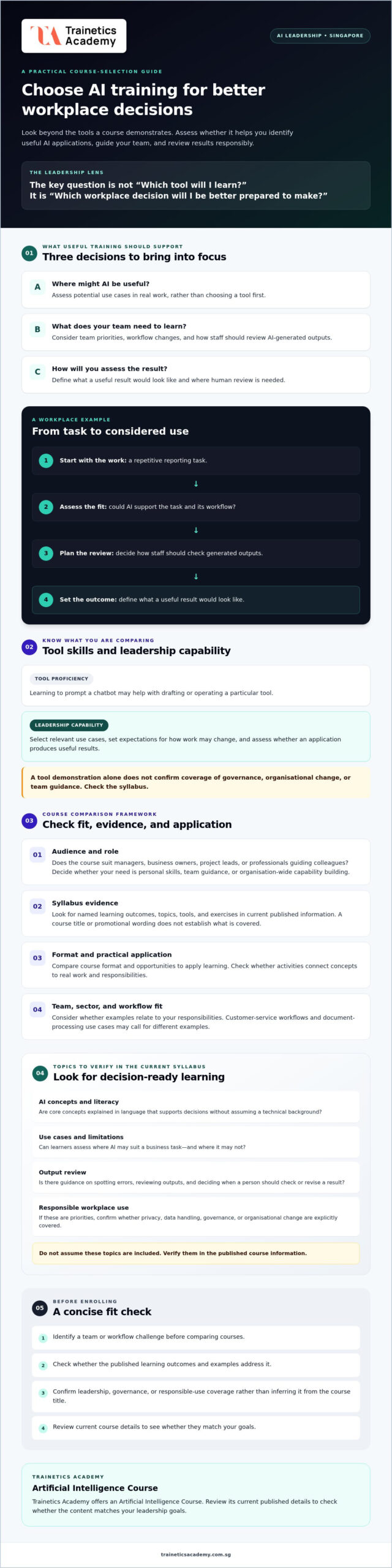
For example, a manager might assess whether AI could support a repetitive reporting task, decide how staff should review generated outputs, and define what a useful result would look like. The leadership challenge may also involve team guidance, process changes, and responsible use. A course title alone does not confirm coverage of these topics. Check the published learning outcomes and examples before enrolling.
The CNA video below introduces a Singapore programme focused on helping firms approach business transformation with AI.
AI tool skills versus AI leadership capability
Tool proficiency can be valuable, but it is only one part of AI learning. Leadership capability includes selecting relevant use cases, setting expectations for how work may change, and assessing whether an application produces useful results. For managers seeking targeted support alongside coursework, executive coaching from Simon Lead LLC helps professionals enhance these core leadership capabilities. Learning to prompt a chatbot may help with drafting. A leader must also consider who reviews the draft and how it fits the team’s process. Check the syllabus for explicit coverage of governance or organisational change rather than assuming these topics are included.
Who may benefit from AI leadership training?
Managers and business owners can look for support with team priorities and workflow decisions. Project leads may need to assess a proposed use case and define what success means. Professionals guiding colleagues may want practical ways to set expectations and encourage careful review. These aims differ from individual upskilling, such as learning a particular tool. When comparing an AI leadership course Singapore option with a broader AI course, first decide whether you need personal skills, team guidance, or organisation-wide capability building.
Trainetics Academy offers an Artificial Intelligence Course. Review its current published details to check whether the content matches your leadership goals.
Which AI leadership course topics matter for workplace decisions?
Judge a course by the decisions it prepares you to make, not by the number of AI terms or tools in its description. For an AI leadership course Singapore learners are considering, useful outcomes connect foundational concepts to workplace choices: which tasks might benefit from AI, what limitations could affect the results, and how a team can assess whether an application is useful.
Sector relevance matters as well. A manager reviewing customer-service workflows may need different examples from a project lead assessing document processing. Look for activities related to your responsibilities, or ask how examples can connect to your work. Treat promotional language as a reason to ask questions, not as proof of syllabus coverage. Confirm named topics, tools, and exercises in the current course information.
Evaluate AI literacy, use cases, and limitations
A suitable course should explain core AI concepts in language that supports decision-making without assuming a technical background. Check whether learners practise assessing where AI may suit a business task and where it may not. For instance, an exercise might help you consider whether a task has clear inputs and outputs that people can review. Verify that any advertised tools and examples appear in the current syllabus.
Useful learning outcomes may also help participants recognise that AI outputs can be incomplete or inaccurate. The aim is not to reject every use case, but to assess its fit and likely value, along with the need for human review before introducing it into a workflow. For leaders looking to audit their readiness first, online resources such as yprtnrs.com provide free assessments to pinpoint practical AI opportunities across an organisation.
Check for decision-making and responsible-use content
Look for explicit guidance on reviewing outputs, spotting errors, and deciding when a person should check or revise a result. If responsible workplace use is a priority, verify whether the syllabus addresses privacy and data handling. Do not assume these topics are included. A course that mentions AI governance may still need closer inspection to establish what learners will study.
Ask providers for the learning outcomes and practical exercises. Before enrolling, check:
- Are the stated outcomes linked to decisions in my role?
- Do examples reflect my sector or a comparable workplace task?
- Will learners practise assessing limitations and reviewing outputs?
- Are privacy, data handling, or governance topics explicitly listed?
Do not treat general AI education as legal compliance training unless the course explicitly confirms that scope. For a local option, review the published Artificial Intelligence Course details and check whether its current content matches your leadership and responsible-use goals.
How can you compare AI leadership courses in Singapore?
Apply the same criteria to each course, then compare the information providers document. A course designed for tool practice may not cover leadership decisions, while a leadership-focused title does not establish what the syllabus includes. Use this framework to assess an AI leadership course Singapore option against your role and workplace priorities.
| Criterion | What to check | Evidence to look for |
|---|---|---|
| Audience | Who is the course intended for? | Published entry requirements or a clear learner profile |
| Outcomes | What should participants be able to do? | Specific learning outcomes tied to work decisions |
| Syllabus | Are leadership topics clearly included? | Listed modules, examples, or practical activities |
| Format | How is learning delivered? | Confirmed information about in-person or virtual learning and interaction |
| Follow-up | What support or next steps are described? | Published details, rather than assumed access or ongoing support |
Compare format, interaction, and practical application
Consider format in relation to your learning needs and the arrangements the provider confirms. Check whether the course includes opportunities to ask questions, discuss workplace scenarios, or practise applying concepts. When comparing in-person and virtual options in Singapore, verify that both are currently available for the specific course rather than assuming every provider offers both.
Assess provider fit and course evidence
Read the learning outcomes, trainer information, and syllabus before enrolling. If the description mentions leadership but does not identify relevant topics, ask the provider what those terms mean in practice. Compare answers consistently and give more weight to documented details than to broad claims, popularity, or course names.
For broader course-selection context, consult an AI course Singapore guide alongside this comparison framework. You can also review the published Artificial Intelligence Course details and check whether the information aligns with your learning goals.
What should Singapore managers check before enrolling in an AI course?
Start with a workplace need, not a course title. Identify a team or workflow challenge, such as reviewing reports, handling routine enquiries, or organising information. Then check whether the course’s stated outcomes and activities match the decisions you need to make. This keeps your search for an AI leadership course Singapore focused on practical fit rather than broad promises.
A five-step course-fit checklist
- 1. Define the learner’s role. Note who will attend and what AI-related decisions they are expected to make, individually or with a team.
- 2. Name the work challenge. Choose a task or workflow the learning should help you assess. Describe the current difficulty without assuming AI is the answer.
- 3. Match outcomes to that need. Compare your goal with the provider’s published learning outcomes. Look for evidence of relevant skills, not just general statements about AI.
- 4. Verify the syllabus. Check which topics and practical activities are confirmed. If leadership, responsible use, or team adoption matters, make sure the course information addresses it explicitly.
- 5. Confirm learning arrangements. Ask about the format, participation expectations, opportunities to ask questions, and any applied activities. Confirm these details rather than making assumptions.
For example, if your challenge is reviewing AI-assisted reports, check whether the course helps participants assess outputs and decide what needs human review. If the published details do not answer that question, ask for clarification before enrolling.
Questions to ask an employer or training provider
Align expectations before choosing a course. Managers can ask which workplace tasks or decisions the learning should support, who will apply it afterwards, and what follow-up would help. Providers can clarify whether a course focuses on leadership decisions, general AI literacy, or individual tool use. Ask for relevant learning outcomes or syllabus details, especially when the description uses broad terms such as “transformation” or “responsible AI.”
- Which decisions or work activities should participants be better prepared to handle?
- Does the course address leadership specifically, or provide broader AI foundations?
- What practical activities are confirmed, and how do they relate to participants’ roles?
- What learning support or follow-up is actually included?
For workplace application ideas, consult an AI productivity tools for business guide, then compare the ideas with the course syllabus to see whether it supports your team’s needs. Review the published Artificial Intelligence Course details against your checklist before deciding whether the content fits.
How can Trainetics Academy support your next AI learning step?
Trainetics Academy offers an Artificial Intelligence Course for individuals and organisations. Its learning is described as interactive and available through physical and virtual platforms. These details offer a starting point, not confirmation that a particular course covers leadership, governance, or workplace adoption. If you are considering an AI leadership course Singapore option, compare the current course information with the decisions and capabilities you want to develop.
Check whether the Artificial Intelligence Course matches your goals
Review the Artificial Intelligence Course details before enrolling. Confirm the intended audience, syllabus, learning outcomes, and current delivery arrangements. Look for explicit coverage of the leadership topics you need. If the details are unclear, ask the academy whether the course supports your objectives rather than inferring fit from its name or general AI descriptions.
Compare the published information with your priority: building personal AI literacy, guiding a team’s adoption, or making decisions about AI use in a workflow. These goals can call for different learning outcomes. Check that the course content aligns with yours before deciding.
Plan individual or team learning
For individual learning, identify the knowledge or workplace decisions you want to strengthen. Organisations can consider customised corporate group training for team learning. Before enquiring, outline the roles involved, the team’s AI learning needs, and a workplace challenge the training should relate to. Then ask which content and format can be confirmed for those needs.
This approach helps distinguish a general AI learning requirement from a request for leadership-specific development. It also gives the provider a clearer basis for responding without assuming a particular syllabus or delivery arrangement.
Review the course information and ask the academy about any questions on syllabus, audience, outcomes, or delivery. Organisations can describe their team’s needs when enquiring about group training. Explore the Artificial Intelligence Course to assess whether it fits your learning goals.
Choose training that moves your next decision forward
The right AI leadership course Singapore option should match the decisions you need to make at work. Compare published learning outcomes and practical activities with your role. Verify that topics such as team adoption or responsible use are explicitly covered instead of inferring them from a course title.
Trainetics Academy provides artificial intelligence training for individuals and organisations. Its information describes physical and virtual learning platforms. Check the current course details to confirm delivery arrangements and whether the content matches your leadership goals. Clear learning priorities can help you choose a course and set a practical next step for yourself or your team.
Review the course information and decide whether it aligns with your goals. Explore the Artificial Intelligence Course, then verify the syllabus and delivery details before enrolling. Thoughtful course selection can help you plan how to approach AI use at work.
Frequently Asked Questions
What does an AI leadership course teach?
An AI leadership course prepares learners to make informed workplace decisions about AI, including where it may fit a task, what limitations to consider, and how people should review results. It differs from training focused only on operating individual tools. Course coverage varies, so read the syllabus and learning outcomes to confirm whether it includes leadership topics relevant to your responsibilities and team.
Who should take an AI leadership course in Singapore?
An AI leadership course in Singapore may suit managers, business owners, project leads, and professionals who guide how colleagues use AI at work. A manager might need to evaluate a team workflow, while a project lead may assess a use case. Before enrolling, check whether the intended audience and course outcomes fit your responsibilities, and decide whether you need individual AI skills or support for wider team adoption.
How do I choose an AI leadership course in Singapore?
Choose an AI leadership course in Singapore by matching its published content to your role and workplace goals. Define the decisions you need to make, then compare them with the course’s learning outcomes and syllabus. Check the confirmed format, interaction, and practical activities. Ask the provider to clarify leadership topics that are not clearly listed, and do not rely on the course title alone.
Do AI leadership courses require coding experience?
Prerequisites vary, so do not assume every AI leadership course requires coding or that none do. Some may focus on concepts and workplace decisions, while others may include technical content. Read the entry requirements and course description, then ask the provider whether coding experience is expected and what level of technical knowledge participants should bring. This helps you select training suited to your starting point.
Can an AI course help managers lead workplace adoption?
An AI course can support workplace adoption if its confirmed curriculum and practical outcomes address the decisions involved. Look for content related to selecting use cases, guiding team workflows, and reviewing outputs. A course focused mainly on operating tools may serve a different learning need. Check the syllabus and ask how activities connect to managers’ responsibilities before enrolling.
Is Trainetics Academy’s Artificial Intelligence Course specifically for leaders?
The course name alone does not confirm leadership-specific coverage. Trainetics Academy offers an Artificial Intelligence Course, but review its current published details to see whether the audience, syllabus, and learning outcomes address leadership responsibilities, workplace adoption, or team guidance. If this is unclear, ask the academy before deciding whether the course matches your goals as a manager or workplace decision-maker.
Is the Introduction AI Course eligible for SkillsFuture Credits or UTAP?
Check the current course information and funding conditions to confirm whether the Introduction AI Course is eligible for SkillsFuture Credit or UTAP. Eligibility and applicable terms can change, and should be verified with the provider before enrolling or making payment plans. Do not assume eligibility applies to other AI courses or every participant. Confirm that the course name and details match your intended enrolment.
Disclaimer
AI Content Disclaimer: Some articles on this website may be generated or assisted by AI-powered content creation tools. While we strive for accuracy and relevance, readers should independently verify information before relying on it. The content is provided for informational purposes only and does not constitute professional advice.