You don’t need a technical background to begin learning generative AI. If unfamiliar terms make course descriptions hard to compare, or you’re unsure whether online lessons will move too quickly, those concerns are a sensible place to start. A generative ai course singapore seniors can consider should explain concepts clearly and show how to use AI tools with care.
The right learning experience connects new ideas to familiar tasks, such as drafting a message, organising plans or exploring a hobby. It should also give you time to build confidence, ask questions and learn that AI responses can be inaccurate. Protecting personal and sensitive information matters just as much as understanding what a tool can do.
This guide explains what a generative AI course may cover and how to assess its level, practical exercises and delivery format. You’ll also find ways to compare beginner courses, check details before enrolling and take a confident first step at a manageable pace.
Key Takeaways
- Understand how generative AI creates responses from prompts, and how using AI tools differs from learning to build them.
- Before choosing a generative ai course singapore, clarify your goal and check the stated prerequisites, learning outcomes and opportunities for hands-on practice.
- Compare in-person and virtual formats based on where you can focus, ask questions and learn through guided practice.
- Prepare one achievable task and a question for class. Practise with non-sensitive information and check AI-generated outputs.
- Use a simple checklist to compare course fit, teaching format, support and confirmed course details before enrolling.
How Generative AI Courses in Singapore Help Senior Learners
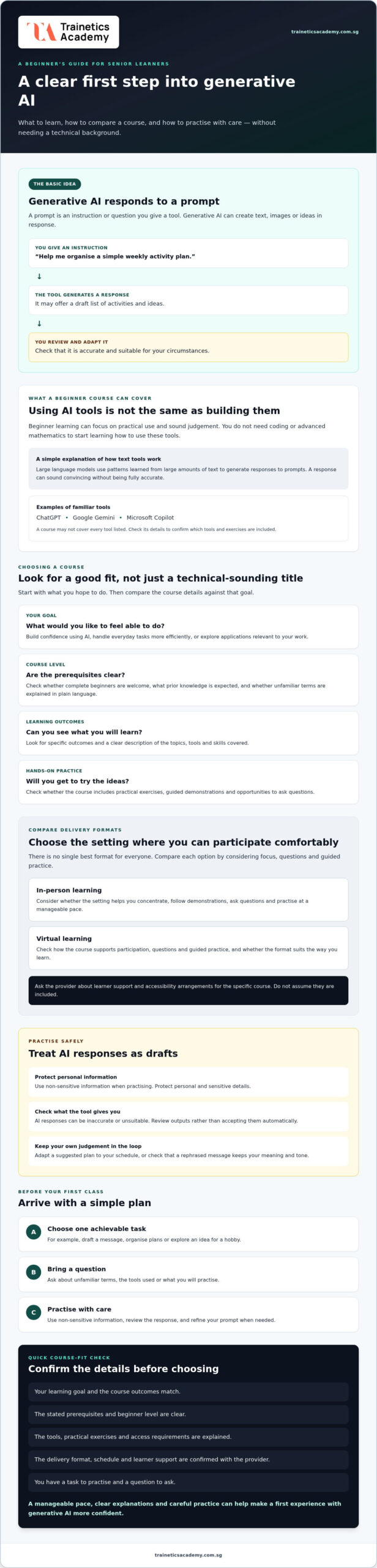
Generative AI creates new content, such as text, images or ideas, in response to a prompt. A prompt is an instruction or question you give a tool. Learning to use these tools is different from studying how to build AI systems. A beginner course can focus on practical use and sound judgement without requiring coding or advanced mathematics.
For senior learners, a useful starting point is to connect the ideas to familiar tasks. AI might help draft a message, summarise a long passage or suggest options for an activity. These outputs may save time, but they are not guaranteed to be correct or suitable. A good generative ai course singapore should build confidence through practice and teach learners to review responses instead of accepting them automatically. For a broader introduction, see What is Generative AI?
For wider context on AI learning in Singapore, watch this CNA report:
What beginners learn about generative AI
Courses may introduce large language models, which power many text-based AI tools. In simple terms, these models use patterns learned from large amounts of text to generate responses to prompts. You don’t need to understand their technical design to use them, but knowing the basic idea helps explain why a response can sound convincing without being fully accurate.
Useful beginner practice includes giving clear instructions, checking the response and refining the prompt when needed. ChatGPT, Google Gemini and Microsoft Copilot are examples of familiar tools, but that does not mean a particular course covers them. Check the course details to confirm which tools and exercises it includes.
Everyday examples that make AI concepts easier to grasp
Try a prompt such as: “Help me organise a simple weekly activity plan. Include time for a walk, errands and rest, and present it as a short list.” Treat the answer as a draft to adapt to your schedule, not as a plan that knows your circumstances.
You could also ask a tool to rephrase a message for clarity. Compare its version with your original and check that the meaning and tone are still accurate before using it. Guided practice helps learners see both the usefulness and limits of AI. To review the academy’s Artificial Intelligence Course, check its current syllabus, prerequisites, delivery format and practical exercises against your learning goals.
How to assess whether a generative AI course suits your needs
Start with the outcome you want. You may want to feel more confident using AI, handle everyday tasks more efficiently or explore applications relevant to your work. A clear goal helps you judge whether the content will be useful, rather than choosing a course based on technical-sounding terms alone.
Next, review the course description for specific learning outcomes, prerequisites and practical exercises. Look for a clear explanation of what you’ll learn and practise. Singapore’s official generative AI skillsets can help you consider capabilities that may matter in a workplace context. Compare those with your own priorities, not just the course title.
Questions to ask before choosing an AI course
Before enrolling in a generative ai course singapore, ask whether it welcomes complete beginners and explains unfamiliar terms in plain language. Find out which tools learners use, whether you need your own account or access, and whether prior knowledge is expected. Confirm the current schedule, delivery format and learner support arrangements directly with the provider, since these details can change.
Teaching pace matters, too. Consider whether you’ll be able to ask questions, follow demonstrations and practise at a manageable speed. If you’re choosing between in-person and virtual learning, think about where you can concentrate and participate comfortably. Ask what support or accessibility arrangements are available for the specific course rather than assuming they are included.
Check funding information separately from course content. Eligibility is course-specific, so verify the course name and current conditions with the provider. The Introduction AI Course is eligible for SkillsFuture Credit and UTAP; don’t assume the same applies to another course.
Recognising practical, learner-centred course design
A practical course should progress from simple activities to more purposeful tasks. Look for a sequence such as refining a prompt, applying it to a work-related task, then reviewing the response before using it. The aim is not just to watch a tool in action, but to practise making informed choices about when and how to use it.
Check whether lessons cover reviewing outputs, fact-checking and responsible use. An AI response can sound polished while missing context or containing errors, so learners need a method for checking important details. A course should develop judgement as well as familiarity with tools.
For a relevant course to compare with your goals, review the AI course in Singapore for professionals and verify its current syllabus, prerequisites, format and practical exercises. Use the same checklist for other options: goal, beginner fit, pace, practice, support and confirmed course details.
Compare learning formats, support, and real-world practice
The best learning format is the one that helps you stay engaged, ask questions and practise with confidence. A classroom may make it easier to speak with an instructor directly, while virtual learning may reduce travel. Neither option suits everyone. Consider your concentration, access to a suitable device and internet connection, and comfort using the learning platform before deciding.
For senior learners, the setting should support participation rather than create unnecessary friction. A report on how seniors in Singapore are learning AI offers local context on how older adults can engage with generative AI. Your preferences matter: ask what the course format involves and how learners can get help if a tool, device or platform is unfamiliar.
In-person or virtual AI learning: what to weigh
In-person sessions may offer direct interaction, while virtual classes can make participation more convenient if you prefer learning from home. Check the actual arrangements rather than assuming how either format works. Ask whether sessions include time for questions, how the instructor helps learners who get stuck, and whether materials can be revisited after a lesson. Clear instructions and a manageable pace can make unfamiliar tools easier to follow.
If you’re considering virtual learning, confirm which device and internet access you’ll need, whether you must create accounts for any tools, and where to get technical help. If you prefer classroom learning, check the location and what support is available during hands-on activities. These practical details can shape the learning experience as much as the course topic.
Does the course connect learning to practical tasks?
A demonstration can show what an AI tool does, but practice helps you decide how to use it. Look for activities connected to your priorities, such as exploring a work task or organising information. A useful exercise might ask you to try an initial instruction, adjust it when the response misses the mark, then compare the revised result with your needs.
Check whether learners get time to practise independently and discuss their approach, rather than only watching the instructor. Clear handouts or examples can also help you revisit a concept at your own pace. If workplace productivity is your main goal, compare the tasks covered with your needs and consult a separate guide to the top AI productivity tools for business for broader tool context.
Trainetics Academy offers physical and virtual learning platforms as part of its wider training delivery. For the current Artificial Intelligence Course, verify the specific format, teaching approach, learner support and practical exercises before enrolling. This helps you compare a generative ai course singapore option based on how you learn best, rather than assuming one format is right for everyone.
Prepare for your first generative AI course and practise safely
Arrive with one achievable goal, not a long list of tasks to master. You might want to learn how to summarise non-sensitive text or create a first draft of a general announcement. Bring a question about a task you genuinely want to understand. AI can assist with parts of a task, but it can’t take responsibility for your decisions or replace your judgement.
Before practising, choose fictional examples or material that is already public. Don’t enter private personal details, confidential work information or other sensitive content into an AI tool unless you understand how that tool handles data. Course practice is a good time to learn safe habits, not to test a tool with information you wouldn’t want to share.
A simple first practice routine
Use a repeatable process to build skill and confidence. Select a low-stakes task, such as summarising a short public notice, then write a clear prompt that explains what you need and how you want the response presented.
- Review: Check whether the response addresses your request, leaves out important context or includes details that seem incorrect.
- Refine: Make the prompt more specific, perhaps by asking for a shorter summary or a clearer structure.
- Compare: Look at how the answer changes and decide which version, if either, is useful for your purpose.
This routine turns practice into a learning exercise. The aim isn’t to find a magic prompt, but to notice how clearer instructions can affect a response and where careful review is still needed.
Build confidence without trusting every answer
Treat generated text as a draft or suggestion, not a verified fact. AI tools can produce fluent responses that contain errors, miss relevant details or reflect assumptions in the prompt. Check important claims against reliable sources and your own knowledge before sharing the content or acting on it. For consequential decisions, consult an appropriate person or authoritative source rather than relying on an AI response alone.
As you prepare for a generative ai course singapore, check what guidance the course gives on privacy, output review and responsible use. Ask whether practice activities use fictional or non-sensitive examples, and whether you’ll have time to discuss uncertain results. These safeguards help you develop skills without giving up control of your information or decisions.
Review the Artificial Intelligence Course details to check the current syllabus, practice activities and delivery format before choosing your next learning step.
Choose a clear next step for learning generative AI in Singapore
Choosing a course is easier when you compare its details with your priorities. Before enrolling in a generative ai course singapore, decide what you want to learn, then check whether the course supports that goal. You might want a beginner-friendly introduction, practical exercises for everyday tasks or learning connected to your work. A suitable option should explain what learners will study and how learning will take place.
A quick checklist before you enrol
Use these questions to review each course consistently:
- Level: Does the course welcome beginners, and are prerequisites clearly stated?
- Learning outcomes: Can you tell what you’ll be able to practise or understand by the end?
- Tools and practice: Which tools are used, and do learners complete guided exercises rather than only watch demonstrations?
- Format and support: Is the delivery arrangement right for you, and how can you ask questions or get help?
- Current details: Have you confirmed the syllabus, schedule and learning arrangements directly with the provider?
Check current information before deciding. Older listings may not reflect a provider’s latest course details, so verify what applies to the specific course you’re considering. If funding matters to you, check the details for that course directly. Don’t assume eligibility based on a general description or information about another course.
Explore structured AI learning in Singapore
Trainetics Academy’s AI course page is one option to investigate as part of your comparison. Review the artificial intelligence course details against your goals, preferred format and need for hands-on practice. Confirm current course-specific details with the provider before deciding whether it fits.
A thoughtful choice doesn’t require you to master every AI tool before class. Focus on whether the course gives you a clear starting point, relevant practice and an environment where you can ask questions. If you’re considering funding, first confirm the course name and its current eligibility with the provider. Funding information should not be treated as interchangeable across courses.
Take the next step at your own pace: shortlist options, check the details and choose the one that best matches your learning priorities. A structured course can guide you from basic concepts to practical use, while your questions and careful evaluation help keep the learning relevant.
Take your first step with confidence
Choosing a generative ai course singapore option starts with your priorities: what you want to learn, how you prefer to study and whether the course offers guided practice. Compare the stated learning outcomes, teaching format and support, then confirm current course details directly with the provider before enrolling.
Remember that generative AI can assist with everyday and work-related tasks, but its responses need review. Build confidence by practising with non-sensitive examples, refining your instructions and checking important information before relying on an output. You don’t need to know everything before you begin. A clear goal and a thoughtful approach are strong foundations for learning.
Trainetics Academy provides professional education in Singapore. Its wider training approach is described as interactive and delivered by qualified professionals, though you should confirm the arrangements for the specific AI course you’re considering. Explore Trainetics Academy’s AI course information and assess whether the current details match your learning needs.
Take the next step at a pace that feels right. With a suitable course and a habit of questioning and checking AI outputs, you can develop practical skills with greater confidence.
Frequently Asked Questions
Is a generative AI course suitable for seniors with no technical experience?
Yes, a beginner-focused course can suit seniors with no technical experience if it explains concepts in clear language and builds skills through guided practice. Check the stated prerequisites and ask whether learners need prior experience with AI tools. A good fit should let you ask questions, practise at a manageable pace and learn to assess AI responses, rather than expect you to understand technical details before you start.
What do you learn in a generative AI course?
A generative AI course typically introduces how prompts guide a tool to create content, such as text, images or ideas. Lessons may cover writing clearer prompts, using AI for tasks like drafting or summarising, and reviewing outputs for errors or missing context. Course content varies, so check the syllabus for the tools, exercises and learning outcomes included before deciding whether they match your goals. If experimenting with visual prompts inspires you to develop hands-on creative skills behind a camera, check out Pictorial for beginner photography courses in Singapore.
Can seniors learn generative AI online?
Yes, seniors can learn generative AI online if the format and course support suit their needs. Before enrolling, confirm whether you need a computer or other device, reliable internet access, and accounts for specific tools. Ask how you can raise questions or get help if the platform is unfamiliar. If possible, compare virtual learning with in-person options to decide where you’re most comfortable concentrating and practising.
How do I choose a beginner-friendly AI course in Singapore?
To choose a generative ai course singapore beginners can follow, start with your goal, such as building confidence or learning practical applications. Check whether the course welcomes learners without prior experience, explains unfamiliar terms and includes hands-on exercises. Review its learning outcomes, pace, format and support arrangements. Confirm current course details directly with the provider, and compare what’s offered with the tasks you want to learn.
Is it safe to use generative AI tools for personal tasks?
Generative AI can help with low-risk personal tasks, but use care with the information you share and the answers you receive. Avoid entering sensitive personal details unless you understand the tool’s data practices. Treat responses as suggestions, not verified facts. Check important information against reliable sources before acting on it, and use fictional or non-sensitive examples while learning how a tool works.
Do I need to know coding before taking a generative AI course?
No, coding usually isn’t necessary for a beginner course focused on using generative AI tools. Learners can start by giving instructions in everyday language, then review and refine the responses. Courses differ, so check their prerequisites and whether they teach practical tool use or AI system development. If you’re new to the topic, look for a course that clearly states what knowledge, if any, you need beforehand.
How can I practise generative AI after a course?
Practise with small, low-risk tasks that reinforce what you learned, such as asking a tool to organise public information or rephrase a non-sensitive draft. Try changing your prompt and comparing the responses. Review outputs for accuracy, relevance and missing context, and avoid sharing confidential or personal information. Keep a note of prompts that work well, along with what you needed to check or correct.
Disclaimer
AI Content Disclaimer: Some articles on this website may be generated or assisted by AI-powered content creation tools. While we strive for accuracy and relevance, readers should independently verify information before relying on it. The content is provided for informational purposes only and does not constitute professional advice.