What if the best AI learning route isn’t the most technical one, but the one that helps you solve a real task at work? For Singapore PRs, choosing among a short course, self-directed study and workplace training can feel uncertain, especially when course costs and funding eligibility matter. Upskilling opportunities for Singapore PRs are most useful when they connect AI skills to the work you want to do next.
You don’t need to master every AI tool to make a purposeful start. This guide compares practical learning routes, explains how to assess course format, hands-on practice and learner support, and helps you match an option to your career goals. It also shows how to separate course suitability from funding eligibility before enrolling. Use these steps to choose an AI learning path that connects foundational concepts with workplace application.
Key Takeaways
- Match an AI learning route to a specific task you want to handle more confidently at work.
- Compare self-directed study, guided courses and employer-supported learning by structure, practice, guidance and relevance to your role.
- Assess whether course outcomes, instructor support and physical or virtual delivery suit your experience and schedule.
- Use these steps to assess Upskilling opportunities for Singapore PRs: define a work goal, identify a skill gap and compare learning options.
- Check course and individual eligibility separately before relying on a funding scheme.
What AI upskilling opportunities make sense for Singapore PRs?
AI upskilling is structured learning that helps you apply AI to work tasks, not simply collect information about new technology. A useful starting point is to learn the fundamentals, then practise using AI tools or workflows for tasks relevant to your role. For a broad overview of what is Artificial Intelligence, explore how the field encompasses systems that perform tasks associated with human intelligence. An AI course can connect those concepts with practical workplace use.
Learning concepts and practising with tools are related but distinct. Concepts help you understand what AI can and cannot do; hands-on practice helps you develop workflows for drafting content, summarising information or organising research. Choose based on your responsibilities, career direction, available study time and preference for independent or guided learning. Trainetics Academy offers interactive AI learning with qualified professionals, including its Artificial Intelligence Course.
Which career goals can AI learning support?
Start with the work, not the job title. Administrative professionals might practise using AI to prepare a first draft or summarise meeting notes. Analytical roles may focus on organising research or turning complex information into a concise overview. Customer-facing staff could practise drafting responses to routine enquiries, then review the output for accuracy and tone. These are examples of task support, not guarantees of promotion, higher pay or a new role.
Make the learning goal specific and testable. For example: “I want to produce a more useful first draft of recurring internal updates.” A clear goal makes it easier to judge whether a course’s content and practice activities relate to your day-to-day work.
What should Singapore PRs clarify before comparing courses?
Write down one task or capability you want to improve, then identify what you need to learn: foundational AI concepts, practical tool use, or both. Compare course content and delivery separately from funding conditions. A physical or virtual format, instructor guidance and interactive practice shape the learning experience, but they don’t determine whether someone qualifies for funding.
Residency status, course eligibility and individual funding eligibility are separate considerations. Singapore PRs don’t receive SkillsFuture Credit. Trainetics Academy’s Introduction AI Course is eligible for SkillsFuture Credit and UTAP, but course eligibility alone doesn’t establish an individual learner’s eligibility. Check current scheme rules and your own circumstances before enrolling. Assess the learning value first, then consider funding when comparing Upskilling opportunities for Singapore PRs.
Compare AI learning routes in Singapore by skill goal and support
The right route depends on what you need to learn and how you learn best. Before choosing, compare the structure, access to guidance, opportunities to practise, schedule and connection to your work. This helps make Upskilling opportunities for Singapore PRs relevant to individual career goals, rather than treating one learning format as right for everyone.
| Learning route | Structure and guidance | Practice and work relevance | Schedule |
|---|---|---|---|
| Self-directed study | You choose the sequence and resources, with limited instructor guidance. | Practice depends on the examples and exercises you select. You’ll need to assess your own progress. | Flexible, but requires consistency and time set aside for learning. |
| Guided AI course | A structured learning path, with instruction and support shaped by the course format. | Look for practical activities that connect concepts to tasks relevant to your role. | Follow the course’s schedule and delivery format. |
| Employer-supported learning | May be organised around a team’s learning needs or a defined work process. | Can focus on a specific workplace application, depending on the training plan. | Timing and access depend on the employer’s arrangements. |
When is a foundational AI course a useful starting point?
A foundational course can suit learners who want to understand core concepts before exploring specialised tools or applications. Guided instruction can arrange unfamiliar ideas into a sequence, while interactive learning gives learners opportunities to engage with the material. Trainetics Academy’s Introduction to AI course offers a structured route for learners seeking that guided start.
The National AI Impact Programme provides context for Singapore’s wider focus on AI learning. Its existence doesn’t determine which course or funding option suits an individual learner, so compare a course’s content and format with your own goal.
When might workplace-led or self-directed learning fit better?
Workplace-led learning may be a practical fit when a team has a clearly defined need, such as applying AI within a particular process. Self-directed study may suit learners who value flexibility and can maintain a steady routine for reading, testing and reviewing what they learn. Neither route is automatically best for every Singapore PR. Choose by matching the approach to your work context, preferred level of guidance and capacity to practise.
How to evaluate AI courses for beginners and working professionals
A useful AI course connects what you learn with what you need to do. Before comparing options, name a task you want to handle more effectively, such as preparing a first draft, summarising information or organising research. Then check whether the learning outcomes and practice activities build skills relevant to that task. This gives you a practical way to assess Upskilling opportunities for Singapore PRs, whether you’re new to AI or strengthening workplace skills.
Which course features support practical AI learning?
Look beyond a list of tools or demonstrations. A well-structured learning experience explains key concepts, shows how they relate to work, and gives learners a chance to practise applying them. Review the course information for:
- Clear learning outcomes: Can you tell what knowledge or capability you’re expected to develop?
- Workplace examples: Do the examples connect with tasks you perform or expect to perform?
- Meaningful practice: Will you work through activities, or mainly watch demonstrations?
- Instructor involvement: Is guidance available to help clarify unfamiliar ideas during learning?
These details matter for beginners who need concepts presented in a logical sequence, as well as working professionals who want practice relevant to their responsibilities. Trainetics Academy provides interactive AI learning with qualified professionals. Explore its Artificial Intelligence Course as one option for structured study.
How should learners compare time, format, and guidance?
Choose a format that fits your work and personal commitments. Physical and virtual learning have different practical considerations, so think about where you can focus and participate consistently. Compare the course schedule and learning sequence with the time you can set aside, then assess whether instructor support and interactive activities suit your learning preferences.
Before enrolling, separate three questions: Is the course content relevant to your goal? Does its delivery format suit your circumstances? Are you personally eligible for any funding you plan to use? These checks are related, but course suitability doesn’t establish funding eligibility. Singapore PRs should review current scheme conditions and individual requirements through the relevant official source. Treat funding information as a separate check from your course comparison.
A simple test can sharpen your decision: after reviewing the course, can you describe one task you’ll be better prepared to approach and how the learning activities will help you practise it? If not, revisit the stated outcomes and course structure before choosing.
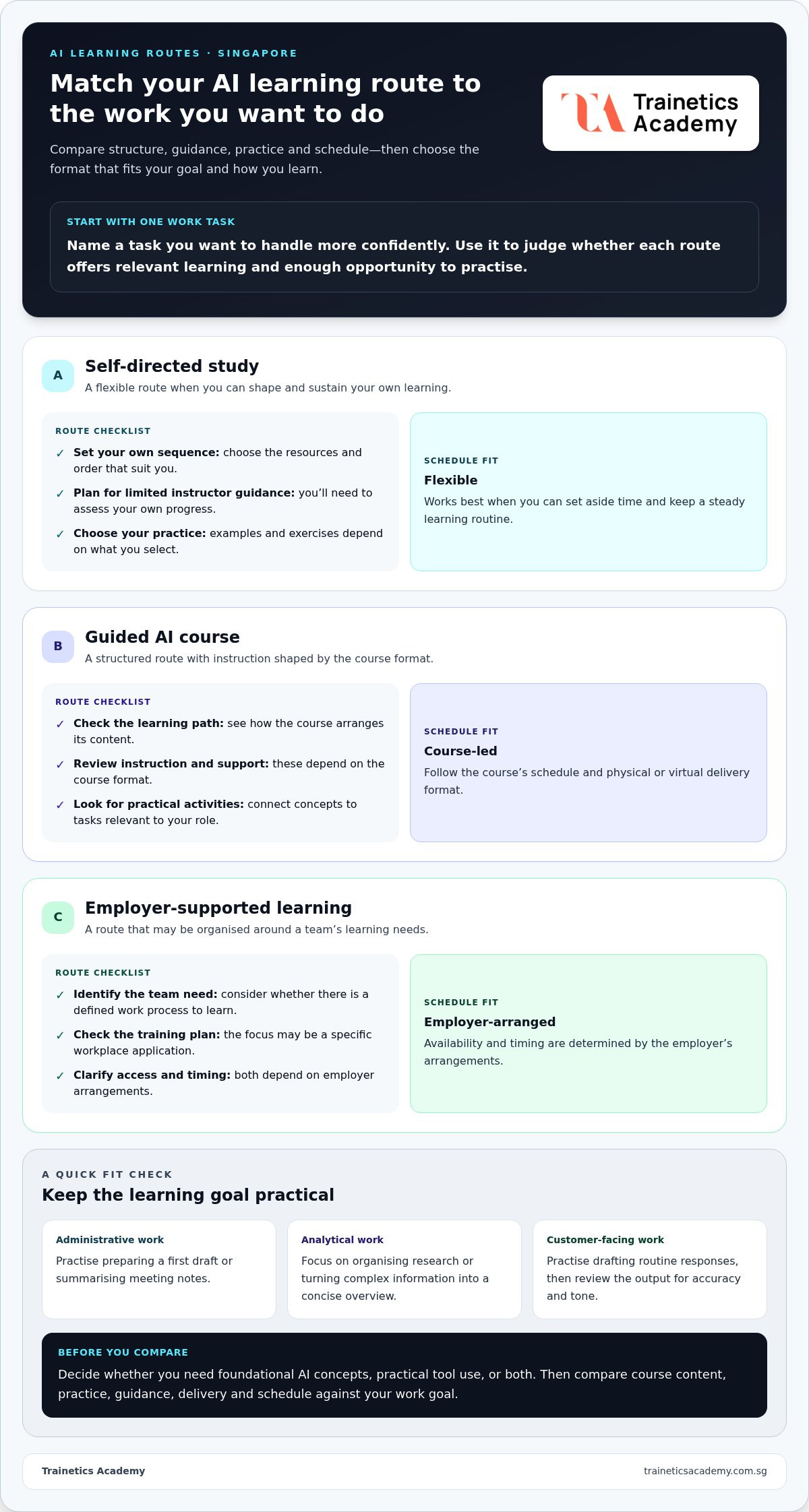
A practical checklist for choosing an AI upskilling route in Singapore
A clear selection process turns course browsing into a work-focused decision. Use these steps to compare Upskilling opportunities for Singapore PRs against your priorities, rather than choosing by title alone.
- Define a work goal. Write down one practical AI task you want to handle more confidently, such as preparing a first draft or summarising information.
- Identify the skill gap. Decide whether you need foundational concepts, practice with AI tools, or a clearer understanding of how to apply AI to a workflow.
- Compare learning routes. Consider self-directed study, a guided course or workplace-supported learning. Match the level of structure and guidance to how you learn best.
- Review course fit. Compare learning outcomes and practice activities with your goal, current skill level and available study time. Check whether the physical or virtual format suits your schedule.
- Verify eligibility. Treat course suitability, course eligibility and your personal eligibility under a funding scheme as separate checks. Review current conditions before making a payment decision.
How can learners connect an AI course to their current role?
Choose a recurring task where AI learning may be relevant, then set a realistic practice goal. For example, you might aim to create a clearer first draft of a routine report. Use fictional or generalised material for practice, and don’t enter confidential workplace information into AI tools. After learning, reflect on what you can apply, what needs more practice and which skill would be a sensible next step.
If employer support could help you learn around a defined team need, include this AI course option in your workplace training discussion. Keep the proposed task specific so the conversation can focus on a practical learning outcome.
What funding details should learners verify?
Review current scheme conditions through official sources, and confirm your own eligibility before relying on funding in your budget. Singapore PRs don’t receive SkillsFuture Credit. UTAP may be available to eligible NTUC members, including PRs, subject to current scheme rules and individual eligibility. Course eligibility and personal eligibility are separate.
Once your goal, learning format and funding checks are clear, consider the Introduction AI Course as a structured AI learning option. Use your written task to judge whether its learning approach aligns with the capability you want to develop.
Turn AI learning into a confident next step with Trainetics Academy
Make your decision in the right order: begin with a work goal, compare how each learning route is structured, then verify any funding eligibility that matters to your circumstances. This keeps Upskilling opportunities for Singapore PRs grounded in practical needs rather than course titles alone. A focused next step could be building a stronger understanding of AI before deciding which workplace applications to explore.
Trainetics Academy is a Singapore training provider offering interactive AI learning delivered by qualified professionals. Learning is available through physical and virtual platforms, giving learners a choice of format. Consider which option fits your schedule and where you can focus and participate consistently.
What can learners expect from a guided AI learning experience?
For learners developing foundational AI understanding, structured instruction can organise new concepts into a clearer sequence. Interactive elements encourage active engagement with the material rather than passive review alone. As you compare a course with your work goal, consider whether its content connects foundational ideas to practical tasks. Learning can build capability, but taking a course alone doesn’t guarantee a particular career or productivity outcome.
How can learners keep progressing after foundational AI training?
Continue learning through careful, appropriate practice. Choose a non-sensitive task where AI may be relevant, use general or fictional information, and review the output critically before considering how the approach might fit your work. Reflect on what you’ve learned: which steps feel clearer, where do you still need guidance, and what skill would help you move forward? Keep confidential workplace information out of AI tools unless your organisation’s policies and procedures allow its use.
As your experience and role requirements develop, your next learning goal may change. You might deepen your understanding of AI concepts, explore a particular workflow, or build the judgment needed to assess AI-generated material. A deliberate progression keeps learning connected to real responsibilities without assuming one course must cover every future need.
For a structured starting point, explore Trainetics Academy’s AI course options and consider which next step aligns with your goal, learning preferences and schedule.
Make your next AI learning step count
The strongest Upskilling opportunities for Singapore PRs begin with a clear work goal. Identify a task you want to approach more confidently, then compare learning routes by structure, practice opportunities, guidance and fit with your schedule. Treat funding eligibility as a separate check, since course suitability and individual eligibility aren’t the same thing.
A guided AI course can offer a structured way to build foundational understanding and connect concepts with practical work. Trainetics Academy provides interactive AI learning delivered by qualified professionals through physical and virtual learning platforms. Choose the format and learning approach that best support your goals and circumstances.
Take a focused next step by exploring AI learning options with Trainetics Academy. Start with a clear objective and choose a course that fits your learning preferences and schedule.
Frequently Asked Questions
What are the best upskilling opportunities for Singapore PRs?
The best option depends on your work goals, the skill you need and how you prefer to learn. For AI, compare self-directed study, workplace-supported learning and guided courses by structure, practice opportunities and relevance to your tasks. Upskilling opportunities for Singapore PRs should be assessed individually: a course may suit one learner’s experience and schedule but not another’s. Check funding conditions separately from course suitability before deciding.
Can Singapore PRs use SkillsFuture Credit for AI courses?
Singapore PRs don’t receive SkillsFuture Credit, so PR status alone doesn’t provide access to this credit. Other support may have different conditions: eligible NTUC members, including PRs, may be able to claim UTAP, subject to current scheme rules and individual eligibility. Course eligibility and personal eligibility are separate. Review the relevant official information before relying on funding to plan or pay for an AI course.
Are AI courses for beginners suitable for Singapore PRs with no technical background?
Yes, an introductory AI course can suit a learner without a technical background if it explains foundational concepts clearly and connects them with practical tasks. Technical experience may matter for some advanced subjects, but it shouldn’t be assumed necessary for every beginner course. Review the stated outcomes, practice activities and learner support, then compare them with your experience and the skills you want to develop at work.
How do I choose between an AI course and self-directed learning?
Choose based on the structure, flexibility and guidance you need to make progress. Self-directed learning can suit someone who wants to set their own pace and can plan regular study and practice. A guided course may fit better if you value a defined learning sequence, instructor support and interactive activities. Compare both routes with your work goal, schedule and learning preferences. The best fit is one you can apply through appropriate practice.
Can my employer support AI upskilling in Singapore?
Your employer may support AI learning when it relates to a team need or a defined work process. Prepare a concise proposal that names the task you want to improve, the skills you aim to build and how you could apply them after training. Raise it through your workplace’s usual process. Keep the case practical and avoid promising a business outcome before the learning and application have taken place.
What should I check before enrolling in an AI course in Singapore?
Review the learning outcomes, course structure, practical activities, instructor support and physical or virtual format. Check that these match your work goal, current skill level and schedule. Then verify course eligibility and your own eligibility for any funding scheme separately, using current official information. Residency status alone doesn’t settle every funding question. A careful comparison helps you judge a course by its learning value and suitability, not just its headline claims.
Disclaimer
AI Content Disclaimer: Some articles on this website may be generated or assisted by AI-powered content creation tools. While we strive for accuracy and relevance, readers should independently verify information before relying on it. The content is provided for informational purposes only and does not constitute professional advice.