What if learning AI felt less like decoding technical jargon and more like practising useful skills at a comfortable pace? It’s understandable to wonder whether an AI course for Seniors in Singapore will assume prior technical knowledge, move too quickly or stay too broad. A suitable course should explain core ideas clearly and connect learning to goals that matter to you.
This guide shows you how to compare AI courses in Singapore by teaching approach, practical relevance and learner support. You’ll find what to look for in beginner-friendly explanations, guided practice and course formats, including physical and virtual learning. Trainetics Academy provides interactive AI education led by qualified professionals. Use the guidance below to assess what a course teaches and whether its learning experience fits your goals, whether you want to understand AI tools for everyday tasks or explore professional applications.
Key Takeaways
- Choose an AI course for Seniors in Singapore based on your goals and starting confidence, not age alone.
- Look for plain-language teaching, clear prerequisites, guided practice and relevant examples to judge whether a course suits beginners.
- Match the course format to your goal, whether you want foundational AI literacy, practical tool-use skills or deeper technical study.
- Prepare by setting one learning goal, noting what you already know and bringing questions based on real tasks.
- Explore Trainetics Academy’s interactive AI education, led by qualified professionals and available through physical and virtual learning platforms.
What Can an AI Course for Seniors in Singapore Help You Learn?
An introductory AI course explains key concepts, tools and responsible-use habits without requiring learners to build the technology themselves. For an AI course for Seniors in Singapore, start with your goals and confidence, not your age. You might want to understand how AI generates answers, try a tool for a personal task or learn how to assess whether its response is reliable.
AI literacy differs from specialist training in coding, model-building or advanced data science. An introductory course focuses on understanding and using AI, while technical study goes deeper into developing systems and working with data. Useful skills include asking clearer questions, recognising the limits of an AI response and knowing when to verify it. For broader context, explore what AI in education means and how AI can be used in learning settings.
This short introduction offers another perspective on AI for older adult learners:
What might seniors use AI to understand or practise?
Start with familiar, low-risk activities. You could ask an AI tool to summarise a non-sensitive piece of text or brainstorm ideas for a hobby, personal project or family gathering. These are examples to explore, not requirements for every learner or course. Check important details rather than treating generated text as fact, since AI can produce inaccurate or misleading responses.
Choose examples that match your interests and comfort level. A guided demonstration can show you how to phrase a request, review the answer and refine your question. This helps you assess the tool instead of simply accepting its first response.
Is an AI course suitable without a technical background?
Using an AI tool is different from developing an AI system. You can learn basic concepts and practise giving instructions in ordinary language without first learning to code. If you’re comparing AI courses for beginners, look for plain-language explanations, demonstrations and time to practise. Check whether the course description says coding is expected.
Learners bring different levels of digital experience, so there’s no single starting point for seniors. Trainetics Academy offers interactive AI education led by qualified professionals through physical and virtual learning platforms. Explore the artificial intelligence course to review a structured way to learn about AI concepts and tools.
How to Judge Whether an AI Course Is Senior-Friendly
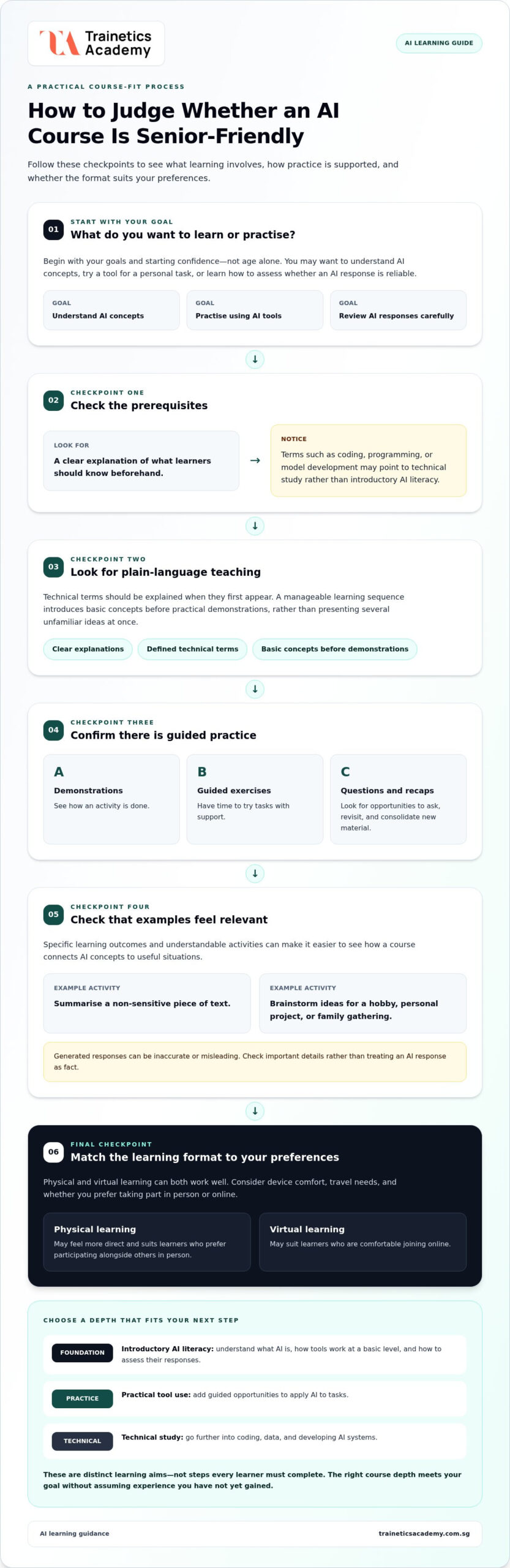
A clear course description should explain what learning will involve before you enrol. For an AI course for Seniors in Singapore, look beyond broad promises and check for four practical signs:
- Clear prerequisites: Does the course explain what learners should know beforehand?
- Plain-language teaching: Are technical terms explained when they first appear?
- Guided practice: Will you see demonstrations and have time to try tasks?
- Relevant examples: Do activities connect AI concepts to useful, understandable situations?
Terms such as “coding,” “programming” or “model development” may signal technical work rather than introductory AI literacy. Look for specific learning outcomes, trainer guidance and opportunities to ask questions. Singapore’s Seniors Go Digital programme offers context on digital learning support for seniors. An AI course can focus more specifically on AI concepts and practice.
Does the course explain AI in clear, manageable steps?
Look for a sequence that moves from basic concepts to practical demonstrations instead of introducing several unfamiliar ideas at once. Technical terms should be defined when they first appear, with explanations that connect each concept to the lesson. Recaps, pauses for questions and chances to revisit an exercise can help learners consolidate new material. These features benefit anyone encountering the subject for the first time.
Does the learning format fit your preferences?
Physical and virtual learning can both work well. Consider your comfort using a device, travel needs and whether you prefer taking part alongside other learners in person. A virtual setting may suit someone comfortable joining online, while a physical classroom may feel more direct. When reviewing AI course learning options, consider which format supports your preferred way to participate. An AI course for beginners should also explain its learning path and support clearly.
| Your priority | Useful course feature |
|---|---|
| Understand concepts without jargon | Plain-language explanations with defined terms |
| Build confidence through practice | Demonstrations, guided exercises and time for questions |
| Know what to expect | Clear prerequisites and specific learning outcomes |
| Choose a comfortable setting | Physical or virtual participation that suits your access and preferences |
Which AI Course Format Fits Your Goals and Starting Point?
Choose a depth of learning that matches what you want to do next. Introductory AI literacy builds a foundation: what AI is, how its tools work at a basic level and how to assess their responses. Practical tool-use learning adds guided opportunities to apply AI to tasks. Technical study goes further into coding, data and developing AI systems. These are distinct learning aims, not steps every learner must complete.
The right course depth meets your goal without assuming experience you haven’t yet gained. If you’re new to AI and want to understand concepts while practising with tools, a beginner course may be a suitable starting point. If you have a specific technical or work-related objective, a more specialised pathway may be a better match. Your interests, experience and intended use matter more than age when choosing a level.
Introductory AI learning or a specialist technical course?
Introductory learning can build understanding and confidence before you decide whether to study further. Specialist technical courses may focus on coding, data analysis or model development. Those subjects can be useful for specific goals, but they aren’t necessary simply to understand or use AI tools. SkillsFuture Singapore’s national skills framework offers context on ICT roles and skills, including technology-related pathways.
- Choose introductory AI literacy if you want foundational knowledge and a guided first look at AI tools.
- Choose practical tool-use learning if your priority is practising how to apply AI tools to relevant tasks.
- Explore technical AI study if you have a clear aim involving coding, data or building AI systems.
For an AI course for Seniors in Singapore, compare the stated outcomes with your starting point. The course description should make its expected experience and learning focus clear, helping you distinguish an introductory course from specialist training.
When should SkillsFuture Credit or UTAP enter the decision?
First identify a course that fits your learning goals, then consider funding eligibility as part of your comparison. Trainetics Academy’s Introduction AI Course is eligible for SkillsFuture Credit and UTAP. This eligibility applies to that course only. For more context on introductory options and funding, see SkillsFuture Intro to AI Courses: Singapore Guide.
Trainetics Academy offers AI education through interactive learning led by qualified professionals, with physical and virtual learning platforms. Review the artificial intelligence course as you compare learning paths with your goals and preferred starting level.
How to Prepare for an AI Course and Keep Learning Afterwards
A little preparation can help you connect course ideas to situations that matter in your life. For an AI course for Seniors in Singapore, focus on one task you’d like to explore rather than trying to learn every tool at once. Use this four-step plan to arrive with a clear purpose and keep practising after class:
- Set one goal: Choose a personal, community or professional task you’d like to understand or try with AI.
- Note what you already know: Write down which AI tools or concepts you’ve encountered and what still feels unfamiliar.
- Participate actively: Ask questions during demonstrations and note anything you’d like the trainer to explain again.
- Practise afterwards: Repeat a simple activity, review the result and check important information before relying on it or sharing it.
What should you prepare before the first lesson?
Read the course description for its prerequisites and any learning materials you’ll need. Bring a question based on your chosen task, along with questions about privacy, reliability and responsible use. For example, ask how to avoid entering personal information into a tool or how to verify an answer before using it. Real questions make practice more relevant than trying to master every AI application.
How can you build confidence after class?
Keep practising in small, repeatable sessions that fit your routine. Try the same straightforward task again, compare the AI response with trusted information and note which prompt produced the clearest result. You can share what you’ve learned with a trusted peer, while keeping private or sensitive details out of AI tools and shared examples.
AI-generated information can sound convincing even when it’s wrong. Treat responses as a starting point: check names, dates, instructions and other details against a reliable source before acting or passing them on. If an answer is unclear, refine your prompt or consult a dependable reference rather than assuming the tool is correct.
For broader course-selection context, see Best AI Course Singapore SkillsFuture: Your 2026 Professional Guide. You can also explore Trainetics Academy’s artificial intelligence course and consider how its learning information aligns with your goals.
Explore AI Learning with Trainetics Academy in Singapore
Choosing an AI course is easier when you can compare its learning approach with the goals you’ve identified. Trainetics Academy is a Singapore provider offering interactive AI education led by qualified professionals, with physical and virtual learning platforms. These options let learners engage with structured instruction in a format that suits their circumstances, without assuming that everyone has the same background or preferences.
What can structured AI learning add to self-study?
Self-study lets you explore AI at your own pace, but it can leave you deciding which concepts to learn first and how they connect. Structured instruction can organize ideas into a clearer sequence, while interaction gives you space to engage with questions and examples as they arise. For someone exploring an AI course for Seniors in Singapore, this can help connect foundational concepts to a personal or professional learning goal.
A guided learning environment also gives you a chance to pause and examine how an AI tool responds, rather than moving from one feature to another. The learning process is about building understanding, asking questions and considering how concepts apply to tasks that matter to you. You don’t need to commit to a technical pathway before deciding what you want to learn.
Choose your next step with confidence
Before choosing, compare the course information with your priorities. Are you looking for a foundation in AI concepts, a guided introduction to tools or a more specialised direction? Consider the stated learning focus and whether the format fits how you prefer to participate. If you’re still deciding where to begin, an AI course for beginners roadmap can help you think through a suitable learning progression.
Trainetics Academy’s interactive approach offers a structured way to explore AI learning in Singapore. Review the course details and consider whether the learning focus aligns with what you want to understand next. Let your learning goal guide your decision.
Explore the AI course in Singapore and review the course information to decide whether it fits your next step.
Take Your Next Step in AI Learning
A suitable AI course for Seniors in Singapore should match your goals, starting confidence and preferred way to learn. Look for clear explanations, guided practice and relevant examples. Keep building familiarity by practising thoughtfully and checking AI-generated information before relying on it.
Trainetics Academy offers interactive AI learning delivered by qualified professionals through physical and virtual learning platforms. This structured approach can help you explore AI concepts and consider how they relate to tasks that matter to you.
Review the course information and decide whether its learning focus fits your next step. Explore the AI course in Singapore and use your learning goal to guide your next step.
Frequently Asked Questions
Is an AI course suitable for seniors with no technical experience?
Yes. An introductory AI course can explain core ideas and guide learners through using AI tools without requiring a technical background. Judge an AI course for Seniors in Singapore by its teaching approach and learning focus, not by assumptions about age or ability. Look for plain-language explanations, clear prerequisites and opportunities to ask questions. Previous experience and confidence vary, so choose a course that fits your starting point.
What should seniors look for in an AI course in Singapore?
Look for clear learning outcomes, stated prerequisites, plain-language teaching, guided practice and relevant examples. The course information should explain whether it focuses on AI literacy and tool use or expects coding and technical experience. Consider how you’ll participate, whether physical or virtual learning suits you, and whether there are opportunities to ask questions. These details help you compare the course with your goals and preferred learning format.
Can seniors learn to use AI tools without learning to code?
Yes. Learning to use AI tools is different from building AI systems, and introductory learning can focus on concepts and tool interaction without coding. You can practise writing clear instructions, reviewing responses and refining a request in ordinary language. Coding matters for some technical pathways, but it isn’t a prerequisite for every AI learning goal. Read course descriptions to see whether programming is expected or whether the focus is on understanding and using AI.
How do I know whether an AI course will be too advanced?
Check the prerequisites, course outline and stated outcomes before enrolling. References to programming, model development, data analysis or prior technical experience may indicate a more specialised course. An introductory course should explain its starting level and whether coding is expected. Use the learning outcomes to judge whether the course matches what you want to learn now, rather than choosing based only on its title.
What can seniors use AI for after taking a course?
You could explore AI tools for organising ideas, drafting questions for a community activity or making a long, non-sensitive document easier to review. The right use depends on your interests and comfort. Treat AI responses as suggestions, not verified facts: check important details against reliable sources before acting or sharing them. Avoid entering personal or confidential information, and choose tasks where an incorrect response would not cause harm.
Is the Introduction AI Course eligible for SkillsFuture Credit and UTAP?
Trainetics Academy’s Introduction AI Course is eligible for SkillsFuture Credit and UTAP. This applies specifically to the Introduction AI Course and should not be assumed to apply to other courses. Review the course information and relevant funding details for your circumstances, keeping your learning goals at the centre of your decision.
How can seniors practise AI safely after a course?
Begin with simple tasks that don’t involve private or sensitive information. Review what a tool produces, check factual claims against a trusted source and avoid relying on an answer for important decisions without verification. Keep notes on prompts that work well and discuss what you’ve learned with someone you trust, while protecting personal details. Regular, manageable practice can help you become more familiar with AI tools without needing to master them all.
Disclaimer
AI Content Disclaimer: Some articles on this website may be generated or assisted by AI-powered content creation tools. While we strive for accuracy and relevance, readers should independently verify information before relying on it. The content is provided for informational purposes only and does not constitute professional advice.