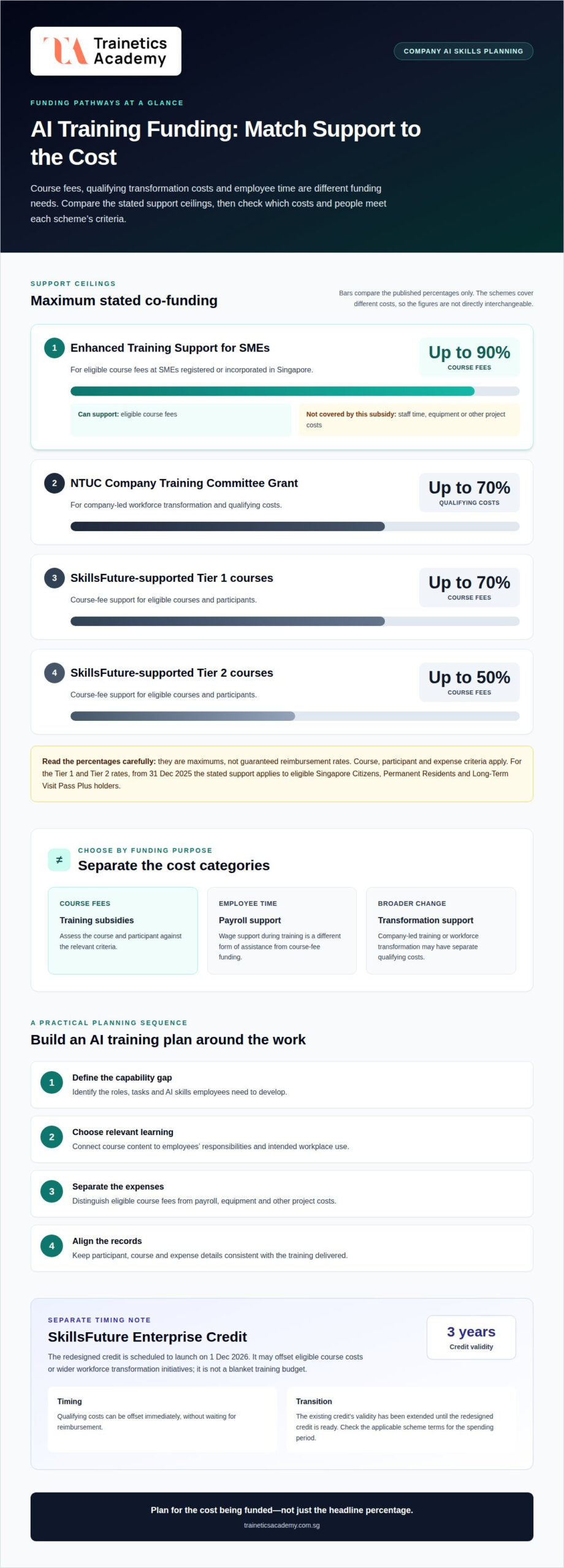
A training grant for companies in Singapore isn’t one-size-fits-all: eligible SMEs can receive up to 90% in training subsidies, while other support may help offset employee wages during training or fund broader workforce transformation. The right option depends on your company’s size, the course and the purpose of the training.
It’s understandable to look first for help with course fees, but funding may also support the time employees spend learning or reskilling for new roles. This guide explains the main routes, including training subsidies, the SkillsFuture Enterprise Credit, absentee payroll support and career conversion programmes, so you can distinguish course funding from workforce and payroll assistance.
For companies building practical AI capability, understanding these distinctions is a useful first step. Learn what each option is designed to support and how company-led training can connect learning with changing job requirements.
Key Takeaways
- Match the funding route to the goal: course fees, employee wages during training, or wider workforce transformation each call for a different approach.
- For company-led transformation, the NTUC Company Training Committee Grant can co-fund up to 70% of qualifying costs, while Career Conversion Programmes can support salary costs for reskilling.
- Assess employee eligibility alongside course criteria, including residency, age and salary conditions where they apply.
- Connect training to the skills employees need in evolving roles, so learning supports a clear workforce development objective.
Enhanced training subsidies for SMEs
For a Singapore SME planning AI skills development, the Enhanced Training Support for SMEs can reduce eligible course fees by up to 90%. The scheme applies to small and medium enterprises registered or incorporated in Singapore. That maximum is a course-fee subsidy, not an automatic payment for every AI course or every employee. Treat it as one part of a structured learning plan.
Start with the work employees need to perform. For example, a team adopting AI tools may need training in evaluating outputs, applying tools to suitable tasks and recognising their limitations. Identify the roles involved and the capability gap before choosing a course. This connects learning to workplace needs instead of selecting training solely because a subsidy may be available.
Next, distinguish eligible course fees from other project expenses. The SME subsidy concerns course fees, so don’t assume it covers staff time, equipment or other costs. An AI learning plan may include several types of expenses, but each must be matched to the support mechanism designed for it. Separating these categories makes it easier to estimate the company’s training commitment.
Costs outside eligible course-fee categories aren’t covered by this subsidy. Common claim issues include a course or participant that fails the relevant criteria, or claim details that don’t correspond with the training undertaken. The exact expense rules depend on the scheme, so assess each item against its requirements rather than treating the 90% maximum as support for the entire AI project.
Use this sequence to shape an AI training plan:
- Define the capability gap. Identify the tasks, roles and AI skills the company needs to develop.
- Choose relevant learning. Match the course content to employees’ responsibilities and intended workplace use.
- Separate expenses. Distinguish eligible course fees from payroll, equipment and other project costs.
- Align claim details. Keep participant, course and expense information consistent with the training delivered.
For example, an SME introducing AI-assisted work processes could plan learning around the specific tasks that are changing. Employees who use AI outputs differently may need different learning objectives. Define those objectives first to assess whether a course fee fits the scheme’s criteria, without assuming that the entire implementation project qualifies.
Use the 90% maximum as a planning reference for eligible course fees, not as a guaranteed reimbursement rate. A focused AI skills plan links roles, learning outcomes and expenses clearly. That gives an SME a practical basis for assessing potential course-fee support while keeping broader transformation costs separate.
SkillsFuture Enterprise Credit
The redesigned SkillsFuture Enterprise Credit is scheduled to launch on 1 Dec 2026. For an AI learning plan, the credit may help offset eligible course costs or wider workforce transformation initiatives. It doesn’t make every AI course or related expense eligible.
Start by defining the AI capabilities employees need. A company introducing AI into its workflows might prioritise practical use, evaluating outputs or adapting tasks. Map those objectives to the employees and activities involved. Then assess whether the proposed course costs and transformation activities fit the credit’s qualifying categories, without assuming the whole initiative is covered.
The redesigned credit lasts for three years and can offset qualifying costs immediately, without waiting for reimbursement. This timing can help a company plan AI learning alongside a wider transformation project. For example, an employer could schedule course learning as part of a project that also changes how a team works. Keep course expenses separate from other project costs in the budget.
The scheme was announced in Budget 2020, and the existing SkillsFuture Enterprise Credit’s validity has been extended until the redesigned credit is ready. When planning AI training during the transition, distinguish the current credit arrangements from the redesigned scheme’s launch and terms. Don’t assume future rules apply to earlier spending.
Use this planning sequence to connect AI learning with the credit:
- Set the capability objective. Identify which roles need AI skills and how employees will use them at work.
- Match activities to costs. Separate course fees from wider transformation expenses, then assess each category against qualifying terms.
- Plan around timing. Account for the 1 Dec 2026 launch date and the credit’s three-year validity.
- Track use by entity.
To check current credit details, course eligibility and application status, use the official channel for the relevant SkillsFuture scheme. Review its current terms and course information before committing company funds. For an AI course, check the specific course listing rather than inferring eligibility from its subject area or your company’s credit.
The credit can support a considered AI learning plan, but it is not a blanket training budget. Connect course selection to workplace capabilities, separate expenses by purpose and plan around the scheme’s timing. This gives employers a clearer basis for assessing how AI learning may fit their workforce transformation priorities.
Training subsidies for employers
For an AI skills plan, separate course-fee support from funding for employee time. Eligible SkillsFuture-supported Tier 1 courses can receive up to 70% course-fee support, while eligible Tier 2 courses can receive up to 50%. From 31 Dec 2025, these rates apply to eligible Singapore Citizens, Permanent Residents and Long-Term Visit Pass Plus holders. Singapore Citizens aged 40 or older may receive enhanced support for eligible courses.
These rates apply to eligible course fees, not wages paid while staff learn. An employer planning AI training should identify the relevant course tier and participant criteria before estimating course support. For example, a team learning to apply AI tools may include employees with different residency statuses. Assess each participant’s eligibility rather than assuming one rate applies to the whole group.
Absentee Payroll funding addresses the employee-time component of AI training. For eligible SkillsFuture-supported training during working hours, it helps employers defray manpower costs. Training outside working hours may qualify for support toward overtime pay. For SWDA-funded courses, funding is S$4.50 per hour, capped at S$100,000 per enterprise per calendar year.
Workfare Skills Support Absentee Payroll has distinct employee conditions. It applies to Singapore Citizens aged 30 and above, or persons with special needs aged 13 and above, who earn S$2,500 per month or less. Eligible support can cover 95% of hourly basic salary, capped at S$13 per hour. These criteria matter when AI training is planned for eligible employees in these groups.
Build an AI training estimate by separating the support components:
- Course fees: Identify the course tier and participant criteria before estimating course-fee support.
- Training time: Record whether employees attend AI training during work hours or outside them.
- Employee criteria: Apply residency, age and salary conditions where the selected support route requires them.
- Annual tracking: Monitor Absentee Payroll claims against the enterprise limit per calendar year.
For concurrent courses, Absentee Payroll funding is disbursed for only one period of time. It may be adjusted so that only one form of wage compensation is paid for that period. This matters if employees attend overlapping AI modules, since separate course schedules do not necessarily create separate payable time periods.
Treat course-fee support and wage assistance as separate parts of an AI learning budget. The course, employee profile and training schedule determine which criteria apply. This gives employers a clearer view of potential support for AI skills development without assuming that a specific course qualifies.
Other programmes may support broader workforce change alongside AI learning. The National Centre of Excellence for Workplace Learning in Singapore offers 70% funding for non-SMEs and 90% funding for SMEs, which may help employers strengthen workplace learning practices.
For sector-specific needs, the National Arts Council Capability Development Grant supports training activities or programmes lasting up to 12 consecutive months in Singapore. Singapore’s Overseas Training Grant supports specialised training programmes that are unavailable in Singapore, including short-term conferences and seminars, specialised certification courses, and study trips. Singapore’s Progressive Wage Credit Scheme co-funds eligible wage increases for Singapore Citizens and Permanent Residents from 2022 to 2026.
Company-led training and career conversion
A training grant for companies in Singapore can support change when learning is tied to a defined workplace outcome. The NTUC Company Training Committee (CTC) Grant co-funds up to 70% of qualifying costs for companies undergoing transformation. It can support in-house and external training, consultancy services, and equipment-related training. This fits projects where employees need new capabilities to adopt processes or technology.
Since the initiative began in 2019, Singapore’s labour movement has established more than 2,700 Company Training Committees. A committee can help shape a transformation plan around workforce needs. For example, a firm introducing a new digital workflow could identify affected roles, the skills employees need, and whether training or equipment-related learning supports implementation.
The Job Redesign+ grant offers a separate route for workforce change. Match project activities to the relevant component.
Career Conversion Programmes address reskilling mid-career new hires or existing employees for new roles. Employers can receive up to 90% salary support. This route suits role conversion, rather than simply enrolling an employee in a course. Define the target role, identify current skill gaps, and connect the training plan to the work the employee will take on.
Documents and deadlines vary by scheme. Prepare a project scope, workforce outcomes, participant roles and itemised costs, then follow the selected grant’s application and claim requirements. For example, the NCSS Overseas Training Grant requires applications at least two months before course commencement.
Choose the route according to the workplace change:
- CTC Grant: Consider it for transformation plans involving training, consultancy or equipment-related learning.
- Job Redesign+: Match eligible project costs to capability building, workforce consultancy or technology solutions.
- Career Conversion Programmes: Consider this support when reskilling existing staff or mid-career hires for different roles.
The right training grant for companies in Singapore depends on the intended change, not simply the course title. A training-only need, a redesigned role and a technology transformation are distinct cases. Align the project plan and cost categories with the relevant funding route before making commitments.
Training can also form part of a wider investment in workplace change. EDG automation projects in Singapore may include training staff to deploy solutions. When preparing such a project, connect learning to the solution employees will use and the tasks they will perform, so training supports deployment rather than sitting apart from it.
Singapore’s Accountancy Industry Digital Plan helps local Small and Medium Practices identify training to improve employees’ digital skills. Practices can consider this support in relation to the employees who need to develop their skills and the digital work they are expected to undertake. The intended workplace change, staff affected and capabilities needed can help employers decide whether training belongs within a broader transformation project or is better treated as targeted digital skills development.
Employer eligibility for SkillsFuture funding
SkillsFuture funding depends on both the course and the employee, not employer status alone. For eligible Tier 1 courses, support can apply when employees are Singapore Citizens, Permanent Residents or Long-Term Visit Pass Plus holders. Eligible Tier 2 courses can also cover these employee groups. Employers should assess the course category and each participant separately.
Course tiers matter because eligibility and support levels differ. Identify the course’s tier before budgeting, then match each employee to the relevant criteria. For example, a team with Singapore Citizens and Permanent Residents may include eligible participants, but the course must still meet the applicable SkillsFuture funding conditions.
Age can affect the support available to Singapore Citizens. Under the SkillsFuture Mid-Career Enhanced Subsidy, citizens aged 40 or older may receive enhanced course-fee support for eligible Tier 1 and Tier 2 courses. This is an employee-specific condition. It does not mean every worker in the same company qualifies for the same subsidy rate.
Employees with disabilities may fall under a separate support route. Eligible Tier 1 courses supported by SG Enable can receive enhanced course-fee support for employees with disabilities. Employers should distinguish this route from general course subsidies and assess the employee and course criteria together. This matters when planning a mixed cohort with different support needs.
Before building a training plan, use this eligibility sequence:
- Identify the course tier. Confirm whether the selected course is Tier 1 or Tier 2 within the relevant SkillsFuture support framework.
- Classify each participant. Record whether each employee is a Singapore Citizen, Permanent Resident or Long-Term Visit Pass Plus holder.
- Apply additional criteria. For Singapore Citizens aged 40 or older, assess the Mid-Career Enhanced Subsidy conditions. For employees with disabilities, consider the SG Enable-supported route.
- Keep funding routes distinct. Match each employee and course to the specific scheme, rather than applying one assumption across the workforce.
For example, a company may enrol employees in one course while planning different learning pathways. First establish the course tier, then map each participant’s status and any relevant age or disability criteria. This helps distinguish general eligibility from enhanced support categories.
Eligibility depends on a combination of factors: course tier, employee status and any scheme-specific conditions. Recording these details before committing to a cohort gives employers a clearer basis for planning SkillsFuture-supported training and estimating the funding that may apply.
Trainetics Academy
Trainetics Academy offers an Artificial Intelligence Course for individuals and organisations developing practical AI capability. For companies considering training options, it can be a relevant step when employees need to build knowledge for changing responsibilities or workplace processes. Match the course to your organisation’s identified skills gap, then assess funding separately against the relevant scheme’s criteria. Grant support depends on scheme eligibility, course conditions and participant requirements, so don’t assume every course qualifies for every form of support.
If AI capability is part of your workforce development plan, explore whether the Artificial Intelligence Course fits your learning objectives. Contact Trainetics Academy to discuss your training goals.
Turn workforce priorities into a practical plan
Make your next move a workforce decision, not just a funding decision. Identify the capabilities your company needs, the roles it should strengthen and the workplace outcomes training must support. Then align the learning plan with a funding route that fits its purpose. This keeps skills development connected to business priorities, whether you are adopting new technology, improving processes or preparing employees for changing responsibilities.
A training grant for companies in Singapore can support that direction, but its value depends on using training deliberately. Set a clear objective before choosing a course, then build a plan that gives employees a practical path to apply what they learn. For AI capability development, connect learning to real tasks and the decisions your team needs to make confidently.
Take the next step by shaping a focused learning plan with Trainetics Academy. Stronger workplace capability starts with a clear purpose and a commitment to putting new skills into practice.
Frequently Asked Questions
What is the SkillsFuture Enterprise Credit and who is eligible?
The SkillsFuture Enterprise Credit is an entity-level credit for qualifying Singapore companies. It is scheduled to launch on 1 Dec 2026 and last for three years. Employees don’t claim this credit individually; the company’s qualifying status determines access.
Can SMEs claim absentee payroll funding for employee training in Singapore?
Yes. SMEs may receive Absentee Payroll funding when the employer, employee and training meet the relevant eligibility conditions for SkillsFuture-supported training. For SWDA-funded courses, support is S$4.50 per hour, with a cap of S$100,000 per enterprise per calendar year. The funding helps offset manpower costs for training during work hours, or overtime pay for training outside work hours. Track concurrent courses carefully, since support applies to only one time period.
Disclaimer
AI Content Disclaimer: Some articles on this website may be generated or assisted by AI-powered content creation tools. While we strive for accuracy and relevance, readers should independently verify information before relying on it. The content is provided for informational purposes only and does not constitute professional advice.