To avoid looking foolish when discussing new technology, assess the problem it solves, the people who might use it, and the evidence that it works, not just the excitement around it. In 1943, IBM chairman Thomas J. Watson predicted a world market of about five computers, a reminder that technical possibility alone doesn’t predict adoption.
It’s understandable to feel pressure to sound confident when artificial intelligence and other emerging technologies dominate conversations. But a measured view is more credible than repeating bold promises or dismissing a tool before understanding it. This article explains how people adopt technology, clarifies terms that are often confused, and offers a practical way to assess a technology’s maturity, usefulness, and risks. You’ll be better equipped to discuss new developments precisely, distinguish demonstrated value from hype, and judge where a technology may fit.
Key Takeaways
- Assess a technology by the problem it solves and the people who may use it, not by the excitement surrounding it.
- Learn how terms such as vibe coding, digital provenance, AEO, and liquid content describe different ideas and uses.
- Separate a technology’s demonstrated capabilities from its promises, and consider its maturity, risks, and practical value.
- Discuss unfamiliar tools with confidence by being precise about what you know, what remains uncertain, and what evidence would help.
- Use focused questions about users, outcomes, and implementation to judge whether a technology deserves further attention.
Human behaviour and technology adoption
People adopt AI when its usefulness, effort, and effect on familiar tasks make sense to them. AI learning helps people assess that fit and understand where human judgement remains essential.
For coverage of emerging technology in Singapore, follow publications from IMDA, A*STAR, GovTech Singapore, and CSA. Their material can help distinguish local developments, research, public-sector applications, and cybersecurity perspectives.
Technology adoption is shaped by the work people already do. A learner using an AI assistant to summarise course notes may value faster revision, but still needs to check that the summary reflects the lesson accurately. A professional drafting customer replies may welcome a first draft, yet prefer to review every response before sending it. These examples show why a tool’s value depends on its role in a real task, not just its technical novelty.
AI education can make this evaluation more grounded. Learners benefit from understanding how generative systems produce outputs, why those outputs can be inaccurate, and how to apply human review. For example, someone studying AI can practise distinguishing a generated explanation from a verified source, then decide what evidence is needed before using it in a report. That knowledge supports considered adoption rather than uncritical use.
Speaking Confidently Without Claiming Expertise
Confident discussion means describing an AI tool’s observed capabilities without claiming expertise you don’t have. Colleagues need useful, bounded information to assess a proposal. For example, say, “I used the assistant to draft a lesson outline; I haven’t assessed its accuracy across subjects.” This makes your experience clear and gives the discussion a sound starting point.
AI courses can also help learners develop a stronger vocabulary for discussing uses and limitations. Describe what a tool did, name the task, and separate your observation from your interpretation. A generated outline is observable; a claim that it improves learning needs evidence from learners and educators.
Workplace Etiquette for Technology Discussions
Workplace etiquette means discussing AI respectfully, with attention to colleagues’ roles and concerns. In a Singapore team, explain the work problem behind a proposal before describing the tool. If an AI assistant might draft internal updates, invite input from the people who prepare and review them. This makes the discussion collaborative and surfaces workflow needs before adoption decisions are made.
Listen carefully when colleagues raise concerns about accuracy, privacy, or changes to their responsibilities. For instance, a staff member reviewing AI-generated customer messages may spot a tone issue that a demonstration missed. Agree on how feedback will be considered, and avoid treating questions as resistance. This keeps workplace discussions focused on practical outcomes and responsible AI use.
Technology vocabulary: vibe coding, digital provenance, AEO, and liquid content
Emerging technology terms often describe different parts of a process, not one complete product. Understanding the distinctions helps you discuss a tool accurately, from how it is built to how its content travels across the internet.
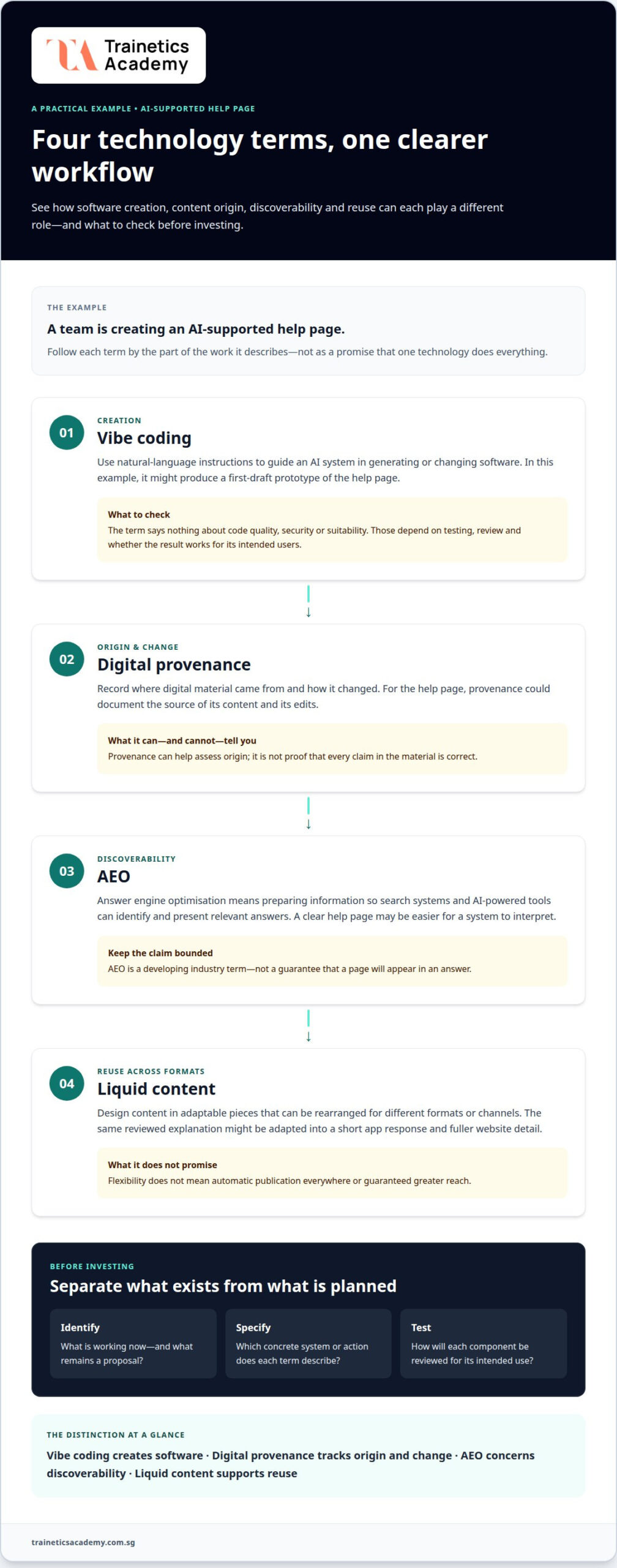
Vibe coding describes using natural-language instructions to guide an AI system in generating or changing software. For example, someone might describe a booking page and ask a machine to produce a first draft. The phrase says nothing about the code’s quality, security, or suitability. Those depend on testing, review, and whether the result works for its intended users.
Digital provenance is information that helps show where a digital item came from and how it changed. A photo might carry a record of its creator and edits, while a document may include version history. Provenance can help assess origin, but it isn’t proof that every claim in the item is correct.
AEO usually means answer engine optimisation: preparing information so search systems and AI-powered tools can identify and present relevant answers. For example, a clear page that directly explains a service may be easier for a system to interpret than an unclear page. AEO is a developing industry term, not a guarantee that a page will appear in an answer.
Liquid content refers to content designed in adaptable pieces that can be rearranged for different formats or channels. A product description, for instance, might provide short text for an app and fuller detail for a website. The idea is flexibility, not automatic publication everywhere or a promise of greater reach.
Keep these terms distinct. Vibe coding concerns software creation; digital provenance concerns origin and change; AEO concerns discoverability; liquid content concerns reuse. If a presentation uses all four, ask which specific system or action each term describes. That distinction prevents a broad technology vision from being mistaken for a working feature.
Consider a team creating an AI-supported help page. Vibe coding might generate a prototype; provenance could document the source of its material; AEO could shape its answers for search; liquid content could adapt those answers for a website and app. Before investing, identify what exists now, what remains planned, and how each component will be tested.
Use a term only when it clarifies the discussion. If “AEO” means a specific publishing process in one meeting, define it before comparing proposals. If “liquid content” is used loosely, ask for a concrete example, such as one reviewed explanation adapted into a short app response. Specific examples make proposed changes easier to evaluate.
Evaluating new technology beyond hype
Assess a technology by its maturity, usefulness, risks, and fit with people’s work. NASA’s Technology Readiness Level, developed in the 1970s, supports consistent discussion of technical maturity across technology types. It offers a useful distinction: a promising concept is not the same as a demonstrated capability. Ask what has been tested, in what setting, and whether results apply to your organisation.
Start with the problem. A tool can be technically impressive yet solve an issue customers don’t have. For example, an AI chatbot may answer routine questions, but its value depends on answer quality, customer needs, and how staff handle complex cases. Assess the full process, including people, existing systems, and steps before and after the tool’s output.
Then separate evidence from forecasts. Economist Paul Krugman predicted the internet’s impact on the global economy would be no greater than the fax machine’s by 2005. The prediction illustrates why confident claims about emerging technology deserve scrutiny. For each claim, identify whether it describes a tested result, a current deployment, or a future vision. Social media attention can reveal public concerns, but popularity alone doesn’t demonstrate performance.
Consider practical outcomes and trade-offs together. In the Reuters Institute survey, 42% described the impact of current newsroom AI initiatives as limited, while 44% called it promising and 13% transformational. Those different assessments show why “AI works” says nothing without context. Ask which task changed, who benefited, and what limitations remained. A newsroom tool that drafts summaries, for example, still needs editorial review and a clear owner for corrections.
Use a consistent assessment before committing resources:
- Need: Name the specific customer or business problem.
- Maturity: Separate a prototype from a tool used in the relevant setting.
- Evidence: Identify how performance was measured and what the test omitted.
- People and process: Map who uses the technology and how work changes.
- Risk: Consider errors, privacy, security, and the consequences of failure.
- Decision: Define what outcome would justify continuing, changing, or stopping.
This framework prevents “new” from becoming a substitute for “useful.” For example, compare cloud computing with mainframe computing from the 1960s by examining the actual workload, operating requirements, and user needs, rather than relying on labels. A technology earns attention when evidence connects its capability to a real benefit, while making limitations and responsibilities visible.
How can I discuss new technology confidently without pretending to be an expert?
Speak confidently by separating what you’ve observed, what a source supports, and what you’re still assessing. For example, say, “I tested the meeting-summary feature on one call; it captured action items, but I haven’t assessed accuracy across different teams.” That statement is precise, useful, and bounded. It avoids presenting one experience as proof of universal performance. To avoid looking foolish when discussing new technology, make the scope of each claim clear.
Use a simple three-part structure in meetings: describe the capability, connect it to a task, then name the evidence. For example: “This AI tool drafts customer replies. It may reduce time spent composing routine messages. We should review sample replies for accuracy before relying on them.” Each sentence has a different purpose: explain the tool, identify possible value, and set an evidence requirement.
Choose verbs that match the strength of your evidence. “Does” suits a demonstrated feature; “may” signals a possible effect; “could” introduces a scenario. Don’t turn a product demonstration into a claim about organisation-wide results. If a vendor shows an AI system summarising one document, describe that demonstration. Don’t claim it will improve every team’s productivity without evidence from those teams. Precision helps you avoid looking foolish when discussing new technology in a meeting.
Make your knowledge boundary explicit and productive. Say, “I can explain the user workflow, but I can’t assess the underlying model architecture.” Then add a useful next step: “Let’s ask the technical lead how the system handles incorrect outputs.” This identifies the right expertise without ending your contribution. It also keeps responsibility with the people who need to inform the decision.
Nate Silver’s advice is that predictions improve when people show greater humility about their ability to predict. Apply that principle by labelling forecasts as forecasts. For instance, “If staff use the assistant regularly, it may change how we handle first drafts” is more defensible than “AI will eliminate this task.” The distinction leaves room for evidence to refine the claim.
- State the scope: Name the feature, user, and task you’re discussing.
- Identify the basis: Say whether your point comes from a test, documentation, or a prediction.
- Separate fact from inference: “The tool generated a draft” is an observation; “it saves time” needs measurement.
- Invite relevant expertise: Direct architecture, security, or workflow questions to the person responsible.
During a discussion of an AI writing assistant, you might say, “I’ve seen it produce a first draft, but I haven’t compared its factual accuracy.” That isn’t a retreat. It gives colleagues a clear basis for deciding what to test next. Credibility comes from making claims proportionate to evidence, not from sounding certain about every emerging technology.
What questions should I ask when learning about unfamiliar technology?
Start with the problem, not the product description. If someone proposes an AI assistant for customer support, ask which enquiries it handles and what happens when it gives an incorrect answer. Those questions clarify the technology’s purpose, users, and the consequences of relying on it.
Use questions that connect claims to real work:
- What task does it perform? Ask for a specific example, such as turning a support request into a draft reply.
- Who benefits? Identify the customer, employee, or team whose work should improve.
- What evidence supports the claim? Distinguish a live demonstration from results observed in the intended setting.
- What can it not do? Ask where the tool fails, such as handling unusual requests or incomplete information.
- What changes in the workflow? Map who reviews outputs, corrects errors, and owns the final decision.
- What information does it use? Clarify which data enters the system and who can access its outputs.
- How will success be judged? Agree on a practical outcome, such as fewer repetitive steps without lower response quality.
Ask for a comparison with the current process. If a team suggests AI-generated meeting notes, find out how staff capture decisions today. Then identify what the new tool changes, such as searching transcripts or assigning action items. Without a baseline, “faster” or “better” remains an impression, not a meaningful comparison.
Assess the technology’s maturity, too. Ask whether the example is a prototype, a limited trial, or an established part of daily work. A polished AI demonstration may show that a model can summarise one document, but not that it handles varied reports reliably. The setting matters.
Questions about people and responsibility matter as much as questions about features. For a system that drafts replies, ask who checks tone, factual accuracy, and sensitive details before sending. Ask who handles a customer complaint if the draft misses its context. Clear ownership prevents a useful tool from creating confusion between employees.
Finally, ask what would change the decision. A project team might continue testing if drafts save effort while remaining accurate, then pause if errors create extra review work. Define the evidence that supports each choice before enthusiasm or resistance takes over. This gives the discussion a practical next step and keeps attention on the technology’s actual role.
Trainetics Academy
Trainetics Academy offers an Artificial Intelligence Course for readers seeking a structured way to build their understanding of AI. Whether you’re exploring an AI course Singapore, SkillsFuture AI courses, AI courses for beginners, or a 1 day AI course Singapore, focus on the learning goals that matter for your work rather than relying on a search label alone.
Choose further study when you want to strengthen your foundation and discuss AI applications with greater clarity. For more information about learning with Trainetics Academy, contact the academy.
Make thoughtful technology judgement part of your next step
To avoid looking foolish when discussing new technology, treat each conversation as a chance to refine your understanding, not prove you know everything. New tools will keep changing, but disciplined judgement remains valuable: stay curious, state what the evidence supports, and keep learning as real uses emerge. That approach helps you contribute constructively at work and make considered decisions about AI.
If you want to build a stronger foundation in artificial intelligence, Trainetics Academy offers an Artificial Intelligence Course. Use that learning to develop your understanding and bring more precision to future discussions. Contact Trainetics Academy to explore your next step. Approach each new technology with curiosity and sound judgement, and let your confidence grow through continued learning.
Frequently Asked Questions
What to do?
Begin by identifying the decision you need to make, then focus your learning on that decision. If your team is discussing an AI transcription tool, clarify whether you need searchable notes, speaker labels, or draft minutes. Let that purpose guide what you read and ask in the meeting. This keeps the conversation focused on a real requirement rather than a broad debate about technology.
How can I verify claims about a new technology before discussing it?
Trace each claim to evidence that matches the product and use case being discussed. Read the product documentation and release notes, then compare them with an independent test or hands-on trial. Check the version tested, the task performed, and any stated limitations. For an AI image tool, for example, try the same brief yourself and assess whether the result meets the standard your work requires.
What are common technology buzzwords and what do they mean?
Buzzwords often compress a broader idea into a short label. A large language model generates and processes text; generative AI creates outputs such as text or images. “Agentic AI” generally describes systems designed to pursue tasks through multiple actions, though the term is used in different ways. Vibe coding, digital provenance, AEO, and liquid content describe distinct concepts, so ask for a concrete product example before relying on the label.
How can I explain the limits of my knowledge gracefully?
State what you understand, name the boundary, and offer a useful next step. For example: “I can explain how the AI tool fits into our customer workflow, but I can’t assess its data security. Let’s bring that question to our security lead.” This keeps you engaged without overstating your expertise and directs the discussion to the colleague best placed to address the technical issue.
How do I distinguish proven technology from hype?
Look for evidence of repeatable performance in conditions similar to your intended use. A compelling demonstration of an AI assistant drafting one email doesn’t establish how it handles varied requests or corrections. Ask whether results have been evaluated across representative tasks, who reviewed them, and what failures occurred. Claims supported only by a launch announcement or promotional demonstration describe potential, not proven value in your setting.
How can I keep up with new technology without spending too much time?
Choose a small area relevant to your work, such as AI tools for customer service, and follow developments from a few credible sources. Prioritise product release notes, technical explainers, and updates from organisations working in that field. Keep a short record of unfamiliar terms and questions for later review. This gives you a focused way to build understanding without trying to follow every technology headline or social media discussion.
How can I compare new technology with existing alternatives?
Compare options against the same task, users, and quality requirements, including the current process. For example, assess an AI scheduling assistant against manual booking and existing calendar software. Consider setup effort, integration needs, error handling, accessibility, and who supports the process. Include the option of changing nothing. A clear comparison shows whether the new tool addresses a meaningful gap or simply adds another system for staff to manage.
Disclaimer
AI Content Disclaimer: Some articles on this website may be generated or assisted by AI-powered content creation tools. While we strive for accuracy and relevance, readers should independently verify information before relying on it. The content is provided for informational purposes only and does not constitute professional advice.