AI courses can help learners understand how AI platforms work and explore topics such as prompt injection, privacy leaks, poisoned data, phishing and deepfakes. These common security threats can affect how a system responds or how people make decisions.
It is reasonable to value AI’s speed and convenience while asking what could go wrong. Learning about these risks in an AI course can help you use these tools carefully and recognise when an AI-generated message, answer or image needs closer scrutiny.
This article explains how attacks on AI platforms work, what they can put at risk and how sensitive information, business processes and trust can be affected. It also covers practical safeguards, from limiting what you share with AI tools to applying human judgement to their outputs.
Key Takeaways
- Learn how AI courses explain the effects of manipulated inputs and compromised training data on AI outputs and sensitive information.
- Recognise how AI courses help learners understand malicious instructions hidden in prompts, documents or web pages.
- Understand how AI courses cover protecting confidential data and applying careful access controls when using AI.
- Learn how AI courses help you spot AI-generated phishing and deepfakes, and use independent checks before acting on urgent requests.
- Explore how AI courses explain the security risks of third-party integrations and support informed use of these tools.
1. Adversarial AI, model poisoning, evasion and privacy attacks
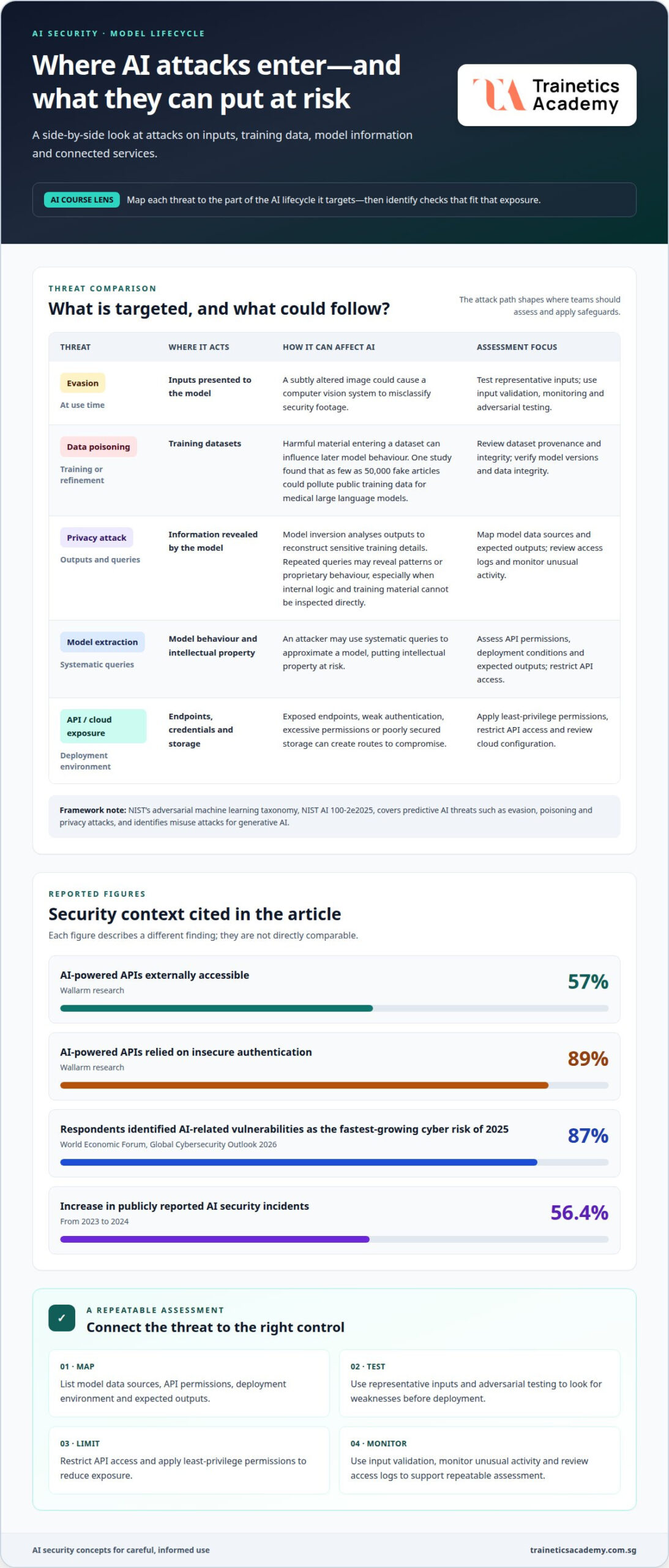
AI courses introduce security by teaching how models learn, receive inputs and produce decisions. Learners can use NIST’s adversarial machine learning taxonomy, NIST AI 100-2e2025, to study predictive AI threats such as evasion, poisoning and privacy attacks. It also identifies misuse attacks for generative AI. This framework helps learners distinguish attacks on a model’s inputs from attacks on its training process or revealed information.
In an AI course, evasion attacks show how data presented to a model during use can be manipulated. A subtly altered image, for example, could cause a computer vision system to misclassify security footage. Lessons on poisoning explain how harmful material can enter training datasets and influence later behaviour. One study found that adding as few as 50,000 fake articles to a public training dataset could pollute medical large language models. Comparing these attacks helps learners understand where checks belong in the AI lifecycle.
AI courses also cover privacy attacks and what a model may reveal. In a model inversion attack, an attacker analyses outputs to reconstruct sensitive details from training data. Black-box models are harder to assess because users cannot directly inspect their internal logic or training material. Repeated queries may still reveal patterns or proprietary behaviour. Model extraction can also let an attacker approximate a model through systematic queries, putting intellectual property at risk.
Course examples can also examine how insecure AI APIs and cloud deployments create routes to compromise. Attackers may target exposed endpoints, weak authentication, excessive permissions or poorly secured storage. Wallarm research found that 57% of AI-powered APIs were externally accessible, while 89% relied on insecure authentication mechanisms. These examples help learners understand why API access, credentials and cloud configuration belong in a model’s security assessment.
Reported figures provide context for AI security lessons. The World Economic Forum’s Global Cybersecurity Outlook 2026 reported that 87% of respondents identified AI-related vulnerabilities as the fastest-growing cyber risk of 2025. Publicly reported AI security incidents increased by 56.4% from 2023 to 2024. Learners can use these figures as context while considering why teams should assess their own systems rather than assume every model faces identical exposure.
AI courses can teach learners to assess how model breaches affect confidentiality, integrity and availability. A stolen model may expose intellectual property, while tampered data can distort decisions. To practise assessing these risks systematically, map the model’s data sources, API permissions, deployment environment and expected outputs. Test representative inputs and review access logs to make the assessment repeatable.
Lessons on AI security can cover ways to reduce exposure, including restricting API access, applying least-privilege permissions, and verifying model versions and data integrity. Input validation and monitoring can help reveal unusual activity, while adversarial testing can expose weaknesses before deployment. These controls connect technical foundations with responsible use: understanding how a model works helps learners identify where an attack could influence its behaviour.
2. Prompt injection and indirect prompt injection in AI courses
In an AI course, prompt injection is a useful concept for learning how hostile instructions can manipulate an AI system’s response. It is among the common security threats with AI platforms because attackers can exploit a model’s tendency to follow text instructions. A direct attack might tell a chatbot to ignore its rules and reveal confidential information. If safeguards fail, the platform could disclose information or misuse connected tools within its permissions.
AI courses can also explain indirect prompt injection, which hides instructions in content an AI system processes, rather than in the user’s visible prompt. For example, a document or web page could tell an AI assistant to send private information elsewhere. If an organization uses AI to summarise that content, the hidden instruction may influence the response or actions.
As part of AI-course learning, students can explore adversarial prompts designed to make generative AI produce inappropriate or unsafe output. Some attempt to extract a system prompt, which contains instructions intended to guide the model. Others try to bypass safeguards using role-play, encoded text or carefully sequenced requests. A successful attempt can expose internal guidance or produce output that conflicts with the system’s intended use.
Learning about prompt injection in an AI course can help explain how it manipulates responses or connected tools. The risk increases when a model can access email, files, databases or external services. For instance, an assistant with broad file permissions might be induced to include sensitive material in a summary. Its access controls determine how far that manipulation can reach.
AI courses can distinguish data poisoning from prompt injection. Data poisoning introduces harmful or misleading material into datasets used to train or refine a model. Poisoning affects the data that shapes behaviour, while prompt injection targets a model during use. Dataset provenance and review help address poisoning; prompt handling and tool restrictions help address injection.
To study common security threats with AI platforms, learners can use OWASP’s Top 10 for LLM Applications to structure a review. Test realistic cases, such as a malicious web page, a hostile document, and a prompt requesting hidden instructions. Continuous monitoring of inputs, outputs, and tool calls can help detect suspicious patterns and support incident investigation.
AI-course learners can explore layered controls to reduce exposure. Separate trusted system instructions from untrusted user content, limit each AI tool to necessary permissions, and validate inputs before processing. Require human approval for consequential actions, such as sending messages or changing records. Red-team testing with varied adversarial prompts can reveal weaknesses, while output checks can catch disclosures or manipulated responses before reuse.
3. Sensitive-data privacy and regulatory compliance in AI courses
AI courses can help learners understand how AI workflows may expose personal, confidential or proprietary information during collection, storage, training, inference and output. For example, an employee might paste a customer record into a public chatbot, or a team might store training files in a cloud location with overly broad access. If attackers obtain those records, they could target individuals, misuse business information or seek details reflected in model outputs.
Training data deserves particular attention in AI-course learning. A model may be shaped by internal files, vendors or open-source repositories, and each source creates a different exposure path. Malicious or altered third-party data can influence model behaviour, while compromised repositories can introduce unsafe components. Learners can practise recording data sources, assigning owners and verifying integrity before material enters training or retrieval workflows.
AI courses can introduce data governance as a practical way to manage these risks. Learners can classify information before use, define which teams and models can access each category, and set retention rules for prompts, logs and generated outputs. For example, a customer-support assistant may need order status but not payment credentials. Limiting inputs to what the task requires reduces unnecessary exposure and makes access decisions easier to explain.
Privacy controls should cover the full AI lifecycle, not just training. In an AI course, learners can review where prompts and outputs are stored, who can retrieve them, and whether connected applications retain copies. They can practise limiting permissions, protecting credentials and logging access to sensitive datasets. A response plan should identify how teams will isolate an affected model, preserve evidence and assess what information may have been exposed.
AI-course learners can also explore how regulatory alignment depends on the system’s purpose, data and deployment context. The European Union’s AI Act prohibitions on certain AI practices have applied since February 2, 2025. For a Singapore organization operating across borders, governance should map relevant jurisdictions and document how data is collected, used, retained and reviewed. That record supports consistent decisions when a model or its use changes.
AI courses can teach a repeatable review before deployment: identify personal and confidential data, document its source, assess access, test outputs for unintended disclosure, and assign responsibility for ongoing monitoring. Learners can revisit the assessment when datasets, model versions or integrations change. This links privacy safeguards with security controls and helps teams spot when a new use introduces a different risk.
Strong AI data protection is an ongoing discipline that learners can develop through AI-course study. Clear ownership, controlled access, verified data and documented decisions help reduce exposure while preserving useful applications. In Singapore, organizations should build these checks into AI governance and assess the rules relevant to each deployment, rather than treating launch as the end of privacy review.
4. AI-generated phishing, deepfakes and social engineering in AI courses
AI courses can help learners understand how generative AI enables attackers to create convincing messages at scale. A phishing email may imitate a supplier’s writing style, refer to a real project, and request an urgent payment. AI can also adapt wording for different recipients, making familiar warning signs less obvious. In ISC2’s 2025 workforce study, 40% of surveyed cybersecurity practitioners said they had experienced AI-optimized social engineering attacks.
As part of AI-course learning, students can examine how deepfakes use synthetic voices, images or video in impersonation attempts. A copied executive voice could be used in a call requesting a confidential file or financial transfer. Learners can practise treating an unusual request as a reason to verify it through a separate, established channel before taking action. A familiar voice or face is not, by itself, reliable proof of identity.
AI courses can also cover how generative AI produces misinformation. Its outputs may sound authoritative while containing invented details, a phenomenon known as hallucination. Attackers can use fabricated statements or images to influence decisions, damage trust or strengthen a fraudulent message. Learners can practise comparing consequential claims with credible sources and checking the original context, especially if the content creates urgency or strong emotion.
AI-course discussions of responsible use can address privacy concerns. Information entered into a generative AI service can create a separate privacy concern. Do not paste passwords, customer records, unreleased plans or confidential business correspondence into a tool unless its handling is appropriate for that information. For example, replace real names and account details with fictional placeholders before asking for help drafting a general response. This reduces the risk of exposing details through prompts or later outputs.
AI courses can help learners understand how organizations reduce social engineering risks with clear procedures. Staff can be trained to pause before opening attachments, approving payments or sharing credentials. Changes to bank details can be confirmed through a known contact method, not the phone number in a suspicious message. Suspected incidents should be reported promptly so security teams can preserve messages, review account activity and coordinate a response.
AI courses can also introduce defensive uses of AI in security operations. Teams can use generative AI to draft threat-hunting queries or summarise alerts, then have analysts review suggested actions. Human oversight matters: an inaccurate summary can hide vulnerabilities, while an automated action may affect legitimate applications. Learners can explore why organizations limit access to security tools, test workflows before deployment and retain audit logs for decisions made with AI assistance.
AI-course learning can bring these ideas together by showing how a disciplined response combines technical controls with informed judgement. Use multifactor verification for sensitive actions, restrict access to business accounts and give staff a clear reporting route. Review incidents for recurring tactics, such as impersonated suppliers or fabricated executive requests. These steps help organizations address AI-assisted manipulation without treating every message or generated image as automatically malicious.
5. What are AI security risks?
AI security risks include compromised third-party components, unsafe plug-ins, unauthorized access and weaknesses in connected services. In an AI course, learners can explore how a vulnerable dependency may affect several systems, not just one model. In 2025, an unsecured third-party integration breach involving Salesloft-Drift OAuth tokens affected more than 700 organizations, illustrating how a supplier compromise can spread through trusted connections.
AI supply chains extend beyond the model itself. They can include training datasets, model libraries, cloud services, plug-ins and application programming interfaces. An AI course can help learners understand how a third-party component may introduce vulnerabilities or a malicious backdoor, changing model behavior or opening access to connected systems. In 2026, 68% of organizations running self-hosted models ingested data through third-party software, according to Wiz’s State of AI in the Cloud report.
Common threats to AI platforms include compromised dependencies, insecure plug-ins, exposed interfaces and unauthorized access. Through AI-course learning, students can examine how supply-chain attacks may corrupt datasets or model files before deployment. A familiar vendor name does not reveal every dependency beneath its product, so understanding component origins, versions and permissions is an important part of learning to assess AI systems.
AI courses can also introduce controls that make dependencies easier to govern. Learners can study how to maintain an inventory of AI models, plug-ins, datasets and service providers, then record each component’s owner and purpose. Restrict integrations to the access they need, protect credentials and review updates before deployment. These measures help limit the impact if a supplier or component is compromised.
As part of an AI course, learners can explore how to protect AI platforms with least-privilege access, strong authentication, model and data integrity checks, and security reviews for third-party components. They can also consider separating sensitive workloads from unnecessary integrations and requiring human approval for high-impact changes, such as granting a plug-in access to customer records or allowing an agent to modify business systems.
AI-course learning can cover ways to assess exposure by identifying AI assets across business units and cloud environments. Learners can map each system’s data flows, external connections and permissions, then test how a component failure could affect confidentiality, service availability or decision-making. Tracking model versions and reviewing logs for unexpected behaviour, such as new outbound connections or unusual access to stored data, can also be part of this learning.
Monitoring must continue after launch, a principle learners can explore in an AI course. Reassess integrations when vendors update components, teams add plug-ins or AI models gain new permissions. Maintain an incident response plan that identifies who can disable an integration, preserve relevant logs and assess affected systems. Regular reviews help cybersecurity teams spot changes before a dependency issue becomes a wider breach.
Build a stronger foundation for evaluating AI systems through structured AI-course learning, then apply that understanding to component inventories, access decisions and ongoing monitoring.
Trainetics Academy
Trainetics Academy offers an Artificial Intelligence Course for people who want to understand AI and its responsible use more clearly. If you are learning how AI platforms work or considering their role in your organization, structured AI education can help you approach the technology with greater confidence and informed judgement. The course is a relevant next step for developing your AI knowledge, not a substitute for specialist cybersecurity advice or incident response.
Explore the Artificial Intelligence Course to see how it fits your learning goals. For further information, contact Trainetics Academy.
Build confident, responsible AI skills
Make informed AI use part of your professional development. Understanding common security threats with AI platforms can help you ask sharper questions, weigh risks before adopting new tools and contribute thoughtfully to decisions about their use. These skills matter as AI becomes part of everyday work across teams and industries.
Keep learning beyond the technical details. Strong AI practice also depends on sound judgement: understanding what a tool can do, recognising where human oversight matters and communicating clearly about its limits. Developing that perspective can help you engage with AI responsibly and prepare for changing workplace expectations.
Trainetics Academy offers an Artificial Intelligence Course for learners who want to deepen their understanding of AI. Contact Trainetics Academy to discuss training and take a considered next step in your learning journey.
Frequently Asked Questions
What Can You Learn in an AI Course?
An AI Course can introduce learners to how AI models work, how to use AI tools and how to assess their outputs. For example, learners may explore how an AI assistant responds to prompts and where its answers may need review. Course content can also cover data, user access and responsible use. Before choosing a course, consider its topics, your goals and whether the level suits your experience.
How Can an AI Course Help at Work?
An AI course can help learners understand how AI may support workplace tasks, from drafting content to organising information. For instance, learners can examine how an AI tool might assist with recruitment and why its recommendations need review. The value depends on the tools and tasks covered: a course focused on drafting has a different emphasis from one exploring AI integrations. Check that the course topics match your learning goals.
How Do AI Courses Explain AI-Powered Cyberattacks?
AI courses can explain how attackers use AI to support tasks such as creating tailored messages, analysing public information or adapting malicious code. A course might use a company announcement to show how a fraudulent supplier email could seem credible. Learners can explore how AI supports preparation and why attacks may still rely on weaknesses such as stolen credentials. This topic can help learners recognise security considerations when using AI.
What AI Security Topics Can You Learn About?
AI courses may cover risks affecting a model, its data, connected services or the people relying on its output. A course example could show how a support chatbot might give an incorrect answer or how an integration could alter records. Learners can consider confidentiality, accuracy, availability and human oversight separately. A risk review exercise can map an AI use to its data sources, users, connected applications and potential consequences.
What Generative AI Security Topics Do Courses Cover?
Generative AI courses may explore protecting prompts and outputs, handling malicious instructions, controlling tool access, and safeguarding models and their dependencies. Output handling can be part of the discussion too. For example, learners might consider how an application that inserts generated text into a database could treat untrusted content as an instruction. Studying the full workflow can help learners understand how information enters a model, which actions it can trigger and how people review results.
Can an AI Course Explain Training-Data Poisoning and Model Manipulation?
An AI course can introduce how training-data poisoning may lead a model to learn misleading patterns, and how manipulation can steer its behaviour during use. A course example might show how a poisoned product dataset could cause a recommendation system to favour incorrect items. Learners can discuss tracking dataset sources, reviewing unexpected changes and testing model behaviour against known examples. Comparing outputs across model versions can also help identify shifts for further investigation.
Can AI Courses Cover Data Leaks Through Chatbots and APIs?
AI courses can explain how sensitive information might leak if a chatbot sends prompts to an exposed API, stores conversation logs insecurely or returns data beyond a user’s access rights. For instance, a course example could show how a support bot might retrieve another customer’s case if identity checks are not linked to each request. Learners can explore scoped credentials, access checks and log reviews. Course discussions can also cover why secrets should not be put in prompts or API parameters.
What AI Supply-Chain Risks Can You Learn About?
AI courses may cover supply-chain risks involving models, plug-ins, libraries and hosted services that introduce unsafe code, altered files or excessive access. A course example might examine a plug-in requesting permission to read files unrelated to its task. Learners can discuss maintaining dependency inventories, pinning verified versions, checking package sources and removing unnecessary integrations. Reviewing permissions after updates can also help learners understand how a changed component may affect system behaviour or data access.
Disclaimer
AI Content Disclaimer: Some articles on this website may be generated or assisted by AI-powered content creation tools. While we strive for accuracy and relevance, readers should independently verify information before relying on it. The content is provided for informational purposes only and does not constitute professional advice.