The biggest process bottleneck may be the step your team rarely sees. AI for business process improvement can reveal it by analysing process data, tracing how work actually moves, and highlighting delays, repeated tasks, or hand-off points that slow results. The goal isn’t to automate for its own sake; it’s to make better decisions about where and how to improve.
It’s understandable to focus first on speed and efficiency. But a process change matters most when it also improves the customer experience. AI can connect operational signals, such as cycle time and backlogs, with customer-focused measures and forecasts, helping teams assess likely outcomes before changing how work is done.
Explore how process mining uncovers bottlenecks, how AI tools support process design, and how predictive analysis can inform improvement decisions. Clear data and relevant KPIs give teams a stronger basis for evaluating whether a change makes work smoother for employees and customers alike.
Key Takeaways
- Learn how AI-supported process management can help teams find opportunities to improve efficiency and focus human effort on higher-value work.
- See how process data can expose delays and hand-offs that are difficult to spot from assumptions alone.
- Compare how AI tools, including digital twins, can support process analysis and help model possible changes before implementation.
- Choose measures that connect operational performance with customer experience, rather than treating speed as the only sign of success.
- Understand how forecasting can help teams assess potential outcomes and make more informed improvement decisions.
What are the benefits of AI-driven Business Process Management?
Learning how AI supports business process management helps professionals assess where analysis and automation may fit. Studying AI for business process improvement also builds a foundation for asking precise questions about data, workflow goals, and human oversight.
Traditional process management often relies on interviews, spreadsheets, and manual reviews, which can leave an incomplete picture of how work moves through an organization. Consider an invoice waiting in an approval queue: a process map can help identify the hand-off, while AI analysis can explore patterns across records. Learning to interpret these signals is more valuable than treating automation as an automatic solution.
AI Technologies for Process Optimization
Machine learning, natural language processing, and robotic process automation are technologies professionals can study to understand different process tasks. Automation may handle structured data entry, for example, while language tools can classify written enquiries. Knowing the distinctions helps professionals assess which technology may suit a defined workflow and where human judgment remains necessary.
Intelligent process automation can increase business productivity by up to 20%, while organizations using AI for workflow optimization can reduce process cycle times by 30-50%. These market figures describe potential outcomes, not a promise for an individual organization. For learners, they provide a reason to examine how process design, data quality, and task suitability affect results. A useful exercise is to compare a process’s current performance with its performance after a controlled change.
AI-Augmented Management Systems
AI-augmented business process management systems combine process models, operational data, and AI analysis. Learning how these elements interact can help professionals interpret workflow exceptions and identify hand-offs that deserve closer review. An invoice system, for instance, might flag recurring delays between submission and approval, while an employee assesses unusual cases.
Processes with repeated tasks, stable rules, and accessible records are generally suitable candidates for AI analysis or automation. Examples across industries include classifying customer enquiries, examining production records, and reviewing maintenance patterns. Understanding these use cases helps learners connect AI capabilities to different business functions without assuming one approach suits every organization.
Effective implementation calls for clean, structured, sufficient data, software that can access relevant records, and staff who can interpret outputs. In Singapore, businesses should consider applicable data-protection and sector requirements in light of the information and decisions involved. Government support for AI adoption depends on programme criteria, business circumstances, and project scope, so evaluating these factors is part of sound adoption planning.
How does AI identify bottlenecks in business processes?
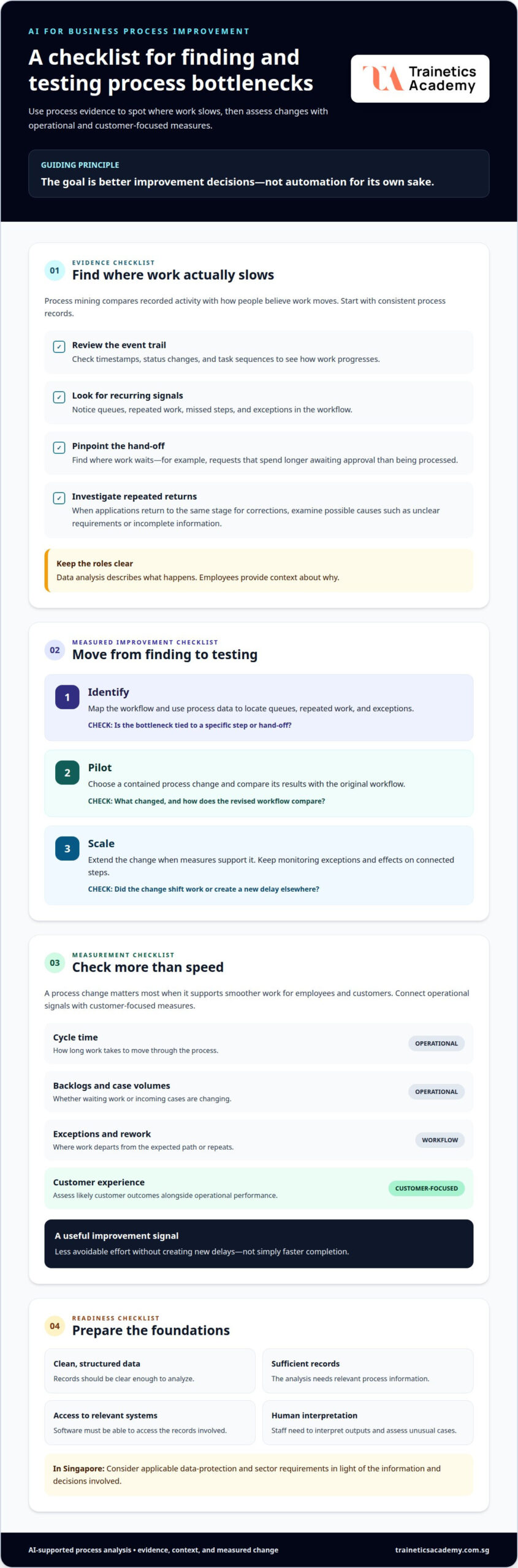
AI identifies bottlenecks by analyzing process data to find where work waits, repeats, or departs from the expected workflow. Process mining compares recorded activity with how employees believe work moves. Event logs may show, for example, that requests spend longer awaiting approval than being processed. This evidence helps teams focus on a specific hand-off instead of redesigning an entire process.
Useful analysis starts with consistent records. Process-mining systems can examine timestamps, status changes, and task sequences to reveal queues, rework, and missed steps. If customer applications repeatedly return to the same stage for corrections, that pattern points to a possible cause, such as unclear requirements or incomplete information. Analysis describes what happens; employees provide context about why.
Real-time monitoring adds a continuous view. Rather than waiting for a periodic review, teams can track changes in case volumes, completion times, and exceptions as workflows run. Real-time AI analytics can improve process accuracy and efficiency by up to 35%. That figure describes potential, not a guaranteed result. Its value lies in helping process owners notice emerging delays and investigate them before they become routine.
A financial-services onboarding initiative documented 23 critical processes while redesigning the customer experience. The example illustrates why mapping connected steps matters: delays can span teams, and changing one task may shift work elsewhere. A process map gives analysts a clearer view of dependencies before they recommend or implement a change.
To identify, pilot, and scale an improvement, teams can follow a measured sequence:
- Identify: Map the workflow and use process data to locate queues, repeated work, and exceptions.
- Pilot: Select a contained process change and compare its results with the original workflow.
- Scale: Extend the change when measures support it, while monitoring new exceptions and effects on connected steps.
Continuous process improvement turns each implemented change into a new opportunity for learning. Teams can compare performance before and after a redesign, review cases that still stall, then adjust the workflow or automation rules. Organizations using AI for continuous improvement see an average increase in efficiency of 20-30%. The useful signal is not simply faster completion; it is whether the change reduces avoidable effort without creating new delays.
Continuous BPM improvement also requires employee insight alongside system data. A dashboard might identify a repeated hold, while staff explain that a missing decision rule causes it. Combining both perspectives helps process owners distinguish a technical issue from a policy or training gap. That disciplined cycle, observe, diagnose, test, and learn, makes AI analysis a practical input to ongoing process management.
AI tools for process design and analysis
AI tools support different stages of process design, from interpreting customer feedback to modelling a proposed workflow. Their value depends on choosing a technology that fits the decision a team needs to make.
AI-Assisted Process Analysis
AI-assisted process analysis applies machine learning and natural language processing to operational records and customer comments. It can group similar feedback, identify recurring topics, and help teams examine where a process may be falling short. A service team, for example, could analyze comments about repeated follow-ups alongside case records to explore whether a hand-off or response step needs redesign.
Process mining examines recorded task sequences, while text analysis works with unstructured material such as survey responses. Combining these technologies can strengthen business process management: a workflow map may show where customers wait, and natural language analysis may help explain the experience behind the delay. Teams should distinguish patterns from causes, then use employee knowledge to interpret the evidence.
Digital twins offer another process-design tool. They create a model that teams can use to simulate proposed changes and forecast outcomes before implementation. An operations team, for example, could model a revised approval route to examine how shifting a decision point might affect connected tasks. The model supports analysis, but its usefulness depends on how well its assumptions reflect the real workflow.
Comparing Tools and Costs
AI business process tools differ by function: process mining maps workflow activity, natural language tools analyze written feedback, and digital twins simulate process designs. Process automation tools handle repetitive actions once teams define suitable rules. Comparing tools by the problem each solves helps organizations avoid selecting a machine-learning system when workflow visibility or a clear automation rule is what they need.
No single cost figure applies across these tool types. Software licensing or usage, data volume, integration work, implementation effort, and ongoing support can all shape the total. A small analysis using existing records has different requirements from an organization-wide automation programme connected to multiple systems. Define the process, data sources, and intended use before comparing proposals.
For a practical comparison, assess each tool against the same process-design questions:
- Evidence: Can it use the available workflow records or customer feedback?
- Fit: Does it analyze, simulate, or automate the task the organization needs to improve?
- Integration: What existing systems and data connections does implementation require?
- Use: Can employees interpret its outputs and apply them within the process?
This approach links technology selection to a specific design decision. A customer feedback model may help prioritize issues, while a digital twin can compare alternative workflows. Process automation can then address a repeatable task with clear rules. Separating these roles makes comparisons more precise and connects tool choice with the intended process outcome.
Customer-focused value measures and KPIs
Process management should measure whether operational changes create value customers can feel. Pair efficiency indicators, such as handling time, with customer outcomes, such as resolution rate, repeat contacts, and satisfaction. A faster service workflow may still disappoint customers, for example, if it increases hand-offs or leaves issues unresolved.
AI customer-service tools can support this balance. AI-powered chatbots and virtual assistants can handle customer enquiries around the clock and provide immediate assistance. Track how often enquiries are resolved, transferred to employees, or followed by another contact. These measures show whether automation improves the customer journey or simply shifts effort to another part of the workflow.
Customer experience deserves direct attention. Forbes reported that 53 percent of customers will walk away after a single bad experience. That finding makes complaint themes, unresolved cases, and repeat contacts useful signals alongside efficiency measures. Machine learning can group feedback by topic, such as confusing instructions or delayed updates, so teams can connect customer comments with specific process steps.
For a balanced KPI set, establish a baseline before a change and monitor the same measures afterward. A service team might track first-contact resolution, average handling time, repeat enquiries, and customer satisfaction. Process mining can connect case histories to these measures, while employee feedback can reveal whether reduced customer effort has created extra work elsewhere.
Build privacy into measurement design from the start. Customer messages and employee workflow records may contain sensitive details. Limit analysis to information needed for the chosen KPI, restrict access by role, and avoid exposing personal details in dashboards. A trend report, for example, can show enquiry categories and resolution patterns without displaying full customer conversations.
Businesses calculate ROI by comparing measured benefits with the full cost of an AI change over the same period. Include process savings and customer outcomes in the benefit assessment, then account for software, integration, implementation, and staff training costs. A lower handling time matters only if service quality remains strong and the change does not create more effort elsewhere.
Use a structured review to interpret results:
- Efficiency: Did completion time, rework, or employee effort change?
- Customer value: Did resolution, repeat contact, or satisfaction improve?
- Privacy: Does each measure use only necessary information?
- Business impact: Do measured benefits justify the total implementation and operating costs?
Review these indicators together rather than treating one KPI as proof of success. If a chatbot answers routine questions quickly but repeat enquiries rise, examine answer quality and escalation paths. This combined view helps teams assess whether AI improves customer service while protecting customer experience and employee capacity.
Process intelligence, bottleneck detection, and forecasting
Process intelligence connects workflow records with operational context to show where performance changes and what may happen next. A service team, for example, can combine case timestamps, queue volumes, and staffing patterns to distinguish a temporary backlog from a recurring capacity constraint.
This view goes beyond locating a slow step. AI can analyze how delays move through connected stages: an approval queue may postpone fulfilment, which then increases customer follow-ups. A process owner can use this sequence to identify the constraint with the widest operational effect, rather than optimizing a single task that leaves the wider delay unresolved.
Forecasting adds a forward-looking layer. A model can use historical case arrivals, completion times, and current queue levels to predict where demand may exceed available capacity. A support team, for example, could compare projected enquiry volumes with its planned staffing pattern, then consider adjusting schedules or routing routine requests differently.
Useful forecasts depend on choosing signals that reflect the process. A backlog total alone may hide whether cases are new, complex, or awaiting customer information. Combining queue age with case type and completion history gives analysts a more meaningful view. Teams should distinguish leading indicators, such as rising incoming demand, from lagging measures, such as missed completion targets.
Forecasts can support decisions through scenario comparisons. A team might model what happens if it changes an approval rule, shifts work between queues, or automates a repeatable task. Comparing scenarios helps leaders assess possible effects on connected workflows before implementation. Forecasts are most useful when assumptions are visible, so process owners can judge whether the selected data reflects current operations.
A practical process-intelligence cycle links analysis to action:
- Connect: Bring together relevant workflow events, service measures, and capacity data.
- Diagnose: Trace how a bottleneck affects later steps, such as fulfilment or customer response.
- Predict: Use demand and completion patterns to identify where pressure may emerge.
- Decide: Compare process changes and monitor the measures tied to the intended outcome.
These capabilities make forecasting an input to process decisions, rather than just a standalone dashboard. A Singapore operations team, for instance, could use predicted queue growth to review task allocation before delays affect customer commitments. Connect every prediction to a specific bottleneck, an accountable decision, and a measure that shows whether the change helped.
Strengthen your ability to interpret AI outputs and apply them to business decisions through an Artificial Intelligence Course.
Trainetics Academy
Trainetics Academy offers an Artificial Intelligence Course for professionals and learners building a practical understanding of AI. If you’re comparing AI courses in Singapore, consider whether the learning helps you connect AI concepts with business decisions and process improvement. HR professionals seeking to apply these ideas to talent development and workplace change may also benefit from AI in human resources training in Singapore.
People exploring AI courses for beginners or a 1 day AI course Singapore can use those search terms to clarify their learning goals, rather than assume every course has the same level or duration. Searches for SkillsFuture AI courses also call for checking eligibility information against the specific course, since funding does not apply universally. Focus on the knowledge you want to build and how it supports your next professional step.
Explore Trainetics Academy’s Artificial Intelligence Course to build your understanding of AI. Contact the academy to discuss your learning goals and take the next step.
Turn AI insight into your next business decision
Lasting progress starts when an organization treats AI as a capability to develop, not a shortcut to buy. For AI for business process improvement, identify a decision that would benefit from stronger evidence, then build the knowledge to assess where AI can contribute. This mindset connects technical possibilities with operational priorities and responsible implementation.
Professional learning can help you develop the vocabulary to take part in these conversations, understand how AI methods apply to business challenges, and make informed choices about future initiatives. Bring your questions about AI and its role in your work to a focused discussion, then decide which learning step best supports your goals.
Contact Trainetics Academy to discuss AI and take a considered next step toward applying AI knowledge with purpose.
Frequently Asked Questions
How does AI improve compliance and reduce risk in process management?
AI can help teams spot unusual transactions, missing records, or deviations from internal procedures sooner. A system could flag a supplier invoice that lacks a required approval record, for example, allowing a reviewer to investigate before payment. Set clear escalation rules and retain human oversight for consequential decisions. AI supports monitoring, but the organization remains responsible for its controls and compliance decisions.
Can AI help in optimizing resource allocation?
Yes. AI can help operations teams match incoming work with staff capacity, relevant skills, and current workload. A service manager, for example, could use demand patterns to plan coverage across enquiry queues, then review whether urgent cases are reaching qualified employees promptly. The purpose is better allocation, not simply fewer staff. Include service quality and workload balance when assessing whether a change benefits the organization.
The question is, how much of this is hype versus reality?
AI is most practical when a process has a clear objective, usable data, and decisions that can be reviewed. Claims become hype when they suggest a tool will fix unclear policies, inconsistent records, or poor service without process changes. A grounded test is to define one business outcome, compare performance before and after a limited deployment, and examine exceptions as well as successful cases.
What is AI process optimization?
AI process optimization uses AI analysis to inform choices about how work is organized, prioritized, or supported. It differs from adding automation without a defined outcome. A claims team might use case patterns to identify submissions that need specialist review, while routine cases follow a simpler route. The design should balance speed with accuracy, fairness, and the needs of employees and customers.
What are the risks of using AI in business processes, including bias, errors, privacy, and security?
AI can reproduce bias in its data, misclassify cases, expose sensitive information, or create security weaknesses through poor access controls. A model trained on incomplete historical hiring records, for example, may rank applicants unfairly. Limit access to operational data, test outputs across relevant groups, log consequential decisions, and provide a human review path. Reassess these controls when data sources, models, or workflows change.
Disclaimer
AI Content Disclaimer: Some articles on this website may be generated or assisted by AI-powered content creation tools. While we strive for accuracy and relevance, readers should independently verify information before relying on it. The content is provided for informational purposes only and does not constitute professional advice.