AI training for HR professionals is most valuable when it strengthens human judgment, not just familiarity with new tools. AI in human resources training in Singapore should connect practical applications with the decisions that shape talent development and workplace change.
HR teams need more than a general introduction to artificial intelligence. They need to understand where AI can support their work, how to use it responsibly, and where professional oversight remains essential. This guide explains what AI in human resources training in Singapore can cover and how it can help professionals build relevant skills.
You’ll learn how course delivery and certification work, then explore ways to apply AI to talent development and organisational change with care. The aim is a clear foundation for evaluating AI’s role in HR and developing the confidence to use it thoughtfully in a professional setting.
Key Takeaways
- Understand how HR-focused AI training is delivered and what attendance and assessment involve before earning a Certificate of Completion.
- Identify practical ways to introduce AI at work while keeping people, communication and change management central.
- Explore how AI can support more personalised talent development and learning without replacing professional judgment.
- Consider responsible-use principles when applying AI to HR decisions, employee information and workplace processes.
- See how an Artificial Intelligence Course can build a stronger foundation for HR professionals developing their AI capability.
Course delivery, duration and certification requirements
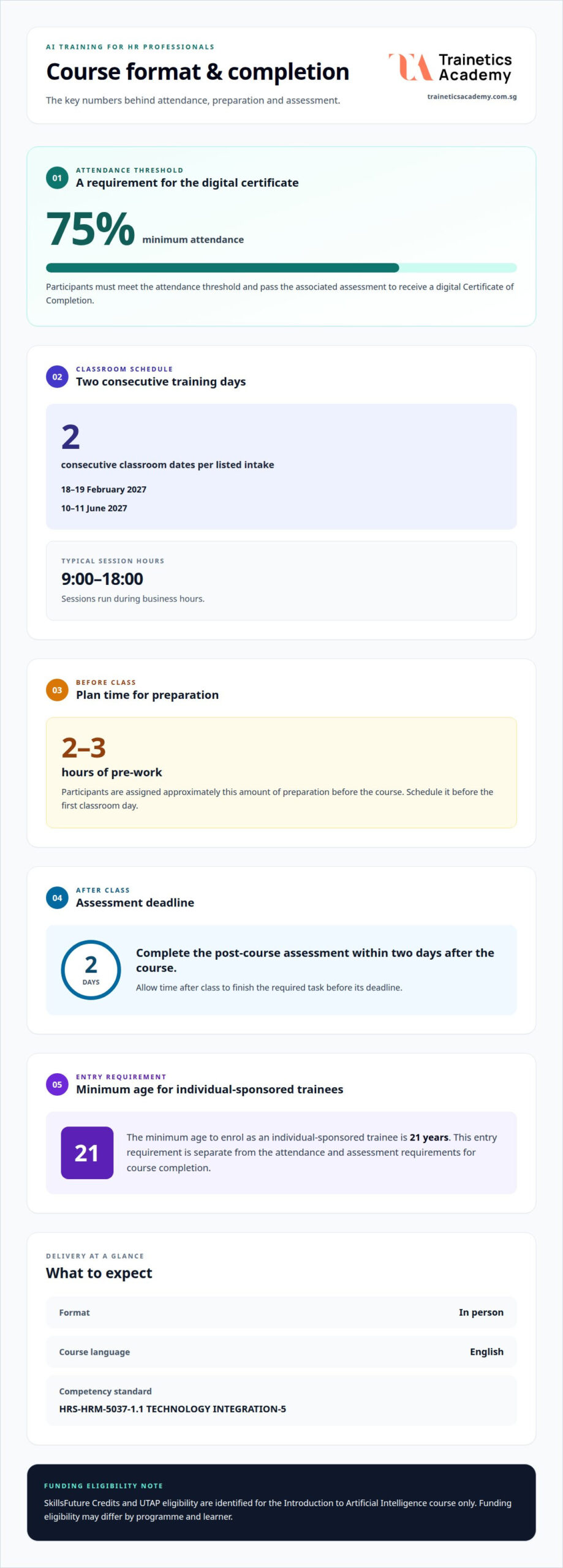
In Singapore, this training combines classroom learning, preparation and assessment. Check the delivery format, attendance threshold, assessment deadline and funding eligibility before selecting an intake.
Course Assessment and Certification
Certification depends on completing both the attendance and assessment requirements. Participants must attain at least 75% attendance and pass the associated assessment to receive a digital Certificate of Completion. The post-course assessment must be completed within two days after the course.
Plan the assessment alongside work commitments. For example, reserve time after class to complete the required task before its deadline. The stated competency standard is HRS-HRM-5037-1.1 TECHNOLOGY INTEGRATION-5. This gives HR professionals a reference point when considering how course learning relates to technology integration in recruitment, talent development and employee engagement.
Duration and Training Hours
Course sessions typically run from 9:00 to 18:00 during business hours. The listed classroom intakes span two consecutive dates, including 18 and 19 February 2027, and 10 and 11 June 2027. This format requires learners to set aside both training days, rather than treating the course as a short evening session.
Participants are assigned approximately 2-3 hours of pre-work before the course. Schedule that preparation before the first classroom day. It can help learners arrive ready to examine how generative AI may enhance HR processes, rather than spending class time catching up on initial concepts.
The course is delivered in person and in English. For Singapore-based HR teams, classroom discussion can help connect AI concepts with workplace examples, such as using technology to support recruitment workflows. The two-day intake structure also gives participants a defined period for learning, discussion and assessment preparation.
Prerequisites affect who can enrol. The minimum age for individual-sponsored trainees is 21 years. Before choosing a course, distinguish this entry requirement from the completion requirements: age relates to eligibility to participate, while attendance and assessment determine whether a learner qualifies for the digital certificate.
Course fees and subsidies depend on the specific programme and learner. Don’t assume that funding attached to one course applies to another. SkillsFuture Credits and UTAP eligibility are identified for the Introduction to Artificial Intelligence course only, so do not treat that information as applying automatically to other AI or HR training.
Use the Artificial Intelligence Course as a foundation for understanding AI concepts that HR professionals can apply thoughtfully. For any training option, compare the delivery format, scheduled hours, preparation, assessment deadline and certification conditions against your professional objectives.
Human-centric implementation and change management
Choose HR training around the decisions your team makes, then connect learning to a defined workplace use. In Singapore, start with an HR task such as recruitment administration or performance management, identify its people-related risks, and select training that builds practical AI judgment alongside familiarity with the technology.
Begin implementation with a clear problem, not a technology demonstration. For example, an HR team could map how it handles employee questions before considering AI-supported responses. Identify who reviews outputs, how employees can raise concerns, and which decisions remain with people. Making responsibilities visible helps teams understand how a new process will affect daily work.
Change management requires communication as well as technical instruction. Explain what a proposed system will do, what it will not decide, and where human review fits. If a tool drafts performance feedback, managers should assess the wording and evidence before sharing it. Employees also need a clear way to raise errors or add context the system missed.
AI-supported performance management should strengthen feedback, not reduce a person to a generated score. Use AI to organise documented examples or draft discussion prompts, then have managers assess them against role expectations and observed work. Decisions about development, recognition or performance should include relevant context and a human explanation.
HR operations also need careful workflow design. For onboarding, AI might help organise standard information or prepare a first draft of a welcome message. HR staff should review details, tone and relevance before using it. This can support routine work while preserving accountability for decisions that affect employees.
Vendor management starts with a defined use case and clear boundaries. Before adopting an AI tool, document the task it will support, the information it needs, and who is responsible for reviewing results. Understand how the vendor explains system limitations, handles updates, supports issue resolution and enables your team to manage outputs.
Keep implementation focused on employee engagement, not adoption targets alone. Gather feedback through team discussions, manager observations or a review of recurring challenges. If employees find AI-generated messages impersonal, for instance, revise the review process and writing guidance. Then assess whether the tool supports the intended HR task without creating avoidable friction.
To choose and implement AI training for an HR team in Singapore, match the content to a defined HR use case and assess learning against that task. Pair training with a small, supervised pilot, clear decision ownership and employee feedback before expanding the workflow.
Close the loop after launch by comparing employee feedback and reviewer findings with the original use case, then adjust guidance or oversight where needed. The page advertises a 59% discount on Certified Artificial Intelligence (AI) for HR Managers Training. The advertised Black Friday offer ends on 27 November 2026.
The Workfare Skills Support scheme was enhanced from 1 July 2023. HR teams can check current scheme information before making assumptions about support, and keep training choices tied to the practical decisions and safeguards identified for their workplace.
Personalised talent development and learning
Artificial intelligence can help HR teams shape learning around role needs, skill gaps and career goals. Start with a specific development outcome, such as helping new managers practise coaching conversations. Then choose activities that build the required capability. This keeps personalisation connected to work, rather than recommending content simply because an employee viewed it.
For onboarding, AI can organise learning materials around a new hire’s role and experience. A recruiter, for example, may need practice preparing structured interviews, while a new team lead may need support with feedback conversations. HR professionals should review recommendations for relevance and tone. Singapore workplaces include varied teams and communication preferences, so learning pathways should account for context rather than assume one approach suits everyone.
Continuous learning works best when employees can apply concepts between formal sessions. A practical cycle is to introduce an AI concept, practise it on a realistic HR task, and reflect on the result. For example, learners can draft an onboarding checklist with an AI tool, then identify missing role-specific information. This develops sound practices without asking a system to make the final HR judgment.
Learning insights and reporting can help HR teams identify where learners need more support. Review completion patterns, assessment responses and learner feedback together. If a group repeatedly struggles to refine prompts for a recruitment exercise, the next session can include guided practice. Reports should inform course design and follow-up, not stand alone as a measure of employee capability.
Synchronous e-learning gives participants and instructors a shared live session online. Use that time for demonstrations, discussion and immediate questions, such as analysing an AI-generated learning recommendation. The course facts also describe online self-paced learners receiving 90 days of access to the learning platform. These formats serve different needs: live learning supports interaction, while self-paced access lets learners revisit material independently.
Hands-on activities turn concepts into repeatable HR skills. Ask learners to draft a low-risk administrative item with AI, then review its accuracy, clarity and usefulness before applying it to a real workflow. Another exercise could compare two suggested learning paths against the same role profile. Participants can explain which better supports the employee’s development and why. These tasks reveal reasoning, not just familiarity with terminology.
For useful reporting, connect learning evidence to a clear development question. HR leaders might assess whether learners can explain an AI output, identify its limitations and propose a human review step. Combine that evidence with employee feedback and manager observations. This gives learning teams a grounded basis for improving HR practices while keeping talent development focused on demonstrated capability and changing workplace needs.
Responsible AI, legal and ethical considerations
AI hiring and employee-management tools can reproduce bias, miss context or expose sensitive information. For example, a screening model may rank applicants using patterns that disadvantage people whose experience differs from its historical data.
Start with the decision, then define the tool’s role. If an application helps shortlist candidates, specify what information it considers and how HR reviews its suggestions. Keep a record of the criteria, the output and the reviewer’s reasoning. This makes it easier to identify errors and explain how a hiring decision was reached.
Fairness requires attention to both the information used and the outcomes produced. Compare recommendations across relevant candidate groups where suitable data and review methods are available. Look for patterns such as consistently lower rankings for applicants with career breaks. Treat that signal as a reason to examine the process, not proof that the model is fair or unfair.
Employee management presents similar concerns. An AI system that summarises performance notes might omit achievements, misunderstand a project delay or give more weight to frequent written updates. Managers should compare generated summaries with documented work and employee context before using them in a review or development discussion.
Privacy should shape each use case from the planning stage. Identify what information an application needs, who can access it and how its outputs will be used. For example, a learning recommendation tool may need role-related skills, but not unrelated personal details. Limit inputs to what supports the stated purpose, and explain the process clearly to affected employees.
To integrate AI responsibly, assign ownership before a programme begins. HR can define the use case, managers can review decisions, and technology teams can support access and system controls. Set a clear way for employees to question an output or add missing context. Review the process whenever the application or its intended use changes.
Diversity goals require active evaluation, not assumptions about the tool. Use structured criteria for recruitment and employee development, then examine whether AI suggestions align with them. If a tool repeatedly recommends similar profiles, HR can review its inputs and decision process. Human reviewers should question patterns rather than simply endorse generated results.
Training should connect ethical concepts to realistic HR tasks. Learners can examine a sample shortlist, identify missing context and explain what they would review before proceeding. They can also practise writing a clear rationale for accepting or rejecting an AI suggestion. These exercises build judgment that transfers across applications, from recruitment to performance management.
Make responsible use a strategic practice. Document the purpose, input boundaries, review steps and escalation route for each AI application. Revisit them when workflows change or employees raise concerns. This gives HR teams a disciplined way to integrate AI while protecting fairness, privacy and meaningful human decision-making.
AI for human resource professionals
Effective AI in human resources training in Singapore connects core concepts with practical workforce decisions. HR professionals need to evaluate AI tools across real processes, not simply learn how to operate them.
Available AI in HR Courses
In Singapore, AI learning is available through training academies and professional education organisations. Course formats and depth vary, so match the scope to your responsibilities. A general AI course can build foundational knowledge, while role-focused learning connects those concepts with recruitment, learning or workforce planning.
Assess a course’s practical exercises, learning outcomes and coverage of responsible use. These elements help learners apply concepts to HR decisions rather than focus only on tool demonstrations. If a course offers a certificate, distinguish that credential from evidence of your ability to assess an AI output and explain its limitations.
Topics Covered in AI for HR Courses
Topics may include generative AI fundamentals, prompt design, workflow applications and output evaluation. For example, practise drafting a job description, then assess it against role requirements and inclusive language. Other useful concepts include data quality, privacy awareness, bias risks and human review. Relate each topic to a specific HR task.
Course exercises can also explore AI-generated communication. Learners might review a draft employee update, identify missing context and revise the wording before use. This builds judgment about how automated outputs can affect workplace understanding and professional decisions.
AI Uses Across HR Functions
In recruitment, AI can help draft materials, organise applications or prepare interview questions. HR staff should assess outputs against role criteria, rather than treat suggestions as hiring decisions. For learning, AI can suggest resources aligned with development needs. Review those suggestions against employee goals and the learning pathways available within the organisation.
Workforce planning can involve using AI to organise information and explore potential skills needs. A team might summarise capability themes from existing plans, then discuss possible gaps with managers. Treat the output as a prompt for planning, not a substitute for context or leadership judgment.
Choosing AI in human resources training in Singapore means matching learning to a practical HR task. Start with one process, assess a tool’s output, and record where human judgment changes the result. This supports a disciplined approach to AI across HR responsibilities.
Explore practical AI learning to strengthen your understanding of AI tools and their workplace applications.
Trainetics Academy
Trainetics Academy offers an Artificial Intelligence Course for learners who want to build practical AI knowledge. For HR professionals, that foundation can support clearer evaluation of AI applications in recruitment, talent development and workplace change. Build your understanding of core concepts, then connect them to the processes and decisions relevant to your role.
This is a useful next step if you want to move beyond general awareness and build confidence with AI. Consider how learning from the course can inform your professional practice while keeping human judgment central to HR decisions.
Contact Trainetics Academy to discuss your AI learning goals.
Turn AI knowledge into deliberate HR practice
The next step is to choose one HR challenge where a stronger understanding of AI could inform your work. Define the decision your team needs to make, the people affected and the evidence that would support a useful outcome. This gives your learning a clear purpose and helps distinguish practical capability from simple familiarity with tools.
For professionals considering AI in human resources training in Singapore, start with a focused use case. A recruitment workflow, employee learning pathway or workforce planning discussion can each provide a setting for thoughtful application. Keep the goal specific, invite relevant perspectives and reflect on what the process should preserve as it changes. This helps HR professionals approach new technology with informed judgment and a clear sense of responsibility.
Trainetics Academy offers an Artificial Intelligence Course for developing foundational AI knowledge. Start a conversation with Trainetics Academy about your learning goals, and take your next step with purpose.
Frequently Asked Questions
How much do AI in HR training courses cost in Singapore?
Course fees and what the learning includes vary by programme. Compare the curriculum, delivery format, assessment requirements and any stated credential before weighing options. For team training, consider whether the learning applies to shared workplace tasks or individual roles. These details help you assess a course’s value for your needs without relying on a general price estimate.
Are AI in HR courses eligible for SkillsFuture Credit?
Funding eligibility depends on the specific course. SkillsFuture Credits and UTAP are identified for the Introduction to Artificial Intelligence course, but should not be assumed for other AI or HR courses. When considering training, distinguish the course content from its funding status and base budget planning on the eligibility information stated for that programme.
Who is eligible for subsidised AI and HR training in Singapore?
Eligibility depends on the programme and the funding scheme’s conditions. A learner’s circumstances and employer sponsorship can affect which support applies. For example, an individual enrolling independently and a company arranging team learning may have different funding arrangements. Review the conditions attached to the specific course before including subsidies in a training budget.
What should HR teams consider about PDPA when using AI?
HR teams should consider how personal information enters an AI workflow and how its output will be used. Before using an application to draft a candidate summary, for example, establish whether the information is appropriate to enter and who can review the result. Set a process for correcting inaccurate details, limiting access and ensuring a person assesses outputs before they inform an HR decision.
How do AI in HR courses in Singapore compare by duration, format and certification?
Courses differ in schedule, delivery method, assessment and any credential offered. Start by considering your work commitments and which learning format supports your participation. Then review what learners must complete to receive any stated certificate. These factors help distinguish programmes that introduce broad AI concepts from those built around practical exercises or independent study.
Disclaimer
AI Content Disclaimer: Some articles on this website may be generated or assisted by AI-powered content creation tools. While we strive for accuracy and relevance, readers should independently verify information before relying on it. The content is provided for informational purposes only and does not constitute professional advice.