AI training creates little value when employees use tools in isolation while core workflows remain unchanged. In 2026, effective corporate AI training Singapore enterprises choose should connect practical skills to real business processes, not stop at theory.
If staff are already experimenting without clear guidance, or your teams are wary of generic lectures, you’re not alone. The challenge is turning interest in AI into consistent workplace practice. A useful programme helps employees write clearer prompts, identify tasks suitable for AI support and handle information responsibly. It also gives leaders a clearer way to assess progress.
This guide explains how to evaluate corporate AI training for different departments, connect learning to everyday productivity tools and establish sensible data-handling practices. It also covers scheduling, delivery formats and funding considerations. Trainetics Academy offers customized corporate group training shaped around team workflows. The aim is practical capability employees can apply, with outcomes your organisation can track.
Key Takeaways
- Identify practical workflow bottlenecks before choosing a corporate AI training Singapore programme.
- Build staff capability in AI fundamentals and prompt writing through examples drawn from everyday business documents.
- Choose a training format that fits your objective, from an executive introduction to department-wide practice.
- Start with suitable workflows, then track how employees apply what they learned.
- Consider customized corporate group training to align learning with your teams’ roles and operational needs.
The Strategic Imperative for Corporate AI Training in Singapore
Corporate AI training Singapore organisations choose should be more than a demonstration of new tools. It should help employees apply AI to real business tasks, with clear guidance on output review and data handling. The goal is practical capability across teams, not awareness alone.
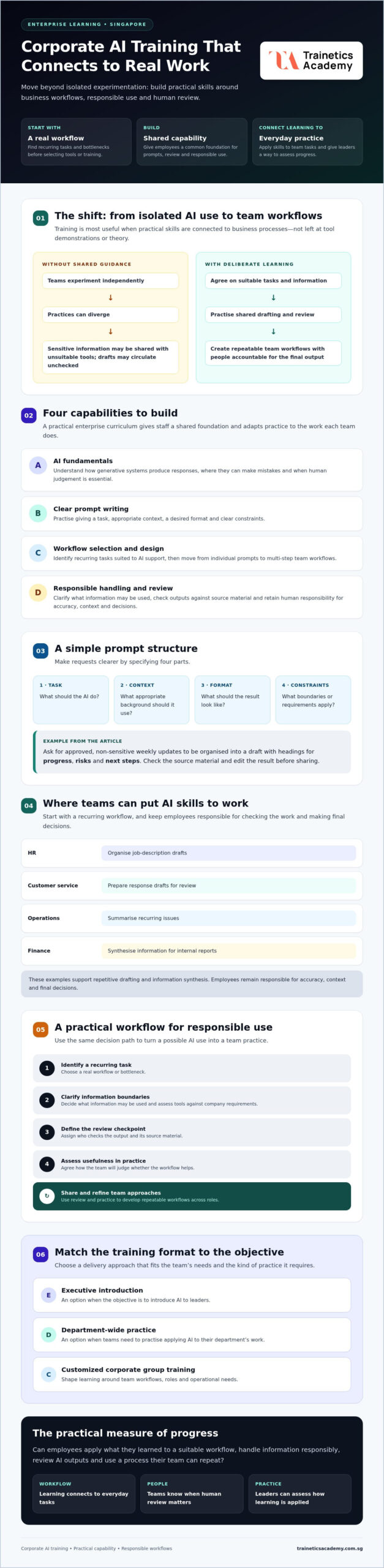
Singapore organisations are looking for ways to improve productivity while managing workforce capacity. When employees adopt AI tools independently, however, practices can diverge. One team might share sensitive material with an unsuitable tool, while another circulates drafts without checking or integrating them into existing processes. Training gives staff a shared foundation and helps organisations move from informal experimentation to deliberate skills development. This fits within a broader corporate education system, where professional learning supports an organisation’s changing needs.
For a workplace perspective on AI use, watch this video:
Bridging the Enterprise Workforce Capability Gap
Employees may worry that new technology will change their responsibilities or expose gaps in their skills. Structured learning replaces guesswork with guided practice. Staff learn what AI can do, where human review remains essential and how to apply tools to familiar tasks. That foundation helps people take part in workplace change rather than feel that it is happening around them.
Training can also help employees move from isolated prompts to repeatable team workflows. For example, a department can agree how to draft, check and refine routine documents, then share the approaches that work. Consistent use of productivity tools can reduce duplicated effort and support collaboration across roles.
Cross-Department Value Creation Beyond Technical Roles
AI capability isn’t limited to developers. HR teams can organise job-description drafts, customer service staff can prepare response drafts for review, operations teams can summarise recurring issues, and finance teams can synthesise information for internal reports. These uses can support repetitive drafting and information synthesis, while employees remain responsible for accuracy, context and final decisions.
Start with a workflow, not a tool. Identify a recurring task, clarify what information may be used, decide who checks the output and agree how the team will assess its usefulness. This gives non-technical employees a practical role in shaping workflows. To consider learning needs, explore Trainetics Academy’s artificial intelligence course.
Core Pillars of an Impactful Enterprise AI Course Curriculum
An effective enterprise AI curriculum gives staff more than a tour of generative tools. It helps them understand how these systems produce responses, where they can make mistakes and how AI can support a workflow without replacing human judgement. For corporate AI training Singapore organisations, a shared foundation helps non-technical employees use AI with purpose and care.
That foundation should connect to the needs of each role. The Skills Framework for ICT offers a Singapore reference point for considering technical and generic skills. Organisations can use relevant skills frameworks to inform priorities, then shape practice around their own tasks and tools.
Strategic Prompt Engineering and Workflow Automation
Teach employees a repeatable prompt structure: state the task, provide appropriate context, define the desired format and specify constraints. For example, a manager preparing a weekly report could ask an AI tool to organise approved, non-sensitive updates into a draft with headings for progress, risks and next steps. Staff should check the source material and edit the result before sharing it.
Build from individual prompts to multi-step workflows. Teams can practise summarising meeting notes, collating information from authorised sources and preparing recurring report drafts. Role-specific context and clear instructions can improve relevance, while review checkpoints keep the process accountable. Assess any productivity tool against company requirements for data handling, access and integration before using it.
Enterprise Data Privacy and Safe Usage Protocols
Training should turn data protection expectations into clear team rules. Employees need to know which information is confidential, what may be entered into a particular AI tool and whom to ask when a use case is unclear. They should not submit sensitive customer, employee or business information to a public tool unless the organisation has assessed and authorised that use.
Tools handle prompts and outputs differently, so teams should check how information is used rather than assume it is private or excluded from model training. Set out permitted use cases, safe examples for practice, access controls and a process for reporting concerns. Singapore’s model AI governance guidance can help organisations consider responsible use, but training should distinguish general guidance from company-specific rules.
Applied Problem-Solving and Quality Review
Use realistic exercises to develop judgement alongside tool fluency. A team might turn supplied market research into a presentation outline, then check each claim against the source material. Review the output for factual errors, missing context, biased wording, confidentiality risks and tone. AI output is a draft, not evidence.
Trainetics Academy offers AI learning for working professionals and corporate teams. Organisations can explore its Artificial Intelligence Course when considering practical learning aligned with workplace needs.
Comparing Corporate AI Training Formats for Singapore Organizations
The right format depends on what employees need to do after training. A leadership group may need a shared understanding of AI opportunities and risks, while a department may need guided practice applying AI to recurring tasks. When comparing corporate AI training in Singapore, consider the learning objective, time for practice, relevance to team workflows and the time employees can realistically commit.
In-person sessions make it easier for colleagues to compare approaches, work through examples and agree on consistent practices. Self-paced virtual modules can offer more scheduling flexibility, but require learners to make time independently and may provide fewer opportunities for immediate discussion. Neither format guarantees that learning will carry over to work. Hands-on exercises, feedback and a clear application plan help bridge that gap.
Intensive 1 Day AI Course Singapore vs. Multi-Week Programs
For leaders considering a 1 day AI course Singapore option, an intensive workshop may suit a team that needs a focused introduction, shared vocabulary and a short list of priority use cases. It can also fit a tight calendar. Treat it as a starting point, not a substitute for sustained practice when employees need to change complex workflows.
Multi-week learning gives departments time to test ideas between sessions, bring back questions and develop a practical project. To limit disruption, schedule sessions around team workloads and use familiar tasks for exercises. After each learning block, assign a small application activity and discuss what worked, so knowledge extends beyond the participants.
Private Corporate Cohorts vs. Public Class Enrollments
A private cohort lets colleagues discuss business challenges in a dedicated setting and practise with examples tailored to their roles. This can support relevant discussion, but it does not replace clear rules about what information may be used. Avoid sharing identifiable customer, employee or commercially sensitive information unless its use has been assessed and authorised.
Public classes may provide a standard learning experience with participants from different workplaces. A private group can instead help colleagues align around shared terminology, workflows and expectations. When customization is available, use fictional or sanitized examples rather than assuming company spreadsheets can be included. Trainetics Academy provides customized corporate group training. Sessions can be delivered on-site at client premises or in person at its Singapore facility.
When choosing a format, weigh these practical factors:
- Goal: Awareness, role-based practice or a team workflow project.
- Schedule: One concentrated session or learning spaced around operational demands.
- Interaction: Live collaboration and feedback, or flexible independent study.
- Application: Whether learners can practise with suitable, non-sensitive examples.
Active exercises give employees a chance to apply concepts, receive feedback and correct mistakes during learning. They are a practical choice when the objective is workplace application. Explore Trainetics Academy’s Artificial Intelligence Course when comparing learning options for your team.
How Organizations Plan and Budget for Corporate AI Upskilling
A practical budget starts with a defined workplace need, not a broad ambition to “use more AI.” For corporate AI training Singapore organisations, identify recurring tasks that take staff time, where delays occur and what skills employees need to improve those workflows. This gives leaders a basis for choosing participants, selecting a format and evaluating results.
Conducting an Internal Department AI Readiness Audit
Map a few representative workflows with the people who perform them. Look for repetitive tasks such as compiling updates, drafting routine communications or organising information. Note the time involved, common bottlenecks and necessary human checks. Assess staff familiarity with AI through a skills discussion or questionnaire, then group learning needs into beginner and intermediate levels. Set distinct objectives for operational staff, team leads and executives.
Use these findings to prioritise a pilot department. Choose a process that is frequent, measurable and suitable for practice with non-sensitive examples. Set a baseline before training, such as task turnaround time or the effort required to prepare a recurring report. Avoid promising savings in advance. Use the baseline to assess whether the change delivers value.
Leveraging Applicable Skills Development Support
Ask your finance or human resources team to check current funding conditions, eligibility and documentation requirements before setting the final budget. Funding rules can vary by course and participant, so confirm details with the relevant programme administrator rather than assuming corporate group training qualifies. The Introduction AI Course is eligible for SkillsFuture Credits and UTAP funding. Do not assume this eligibility applies to other courses or formats.
Build a business case around the operational need, intended learners, learning objectives, delivery logistics and measures of success. For a structured approach, consult how to ask for training in Singapore. Include staff time in your planning and explain how learning will connect to a specific workflow improvement, without treating projected benefits as guaranteed results.
Tracking Adoption and Workflow KPIs
Choose a small set of indicators before training. A team might track report preparation time, turnaround for routine tasks, how many staff apply an agreed workflow and how often AI-assisted drafts pass review with limited revision. Set a review schedule that suits the task, then compare results with the baseline and account for changes in workload or process. For broader enterprise oversight, workplace platforms like heartsy™ can help unify scattered learning and organizational data into predictive analytics to measure long-term capability growth.
Appoint a department champion to answer practical questions, collect feedback and reinforce safe-use expectations. Use the review to refine prompts, identify further training needs and decide whether another workflow merits attention. To explore practical AI learning for your team, review Trainetics Academy’s Artificial Intelligence Course.
Customized Corporate Group Training with Trainetics Academy
Effective corporate AI training in Singapore should reflect how people work. Trainetics Academy offers customized corporate group training for businesses, with practical learning shaped around team roles, workflows and business objectives. This gives organisations a way to build shared AI capability using examples relevant to day-to-day work.
Start by identifying who needs training, which tasks they want to improve and what employees should be able to apply afterwards. Then discuss the learning focus and delivery arrangements. Agree on safe practice materials in advance, using fictional, public or suitably sanitized examples rather than assuming confidential operational data can be shared.
Bespoke Enterprise Curriculum for Business Teams
Training can be tailored to each group’s experience and responsibilities. Employees new to AI may need foundational understanding and practice writing clear prompts for routine work. More experienced teams may focus on refining repeatable workflows, reviewing generated outputs and identifying appropriate human checkpoints. Practical exercises can draw on familiar business scenarios, document types and templates, using safe examples selected by the organisation.
This approach makes learning relevant across departments without requiring every employee to have a technical background. A team could practise structuring a routine report, drafting internal communications or summarising non-sensitive material, then review the output against its own quality standards. Explore the Artificial Intelligence Course syllabus to understand the course subject matter.
Flexible On-Site and Central CBD Delivery Options
Trainetics Academy delivers in-person learning at its facility at 10 Anson Road, Level 22, International Plaza, Singapore 079903, or on-site at client premises. Teams can consider the location, schedule and learning needs when discussing delivery arrangements.
Private group learning can help colleagues practise together and align on shared expectations, but it does not by itself protect sensitive information. The organisation should set clear data-handling rules and provide suitable training materials. Before sessions, team leads can identify relevant workflows, confirm learning priorities and prepare examples that do not expose confidential customer, employee or business details.
As a next step, outline your team’s roles, current AI experience and priority workflows, then review the Artificial Intelligence Course while considering a suitable corporate learning approach.
Build Your Team’s Next AI Capability
Effective corporate AI training Singapore organisations invest in connects practical skills to real workflows, gives employees clear guidance for responsible use and defines how progress will be assessed. A suitable format helps teams fit learning around their work and apply it afterwards.
Trainetics Academy offers customized corporate group training shaped around business workflows, with in-person learning at its facility at International Plaza or on-site at client premises. Start by identifying team priorities and tasks where AI learning could make a practical difference. Then align the learning focus and delivery approach with those needs.
Explore Trainetics Academy’s Artificial Intelligence Course and discuss a corporate learning approach for your team. Share your team’s priorities and the workflows you want to address to help guide the conversation.
Frequently Asked Questions
What makes corporate AI training different from general public AI courses in Singapore?
Corporate AI training is planned around an organisation’s workforce and learning objectives. It can bring colleagues together to build shared understanding and focus on role-relevant skills, rather than relying only on general examples. Before selecting a course, clarify whether the content can be tailored to your team, what participants will practise and how they can apply their learning at work.
Can non-technical employees benefit from an enterprise AI course Singapore?
Yes. Non-technical employees can learn practical AI skills without a programming background. AI courses for beginners can help staff give clear instructions, assess generated responses and decide when human review is needed. Ask whether course activities suit different experience levels so both first-time learners and more confident users can participate meaningfully.
How quickly can our organization organize a private corporate group training session?
Timing depends on participant availability, preferred location and the group’s learning objectives. Trainetics Academy has not specified a standard booking lead time, so confirm current arrangements directly. For an efficient discussion, prepare preferred dates, participant numbers, their familiarity with AI and the outcomes you want the training to address.
What specific workplace tools and frameworks are covered in corporate AI training?
The tools and frameworks depend on the course content and learning objectives. Trainetics Academy offers hands-on Artificial Intelligence Course training, but a fixed software list isn’t provided here. Share the applications your team uses and ask which can be covered in practice. You can also confirm whether the course addresses prompt development, responsible use, output evaluation and role-specific applications.
Is your Introduction AI Course eligible for SkillsFuture Credits and UTAP funding?
Yes. Trainetics Academy’s Introduction AI Course is eligible for SkillsFuture Credits and UTAP funding. This applies specifically to the Introduction AI Course, not automatically to other courses or corporate group arrangements. Before registering, check the relevant funding conditions and confirm that the course and intended participants meet them.
Where are Trainetics Academy corporate training sessions conducted in Singapore?
In-person sessions are conducted at Trainetics Academy’s facility at 10 Anson Road, Level 22, International Plaza, Singapore 079903, or on-site at client premises. Discuss your preferred location, participant schedules and learning format when planning the session. Confirm the final arrangements directly with the academy.
How does Trainetics Academy protect our proprietary company data during workshops?
Available information doesn’t specify a particular data-protection process for workshops, so clarify arrangements before sharing proprietary material. Ask which tools will be used, what information participants may enter and how workshop materials are handled. Your organisation can prepare fictional or suitably sanitized examples for practice. Use internal data only after your company has assessed and authorised its use for the session.
Disclaimer
AI Content Disclaimer: Some articles on this website may be generated or assisted by AI-powered content creation tools. While we strive for accuracy and relevance, readers should independently verify information before relying on it. The content is provided for informational purposes only and does not constitute professional advice.