A course with “prompt engineering” in its title may not be the one that best prepares you for work. A search for “prompt engineering course singapore” brings up options that can sound alike, even when their teaching methods and practical focus differ. The key question is whether you’ll learn adaptable prompting skills or mainly watch demonstrations using one AI tool.
Compare courses by practice, transferability and fit, not by the course label alone. Look at the exercises, delivery format and learning outcomes, then consider how they relate to tasks in your role. Before enrolling, confirm what tools and activities the course covers and what learners are expected to be able to do.
Trainetics Academy offers AI courses through physical and virtual learning, with interactive elements delivered by qualified professionals. If you’re considering its broader AI training, check the current curriculum to see whether it addresses your prompt engineering goals. Apply the same criteria to every option, then choose the course that best supports the skills you want to use at work.
Key Takeaways
- Compare a prompt engineering course singapore by how well its skills transfer to tasks you actually perform, not by its title alone.
- Check whether the learning design includes guided exercises, independent practice and useful instructor feedback, rather than demonstrations alone.
- Choose a course format that matches your goals. Foundational learning and focused practice can suit different needs.
- Before enrolling, confirm the current curriculum, tools covered, delivery mode, dates, fees and course requirements with the provider.
- If considering Trainetics Academy’s broader AI learning, verify that its current curriculum covers the prompt engineering skills you want to develop.
What to compare when choosing a prompt engineering course in Singapore
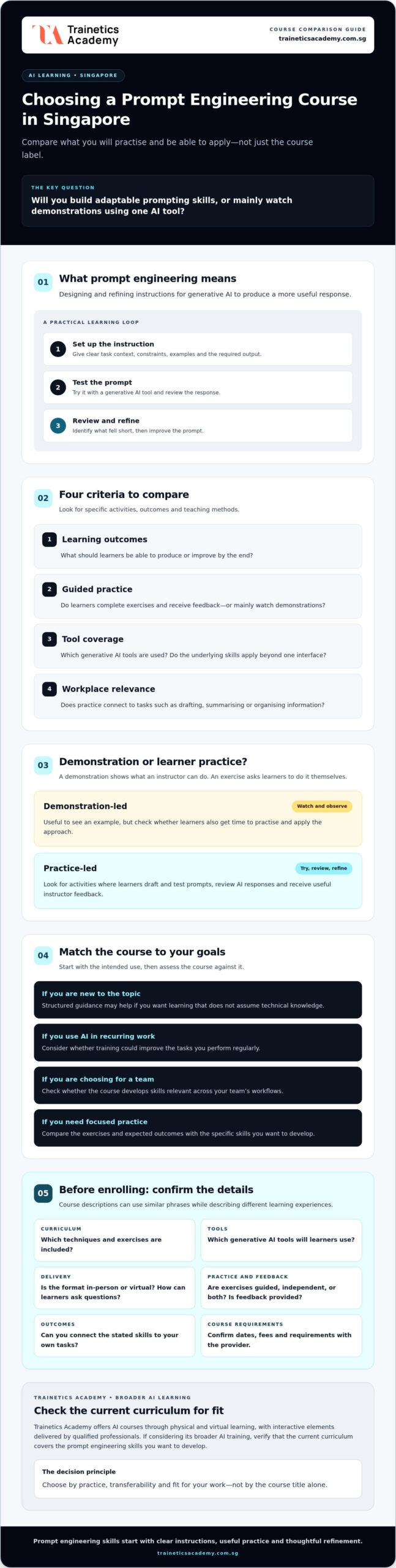
Which course will help you build skills you can apply in your own work? A search for a prompt engineering course singapore learners can use may surface programmes with similar-sounding promises, but a title alone doesn’t tell you what you’ll practise or be able to do. Compare learning outcomes, guided practice, tool coverage and workplace relevance before deciding.
Prompt engineering means designing and refining instructions for generative AI to produce a more useful response. For a concise introduction to what prompt engineering is, start with the core concept, then assess how each course teaches learners to apply it.
To build a foundation before comparing course details, watch this introduction to prompting with AI language models:
Use these four criteria to look past promotional language:
- Learning outcomes: What should learners be able to produce or improve by the end?
- Guided practice: Do learners complete exercises and receive feedback, or mainly watch demonstrations?
- Tool coverage: Which generative AI tools are used, and are the underlying skills applicable beyond one interface?
- Workplace relevance: Does practice connect to tasks such as drafting, summarising or organising information?
A course title or marketing claim doesn’t establish how deeply a topic is covered. Look for specific activities, outcomes and teaching methods, then confirm the details with the provider.
What should a prompt engineering course teach?
Look for instruction on giving an AI clear task context, setting constraints, supplying examples and specifying the required output. Useful practice also involves reviewing a response, identifying what fell short and refining the prompt. Ask providers which techniques and exercises are included. Don’t assume a technique is taught simply because the course uses the broad label “prompt engineering.”
Who benefits from prompt engineering training?
Professionals who use generative AI for recurring work can assess whether training would help improve those tasks. Beginners may benefit from structured guidance that doesn’t assume technical knowledge. Individual learners can prioritise personal capability gaps, while employers should consider whether a course develops skills relevant across their teams and workflows. Start with the intended use, then judge each course against it.
Compare Singapore prompt engineering courses by learning design
Course descriptions may use the same phrases, such as “hands-on” or “beginner-friendly,” while describing very different learning experiences. Compare what learners actually do, how they receive guidance and what they should be able to apply afterwards. This framework can help you assess a prompt engineering course singapore providers offer without treating promotional language as proof of equivalent depth.
| Criterion | What to check | Question to ask |
|---|---|---|
| Structure | How topics progress from core concepts to applied tasks | Is the learning sequence and time allocated to practice clear? |
| Practice | Whether learners draft, test and refine prompts | Are exercises guided, independent, or both? Is feedback provided? |
| Tools | Which generative AI tools learners use | Do outcomes explain principles that can transfer to other tools? |
| Delivery | In-person or virtual format and opportunities to interact | How can learners ask questions and get help during activities? |
| Outcomes | Skills or work outputs learners are expected to develop | Can you connect the stated outcomes to your own tasks? |
A demonstration shows what an instructor can do; an exercise asks learners to do it themselves. Look for activities where participants create a prompt, review the AI response, identify gaps and revise their instructions. Independent practice matters, but instructor feedback can help learners understand why an approach worked or where it needs improvement. Ask how questions are handled during exercises instead of assuming interaction from a “practical” label.
How much hands-on practice should you look for?
Check whether examples resemble tasks you expect to perform, such as drafting a structured update or summarising supplied information. Generic exercises can introduce a concept, but realistic scenarios help you judge whether you can adapt it to your work. Confirm what learners actually complete and whether instructors review their attempts or simply demonstrate a preferred answer.
Does the course teach skills beyond one AI tool?
A tool list tells you what may be used in class, not whether the learning transfers. Look for outcomes that explain how to provide context, set constraints and refine instructions across different interfaces. Singapore’s IMDA official skills framework can offer a reference point for considering relevant generative AI competencies. Ask providers how they help learners adapt as tools change.
In-person learning may suit those who value direct interaction, while virtual delivery can provide access without travelling to a classroom. Compare the actual opportunities to participate in each format. Don’t judge quality by duration, a certificate or the number of named tools alone. Weigh these details against the teaching approach and outcomes. For information about a local provider’s broader AI course, review Trainetics Academy’s AI courses and confirm whether the current curriculum matches your prompting goals.
Which prompt engineering course format fits your goals?
The right format depends on what you need to do next. Some learners need clear foundations and supported practice; others already use generative AI and want focused work on a specific task. There’s no universal sequence, so compare a prompt engineering course singapore option against your starting point, available time and intended use.
For individual learning, define a practical outcome, such as improving how you draft, summarise or organise information with AI. Employers should start with the team’s recurring tasks, then decide whether shared learning outcomes and relevant exercises are needed. Singapore’s National AI Impact Programme provides context for workplace AI upskilling, but each organisation still needs to identify its own capability goals.
| Learner situation | Format to consider | Questions to ask the provider |
|---|---|---|
| New to generative AI | Introductory foundations with supported exercises | What starting knowledge is expected? What will learners practise? |
| Already using AI for work | Focused practice tied to a specific task or skill gap | Do activities address my intended use, and is feedback provided? |
| Employer developing team capability | Learning aligned to recurring team tasks and shared outcomes | Can activities relate to our workflows? Is a group format or customisation available? |
| Need flexible access | In-person or virtual delivery, depending on interaction needs | How do learners ask questions and take part in practice? |
How should beginners compare course options?
Start with prerequisites and the clarity of the course description. Look for plain explanations of core concepts and specific details about what learners will practise, not just a promise of hands-on learning. If the expected starting knowledge isn’t stated, ask the provider directly. A suitable introductory format should make room to try tasks with guidance, rather than assume familiarity with technical terms or AI tools.
What should businesses assess for team training?
Identify recurring tasks where staff may use generative AI, then ask whether course activities can reflect those workflows. For example, a team that regularly prepares internal summaries may want practice based on that type of output. Confirm the group-training format, interaction and any customisation options before planning. Don’t assume a public course can be adapted to your organisation’s needs; verify the scope with the provider.
Choose by fit, not by label. An introductory course can suit an experienced learner addressing a new skill gap, while a focused format may work for a beginner with a clearly defined task. If considering Trainetics Academy’s AI courses, check the current curriculum and delivery details to see whether they match your goals.
Use this checklist before enrolling in a Singapore course
Before you commit to a prompt engineering course singapore providers list, compare its claims with your learning goals and work context. Course pages may not answer every practical question, so confirm current details directly with the provider. Use this checklist to assess options consistently.
- 1. Define your goal. Write down what you want to do better, such as preparing clearer drafts or extracting key points from information. A specific goal makes it easier to assess relevance.
- 2. Inspect the curriculum. Compare the published topics and learning outcomes with the tasks you want to improve. Check what the course actually teaches rather than relying on its title or a general promise of practical skills.
- 3. Assess the practice. Find out what learners will do during class. Ask whether activities involve drafting, testing and refining prompts, and whether guidance or feedback is available as learners practise.
- 4. Verify the logistics. Confirm current dates, delivery mode, fees, prerequisites and other course requirements with the provider. Check that the schedule and learning format work for you before enrolling.
- 5. Compare overall fit. Weigh the outcomes, practice, support and logistics against your goal. Don’t assume a longer course or a list of tools automatically means a better match.
What course details should you verify?
Ask for the current curriculum, prerequisites, schedule and delivery arrangements. Clarify which practical activities are included and how learners can get support or ask questions. If you’re checking payment options or eligibility for any funding, verify the details against current official course information and confirm them directly with the provider. Don’t assume the same terms apply across different courses.
How can you judge relevance to your work?
List two or three tasks where stronger prompting could help, then match each one to a course exercise or stated outcome. If you prepare summaries, for example, check whether the course lets learners practise specifying the source material, desired focus and output format. Ask whether examples can reflect your professional context, but don’t share confidential workplace information.
A provider’s general AI course may be worth investigating if its current curriculum aligns with your goals. Review Trainetics Academy’s AI course information, then confirm the prompt engineering coverage, format and enrollment details directly before deciding.
Consider Trainetics Academy for broader AI learning in Singapore
Trainetics Academy is a Singapore provider of AI courses, which may suit learners whose development goals extend beyond prompt writing alone. Its programmes are available through physical and virtual learning, with interactive elements and qualified professionals. The available information doesn’t confirm a dedicated prompt engineering course or specific prompt engineering content. If you’re comparing a prompt engineering course singapore option with broader AI learning, verify the current curriculum rather than relying on the course category or title.
When might a broader AI course be the right fit?
Broader AI learning may be relevant if you want to build capability across several applications, not just improve how you write instructions for generative AI. Start with the outcomes you need, then compare them with the course’s stated curriculum. For example, if your priority is practising prompt refinement, ask whether learners will draft, test and revise prompts. Don’t assume a dedicated module is included unless the academy confirms it.
Review the Artificial Intelligence Course information as one option for assessing broader AI learning. Compare its current course details with the criteria in this guide, including learning outcomes, practical activities and delivery format. This helps you judge whether the course supports your goals without treating a broader AI course as a substitute for prompt-specific training.
What should you ask Trainetics Academy before enrolling?
Contact the academy to confirm the details that matter to your decision. Ask whether the current AI course curriculum includes prompt engineering practice, what activities learners complete and how the course is delivered. Verify the latest curriculum, schedule, fees and course requirements directly before enrolling, as these details can change.
Be specific about your intended application. If you want to use AI for drafting, analysis or summarising, ask whether the course outcomes and exercises align with that goal. If prompt engineering practice isn’t covered, you can decide whether broader AI learning still fits your development plan or whether to compare other options.
For additional context on professional AI learning, see Trainetics Academy’s AI course guide for professionals. Then use the comparison checklist to assess the current details and contact the academy with any remaining questions. A clear fit between your goals and the confirmed curriculum is a stronger basis for choosing than a course label alone.
Choose training that moves your work forward
The strongest course choice is the one that matches your goals, not simply the one with the most familiar title. As you compare a prompt engineering course singapore option, look for clear learning outcomes, opportunities to practise and skills you can apply to your own tasks. Confirm the current curriculum, delivery mode, schedule and fees directly with the provider before enrolling.
If your goals extend beyond prompt writing, Trainetics Academy offers AI courses through physical and virtual learning. The academy describes its programmes as interactive and delivered by qualified professionals. Available information doesn’t confirm a dedicated prompt engineering course, so check whether the current curriculum covers the practice you’re seeking.
Explore Trainetics Academy’s Artificial Intelligence Course and compare its current details with your learning priorities. Contact the academy to confirm whether the curriculum and delivery format match your goals.
Frequently Asked Questions
What should I look for in a prompt engineering course in Singapore?
Look for clear learning outcomes, practical exercises and a curriculum connected to tasks you want to improve. A prompt engineering course singapore learners are comparing should explain whether you’ll draft, test and refine prompts, and whether you’ll receive guidance or feedback. Check which AI tools the course uses, but don’t treat a tool list as proof that skills will transfer. Confirm the current curriculum and delivery details with the provider.
Is a prompt engineering course suitable for beginners?
Yes, a course can suit beginners if it explains core ideas clearly, states its prerequisites and provides supported practice. Check what learners will actually do instead of relying on labels such as “beginner-friendly.” A useful starting point may include practising how to give an AI task context, constraints and output instructions, then improving the prompt after reviewing the response. If your prior knowledge is unclear, ask the provider what experience is expected.
Can prompt engineering skills be applied across different AI tools?
Many prompting principles, such as providing relevant context, setting constraints and specifying the desired response, can be useful across generative AI tools. However, each tool may have different features and instructions, so techniques may need adapting. Check whether course outcomes teach underlying principles or focus mainly on one interface. Ask how learners are taught to adjust prompts as tools change, and practise applying the same approach in tools relevant to your work.
How do I compare online and in-person prompt engineering courses?
Compare how each format supports participation and access. In-person classes may make direct discussion easier, while virtual learning can remove the need to travel to a classroom. Neither format guarantees more practice or stronger feedback. Ask how learners complete exercises, raise questions and receive instructor support in that specific course. Also confirm the delivery mode, schedule and any technical requirements before enrolling, so the format fits your routine and learning preferences.
Do I need coding experience to learn prompt engineering?
Coding experience isn’t necessarily a prerequisite for learning foundational prompt-writing skills, but requirements depend on the course and its intended outcomes. Many introductory activities focus on writing and refining instructions in natural language. If a programme includes technical material or assumes experience with particular tools, that may affect what you need to know beforehand. Review the stated prerequisites and ask the provider directly whether coding or other prior knowledge is expected.
What should I verify before enrolling in an AI course in Singapore?
Confirm the current curriculum, prerequisites, dates, delivery mode, fees and course requirements directly with the provider. Check that the stated outcomes and practical activities match tasks you want to improve. Ask how learners get support during exercises, and verify any payment or funding details against current official course information rather than assuming they apply to every course. These checks help you compare options based on substance and suitability, not just their titles.
Is Trainetics Academy’s AI course specifically a prompt engineering course?
Available information confirms that Trainetics Academy offers AI courses, but it doesn’t establish that its AI course is specifically a prompt engineering course or confirm its prompt engineering curriculum. The academy describes its programmes as interactive and delivered by qualified professionals through physical and virtual learning. Before enrolling, ask whether the current course includes prompt engineering practice, and confirm its curriculum, schedule, format and fees directly with the academy.
Disclaimer
AI Content Disclaimer: Some articles on this website may be generated or assisted by AI-powered content creation tools. While we strive for accuracy and relevance, readers should independently verify information before relying on it. The content is provided for informational purposes only and does not constitute professional advice.