Did you know that 64% of financial institutions in Singapore are now actively deploying AI in key business functions? If you’re asking how to future-proof my finance career in Singapore, you recognize that the industry has shifted from experimentation to scaled deployment. It’s understandable to feel pressured by the speed of automation or the complexity of the 2026 MAS Guidelines on Artificial Intelligence Risk Management. You likely want to maintain your professional readiness and technical mastery without committing to long-term academic programs that take years to complete.
This guide provides the strategic roadmap you need to master essential AI skills and secure your professional identity. You’ll learn how to integrate tools like ChatGPT into your financial reporting and communication workflows to drive immediate productivity. We’ll preview the specific steps to build a resume that stands out, including how to select a 1 day AI course Singapore leaders recognize. Our Introduction AI Course is eligible for SkillsFuture Credits and UTAP funding, providing an accessible pathway at 10 Anson Road, Level 22, International Plaza, Singapore 079903. You can begin your journey toward career excellence through specialized SkillsFuture AI courses today.
Key Takeaways
- Understand the evolution from manual data processing to strategic advisory as 2026 MAS guidelines redefine risk management and governance standards.
- Learn the exact steps to future-proof my finance career in Singapore by mastering prompt engineering for complex financial modeling and data synthesis.
- Evaluate the immediate ROI of a targeted AI course Singapore leaders prioritize over traditional degrees to meet the urgent hiring needs of 2026.
- Conduct a professional workflow audit to identify high-impact automation opportunities tailored to your specific financial sub-sector and technical goals.
- Build a standout resume by gaining proficiency in business writing and practical communication skills using ChatGPT through disciplined, face-to-face training.
Table of Contents
The 2026 Singapore Finance Landscape: Why AI Proficiency is Mandatory
Strategic Training at International Plaza for Finance Professionals
The 2026 Singapore Finance Landscape: Why AI Proficiency is Mandatory
Excellence in Singapore’s financial sector now demands a fusion of traditional expertise and technical mastery. As of May 2026, the Monetary Authority of Singapore (MAS) has moved into a critical implementation phase for its Guidelines on Artificial Intelligence Risk Management. This regulatory shift forces financial institutions to move beyond basic experimentation. They’re now embedding AI into core governance and oversight frameworks. If you want to future-proof my finance career in Singapore, you must evolve alongside these institutional changes. The 12-month transition period currently underway marks a definitive end to the era of purely manual financial oversight.
To better understand how these shifts impact your professional growth, watch this helpful video:
The transition from manual data entry to AI-driven strategic advisory is no longer a future projection; it’s a current reality. With 64% of Singaporean financial institutions actively deploying AI in business functions, the industry is moving at an incredible pace. This rapid adoption is creating a significant skills gap. AI capabilities have become the hardest-to-fill roles in 2026 according to recent ManpowerGroup reports. Professionals who fail to adapt risk displacement as automation takes over routine compliance and reporting tasks. Those who command these technologies will find themselves at the center of the industry’s evolution, moving from data processors to strategic architects.
The Shift from Transactional to Strategic Finance
The days of manual reconciliation and basic auditing are fading. AI now handles these repetitive tasks with precision. This shift doesn’t mean human roles are disappearing. Instead, it redefines them. There’s a rising demand for professionals who can interpret AI-generated insights to provide high-level strategic advice. Your value lies in exercising emotional intelligence and complex decision-making that machines can’t replicate. Mastering technical workflows allows you to step into these senior advisory roles with confidence. It’s about leveraging high-level scientific discourse to drive practical business outcomes for high-net-worth clients and institutional investors.
Singapore’s Position as a Global AI Financial Hub
Singapore remains a dominant force in Financial technology (FinTech). The government’s Smart Nation initiative has fundamentally reshaped finance job descriptions across the island. Local firms now prioritize candidates who possess verified AI training over those with static degrees. Whether you’re at a boutique firm or a major bank, your professional readiness is measured by your ability to leverage modern tools. Enrolling in specialized training provides the practical edge needed to stand out. This commitment to continuous improvement ensures you remain relevant as regional benchmarks continue to rise. Professionals who bridge the gap between rigorous science and dynamic coaching will secure the most prestigious opportunities in the market.
Essential AI Skills to Future-Proof Your Financial Career
To future-proof my finance career in Singapore, you must move beyond passive observation and actively cultivate a technical skillset that integrates Generative AI into daily operations. Mastery is non-negotiable. While basic AI awareness was sufficient in previous years, the 2026 landscape demands a sophisticated understanding of prompt engineering to synthesize complex datasets and automate high-level reporting. Professionals who command these tools are becoming indispensable assets to their firms.
Compliance and ethics serve as the foundation of professional readiness in 2026. As financial institutions scale their AI deployment, understanding the nuances of data privacy and algorithmic bias is essential for senior management. This focus on security is reinforced by the MAS initiative on AI, which emphasizes harnessing these technologies to combat financial crime effectively. You must be able to audit AI outputs to ensure they align with Singapore’s progressive regulatory standards and the 12-month transition period for AI risk management frameworks.
Mastering Business Writing with ChatGPT for Reports
High-stakes communication requires more than just a quick draft; it requires precision. You can improve your business writing with ChatGPT by focusing on prompt structures that prioritize clarity and regulatory alignment. In 2026, the ability to generate high-impact investment memos and executive summaries in minutes is a baseline expectation. Using Large Language Models (LLMs) effectively allows you to maintain a professional tone while drastically reducing the time spent on administrative drafting. This efficiency is critical in a sector where 43% of firms are already using AI to improve compliance and regulatory processes.
Data Synthesis and Predictive Analytics
Data is the lifeblood of finance, but its value is locked behind the ability to synthesize it quickly. Moving beyond legacy Excel workflows toward AI-assisted data visualization allows you to identify market trends and risk factors with unprecedented speed. According to the Ministry of Manpower in April 2026, 70.7% of firms adopting AI report significant improvements in worker productivity. This gain is achieved by keeping a human-in-the-loop to ensure financial accuracy. Your role as a professional is to validate these AI-driven insights, ensuring that predictive analytics serve as a robust guide for strategic decision-making rather than a black-box solution. To lead in this space, consider exploring comprehensive Artificial Intelligence courses to refine your technical mastery.
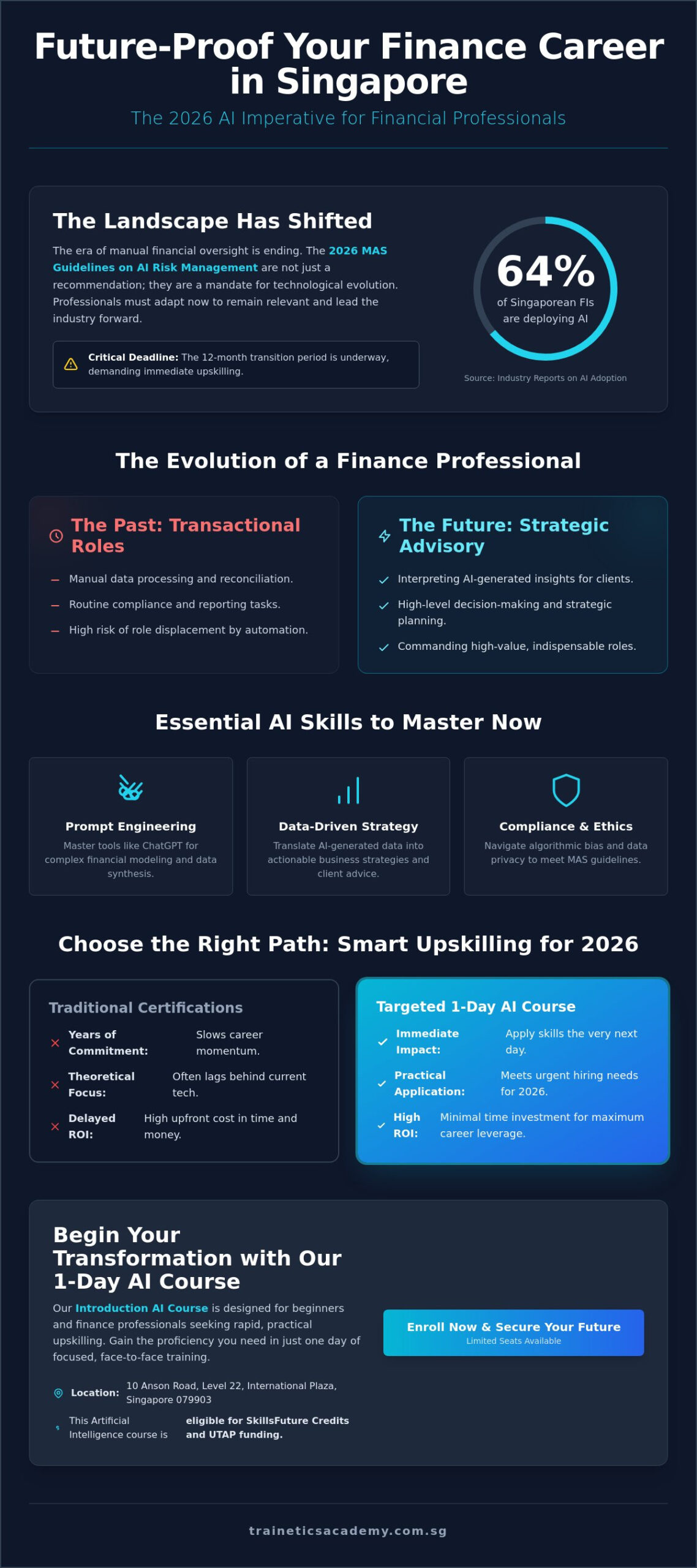
Traditional Certifications vs. Short-Term AI Upskilling
The debate between pursuing a two-year Master’s degree and engaging in targeted short-term training has reached a turning point in 2026. While traditional academic qualifications provide a foundational understanding of economics, they often struggle to keep pace with the exponential growth of generative technologies. Hiring managers in Singapore’s top-tier banks now prioritize micro-credentials that demonstrate immediate technical agility. They look for professionals who don’t just understand theory but can execute automated workflows today. This shift aligns with the official AI strategy for Singapore’s financial sector, which emphasizes the urgent need for a workforce that is proficient in AI adoption to maintain our regional competitiveness.
Sustainable success requires a hybrid approach. You shouldn’t abandon professional exams like the CFA or CPA; instead, you must bridge the gap between those foundational principles and modern automation. To future-proof my finance career in Singapore, the goal is to become an AI-augmented professional. This means you possess the disciplined rigor of a traditional financier while wielding the efficiency of a data scientist. Mastery is mandatory. You don’t need a new degree to remain relevant, but you do need to prove you can apply AI to existing financial frameworks to drive measurable results.
The Rise of the 1-Day AI Course in Singapore
Time is the most valuable asset for finance directors and senior managers. Spending months in a lecture hall isn’t feasible when market dynamics shift weekly. This reality has fueled the demand for intensive sessions that bypass theoretical fluff to focus on specific financial use cases, such as automated risk assessment or prompt-driven data synthesis. If you are looking for an 1 day AI course Singapore leaders can trust, our curriculum ensures you receive high-level instruction in a professional environment. These sessions prioritize immediate application, allowing you to return to your firm with a technical edge that generic online tutorials cannot provide.
Building a Hybrid Professional Identity
Positioning yourself as a Finance Technologist on LinkedIn signals to recruiters that you understand both the "why" of accounting and the "how" of automation. You aren’t just a user of software; you’re a designer of automated workflow solutions. This identity is built through continuous, incremental learning. Short-term Artificial Intelligence courses allow you to stack skills over time, creating a resume that reflects both stability and innovation. This methodical approach ensures your career remains resilient regardless of how quickly the underlying technology evolves. It’s about maintaining professional readiness through constant, technical refinement and a commitment to international benchmarks.
Step-by-Step: How to Future-Proof Your Finance Career
Success in 2026 is reserved for those who treat their professional development with the same rigor they apply to a complex financial audit. To future-proof my finance career in Singapore, you must move beyond passive awareness and adopt a proactive implementation strategy. This involves a methodical transition from legacy manual processes to AI-augmented workflows that prioritize high-level decision-making. You aren’t just changing your tools; you’re re-engineering your professional identity for an era where technical agility is the primary benchmark of excellence.
Auditing Your Current Skills and Workflows
Begin by conducting a comprehensive audit of your weekly output to identify automation candidates. Focus on data-heavy tasks like monthly variance analysis or regulatory reporting preparation that consume significant mental bandwidth. By mapping these functions against the 2026 industry requirements, you can pinpoint specific skill gaps that require immediate attention. Consulting with mentors about the tech stacks used in top-tier firms provides a realistic view of the capabilities currently in demand. This gap analysis ensures your upskilling efforts are targeted and efficient, allowing you to focus on high-impact technical mastery rather than general digital literacy. Understanding where your current capabilities sit relative to regional benchmarks is the first step toward professional resilience.
Leveraging Government Support for Training
Singapore’s robust educational framework offers significant resources to facilitate this career pivot. You should actively explore how to utilize your SkillsFuture credits for specialized training that aligns with your specific sub-sector. Whether you’re in wealth management or corporate accounting, staying ahead of the curve requires a commitment to continuous learning. For a comprehensive overview of how to maximize these resources, refer to our ultimate guide to SkillsFuture courses. This proactive approach to development ensures you remain at the forefront of the industry’s technological shift while maintaining the high standards expected in a global financial hub. Secure your professional future by enrolling in an Artificial Intelligence Course today.
Strategic Training at International Plaza for Finance Professionals
To truly future-proof my finance career in Singapore, you must choose a training environment that mirrors the intensity of the industry itself. While digital tutorials offer basic knowledge, they often lack the technical rigor and immediate feedback required for high-stakes financial operations. Training at International Plaza allows you to step out of your office and into a space dedicated to professional evolution. You’re surrounded by the very institutions currently implementing the 2026 MAS guidelines, creating a unique linguistic and professional space where the science of AI meets the practicalities of high-level finance.
Face-to-face instruction provides a level of accountability that online platforms can’t replicate. You’ll engage in disciplined, hands-on sessions that focus on technical mastery rather than theoretical overviews. This environment also serves as a gateway to an exclusive professional community. Networking with other finance leaders in the heart of the CBD allows you to share insights on automated workflow design and regulatory compliance. These connections are vital as the industry moves toward scaled AI deployment, ensuring you remain at the forefront of local innovation.
Introduction AI Course for Finance Beginners
Our Introduction AI Course is designed specifically for non-technical professionals who need to command modern tools without a coding background. The curriculum is structured and logical, moving from foundational concepts to advanced applications in financial reporting. During these sessions at our CBD training centre, you’ll work through real-world scenarios that mirror the challenges of 2026. This methodical approach ensures you leave with a professional identity defined by technical readiness and precision. You’ll learn to use AI not just as a tool, but as a strategic partner in your decision-making process.
Achieving Immediate ROI in Your Current Role
Securing a prestigious career requires you to demonstrate immediate value to your firm. Once you’ve mastered these new capabilities, you can present a data-driven case for promotion to your current employer. Documenting how you’ve reduced reporting time or improved the accuracy of risk assessments provides concrete evidence of your growth. This strategic move is the final step to future-proof my finance career in Singapore as the industry moves toward total AI integration.
Beyond professional advancement, these skills restore your work-life balance by eliminating low-value, repetitive tasks. You’ll gain the freedom to focus on high-level strategic advisory, which remains the key differentiator for human professionals. It’s time to transition from a traditional role to a visionary leader. Take the next step toward excellence by enrolling in our Artificial Intelligence Course today. This investment in your technical mastery is the most secure path to remaining indispensable in Singapore’s evolving financial sector.
Secure Your Professional Identity in the AI Era
The transition toward an AI-augmented financial sector is a call to leadership for those willing to embrace technical rigor. We have explored how the 2026 landscape demands a departure from legacy workflows in favor of strategic advisory and prompt-driven synthesis. By integrating these emerging technologies into your professional repertoire, you don’t just survive the shift; you define it. To future-proof my finance career in Singapore, the commitment must move beyond awareness into a disciplined pursuit of technical mastery and professional readiness.
Your journey toward excellence is supported by a community of industry leaders dedicated to raising professional benchmarks. You now have the roadmap to audit your current output and leverage specialized training to command modern tools with precision. This evolution ensures that your professional identity remains synonymous with innovation and reliability. Take the definitive step toward securing your role in this dynamic market by focusing on the practical application of generative tools in high-stakes environments.
Enroll in our Artificial Intelligence Course today to lead the future of finance! Your transformation into a visionary professional is the most secure investment you can make for the years ahead. Embrace the challenge of continuous improvement and step into your new role with confidence.
Frequently Asked Questions
What are the best AI courses for finance professionals in Singapore?
The most effective programs focus on immediate technical application within the 2026 regulatory framework. You should look for an AI course Singapore leaders recognize for its emphasis on prompt engineering and automated financial synthesis. These courses allow you to bridge the gap between traditional accounting principles and modern generative workflows. Professional readiness is best achieved through hands-on sessions that prioritize real-world financial use cases over theoretical lecturing.
Is the Introduction AI Course eligible for SkillsFuture Credits?
Yes, our foundational AI training is eligible for these local subsidies. Professionals can utilize their available credits to offset the cost of high-impact technical education. This support ensures that upskilling remains accessible for those committed to excellence in the financial sector. By leveraging these resources, you can attain specialized skills that enhance your professional identity without significant financial friction.
How can I use SkillsFuture Credits to future-proof my career in 2026?
You can apply your credits toward specialized SkillsFuture AI courses that target high-demand capabilities like automated risk assessment. Start by identifying the technical gaps in your current workflow and selecting a program that offers immediate ROI. This proactive approach allows you to stack micro-credentials that signal your agility to top-tier hiring managers. It’s a strategic way to future-proof my finance career in Singapore while maintaining a competitive edge in a rapidly evolving market.
Will AI replace financial analysts in Singapore by 2030?
AI is set to augment the role of analysts rather than replace them entirely. While automation handles data synthesis and basic reconciliation, human experts are vital for ethical oversight and complex strategic advisory. The industry is shifting toward a model where the analyst acts as a "human-in-the-loop" to validate AI outputs. Professionals who command these tools will lead the next generation of financial services, while those who resist may find their routine tasks increasingly automated.
Where is Trainetics Academy located for in-person training?
Trainetics Academy is situated at International Plaza, Level 22, conveniently located in the heart of the Tanjong Pagar financial district. This central location provides easy access for busy professionals working in the CBD. Training in person allows for disciplined instruction and networking with other ambitious leaders. Our facility is designed to provide a professional environment where you can focus on technical mastery alongside other dedicated practitioners.
Can I use UTAP funding for AI-related training programs?
Yes, UTAP funding is available for eligible NTUC members who seek to enhance their technical capabilities. This subsidy works in tandem with other local frameworks to support the continuous professional development of the workforce. Using these resources allows you to pursue Artificial Intelligence courses that raise your professional benchmarks. It’s a practical way to ensure you’re prepared for the high standards of the 2026 financial market.
What specific AI tools should a finance professional learn first?
You should prioritize learning ChatGPT for business writing and data synthesis tools that integrate with existing financial software. Mastery of prompt engineering is critical for generating accurate investment memos and executive summaries. Additionally, focus on AI-assisted visualization tools that help identify market trends faster than traditional methods. These foundational technologies provide the immediate productivity gains required to stand out in senior management circles.
How long does it take to learn basic AI implementation for business?
You can master basic implementation through a 1 day AI course Singapore professionals use for intensive, focused upskilling. These short-term sessions are designed to bypass theoretical fluff and deliver actionable technical workflows. You’ll learn to automate repetitive tasks and improve your professional communication within a single day. This efficient learning path is ideal for beginners who need to see immediate results in their current roles.
Disclaimer
AI Content Disclaimer: Some articles on this website may be generated or assisted by AI-powered content creation tools. While we strive for accuracy and relevance, readers should independently verify information before relying on it. The content is provided for informational purposes only and does not constitute professional advice.