Did you know that 92% of generative AI projects are now delivering a positive ROI, with an average return of 49%? Despite these compelling 2026 statistics, many professionals still face executive skepticism and deep-seated concerns regarding data security. Learning how to get management buy-in for AI projects is the critical bridge between recognizing this potential and securing the resources required for actual implementation. You likely understand that AI represents a fundamental organizational transformation, yet finding the budget for technical upskilling remains a significant hurdle in many boardrooms today.
This guide promises to equip you with a strategic framework to align leadership with AI innovation and secure necessary resources for your team. We provide a clear roadmap for executive presentations that address the fear of implementation failure while highlighting the tangible business value of agentic AI. You’ll learn how to present a compelling case for professional development that emphasizes technical mastery and organizational readiness. By the end of this article, you’ll have the tools to transform skepticism into support and lead your organization toward a prestigious, tech-driven future.
Key Takeaways
- Recognize why shifting from experimentation to execution is the 2026 professional standard for leadership and competitive excellence.
- Explore how a Learning AI Course serves as a catalyst to bridge the executive knowledge gap and unify technical potential with strategic vision.
- Master the precise framework for how to get management buy-in for AI projects by auditing workflows and presenting scientifically grounded ROI models.
- Overcome skepticism regarding data security and implementation risks through a disciplined governance framework that ensures professional readiness.
- Secure the necessary resources for team upskilling by identifying how the Introduction AI Course is eligible for SkillsFuture Credits and UTAP funding.
The 2026 Business Imperative: Why Management Needs an AI Strategy Now
In 2026, the transition from AI experimentation to full-scale execution has reached a critical tipping point. Businesses no longer view these technologies as experimental pilots; instead, they are the foundation of modern competitive advantage. The stakes are high. Leaders who fail to integrate agentic AI into their core operations risk falling behind as competitors double their AI spending to roughly 1.7% of total revenue. Success in this environment requires understanding the technology adoption curve, as moving from early adoption to the early majority requires a disciplined, top-down strategy. Innovation cannot wait.
Securing resources for these initiatives is often the biggest hurdle for department heads. Learning how to get management buy-in for AI projects is no longer just a technical pitch, it is a strategic necessity to ensure your organization remains resilient. Efficiency is the goal. When you master how to get management buy-in for AI projects, you move from being a technical implementer to a visionary leader. Companies that prioritize Artificial Intelligence courses for their staff are already seeing an average ROI of 171%, proving that the cost of inaction far outweighs the investment in professional upskilling.
To better understand the nuances of strategic alignment, watch this helpful video on securing leadership support:
The Competitive Landscape in Singapore
Singaporean industries are setting international benchmarks by integrating AI directly into complex supply chains and retail operations. With 65% of enterprises increasing their AI budgets in 2026, the local market is moving beyond simple generative text to implement multimodal models that reason and plan autonomously. Professional readiness in this market starts with a commitment from the top. Executives must recognize that staying competitive requires a workforce trained through a high-caliber Artificial Intelligence Course. This isn’t just about software; it’s about raising professional benchmarks across the entire local ecosystem to meet the demands of a global economy.
Defining the Value Proposition
A successful pitch focuses on long-term change management rather than short-term software fixes. You must translate technical capabilities into immediate business process efficiencies that resonate with the C-suite. Management needs to see AI as a gateway to a prestigious and efficient professional identity for the company. By focusing on targeted investments, you can demonstrate how a Learning AI Course transforms staff performance. When you explain how the Introduction AI Course is eligible for SkillsFuture Credits and UTAP, the financial barrier lowers. This makes the path to enrolling in SkillsFuture AI courses both scientifically grounded and practically achievable for any forward-thinking firm in Singapore.
Closing the Executive Knowledge Gap: The Power of a Learning AI Course
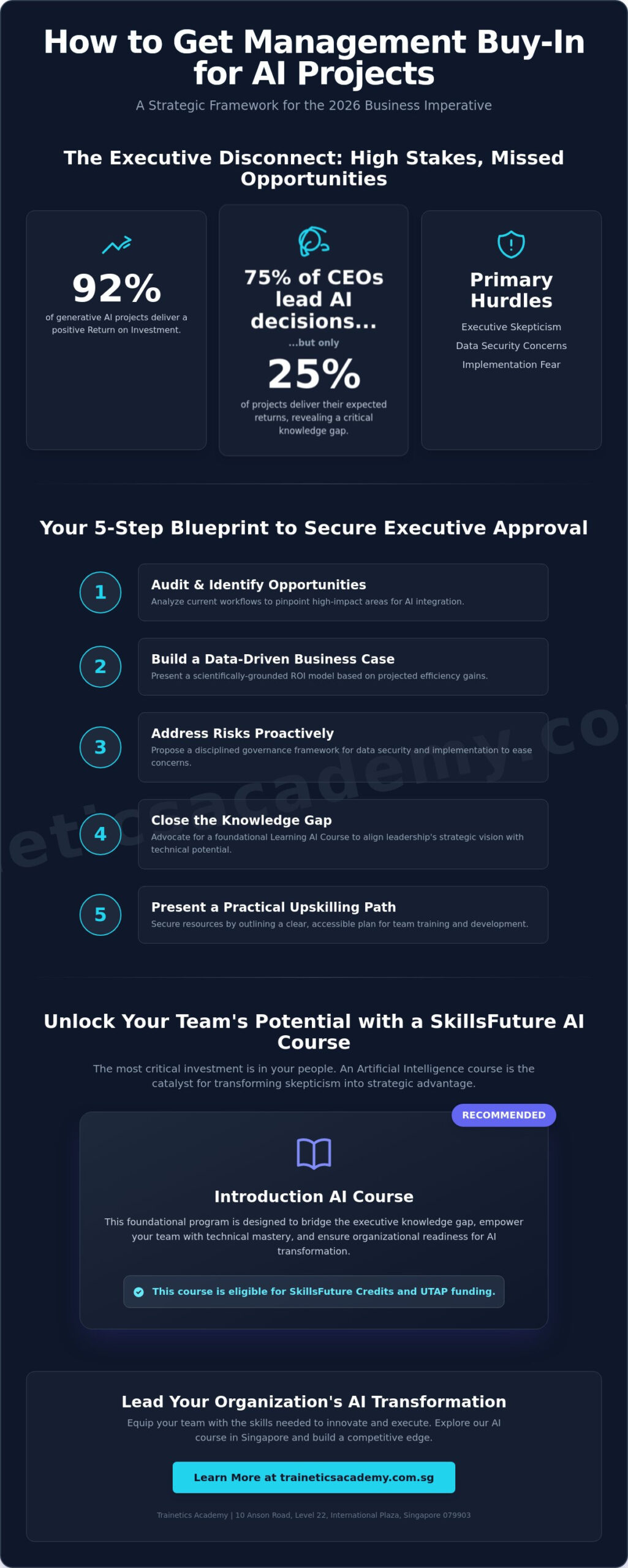
The Executive Knowledge Gap is a silent barrier to organizational excellence. While 75% of CEOs now identify as the main decision-makers for AI initiatives, an IBM study reveals that only 25% of AI projects actually deliver their expected returns. This disconnect occurs when leadership lacks the foundational literacy to separate market noise from strategic value. Mastering how to get management buy-in for AI projects requires a commitment to education that transforms skeptics into visionary mentors who understand the science behind the software.
A high-caliber Learning AI Course provides the academic rigor necessary to ground corporate decisions in reality. When executives understand the underlying mechanics of machine learning and data foundations, they gain the confidence to scale projects from pilot to production. This foundational knowledge ensures that every dollar allocated is backed by a logical framework for success rather than speculative trends. By investing in leadership education first, organizations create a top-down culture of professional readiness that is essential for 2026’s competitive landscape.
Demystifying AI for Leadership
Leadership education should prioritize high-level concepts such as data foundations and automation frameworks over low-level technical jargon. We can view AI algorithms through the lens of biological adaptation; much like human movement biology is refined through feedback loops, AI models rely on structured data processing to achieve precision. Using these analogies helps management see AI as a disciplined tool for optimization. By focusing on professional development outcomes, you shift the executive conversation from technical complexity to measurable organizational growth.
The Benefits of Professional Upskilling
Structured learning paths offer a methodical flow that builds trust within the C-suite. When leadership engages with an Artificial Intelligence course, they signal a commitment to international benchmarks and professional mastery. This disciplined approach eliminates the knowledge gap and fosters an environment where innovation is scientifically validated. To begin this transformation, exploring the curriculum of our Introduction AI Course is a strategic first step toward total professional readiness. Aligning your team with these standards ensures that your pursuit of excellence is supported by the highest level of technical expertise.
Building the Strategic Blueprint: 5 Steps to Secure Executive Approval
Securing a mandate for innovation requires more than a visionary idea; it demands a disciplined, step-by-step methodology. To master how to get management buy-in for AI projects, you must present a blueprint that mirrors the precision of a scientific study. This approach transforms a vague request for funding into a structured investment proposal that leadership can trust. By following a logical path, you demonstrate professional readiness and a commitment to international benchmarks of excellence. Each step in this process is designed to reduce friction and align technical potential with corporate ambition.
- Audit Existing Workflows: Begin by identifying high-impact opportunities where bottlenecks currently hinder performance. Much like identifying a biomechanical inefficiency in human movement, this audit pinpoints exactly where automation and intelligent reasoning can drive the most value.
- Align with 2026 Vision: Ensure your objectives directly support the company’s strategic goals for the year. Whether the focus is on scaling operations or enhancing market share, AI must be the engine of your strategy, not just a passenger.
- Develop a Resource Plan: A comprehensive plan accounts for both the technology stack and human capital. This includes a clear strategy for upskilling staff through a specialized AI Course to ensure technical mastery and operational security.
- Establish Clear KPIs: Define what success looks like for your initial pilot. Use metrics like the 171% average ROI seen in successful enterprise deployments to set realistic yet ambitious benchmarks for your team.
- Present a Phased Roadmap: Structure your proposal to prioritize low-risk, high-reward wins. This methodical flow builds confidence and allows for adjustments before larger capital outlays are required.
Aligning with Corporate Goals
Success depends on your ability to connect AI initiatives to the bottom line. Accelerate revenue growth, reduce operational costs, and elevate customer satisfaction. These active goals resonate with executives who value tangible outcomes over theoretical potential. When you frame your project as a vehicle for productivity tools for business integration, you position the technology as a practical solution to existing challenges. This alignment ensures that your pursuit of excellence is viewed as a core business requirement rather than an optional expense. It transforms the conversation from “what we could do” to “what we must achieve.”
The Importance of a Phased Approach
Starting with smaller, targeted implementations reduces executive anxiety and builds organizational ambition. This “micro-buy-in” strategy allows you to prove the concept without demanding massive upfront resources. It creates a learning path that mirrors a structured curriculum, where foundational success paves the way for advanced applications. By securing approval for staff to attend an Artificial Intelligence course early in the process, you build a team capable of managing complex transitions with precision. This disciplined progression ensures that your organization masters how to get management buy-in for AI projects through repeated, validated successes that build long-term trust.
Addressing Risk and ROI: How to Overcome Common Management Objections
Addressing the “buckets of cash” syndrome is the first step in neutralizing executive hesitation. Many leaders fear that AI is a bottomless pit of expenditure without a clear exit strategy. To counter this, your proposal must focus on targeted, high-impact investments rather than broad, unfocused spending. Mastering how to get management buy-in for AI projects involves presenting a budget that is surgically precise. You aren’t asking for a blank check; you’re requesting a strategic allocation for a specific, scientifically validated outcome. This level of financial discipline mirrors the high standards expected in any prestigious professional environment.
Scientific validation is your strongest ally when establishing credibility with a skeptical C-suite. While an IBM study suggests that only 25% of initiatives deliver expected returns, Omdia reports that 92% of generative AI projects are now delivering a positive ROI, with an average return of 49%. These aren’t just numbers; they’re evidence of a maturing technology landscape. By providing these metrics, you provide the security management needs to move forward. You’re showing that your pursuit of excellence is grounded in documented success across the global market. Leveraging these international benchmarks allows you to overcome the “expertise” objection by aligning your project with proven regional educational frameworks.
Mitigating Implementation Risks
Real-world failures, such as the widely reported issues with Air Canada’s chatbot or McDonald’s automated drive-thrus, underscore the necessity of a “human-in-the-loop” strategy. These cases demonstrate that AI cannot operate in a vacuum. Your proposal must put data protection principles at the heart of the implementation. Professional training ensures that your team can identify algorithmic bias or misidentified data before it impacts the bottom line. This methodical approach to risk management transforms a potential liability into a secure, scalable asset that reinforces your company’s professional reputation.
Proving Training ROI
Justifying the cost of an AI course Singapore requires a focus on long-term operational precision and professional readiness. Higher staff retention and reduced turnover are direct results of investing in your team’s professional identity. You can use specific training ROI metrics to show how upskilling leads to measurable efficiency gains in daily workflows. Proving the value of education is a cornerstone of how to get management buy-in for AI projects, as it addresses the human capital side of the equation. To ensure your team reaches this benchmark, remember that the Introduction AI Course is eligible for SkillsFuture Credits and UTAP. This makes the transition into a tech-empowered future both financially viable and strategically sound.
Equip your team with the skills to lead by enrolling them in our Artificial Intelligence course today.
Operationalising Success: Upskilling with a SkillsFuture AI Course in Singapore
Operationalising success requires a transition from strategic theory to technical mastery. The Introduction AI Course at Trainetics Academy serves as the definitive starting point for teams ready to move beyond basic pilots. This curriculum is designed to foster professional readiness and ensure that your staff can manage the complexities of agentic AI with precision. When you finally master how to get management buy-in for AI projects, your next responsibility is to select a training partner that mirrors your organization’s commitment to excellence. A structured approach to education ensures that the pursuit of innovation remains scientifically grounded and practically achievable.
Utilising SkillsFuture AI courses is a strategic method to lower the barrier for corporate entry while maintaining high professional standards. By integrating these resources into your human capital plan, you demonstrate a disciplined approach to budget management that resonates with the C-suite. High-standard training isn’t just an expense; it’s a gateway to a prestigious professional identity for your entire workforce. We invite you to visit our centre at 10 Anson Road, Level 22, International Plaza, Singapore 079903, to discuss how we can tailor our curriculum to your specific business process efficiencies.
Choosing the Right Training Partner
Selecting a partner involves more than just checking boxes; it requires finding a mentor that values academic rigor. Our highly qualified professionals deliver an interactive, high-standard curriculum that aligns with international benchmarks and local excellence. This ensures your team receives the highest standard of education available in the Singaporean market. Whether through physical or virtual learning platforms, our structured learning paths provide a predictable pace for corporate growth. This diversity in delivery is essential for a workforce that values both flexibility and technical mastery.
Your Next Steps for Buy-In
Your final step in mastering how to get management buy-in for AI projects is drafting a proposal that speaks the language of leadership. Use the sophisticated terminology of professional development to frame upskilling as a long-term asset that drives operational precision. We recommend scheduling a briefing session at our International Plaza location to review our technical frameworks. This allows executives to see the depth of our curriculum and understand how technical mastery leads to visionary leadership. Committing to this professional identity ensures that your organization doesn’t just adopt AI, but excels through it by raising professional benchmarks across every department.
Lead the Future of Organizational Innovation
Mastering how to get management buy-in for AI projects is the definitive step toward establishing your professional identity as a visionary leader. You have explored the strategic necessity of aligning technical potential with 2026 corporate goals and learned to mitigate risks through structured education. By presenting a scientifically validated roadmap, you transform executive skepticism into a commitment to excellence. This disciplined approach ensures that your pursuit of innovation remains secure, scalable, and rooted in the highest standards of professional readiness.
Our curriculum is designed by industry-leading professionals at our center located at 10 Anson Road, Level 22, International Plaza, Singapore 079903. We provide the academic rigor necessary for your team to achieve technical mastery in the modern market. Take the next step in your professional development and empower your team with our Introduction AI Course, which is eligible for SkillsFuture Credit and UTAP today. Secure your organization’s competitive edge by raising professional benchmarks and leading with precision. Your journey toward technical excellence starts here.
Frequently Asked Questions
How do I justify the initial cost of an AI course for my team?
Focus on long-term efficiency and talent retention. High-quality training reduces implementation errors that lead to costly failures. By positioning the course as a strategic investment in human capital, you align with international benchmarks for professional readiness. The Introduction AI Course is eligible for SkillsFuture Credits and UTAP, which significantly minimizes the financial impact on the company’s bottom line while elevating team performance.
What are the most common reasons management rejects AI project proposals?
Rejection often stems from executive skepticism regarding hype and fears of data breaches. Management frequently worries about “buckets of cash” syndrome, where spending lacks a clear exit strategy or measurable ROI. To overcome these hurdles, you must demonstrate a disciplined roadmap that aligns with the company’s 2026 strategic vision. Mastering how to get management buy-in for AI projects involves addressing these specific anxieties with scientifically grounded evidence and phased implementation plans.
How can I demonstrate a clear ROI for AI implementation in the first year?
Use specific industry benchmarks to project tangible gains in operational precision within the first twelve months. Research indicates that the average payback period for enterprise AI deployments is between 6 to 18 months. Track KPIs such as time saved on manual data processing or increased customer response accuracy. These metrics provide the empirical proof leadership requires to validate the success of the initial pilot phase and justify further resource allocation.
Are there any government subsidies eligible for AI training in Singapore?
Singaporean citizens can receive up to 70% subsidies for the Introduction AI Course. For those aged 40 and over, this support increases to 90% under mid-career enhancement frameworks. Permanent Residents and LTVP+ holders are also eligible for up to 70% subsidies on this specific curriculum. These initiatives lower the entry barrier for corporations looking to upskill their workforce through structured SkillsFuture AI courses that meet local excellence standards.
What is the best way to handle executive fears about AI and job displacement?
Frame AI as a tool for human augmentation rather than replacement. Highlight that agentic AI systems require human oversight to manage complex reasoning and ethical planning. By fostering a culture of psychological safety, you bridge the trust gap between leadership and employees. Emphasize that professional upskilling allows staff to transition into higher-value roles, ensuring the organization maintains its prestigious professional identity while embracing the future of technology.
How do I choose the right AI project to start with for my first proposal?
Identify a low-risk, high-reward workflow that currently suffers from significant bottlenecks. Audit your existing processes to find repetitive tasks where intelligent automation can yield immediate process efficiencies. Starting with a manageable pilot project reduces executive anxiety and allows for “micro-buy-in.” This methodical approach builds the necessary ambition for larger-scale transformations once the initial concept is scientifically validated and proves its strategic value to the firm.
How can I address data security concerns when proposing AI tools?
Propose a governance framework that aligns with Singapore’s Model AI Governance Framework for Agentic AI. Explicitly detail how data protection principles are integrated into the project lifecycle, from data ingestion to model output. Demonstrating a “human-in-the-loop” strategy is a crucial part of how to get management buy-in for AI projects, as it reassures management that the pursuit of innovation won’t compromise the company’s data integrity or professional reputation.
Why is professional upskilling more effective than hiring external AI consultants?
Internal upskilling builds a sustainable professional identity and keeps proprietary knowledge within the organization. While consultants provide temporary fixes, a team trained through an Artificial Intelligence course develops deep, contextual expertise that evolves with the business. This approach fosters long-term operational precision and ensures that your staff can lead future innovations autonomously. Investing in your own people is a hallmark of visionary leadership and a commitment to raising professional benchmarks.
Disclaimer
AI Content Disclaimer: Some articles on this website may be generated or assisted by AI-powered content creation tools. While we strive for accuracy and relevance, readers should independently verify information before relying on it. The content is provided for informational purposes only and does not constitute professional advice.