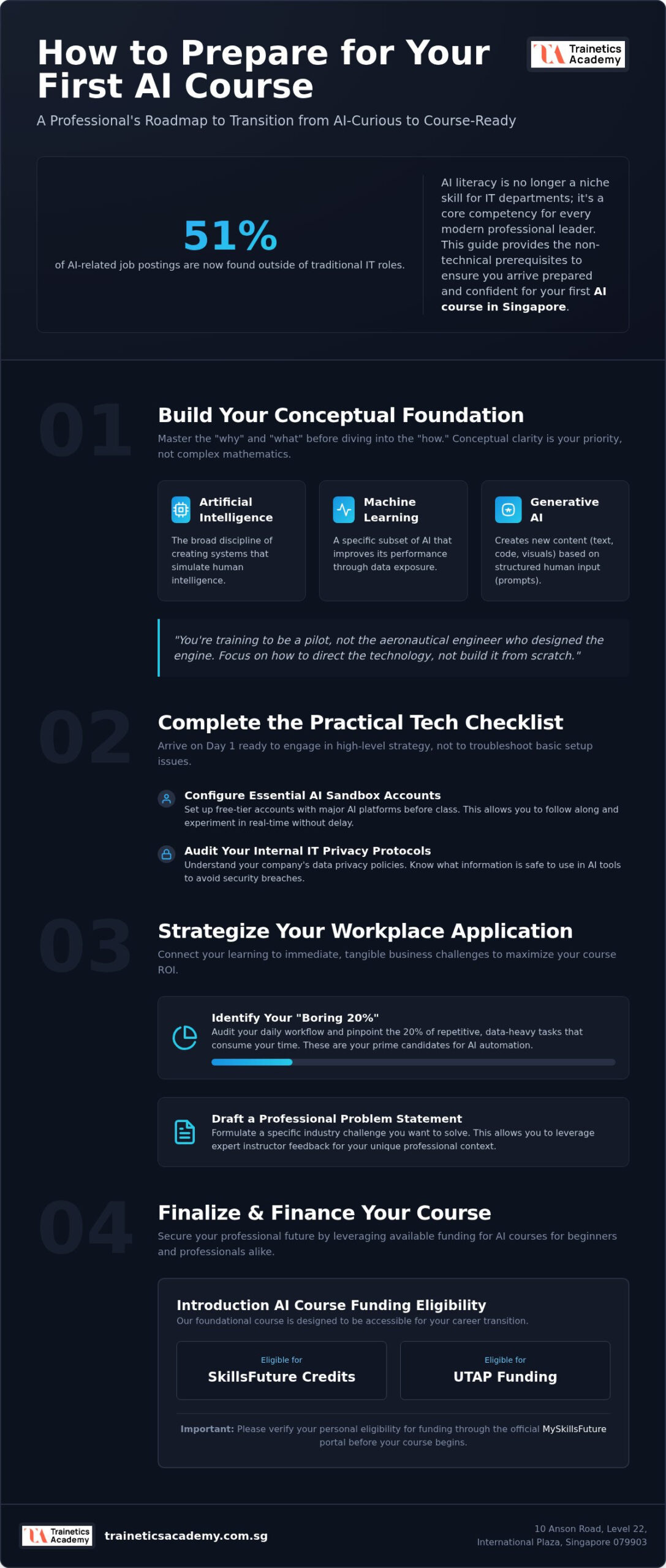
More than 51% of AI-related job postings are now found outside of traditional IT roles, signaling a shift where AI literacy has become a core competency for every professional leader. You likely feel the pressure to keep pace but worry that you lack the technical background or that you’re simply too late to start. It’s a common anxiety when considering an AI course Singapore professionals are now prioritizing, yet your existing industry expertise is your greatest advantage. This roadmap details exactly how to prepare for my first ai course so you can transition from being AI-curious to truly course-ready.
We’ll provide a clear list of non-technical prerequisites and the specific tools to sign up for before you visit us at 10 Anson Road, Level 22, International Plaza, Singapore 079903. Our Introduction AI Course is eligible for SkillsFuture Credits and UTAP funding, ensuring this career transition is both accessible and scientifically grounded. Follow this professional checklist to build the confidence required for high-level class discussions and to set a new benchmark for your career growth in 2026.
Key Takeaways
- Establish a clear conceptual framework by understanding the distinctions between Machine Learning and Generative AI before your first session.
- Learn exactly how to prepare for my first ai course by configuring essential AI sandbox accounts and auditing your internal IT privacy protocols.
- Identify your “Boring 20%”—those repetitive, data-heavy tasks—to create a practical roadmap for immediate workplace application.
- Draft a professional problem statement that allows you to leverage expert instructor feedback for your specific industry challenges.
- Secure your professional future by verifying your eligibility for SkillsFuture Credits and UTAP funding through the official MySkillsFuture portal.
Why Preparation is Key for Your First AI Course Singapore
Entering a classroom in 2026 feels different than it did just a few years ago. AI literacy is no longer a luxury reserved for tech enthusiasts; it is a foundational requirement across Singapore’s professional landscape. Success in an AI Course depends heavily on the steps you take before the first lecture begins. We define AI Readiness as a strategic blend of basic conceptual awareness and clearly defined professional goals. By establishing these early, you eliminate the Day 1 Anxiety that often plagues non-technical professionals. If you feel overwhelmed by the technical jargon, reviewing a comprehensive overview of AI can provide the necessary context to ground your learning. This proactive approach is a core part of our AI Course Singapore: Complete Professional Guide for 2026.
Preparation transforms you from a passive observer into an active participant. When you understand the baseline terminology, you can engage in high-level discussions that move beyond basic definitions. You’ll find that knowing how to prepare for my first ai course allows you to focus on strategic application rather than simple comprehension. This shift in focus is what separates a standard student from a future industry leader.
Overcoming the Non-Technical Barrier
Many professionals hesitate to enroll because they believe AI mastery requires a computer science degree. This is a common misconception that hinders career growth. In our curriculum, we focus on the distinction between a Developer who builds the architecture and a Power User who leverages that architecture for professional excellence. You don’t need to write code to master these tools. Learning how to prepare for my first ai course involves adopting a growth mindset that values precision and efficiency over technical complexity. Focus on how these systems can amplify your current expertise rather than replacing it. Professional excellence in 2026 is about how you direct the technology, not how you build it from scratch. If you’re weighing your educational options, understanding what to choose instead of a university degree for AI can help you identify the fastest path to career-ready skills.
Maximizing Your SkillsFuture Investment
Time is your most valuable asset. Arriving prepared ensures you don’t spend the first half of a session catching up on basic definitions. This is especially critical when attending a 1 day AI course Singapore, where every hour is packed with intensive learning. Our Introduction AI Course is eligible for SkillsFuture Credit and UTAP, making it a secure investment in your professional identity. By doing the legwork now, you ensure that every dollar of government support translates into tangible workplace results. Proper preparation means you’ll spend your class time engaging in high-level strategy rather than struggling with basic login screens or interface navigation.
Building the Foundation: Concepts to Learn Before Day 1
Forget the myth that you need a background in linear algebra or advanced calculus to succeed in 2026. Professional AI readiness starts with conceptual clarity rather than mathematical complexity. If you’re currently asking how to prepare for my first ai course, your priority should be understanding the logic of the systems you’ll be directing. You’re training to be a pilot, not the aeronautical engineer who designed the engine. Learning how to prepare for my first ai course requires you to focus on the “why” and “what” before diving into the “how.”
Start by distinguishing between Artificial Intelligence, Machine Learning, and Generative AI. While AI is the broad discipline of creating intelligent systems, Machine Learning is the specific subset that improves through data exposure. Generative AI is the most relevant for modern professionals; it’s a force multiplier for business productivity that automates the creation of high-quality text, code, and visual assets based on structured human input. You should also grasp the “black box” concept. This means acknowledging that while we can’t always see every internal processing step, we can master the relationship between specific inputs and their resulting outputs. For a broader perspective on how these technologies are managed at a strategic level, explore U.S. government AI resources to see real-world policy applications.
Demystifying AI Terminology
Mastering a few key prerequisites ensures you aren’t lost when the instructor begins the technical deep dive. First, view “Prompts” as your new interface for work. They are the precise instructions that guide the model’s output. Second, recognize the difference between “Training Data”—the information the model was built on—and “Real-time Output,” which is the response generated specifically for you. Finally, you must understand “Hallucinations.” These occur when a Large Language Model (LLM) generates factually incorrect information that sounds perfectly plausible. In a professional setting, identifying these errors is your primary responsibility as a human-in-the-loop.
AI Courses for Beginners: Setting Realistic Expectations
A professional AI Course focuses on immediate workflow integration and prompt engineering rather than building neural networks from scratch. You’ll learn to analyze data and automate repetitive tasks, which is the core goal of the AI Course for Absolute Beginners Singapore: Your 2026 Roadmap to Mastery. By establishing this baseline literacy, you’ll enter the classroom ready to tackle advanced applications. If you’re ready to elevate your professional identity, consider how these tools can transform your daily output starting today.
The Practical Tech Checklist: Accounts and Privacy Setup
Transitioning from theoretical knowledge to practical application requires a structured setup. If you’re wondering how to prepare for my first ai course, the answer lies in your digital toolkit. Classroom time is for mastery, not for troubleshooting login screens or verifying email addresses. By completing your administrative setup in advance, you ensure every minute of your training is dedicated to high-level skill acquisition. Professionalism starts with readiness.
Essential Tools for Your AI Journey
Step 1 is securing access to “The Big Three” platforms. You should create accounts for ChatGPT, Google Gemini, and Claude immediately. Each model has a distinct personality and logic; comparing these interfaces before your first session allows you to identify which tool aligns best with your specific professional workflow. For those enrolled in a 1 day AI course Singapore, this step is non-negotiable. It saves approximately 30 minutes of classroom time that would otherwise be lost to basic setup. Having your mobile apps ready also facilitates cross-platform learning, allowing you to test prompts on the go.
Data Privacy and PDPA Readiness
Professional excellence requires a strict adherence to ethical and legal standards. Before you begin, you must check your corporate IT policy regarding third-party AI tool usage. Many organizations have specific protocols for data handling that you must respect. In Singapore, this is governed by the Personal Data Protection Act (PDPA). As an industry leader based at 10 Anson Road, Level 22, International Plaza, Singapore 079903, we emphasize the “Golden Rule” of AI usage: never input Personally Identifiable Information (PII) into public models.
By December 31, 2026, organizations in Singapore must cease using NRIC numbers for authentication. This shift reflects a broader national commitment to data security that you must carry into your AI Course. Reviewing these principles ensures you can experiment freely without compromising sensitive company data or violating regional compliance standards. Preparation isn’t just about technical skill; it’s about professional responsibility and maintaining the highest standards of data integrity.
Strategic Preparation: Audit Your Daily Workflow
Strategic excellence in AI implementation begins with a thorough audit of your current professional output. If you’re researching how to prepare for my first ai course, you must move beyond general curiosity and identify specific inefficiencies. We call this “The Boring 20%.” These are the repetitive, text-heavy, or data-dull tasks that consume your cognitive energy without adding high-level strategic value. Documenting a precise problem statement before you arrive ensures that your instructor can provide tailored feedback that applies directly to your role. To start identifying these bottlenecks, view our comprehensive curriculum and match your needs to our modules.
Gather samples of anonymized unstructured data; this includes emails, meeting transcripts, or lengthy reports. These real-world assets become the raw material for your hands-on exercises. Additionally, prepare three targeted questions regarding AI’s impact on your specific industry, such as legal, marketing, or logistics. This level of preparation positions you as a visionary leader within your department. It ensures you aren’t just learning a tool; you’re developing a professional identity rooted in innovation and precision.
Identifying Automation Opportunities
Examine your workflow through a lens of algorithmic logic. If a task can be described with step-by-step instructions, it’s a prime candidate for AI automation. Tasks involving the summarization of dense documents or the generation of creative first drafts are also high-priority areas. By identifying these opportunities early, you set a professional benchmark for innovation that your peers will struggle to match. You don’t need to be a developer to spot these patterns; you just need to be a disciplined observer of your own professional habits.
Bringing Real-World Scenarios to Class
Students who bring specific use cases to an AI Course Singapore typically learn three times faster than those who rely on generic examples. You’ll be ready to present a “Prompt Challenge” to your trainer, forcing the technology to solve a real-world bottleneck. This active engagement is what transforms a standard certification into a career-defining moment. Whether you’re attending a 1 day AI course Singapore or a longer program, the depth of your preparation determines the height of your professional readiness. Don’t just attend; lead the discussion by solving problems that matter to your organization.
Final Steps: Selecting and Financing Your AI Course
Selecting the right program is the culmination of your strategic preparation. As you finalize how to prepare for my first ai course, prioritize a curriculum that directly addresses the “Boring 20%” you identified in your workflow audit. A high-caliber AI Course should offer more than just theoretical knowledge; it must provide a laboratory for solving your specific professional bottlenecks. Review the syllabus to ensure it emphasizes prompt engineering and workflow automation over obsolete coding exercises. Secure your enrollment early, as popular 1 day AI course Singapore sessions often reach capacity weeks in advance due to their intensive nature.
By handling the administrative and financial logistics now, you clear the path for deep, uninterrupted learning when you finally enter the classroom. This alignment between your audited needs and the course content is the most reliable predictor of your long-term return on investment. This methodical approach ensures your focus remains entirely on mastering the technology rather than navigating last-minute paperwork.
Navigating SkillsFuture AI Courses
Professional readiness is a commitment to excellence that requires clear financial planning. Check your available credit balance via the MySkillsFuture portal before registering to ensure you have a clear understanding of your available subsidies. Navigating the portal early allows you to manage your claims efficiently, ensuring that your journey toward professional mastery is as seamless as possible. We focus on delivering professional-grade training that respects both your time and your commitment to raising industry benchmarks.
Post-Course Planning
Your journey doesn’t end when the session concludes. To truly master the concepts covered, you must plan for the “Day 2” application. Prepare a “Learning Log” to track every instance where you apply a new prompting technique or automation workflow in your office. We also recommend identifying a “Learning Buddy” within your organization. Practicing your prompts with a peer creates a feedback loop that accelerates your mastery and helps establish new professional benchmarks within your team. For a broader look at the landscape, consult our SkillsFuture AI Courses in Singapore: 2026 Overview to stay ahead of regional trends and opportunities.
Master Your Professional Evolution
Success in the digital economy of 2026 isn’t determined by your technical background; it’s defined by your strategic readiness. By auditing your daily workflow for automation opportunities and establishing a robust conceptual foundation, you’ve completed the most critical steps of your journey. You now possess a clear roadmap on how to prepare for my first ai course, from securing your digital sandbox to aligning your learning goals with international professional benchmarks. This proactive mindset ensures you’ll extract maximum value from every interactive session delivered by our qualified industry professionals.
Your transition into an AI-empowered leader is a pursuit of excellence that begins with a single, decisive action. We provide the gateway to this prestigious career shift through a curriculum designed for immediate workplace impact. Enroll in our SkillsFuture-eligible Introduction AI Course today and join a community dedicated to raising professional standards. With eligibility for UTAP funding and a focus on practical mastery, your path to becoming a visionary mentor in your field is clear. Step into the classroom with confidence and start leading the innovation your industry demands.
Frequently Asked Questions
Do I need to know how to code before taking an AI course for beginners?
No coding experience is required to excel in a modern AI Course Singapore. These programs are specifically engineered for professionals who need to master the art of prompt engineering and strategic oversight. Your role is to act as a high-level director of the technology, using natural language to achieve complex business outcomes rather than writing raw syntax or managing backend architecture.
Is there any math I should refresh before my first AI course?
You don’t need to revisit calculus or statistics to become a proficient user of generative tools. While the underlying models are built on complex mathematics, your professional success depends on logical reasoning and the ability to structure clear, sequential instructions. Focus on developing a disciplined approach to problem-solving, as this is the primary skill used when interacting with Large Language Models.
Which AI tools should I install on my computer before the class starts?
Most professional AI tools are accessed directly through your web browser, so local installations are rarely necessary. Before your first session, verify that your hardware can run modern browsers and that you have stable internet access. While we previously identified the essential accounts to create, ensure your browser is updated to the latest version to support the advanced features found in modern AI interfaces.
Can I use SkillsFuture Credit for a 1 day AI course Singapore?
Many professional development programs in this field are supported by national funding frameworks. You should log in to the official MySkillsFuture portal to verify the current subsidy status of your selected program. This ensures you can leverage available credits to offset costs, making the acquisition of high-demand skills a more accessible investment in your professional identity.
How much time should I set aside for pre-course preparation?
We recommend a minimum of two to four hours for a thorough pre-course audit. This time should be split between identifying repetitive tasks in your current workflow and setting up your experimental sandbox accounts. Arriving with these administrative tasks completed allows you to engage immediately with the interactive curriculum, ensuring you don’t waste valuable classroom time on basic configurations.
What should I do if my company doesn’t have an AI policy yet?
Focus on using anonymized data and public information for all your classroom exercises. If an internal policy is still being drafted, you can take a leadership role by demonstrating the safe, ethical application of these tools. Adhering to strict data integrity standards during your training provides a professional benchmark that your organization can use when establishing its own formal AI governance protocols.
Is a 1-day AI course enough to become proficient?
A 1 day AI course Singapore is designed to provide an intensive, high-impact foundation that triggers immediate productivity gains. While true mastery is a continuous pursuit, this focused format equips you with the essential prompt engineering techniques and automation strategies needed to transform your daily output. It acts as a catalyst for ongoing professional development and iterative learning in the workplace.
What is the difference between an AI course and a data science course?
An AI Course focuses on the practical application of generative models to create content and automate business processes. Data science, conversely, is a broader field centered on statistical analysis and predictive modeling using historical datasets. While data science professionals build the models, an AI course empowers you to use those models as a force multiplier for your existing professional expertise. For professionals questioning whether a traditional academic path is the right choice, exploring what to choose instead of a university degree for AI offers a compelling case for targeted, industry-focused training programs.
Disclaimer
AI Content Disclaimer: Some articles on this website may be generated or assisted by AI-powered content creation tools. While we strive for accuracy and relevance, readers should independently verify information before relying on it. The content is provided for informational purposes only and does not constitute professional advice.