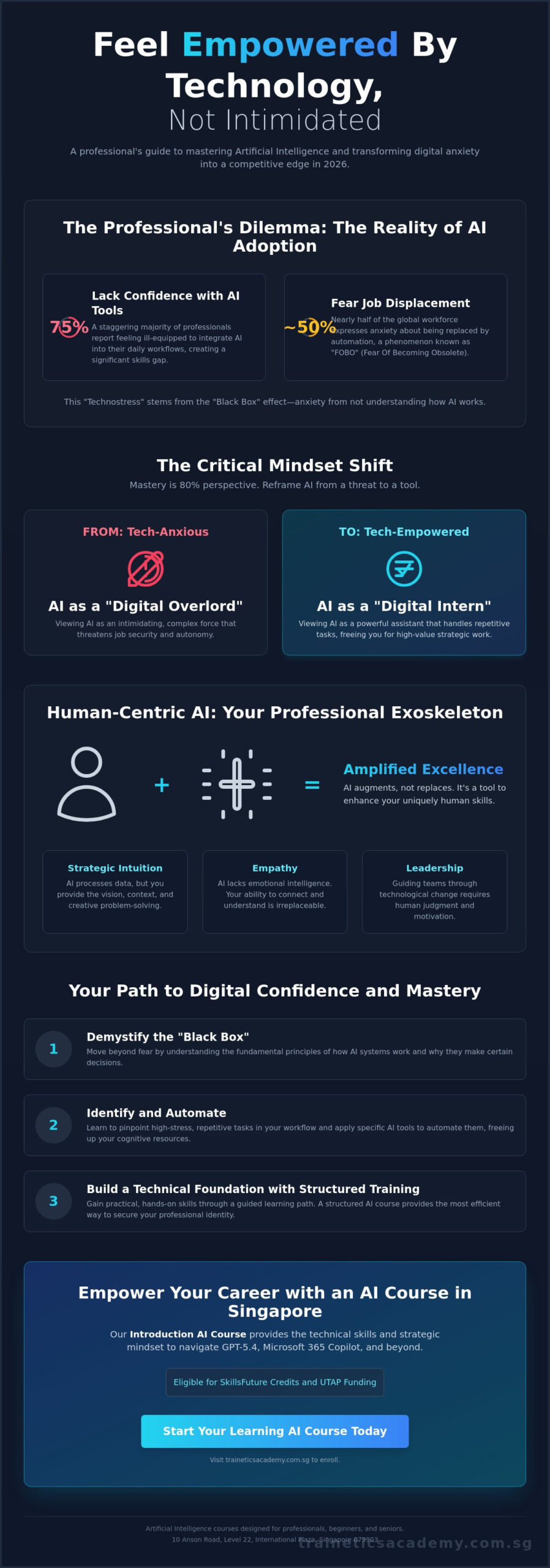
While the global AI usage rate climbed to nearly 18% in early 2026, a staggering 75% of professionals still report a lack of confidence when integrating these tools into their daily workflows. It’s natural to feel a sense of “FOBO,” or the fear of becoming obsolete, especially when nearly half of the global workforce expresses anxiety about job displacement. However, the secret to career longevity isn’t found in resisting change, but in mastering the mechanics of innovation. You can feel empowered by technology not intimidated when you view Artificial Intelligence as a sophisticated partner rather than a replacement for your human expertise.
Coding is no longer a prerequisite for technical mastery in the age of generative intelligence. The primary skill required in 2026 is “prompting,” which is the ability to communicate strategic intent clearly to a machine. By focusing on your existing industry expertise and learning how to direct AI co-pilots, you can achieve professional readiness without ever writing a single line of complex programming code. This shift is also evident in education, where platforms like Noeta help students master complex STEM subjects through adaptive, AI-driven tutoring.
Human biology is wired to seek predictability and routine. Rapid innovation disrupts these mental models, leading to a state of constant physiological alert. Information overload follows as we try to track every update from GPT-5.4 to the latest Microsoft Copilot agents. This volume of data paralyzes decision-making rather than aiding it. This state of constant vigilance drains cognitive resources that should be spent on creative problem-solving. Feeling intimidated is a natural response to a fundamental paradigm shift in how we work. It’s the brain’s way of signaling that the environment has changed faster than our current skill sets can manage. To ensure that the next generation does not face these same hurdles, NextWaveSTEM delivers comprehensive K-12 STEM solutions that foster digital confidence and technical literacy from an early age.
This guide serves as your professional blueprint to transform digital anxiety into a decisive competitive edge. You’ll learn how to navigate the latest updates from GPT-5.4 to Microsoft 365 Copilot with the precision of an industry leader. We’ll examine the strategic “why” behind these systems and provide a clear path toward technical mastery. To begin your journey, our Introduction AI Course is eligible for SkillsFuture Credits and UTAP funding, ensuring that elite-level professional development remains accessible as you redefine your career identity in this automated era.
Key Takeaways
- Demystify the “Black Box” effect by understanding the psychological roots of technostress and adopting a growth-oriented professional mindset.
- Reframe Artificial Intelligence as a human-centric exoskeleton designed to amplify your unique strategic intuition, empathy, and leadership.
- Discover how to feel empowered by technology not intimidated by applying a systematic five-step framework to build your digital confidence.
- Learn to identify and automate high-stress repetitive tasks using specific AI tools tailored to your professional objectives.
- Understand how structured training, such as an Introduction AI Course, provides the technical foundation needed to secure your professional identity in 2026.
Understanding Technostress: Why We Feel Intimidated by Innovation
Technostress is the psychological struggle to adapt to new computer technologies in a healthy or productive manner. It’s a common condition in 2026. Many professionals feel overwhelmed by the sheer pace of AI integration and the pressure to remain relevant. You can feel empowered by technology not intimidated by recognizing that this stress isn’t a personal failing, but a biological reaction to rapid change.
The “Black Box” effect creates deep-seated anxiety because it obscures the logic behind automated outcomes. When you don’t understand how a system arrives at a conclusion, you lose your sense of agency. In Singapore’s high-stakes economy, this fear is compounded by a dual pressure: the FOMO of missing the next wave and the visceral dread of being replaced by an algorithm. For seniors and mid-career professionals, this technostress can feel like an insurmountable barrier. It’s a psychological weight that prevents you from seeing the tool as a professional asset.
To better understand how these psychological triggers affect our professional confidence, watch this helpful video:
The Root of Digital Anxiety
Human biology is wired to seek predictability and routine. Rapid innovation disrupts these mental models, leading to a state of constant physiological alert. Information overload follows as we try to track every update from GPT-5.4 to the latest Microsoft Copilot agents. This volume of data paralyzes decision-making rather than aiding it. This state of constant vigilance drains cognitive resources that should be spent on creative problem-solving. Feeling intimidated is a natural response to a fundamental paradigm shift in how we work. It’s the brain’s way of signaling that the environment has changed faster than our current skill sets can manage.
The Hidden Cost of Hesitation
Avoiding new tools creates a widening digital divide that can plateau even the most successful careers. The psychological toll of stagnation is often heavier than the effort required for upskilling. Taking the first step toward mastery provides immediate relief by replacing uncertainty with direct action. Leadership in 2026 requires more than technical proficiency; it demands a willingness to guide teams through these transitions with confidence. Enrolling in a structured AI Course is the most efficient way to bridge this gap. Mastering these tools allows you to feel empowered by technology not intimidated by the future of your professional field.
The Mindset Shift: Moving from Tech-Anxious to Tech-Empowered
Transitioning from a state of intimidation to one of mastery requires more than just technical tutorials; it demands a fundamental shift in your professional philosophy. While many professionals operate with a fixed mindset, believing their technical aptitude is static, the most successful leaders in 2026 embrace a growth mindset. They understand that proficiency is a result of disciplined practice rather than innate talent. You can feel empowered by technology not intimidated by recognizing that technical mastery is actually 20% about the specific tools and 80% about your perspective.
Instead of viewing AI as a “Digital Overlord” that threatens your autonomy, reframe it as a high-performance “Digital Intern.” This intern is incredibly fast at processing data but lacks your strategic intuition, empathy, and ethical judgment. Research on Overcoming Computer Anxiety suggests that this type of cognitive reframing is the primary catalyst for technical adoption. When technology serves your specific intent, it moves from being a source of stress to being a vehicle for excellence.
Cultivating a Beginner’s Mindset
Paradoxically, experts often face the steepest learning curves because they fear losing their status as an authority. True mastery begins by letting go of the need to be right and embracing the courage to ask “dumb” questions. These foundational inquiries are what bridge the gap between confusion and clarity. This mindset is especially critical for seniors and mid-career professionals who are integrating new tools into decades of established experience. Our AI Course Singapore: The Ultimate 2026 Guide for Professionals explores how this humility accelerates the learning path. By approaching new systems with a beginner’s curiosity, you dismantle the psychological barriers that lead to technostress.
Breaking Down Complex Systems
Artificial Intelligence is not magic; it’s advanced pattern recognition based on mathematical logic. You can deconstruct any new tool into three core functions: Input, Process, and Output. When you understand what you’re feeding the system and why it produces a specific result, the intimidation factor disappears. Artificial Intelligence is a logic-based collaborator that processes data to support human strategic decisions. By mastering these foundational mechanics, you ensure that you feel empowered by technology not intimidated by the complexity of modern systems. For those ready to formalize this mindset shift, our Artificial Intelligence Course offers the structured rigor needed for professional readiness.
Human-Centric AI: Why Technology Augments Excellence
The transition from a manual to an automated professional environment isn’t about replacement; it’s about enhancement. While algorithms excel at processing vast datasets, they cannot replicate human intuition, empathy, or strategic ethical judgment. We view the integration of these systems through the “Exoskeleton” metaphor. Just as a physical exoskeleton allows an individual to lift heavier loads with less strain, AI allows you to process more information and execute complex tasks with surgical precision. By adopting a Human-Centered Approach to the AI Revolution, you ensure that technology remains a servant to your professional vision. This perspective allows you to feel empowered by technology not intimidated by its capabilities.
Professional benchmarks are evolving rapidly. In previous decades, the value of a professional was measured by what they “knew.” Today, value is increasingly defined by how effectively one can “prompt” and direct machine intelligence. High-quality Artificial Intelligence courses emphasize this synergy. They teach you to lead the machine rather than follow it. This shift in focus from raw knowledge to strategic orchestration is the hallmark of a modern industry leader. It’s about combining your decades of industry experience with the raw processing power of modern tools.
AI as Your Digital Co-Pilot
Your co-pilot is designed to handle the cognitive drudge work that often leads to burnout. Tasks such as repetitive data entry, complex scheduling, and preliminary market research can now be delegated to specialized agents. This delegation frees up your creative energy for higher-level strategic planning. This efficiency is particularly visible when Mastering Professional Communication with AI. By using tools to refine business writing and streamline correspondence, you reclaim hours of your day. This practical application helps you feel empowered by technology not intimidated by growing workloads.
Preserving the Human Touch
As AI handles tasks associated with high IQ, such as logic and pattern recognition, the relative value of Emotional Intelligence (EQ) skyrockets. Empathy and ethical oversight are uniquely human traits that machines cannot simulate with genuine depth. Maintaining a “human-in-the-loop” strategy is essential for accurate and ethical implementation. You can use AI to research and prepare for high-stakes human interactions, but the final delivery remains your professional signature. This balanced approach ensures your professional identity remains rooted in human excellence while being supported by technological power.
5 Steps to Building Digital Confidence and Mastery
Transitioning from a growth mindset to actual technical proficiency requires a structured, tactical approach. You can feel empowered by technology not intimidated by breaking your learning journey into manageable, high-impact phases. This systematic progression ensures you build competence without the typical fatigue associated with rapid innovation. By focusing on practical application rather than abstract theory, you’ll see immediate returns on your time investment.
- Step 1: Identify one repetitive task that causes you stress. Start with “low-hanging fruit” like summarizing meeting transcripts, sorting complex spreadsheets, or drafting standard client emails.
- Step 2: Research a specific AI tool designed to solve that problem. Focus on one solution at a time, such as a specialized agent for Excel or a dedicated business writing assistant, to avoid cognitive overload.
- Step 3: Enroll in a structured Introduction AI Course to learn the fundamentals. Formal education provides the academic rigor and logical pathing that scattered self-study often lacks.
- Step 4: Practice in a “sandbox” environment where mistakes have no consequences. Use personal projects or simulated data to test new prompts before applying them to high-stakes professional work.
- Step 5: Join a community of learners to share prompts and troubleshoot together. Collective intelligence accelerates individual mastery and provides a support network for technical challenges.
Choosing the Right AI Course
Self-study often fails because it lacks a cohesive learning path and professional accountability. When you select a program, prioritize those led by industry experts who offer interactive, real-world applications. The Introduction AI Course at Trainetics Academy is specifically designed to bridge the gap between technical complexity and professional readiness. It’s useful to know that this specific course is eligible for SkillsFuture Credits and UTAP funding, making it a strategic choice for mid-career professionals and seniors. You can take the first step toward excellence by enrolling in our foundational course today.
Practicing in a Safe Environment
Developing a “sandbox” mindset is crucial for overcoming the fear of making errors. Use models like ChatGPT or Claude as a dedicated learning tutor to explain complex concepts in plain language. Implement the “Learn-Apply-Reflect” cycle: absorb a new technique, apply it to a test case, and reflect on the output’s accuracy. This iterative process builds the muscle memory needed to feel empowered by technology not intimidated by new updates. For a deeper dive into financial support for your training, see our guide on Maximizing Your SkillsFuture Credit for AI Courses.
Empower Your Career with Trainetics Academy’s AI Training
Trainetics Academy serves as a disciplined gateway to your new professional identity. We apply the same academic rigor and pursuit of excellence found in elite sports science to the rapidly evolving field of tech innovation. Our facility at 10 Anson Road, Level 22, International Plaza, Singapore 079903, is designed to reassure students that they are receiving the highest standard of education available. You’ll feel empowered by technology not intimidated when you train within a framework that values precision, hard work, and continuous improvement. This approach transforms a complex Artificial Intelligence course into a manageable, professional benchmark for success.
The Introduction AI Course Curriculum
Our curriculum is a structured learning path that mirrors the systematic nature of our high-level fitness education programs. We move logically from foundational concepts to advanced applications, ensuring a steady, predictable pace that builds trust. The modules include:
- Scientific Prompt Engineering: Mastering the language of machine collaboration.
- Workflow Automation: Identifying and optimizing repetitive professional tasks.
- Data Integration: Using AI to enhance strategic decision-making and reporting.
- Ethical Oversight: Implementing “human-in-the-loop” protocols for accuracy.
This AI course Singapore professionals choose focuses on hands-on learning delivered by industry experts. Every session is designed to satisfy the intellectual curiosity of advanced practitioners while remaining accessible to beginners and seniors. We prioritize professional readiness, ensuring you leave with the skills to improve daily productivity immediately. Our instructors act as visionary mentors, guiding you through the technical mastery required for a prestigious career in 2026.
Joining the Trainetics Community
The value of your certification extends far beyond the final module. Becoming part of the Trainetics community offers long-term security in an increasingly automated job market. You’ll network with other visionary leaders who are committed to raising professional benchmarks across various sectors in Singapore. We provide ongoing support that ensures technical mastery remains a permanent part of your professional toolkit. Our mentors demystify complex jargon, making the transition into a tech-empowered role feel scientifically grounded and secure. This community acts as a rallying cry for excellence, pushing every member to achieve their highest potential. Register for the Introduction AI Course today to secure your professional future.
Secure Your Professional Legacy in the Age of AI
The transition toward an automated economy isn’t a threat to your expertise; it’s a call to raise your professional benchmarks. By reframing machine intelligence as a digital exoskeleton, you reclaim your agency and focus on the high-level strategic decisions that define true leadership. Technical mastery is always the result of disciplined, structured learning rather than accidental discovery. You can feel empowered by technology not intimidated when you have a clear roadmap and a supportive community of experts guiding your progress.
Our interactive curriculum is delivered by qualified professionals who understand the unique needs of Singapore’s workforce. To support your growth, our Introduction AI Course is eligible for SkillsFuture Credit and UTAP subsidies. We invite you to join us at our facility at 10 Anson Road, International Plaza, to begin this transformation. Taking this step ensures your skills remain relevant and your professional identity remains secure in a competitive market.
Enroll in our Introduction AI Course and take control of your digital future today. The path to technical excellence is open to those who have the vision to lead.
Frequently Asked Questions
Is an AI course hard to learn for someone with no technical background?
Modern training programs are designed to be accessible to professionals regardless of their initial technical proficiency. You don’t need a background in computer science to master these systems because the focus has shifted from writing code to directing logic through natural language. Our curriculum prioritizes the strategic application of tools, ensuring that every student can build a professional identity rooted in technical mastery without feeling overwhelmed by complexity.
How can seniors benefit from an Introduction AI Course in Singapore?
Seniors benefit by reclaiming their time and maintaining a competitive edge in a rapidly evolving job market. Learning to automate repetitive digital tasks reduces the cognitive load often associated with modern work environments. A skillsfuture ai course for seniors provides a disciplined path to digital literacy, ensuring that experienced professionals can feel empowered by technology not intimidated by the pace of innovation in 2026.
Is the Introduction AI Course at Trainetics Academy eligible for SkillsFuture Credit?
Yes, our Introduction AI Course is eligible for SkillsFuture Credits and UTAP funding for all qualifying individuals. We believe that elite professional development should be accessible to those committed to raising their professional benchmarks. This financial support allows mid-career professionals and seniors to invest in high-level training that bridges the gap between traditional expertise and the new automated landscape of Singapore’s economy.
What is the difference between feeling intimidated and experiencing technostress?
Intimidation is the initial emotional response to the perceived complexity of a new tool or system. Technostress is the deeper psychological and physiological struggle to adapt to frequent digital updates in a healthy manner. While intimidation can be solved with a single mindset shift, managing technostress requires a structured learning path. Our courses address both by providing the scientific validation and practical skills needed to regain control.
Can I attend the AI course at International Plaza virtually or physically?
We strongly recommend physical attendance at our professional facility to maximize interactive, hands-on learning with our industry experts. You can find us conveniently located at 10 Anson Road, Level 22, International Plaza, Singapore 079903. This disciplined environment allows for real-time troubleshooting and networking with other professionals, which is essential for building the confidence required to feel empowered by technology not intimidated by digital shifts.
Do I need to know coding to feel empowered by technology?
Coding is no longer a prerequisite for technical mastery in the age of generative intelligence. The primary skill required in 2026 is “prompting,” which is the ability to communicate strategic intent clearly to a machine. By focusing on your existing industry expertise and learning how to direct AI co-pilots, you can achieve professional readiness without ever writing a single line of complex programming code.
How long does it take to see the benefits of AI training in my daily work?
Most professionals report significant productivity gains within the first 24 hours of completing their initial training. Our one-day intensive course focuses on immediate applications, such as automating business correspondence and streamlining data analysis. This rapid implementation provides the psychological relief that comes from seeing technology work for you, effectively replacing digital anxiety with a palpable sense of professional security and technical mastery.
What should I do if I feel overwhelmed by the speed of AI updates?
Focus on the foundational principles of machine logic rather than attempting to track every minor software release. When you understand the “why” behind how AI processes information, individual updates become easy to integrate into your existing workflow. Adopting the “Digital Intern” mindset allows you to delegate the drudgery while you maintain strategic oversight, ensuring that your professional identity remains rooted in human excellence and visionary leadership.
Disclaimer
AI Content Disclaimer: Some articles on this website may be generated or assisted by AI-powered content creation tools. While we strive for accuracy and relevance, readers should independently verify information before relying on it. The content is provided for informational purposes only and does not constitute professional advice.