Did you know that 70.7% of Singaporean firms using artificial intelligence already report measurable improvements in worker productivity? In an economy where 63.4% of the working-age population leverages these tools, the distance between manual reporting and high-performance automation is widening. You’ve likely felt the exhaustion of repetitive data entry or the pressure of peers who seem to move faster. Mastering these shifts requires more than curiosity; it demands a structured ai for process automation course sg to bridge the gap between foundational theory and technical execution.
It’s natural to feel overwhelmed by the rapid growth of agentic AI, especially when trying to identify which tools actually fit the Singaporean SME context. We agree that your professional time is too valuable for manual reporting fatigue. This guide provides a definitive roadmap to automate 20-30% of your workload, giving you the confidence to mentor AI agents rather than fear replacement. You’ll discover how to design workflows that eliminate manual tasks and secure a professional certification to enhance your resume. We will preview the essential steps to future-proof your career and achieve the professional readiness that defines an industry leader in 2026.
Key Takeaways
- Transition from traditional rule-based RPA to judgment-based intelligent automation to effectively manage complex, high-stakes digital tasks.
- Master the three pillars of Perception, Decision, and Action to integrate Large Language Models as the strategic “brain” of your business workflows.
- Execute a “Redundancy Audit” to identify high-volume tasks that offer the greatest return on investment for your initial automation efforts.
- Develop the practical skills to design and implement these workflows by enrolling in a dedicated ai for process automation course sg.
- Future-proof your professional identity in Singapore’s 2026 economy by starting with small, high-impact pilot projects that build technical authority.
Understanding AI for Process Automation in the Modern Singaporean Workplace
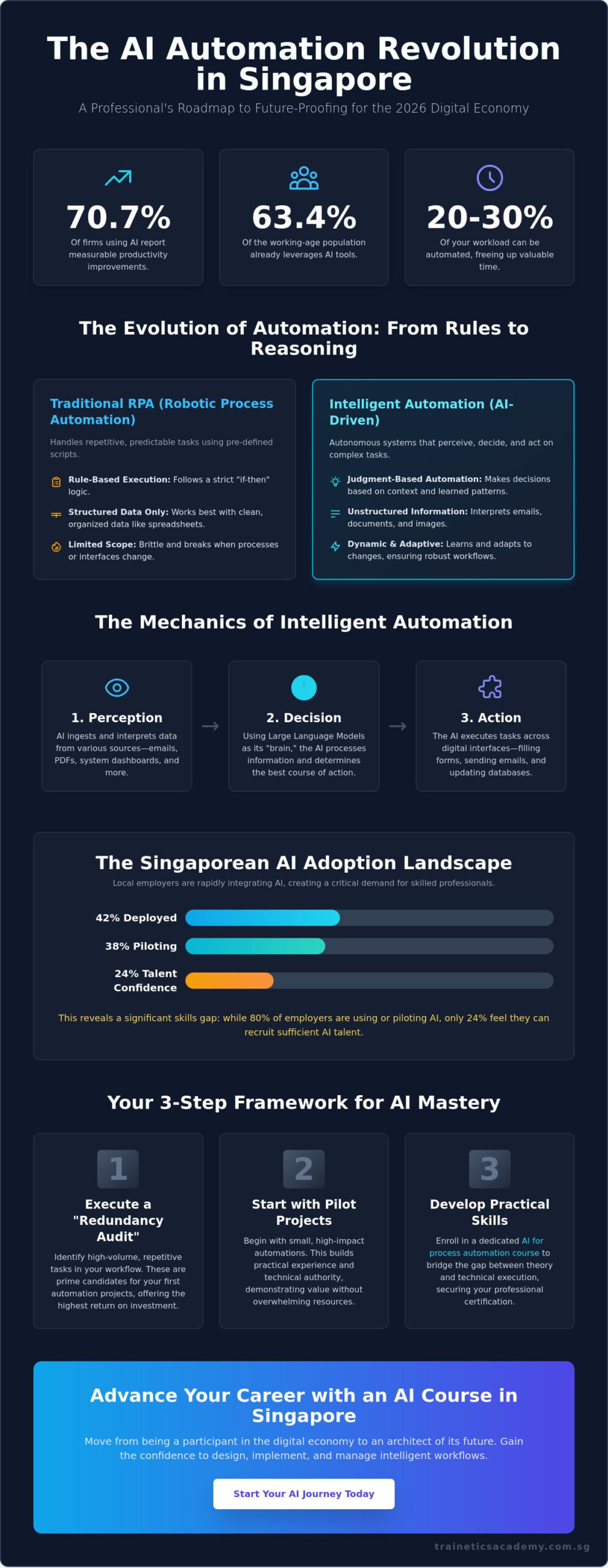
AI for process automation is the deployment of intelligent algorithms designed to execute repetitive digital tasks with surgical precision. Within Singapore’s 2026 digital economy, this represents a fundamental shift in how we perceive professional output. It’s no longer just about speed; it’s about accuracy and scale. By integrating Intelligent Automation (IA), businesses can move beyond static rules and embrace systems that learn from data patterns. This evolution is critical. Currently, 42% of Singaporean employers have already deployed AI, and 38% are piloting these technologies to secure a competitive edge.
The transition from traditional Robotic Process Automation (RPA) to AI-driven systems marks the move from rule-based execution to judgment-based automation. While RPA handles structured data through predefined logic, AI-driven workflows interpret unstructured information, making decisions that previously required human intervention. This shift is why professionals are increasingly seeking a comprehensive ai for process automation course sg to stay ahead of the curve. Those who rely on manual workflows risk falling behind, while AI-augmented professionals are reporting productivity gains of up to 70.7%.
To better understand the differences between traditional automation and modern AI agents, watch this helpful comparison:
The Evolution from Macros to AI Agents
The journey of workplace efficiency began with simple Excel macros. These were essentially digital scripts for basic, repetitive tasks. Today, we manage sophisticated AI agents that act as digital partners. Agentic AI refers to systems capable of autonomous reasoning and multi-step execution. Instead of you telling the tool exactly what to do at every step, you provide the objective. The agent then determines the best path to achieve it. This change requires a shift in professional identity from a simple “doer” to a disciplined manager of intelligence.
This evolution of identity is most effective when individual objectives are seamlessly synchronized with the broader company mission. To explore how technology can facilitate this synergy, learn more about Kaika AI and its innovative approach to workforce alignment.
Why Singaporean Professionals are Prioritising AI Literacy
Singapore’s Smart Nation initiative for 2026 places a premium on digital agility. Local SMEs and MNCs operate in a manpower-lean environment where efficiency is the only path to scalability. With only 24% of employers believing they can recruit sufficient AI talent, the demand for upskilled professionals has reached a critical point. Gaining these skills isn’t just a career choice; it’s a necessity for professional readiness. For a deeper dive into the educational landscape, refer to this AI Course Singapore: The Ultimate 2026 Guide for Professionals. Enrolling in a specialized ai for process automation course sg allows you to bridge the gap between high-level scientific discourse and practical career execution. You’ll move from being a participant in the digital economy to an architect of its future.
The Mechanics of Intelligent Automation: How AI Transforms Workflows
Intelligent automation operates on a foundational triad: Perception, Decision, and Action. Perception allows the system to ingest and interpret data; Decision involves the cognitive processing of that information; and Action is the execution of a task across digital interfaces. This structured approach aligns with Singapore’s National AI Strategy 2.0, which emphasizes the development of robust AI ecosystems. Unlike simple scripts, intelligent systems use Large Language Models (LLMs) to function as a central nervous system, coordinating these pillars to handle nuance and ambiguity that traditional software simply cannot process.
To bridge the gap between AI cognition and operational reality, professionals utilize Application Programming Interfaces (APIs) and connectors. These act as the digital sinews linking the AI “brain” to existing enterprise software like CRM or ERP systems. Understanding these connections is a primary focus for those enrolled in a leading ai for process automation course sg, as it equips them with the technical readiness to deploy agents safely. However, maintaining high professional standards requires a “Human-in-the-loop” framework. This ensures that while AI handles the heavy lifting, a human mentor provides the ethical oversight and final validation necessary for business integrity. Professionals who want to go deeper on governance and liability should also explore an understanding AI ethics and risks course to ensure their automation deployments meet Singapore’s evolving regulatory standards.
Large Language Models (LLMs) as Workflow Orchestrators
Modern LLMs such as ChatGPT, Claude, and Gemini have evolved into sophisticated orchestrators capable of interpreting complex, multi-layered instructions. Mastery in this space relies heavily on prompt engineering, which is the precise science of instructing an AI to achieve specific outcomes. In 2026, LLMs have effectively eliminated the need for rigid, hard-coded logic by providing a flexible cognitive layer that adapts to changing data inputs in real-time. This is a core component of any high-tier Artificial Intelligence Course designed for modern professionals who value precision and technical mastery.
No-Code and Low-Code Automation Platforms
The barrier to entry for technical automation has effectively vanished. No-code and low-code platforms now democratize the field for ai for process automation course sg participants, allowing them to build complex agents without writing a single line of Python. Technical mastery is no longer defined by your ability to memorize syntax, but by your capacity for logical process design and strategic implementation. This shift empowers professionals to focus on leadership and innovation rather than troubleshooting code, making the transition into an AI-driven career feel both scientifically grounded and practically attainable.
Identifying High-Impact Automation Opportunities in Your Business
Automation anxiety is a natural response to the rapid integration of AI in the workplace, yet it often stems from a lack of technical clarity. Instead of fearing displacement, visionaries view these shifts as an opportunity to shed low-value tasks and ascend to higher levels of leadership. In Singapore’s manpower-lean environment, identifying which processes to delegate to a machine is a core competency for any modern professional. Enrolling in a targeted ai for process automation course sg provides the disciplined framework required to execute a “Redundancy Audit” on your own desk, turning manual fatigue into strategic advantage.
High-impact wins usually hide in plain sight. They are the tasks you perform daily that require minimal creative judgment but consume significant mental energy. By focusing on high-volume, low-complexity activities, you build the necessary confidence to manage more sophisticated AI agents. This methodical approach ensures that your transition into an AI-augmented role is both scientifically grounded and professionally secure.
The 3-Step Task Audit for Professionals
To begin your automation journey, evaluate your weekly responsibilities through these three rigorous lenses:
- Step 1: Frequency. Identify tasks you perform daily or weekly. High-frequency actions offer the greatest return on investment because even saving ten minutes per day compounds into hours of reclaimed productivity every month.
- Step 2: Logic. Determine if the task follows clear rules or patterns. If you can write down the steps as a flowchart, an AI can likely execute it. Tasks that rely on “if-this-then-that” logic are prime candidates for early automation.
- Step 3: Data. Assess the inputs and outputs. AI thrives on digital, structured data. If your workflow involves moving information between spreadsheets, emails, or CRM systems, it’s ready for an intelligent overhaul.
Real-World Examples in the Singapore Context
Local industries are already seeing significant transformations through these audits. In Singaporean accounting firms, professionals use AI to automate invoice processing and reconciliation, reducing the time spent on manual entry by 30% or more. This allows junior staff to focus on advisory roles rather than data verification.
In the retail and e-commerce sectors, businesses are deploying AI for customer sentiment analysis. By automatically categorizing feedback from local marketplaces, marketing teams can pivot strategies in real-time based on consumer behavior. Professionals looking to deepen their ability to extract insights from unstructured text data will find that a natural language processing (NLP) course for business analysts provides the specialized skills to automate sentiment analysis and entity extraction at scale. Similarly, HR departments are streamlining onboarding processes using intelligent chatbots that handle document collection and FAQ responses. These practical applications demonstrate why a foundational Artificial Intelligence Course is essential for those aiming to raise professional benchmarks in their specific industry.
How to Implement AI Automation: A Step-by-Step Framework
Implementing AI automation requires a disciplined, systematic approach that mirrors the rigor of scientific training. It isn’t about chasing every new tool that enters the market; instead, it’s about building a sustainable framework that elevates your professional output. Success begins with a small, contained pilot project. By choosing a low-risk task, you build the technical confidence necessary to manage more complex systems later. This methodical progression is a core pillar of any elite ai for process automation course sg, ensuring you move from theory to execution with precision. Selecting the right tools is a critical skill that defines your professional readiness in Singapore’s 2026 digital economy.
Step 1: Mapping the Current Manual Process
Before you introduce AI, you must visualize your “as-is” workflow. This involves documenting every mouse click, decision point, and data transfer in your current manual process. Mapping the “as-is” against the “to-be” automated state allows you to identify bottlenecks where human intervention remains essential for quality control. During this design phase, leveraging productivity tools for business can help you visualize logic gates before you touch any automation software. Professionals who skip this step often find their AI agents failing because the underlying logic was never sound. Clear flowcharts act as the blueprint for your digital workforce.
Step 2: Selecting and Configuring AI Agents
Once your logic is mapped, you must select the right tool for the job. You’ll often choose between general-purpose LLMs for creative synthesis or specialized automation agents for data-heavy tasks. Security is paramount here. You must configure strict privacy parameters to ensure corporate data remains within protected silos. This level of technical readiness is exactly what a 1 day AI course Singapore prepares you for. It provides the foundational skills to configure these agents without compromising professional ethics or data integrity. Integrating these steps into your daily routine is the hallmark of a graduate from a high-tier ai for process automation course sg.
After configuration, the process enters the testing and iteration phase. Monitor the AI output with the same scrutiny you’d apply to a new hire. If the accuracy isn’t meeting your high standards, refine the prompts or the workflow logic. Finally, document the entire process. Documentation ensures organizational continuity; it allows your team to scale the automation without starting from scratch if you move into a higher leadership role. Mastering these steps transforms you from a manual worker into a visionary architect of digital systems. Ready to lead the charge? Secure your spot in our Artificial Intelligence Course today and start building your future.
Advancing Your Career with an AI Course at Trainetics Academy
Transitioning from manual workflows to intelligent automation is a journey that requires more than just technical tools; it demands a shift in professional identity. Trainetics Academy stands as a disciplined and visionary mentor, guiding professionals through this evolution with academic rigor and a commitment to excellence. While others offer superficial tutorials, we provide a gateway to a prestigious career by grounding high-level scientific discourse in practical, workplace-focused training. Our ai for process automation course sg is designed to transform you from a participant in the digital economy into a decisive leader who manages intelligent agents with confidence.
The “Introduction AI Course” serves as the premier starting point for those ready to master automation. This program isn’t a hobbyist class; it’s a rigorous professional development track that aligns with international benchmarks and regional educational frameworks. For Singaporeans seeking to upskill, this Introduction AI Course is Eligible for SkillsFuture Credits and UTAP funding. By choosing a Singapore-based leader, you secure a certification that signals professional readiness to SMEs and MNCs alike. You can find our physical learning platform located at 10 Anson Road, Level 22, International Plaza, Singapore 079903, where we cultivate the next generation of top-tier professionals.
Why Trainetics Academy for AI Training?
Our curriculum is delivered by qualified professionals who understand the technical nature of human-machine collaboration. We emphasize immediate workplace application, ensuring that the logic and frameworks you learn on day one can be deployed at your desk on day two. This focus on professional readiness is what sets us apart from academic degree programs that often lack practical agility. We foster a supportive yet demanding environment that mirrors the high standards of the industry itself. You’ll engage with sophisticated terminology and professional development jargon that prepares you to lead innovation within your organization.
Enrolling in the Introduction AI Course
The enrollment process is structured to be logical and predictable, catering to both individuals and corporate groups looking to raise their professional benchmarks. Whether you’re an independent practitioner or part of a larger team, our training programs provide a clear learning path toward technical mastery. It’s important to recognize that the Introduction AI Course is Eligible for SkillsFuture Credit and UTAP subsidies, making this high-level education accessible to all ambitious Singaporeans. Visit us at 10 Anson Road, Level 22, International Plaza, Singapore 079903 to learn more about how our ai for process automation course sg can future-proof your career. Join a community of disciplined professionals dedicated to continuous improvement and scientific validation.
Secure Your Professional Legacy in the Age of Automation
The transition from manual data entry to intelligent workflow orchestration is no longer a futuristic concept; it’s the current benchmark for professional excellence in Singapore. By mastering the mechanics of perception, decision, and action, you move beyond the role of a task-executor to become a strategic architect of digital systems. You’ve learned that success lies in identifying high-impact redundancies and implementing pilot projects with disciplined logic. Technical mastery in 2026 is about managing AI agents with the same precision a scientist applies to a laboratory experiment.
Elevating your professional identity requires a commitment to continuous improvement and expert guidance. Trainetics Academy provides the academic rigor and supportive environment needed to navigate these shifts successfully. Our highly qualified professional instructors deliver a curriculum focused on immediate workplace application through interactive physical and virtual learning platforms. Don’t let your career be defined by manual fatigue when you can lead with innovation. Master AI automation today with our professional AI Course and join the ranks of Singapore’s tech-ready leaders. Your journey toward technical mastery starts with the right ai for process automation course sg. Build the future you deserve.
Frequently Asked Questions
What is the best AI for process automation course sg for beginners?
The Introduction AI Course at Trainetics Academy is widely regarded as the premier entry point for professionals seeking a comprehensive ai for process automation course sg. It prioritizes professional readiness by translating complex scientific discourse into actionable workplace strategies. Students gain the technical confidence to identify high-impact redundancies and manage digital agents effectively. This structured approach ensures that individuals from any industry can achieve technical mastery and refine their professional identity.
Do I need to know how to code to use AI for automation?
You don’t need coding skills to master modern AI automation. The shift toward no-code and low-code platforms means that technical mastery is now defined by your logical process design rather than your ability to write syntax. By using Large Language Models as orchestrators, you can build sophisticated workflows through precise instructions. This democratization allows professionals from all backgrounds to manage digital agents with the authority of a visionary mentor.
Can I use SkillsFuture for AI online courses at Trainetics Academy?
Many of our foundational programs are designed to align with regional educational frameworks and local support schemes. For specific details on which programs are currently Eligible for financial assistance, we recommend reviewing our latest course brochures or consulting with our enrollment team. This ensures you have the most accurate information regarding professional development support as you work toward raising your benchmarks in the 2026 digital economy.
How long does it take to learn basic AI automation?
You can grasp the foundational principles of AI automation in a single day. A focused ai for process automation course sg provides the framework needed to start automating basic tasks immediately. While technical mastery is a continuous journey, a 1-day intensive workshop equips you with the logic and tools to reclaim significant portions of your workday. Continuous improvement follows as you scale your pilot projects with precision.
Is AI for process automation only for IT professionals?
AI for process automation is essential for all professionals, not just those in technical roles. Marketing, HR, and Finance departments in Singapore are already seeing significant gains by automating data-heavy workflows. Any role that involves repetitive digital tasks can benefit from these tools. It allows you to shed manual fatigue and focus on high-level leadership and innovation within your specific industry, mirroring the expectations of the modern workforce.
What are the benefits of a 1 day AI course Singapore compared to longer programs?
A 1 day AI course Singapore offers an intensive, high-impact learning experience tailored for busy leaders. Unlike academic degree programs that require months of commitment, this format focuses on immediate workplace application and the rapid deployment of automation pilots. It provides the essential logic and technical readiness required to start reclaiming your time without the burden of a long-term schedule. This efficiency is vital in Singapore’s fast-paced corporate environment.
How does AI automation improve business ROI for Singaporean SMEs?
AI automation significantly improves ROI by allowing Singaporean SMEs to scale operations within a manpower-lean environment. By delegating low-complexity tasks to intelligent agents, businesses reduce overhead and minimize human error in data-heavy processes. This allows the workforce to pivot toward higher-value leadership roles. The resulting efficiency gains strengthen the bottom line and future-proof the organization against the evolving demands of the digital economy.
What is the difference between RPA and AI-driven automation?
Traditional RPA follows rigid, rule-based logic to handle structured data, whereas AI-driven automation uses cognitive judgment to interpret unstructured information. While RPA acts like a digital script, AI agents function as partners that can reason through multi-step instructions. This evolution allows for the automation of tasks that previously required human intervention. It marks the transition from simple tools to the sophisticated digital intelligence required for professional excellence. Leaders who want to ensure their AI deployments remain compliant and trustworthy should complement their technical training with a dedicated understanding AI ethics and risks course that addresses PDPC compliance and responsible governance frameworks.
Disclaimer
AI Content Disclaimer: Some articles on this website may be generated or assisted by AI-powered content creation tools. While we strive for accuracy and relevance, readers should independently verify information before relying on it. The content is provided for informational purposes only and does not constitute professional advice.