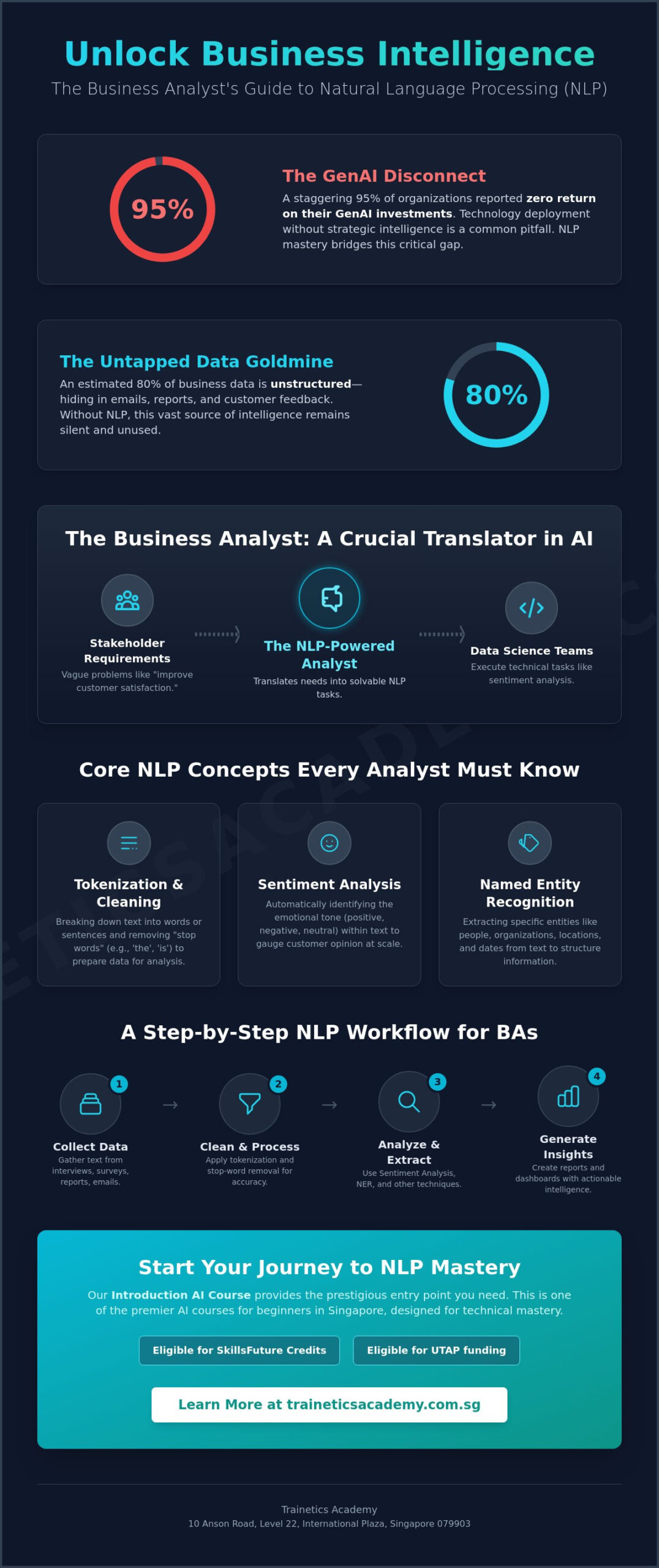
Did you know that 95% of organizations reported zero return on their GenAI investments in 2025? This staggering figure reveals a fundamental disconnect between deploying technology and achieving genuine intelligence, making a natural language processing (nlp) course for business analysts an essential investment for future-ready leaders. You likely understand the exhaustion of manual feedback analysis or the anxiety of missing critical insights hidden within vast oceans of unstructured text. It’s a common challenge for professionals in the Singapore tech scene who want to avoid the erosion of foundational skills while striving for scientific rigor and professional excellence.
Mastering NLP is the definitive solution to transform these data challenges into a strategic competitive advantage. This guide demonstrates how these tools empower you to automate sentiment analysis and extract key entities, effectively bridging the gap between business needs and data science teams. Our Introduction AI Course is eligible for SkillsFuture Credits and UTAP funding, offering a prestigious entry point for those seeking high-standard AI courses for beginners. By choosing a dedicated AI course Singapore, you secure a professional identity rooted in technical mastery and international benchmarks.
We’ll preview the essential 2026 tools, including Hugging Face Transformers and scikit-learn 1.9.0, to ensure your skills remain current and secure. Whether you’re seeking a 1 day AI course Singapore or a deeper dive into SkillsFuture AI courses, this guide provides the roadmap for your professional evolution. Visit us at 10 Anson Road, Level 22, International Plaza, Singapore 079903, to begin your journey toward becoming a visionary leader in the world of data.
Key Takeaways
- Define the strategic shift from manual text review to automated machine interpretation of human language to drive business value.
- Identify how a natural language processing (nlp) course for business analysts empowers you to extract actionable intelligence from stakeholder interviews and customer feedback.
- Resolve the technical dilemma between learning Python and utilizing low-code NLP platforms to suit your specific career trajectory and technical goals.
- Implement a logical, step-by-step workflow for data collection and text cleaning to ensure your business intelligence is accurate and scientifically validated.
- Learn why our Introduction AI Course is eligible for SkillsFuture Credits and UTAP funding, providing a gateway to professional mastery in the Singapore tech sector.
What is Natural Language Processing (NLP) for Business Analysts?
At its core, Natural Language Processing is the scientific discipline of teaching machines to understand, interpret, and generate human language. For a professional aiming to raise their personal benchmarks, this isn’t merely a technical subfield; it’s a strategic tool. It’s not just about code; it’s about context. Modern NLP has evolved far beyond simple keyword matching. We’ve moved into the era of Large Language Models (LLMs) that distinguish between Natural Language Understanding (NLU), where the machine grasps intent, and Natural Language Generation (NLG), where it produces coherent text.
Industry data suggests that approximately 80% of business data exists in unstructured formats like emails, PDF reports, and social media posts. As a Business Analyst, you are the gatekeeper of this information. Without the right skills, this data remains silent. Enrolling in a natural language processing (nlp) course for business analysts provides the technical mastery required to unlock these insights and translate them into actionable intelligence.
To better understand the foundational mechanics of how machines process text, watch this helpful video:
The BA as the “Translator” in AI Projects
A visionary mentor understands that technology only succeeds when it solves a human problem. In AI projects, the Business Analyst acts as the “Translator.” You bridge the gap between stakeholder requirements and technical data science teams. This involves translating a vague business problem, such as “Why are our clients unhappy?”, into an NLP-solvable task like sentiment analysis or text classification. Your role ensures that the AI’s output aligns perfectly with organizational KPIs and user needs. You don’t just facilitate the project; you guarantee its professional readiness.
Core NLP Concepts Every Analyst Must Know
Technical mastery begins with foundational concepts. Before you can derive value from an Artificial Intelligence Course, you must understand the mechanics of text processing. These foundations allow you to communicate effectively with engineers while maintaining a focus on business outcomes.
- Tokenization and Stop Word Removal: This is the essential first step of text cleaning. It involves breaking down sentences into individual units (tokens) and removing common words like “the” or “is” that don’t add analytical value.
- Sentiment Analysis: This technique measures the emotional tone behind words. It’s vital for analyzing customer feedback at scale to detect shifts in brand perception.
- Named Entity Recognition (NER): This allows you to extract specific entities such as people, places, and organizations from massive document sets, turning a messy legal file into a structured database.
By mastering these elements through a dedicated natural language processing (nlp) course for business analysts, you position yourself as a leader in the next wave of business intelligence. This knowledge ensures you aren’t just reacting to the AI wave but actively directing its impact on your career.
Strategic Value of an NLP Course for Business Analysts
The evolution of the modern analyst requires more than just proficiency in SQL or Excel. It demands a mastery of unstructured data. By pursuing a natural language processing (nlp) course for business analysts, you transition from being a passive observer of data to a proactive architect of business intelligence. This technology is revolutionizing business operations by enabling the automation of qualitative analysis at an unprecedented scale. Analysts who harness these tools don’t just report on the past; they predict the future needs of the organization.
Strategic value manifests in several critical areas of the business analysis lifecycle:
- Automated Qualitative Analysis: Processes thousands of surveys, reviews, and social media mentions to find trends that manual reading would miss.
- Precision Requirements Gathering: Employs text mining to identify recurring pain points or conflicting requirements within stakeholder interview transcripts.
- Competitive Intelligence: Uses automated web scraping and text summarization to monitor competitor movements and market shifts in real-time.
- Operational Efficiency: Designs the logic for intelligent chatbots and self-service portals, significantly reducing the burden on human support teams. For those interested in how these conversational interfaces are optimized for AI search, you can check out AISEOAgency SG.
From Manual Analysis to AI-Driven Insights
Traditional spreadsheet-based analysis fails when confronted with the nuance of human language. It’s impossible to manually read and categorize every customer review without introducing human bias or fatigue. NLP offers a scientifically grounded method to listen to the “voice of the customer” across every digital touchpoint. Imagine the impact of summarizing 1,000 support tickets in seconds. Instead of spending weeks identifying recurring bugs, you deliver immediate, evidence-based solutions to your engineering team. This level of precision is what separates top-tier professionals from the rest. If you’re ready to elevate your career, exploring our specialized Artificial Intelligence Course is the first step toward technical mastery.
Future-Proofing Your Career in Singapore’s Tech Hub
Singapore’s 2026 tech landscape prioritizes professionals who bridge the gap between technical execution and business strategy. The demand for AI-literate talent is no longer a trend; it’s a benchmark for excellence. Moving from a functional analyst to a strategic AI consultant requires a specialized education that emphasizes professional readiness. Taking an AI course Singapore professionals trust can lead directly to senior leadership roles. You become the visionary mentor who guides organizations through the complexities of the AI wave, ensuring that every technological investment yields a tangible return on intelligence. As you advance your career, understanding the regulatory environment is equally critical; completing an understanding AI ethics and risks course ensures your deployments remain compliant with Singapore’s evolving governance frameworks. This transition isn’t just about learning a new skill. It’s about claiming a professional identity at the forefront of innovation.
Coding vs. No-Code: Choosing the Right NLP Path
The primary question facing many professionals today is whether they must become programmers to remain relevant. Choosing a natural language processing (nlp) course for business analysts often triggers a debate between technical depth and strategic speed. You don’t necessarily need to master Python to leverage the power of AI, but you do need to understand the underlying logic of the models you deploy. Professional readiness in 2026 involves knowing which path aligns with your organizational goals and your personal career trajectory. Mastering these tools through a natural language processing (nlp) course for business analysts ensures you remain a top-tier professional, regardless of the specific software you use.
Low-code and no-code platforms like MonkeyLearn, AWS Comprehend, and Azure Cognitive Services have democratized access to sophisticated text analysis. These tools allow you to perform entity extraction and sentiment analysis without writing a single line of code. For many, a 1 day AI course Singapore analysts attend provides the perfect balance, offering immediate upskilling that translates directly to the boardroom. It’s about working smarter, not just harder, to achieve scientific validation for your business insights.
The Python Path: For Technical Analysts
Technical mastery often requires a deeper dive into the mechanics of data. If your role involves building custom models for niche industry terminology, such as specialized medical or legal jargon, understanding the basics of Python within an AI course sg context is invaluable. This path isn’t just about coding; it’s about establishing a professional identity as someone who can collaborate seamlessly with developers. By speaking their technical language, you ensure that the outputs of your models meet the highest standards of precision. Custom scripts allow for a level of granular control that off-the-shelf tools sometimes lack, particularly when dealing with complex, multi-layered data pipelines.
The No-Code Path: For Strategic Analysts
Visionary mentors recognize that speed is often a competitive advantage in a fast-paced market. The no-code path focuses on leveraging pre-trained models for immediate business impact. You can use prompt engineering as a primary interface for NLP tasks, utilizing advanced LLMs like ChatGPT or Claude to summarize lengthy reports or categorize stakeholder feedback. This approach integrates effortlessly into existing workflows like Excel or Power BI, turning you into a high-efficiency architect of intelligence. Our Artificial Intelligence Course emphasizes these practical applications, ensuring you can deliver results from day one. This Introduction AI Course is eligible for SkillsFuture Credits and UTAP funding, making it an accessible gateway to excellence for those who prioritize strategic output over technical minutiae.
Integrating NLP into the Business Analysis Workflow
Success in the digital economy isn’t about having the most data; it’s about having the most disciplined approach to extracting value from it. Integrating these tools into your daily operations requires a structured methodology that mirrors a professional learning path. For organizations aiming to capitalize on this, agencies like Content Marketing SG demonstrate how optimized content can thrive in modern search environments. A natural language processing (nlp) course for business analysts provides more than just technical theory. It offers a framework for solving complex organizational problems with scientific precision. You aren’t just processing text; you’re engineering clarity from chaos.
The integration process follows five rigorous stages:
- Step 1: Identifying the Business Problem. Start with a clear objective. Instead of asking for general insights, ask specific questions like “Why is our customer churn rate increasing?” or “What specific feature requests are recurring in our support logs?”
- Step 2: Data Collection and Text Cleaning. Gather raw text from surveys, emails, or transcripts. Use the cleaning techniques we discussed earlier to prepare the data for analysis.
- Step 3: Selecting the NLP Technique. Decide if the problem requires sentiment analysis to gauge emotion or topic modeling to identify recurring themes within the dataset.
- Step 4: Interpreting Results and Communicating. Translate technical outputs into business intelligence that stakeholders can understand. Your role is to turn a sentiment score into a strategic recommendation.
- Step 5: Iteration and Continuous Improvement. Refine your models based on feedback to ensure ongoing accuracy and professional readiness.
NLP for Requirements Management
The role of the “translator” is most critical during the requirements phase. You can use text summarization to condense hours of stakeholder meeting transcripts into concise, actionable summaries. This ensures that no critical detail is lost in the noise. By employing text comparison algorithms, you can identify conflicting requirements across multiple documents before they lead to costly development errors. Automating the tagging and categorization of user stories allows you to maintain a high standard of organization, ensuring that your team stays focused on high-priority delivery.
NLP for Market and Sentiment Analysis
In the competitive Singaporean market, tracking brand perception is a continuous necessity. You can analyze sentiment across local social media platforms to detect shifts in public opinion before they become crises. Examining competitor product reviews allows you to find feature gaps that your organization can exploit. This strategic oversight is enhanced by implementing AI for process automation in your feedback loops, ensuring that insights move from the customer to the product team without delay. To master these frameworks, consider enrolling in our Artificial Intelligence Course to secure your professional identity.
By following this systematic approach, you elevate the benchmark for business analysis within your firm. If you’re ready to bridge the gap between raw data and strategic leadership, our natural language processing (nlp) course for business analysts is the professional gateway you’ve been seeking. Join us at 10 Anson Road, Level 22, International Plaza, Singapore 079903, to begin your transformation.
Getting Started: Trainetics Academy’s AI Course for Beginners
The transition from understanding the strategic value of text analysis to implementing it in your daily work requires a high-standard educational foundation. Our Introduction AI Course at Trainetics Academy is meticulously designed for professionals who demand excellence and professional readiness. Unlike traditional academic programs that prioritize dense mathematical theory, our approach favors immediate, practical application. We empower you to master the tools discussed in this guide, ensuring that your natural language processing (nlp) course for business analysts experience translates directly into measurable business outcomes. You’ll learn to move beyond the hype and focus on the scientific validation of your data insights.
Our training facility is conveniently located at 10 Anson Road, Level 22, International Plaza, Singapore 079903. This central location serves as a gateway for ambitious professionals seeking to raise the benchmark of their technical mastery. Whether you are looking for a comprehensive AI Course or a specialized 1 day AI course Singapore analysts can utilize for rapid upskilling, we provide the structured environment necessary for your professional evolution. This specific Introduction AI Course is eligible for SkillsFuture Credits and UTAP funding, making elite education accessible to those dedicated to continuous improvement.
Why Choose Trainetics Academy in Singapore?
We pride ourselves on an interactive curriculum delivered by industry-qualified professionals who understand the nuances of the local tech sector. Our focus on “AI for non-coders” ensures that the barrier to entry remains low while the standards for output remain exceptionally high. You’ll gain hands-on experience with the latest models and frameworks, positioning yourself as a leader in your organization. To explore our full range of offerings, check out our AI Course Singapore for more details. We don’t just teach technology; we offer a professional identity rooted in leadership and innovation. This commitment to quality makes us a top choice for those seeking AI courses for beginners that deliver real-world results.
Next Steps for Your Professional Journey
Securing your spot in the next cohort is a straightforward process designed with your busy schedule in mind. You can utilize your SkillsFuture AI courses allocation, as the Introduction AI Course is eligible for SkillsFuture Credits and UTAP funding. This financial support ensures that the highest standard of education remains within reach for the Singaporean workforce. Preparing for your first day at 10 Anson Road, Level 22, International Plaza, Singapore 079903, involves more than just bringing a laptop; it’s about adopting the mindset of a visionary mentor. You’ll join a vibrant community of AI-ready professionals who value precision and hard work. By choosing this natural language processing (nlp) course for business analysts, you aren’t just learning a skill; you’re future-proofing your career in the most dynamic tech hub in the region. Complement your NLP expertise by also exploring an understanding AI ethics and risks course to ensure your implementations meet the rigorous compliance standards expected of senior professionals in 2026.
Master the Future of Business Intelligence
The transition from a functional analyst to a visionary leader requires a commitment to technical mastery and professional readiness. You’ve discovered how NLP transforms unstructured text into a strategic asset, allowing you to automate sentiment analysis and refine requirements gathering with scientific precision. Investing in a natural language processing (nlp) course for business analysts is the definitive step toward securing your professional identity in Singapore’s 2026 tech hub. Whether you leverage no-code platforms or explore custom models, the ability to bridge the gap between data and strategy remains your most valuable competitive advantage.
Take the lead in your career by joining our practical, 1 day AI course Singapore professionals trust for immediate impact. Our Introduction AI Course is taught by industry experts at 10 Anson Road, Level 22, International Plaza, Singapore 079903, and is eligible for SkillsFuture Credits and UTAP funding. This focused curriculum ensures you gain the highest standard of education without the delays of traditional academic programs. Enroll in our Introduction AI Course and Master NLP Today to begin your journey toward excellence. The future belongs to those who bridge the gap between technical innovation and business leadership.
Frequently Asked Questions
Do I need to know how to code to take an NLP course for business analysts?
No, you don’t need coding proficiency to succeed in a natural language processing (nlp) course for business analysts. Our curriculum emphasizes the use of no-code platforms and pre-trained models that allow you to extract insights without writing Python. This ensures that strategic analysts can focus on business intelligence and decision-making rather than technical syntax. It’s about mastering the logic of AI to lead data science teams effectively.
How much can I claim using SkillsFuture for AI courses at Trainetics Academy?
You can use your available credits to offset the fees for our foundational training sessions. Since credit balances vary per individual based on age and previous usage, we recommend checking your specific balance on the official SkillsFuture portal. This financial support facilitates your professional journey toward technical mastery without a significant upfront investment. Our team can assist you with the claim process during registration.
Is a 1 day AI course Singapore enough to learn NLP fundamentals?
A 1 day AI course Singapore professionals attend is designed to deliver a high-impact, intensive overview of essential NLP mechanics. You’ll move rapidly from foundational concepts like tokenization to practical applications like sentiment analysis. While mastery takes time, this format provides the scientific grounding and professional readiness required to start implementing AI tools in your workplace immediately. It’s an efficient gateway for busy leaders.
Can I use NLP to automate my business requirements documents?
Yes, NLP techniques are exceptionally effective at automating the processing of business requirements documents. You can use text summarization to condense lengthy stakeholder transcripts and entity extraction to identify key project milestones or deliverables automatically. This reduces manual effort and minimizes human error, ensuring your documentation meets the highest standards of precision and organizational clarity. It’s a transformative tool for modern requirements management.
What is the difference between an AI course for beginners and a data science degree?
An AI course for beginners focuses on practical, immediate workplace application, whereas a data science degree involves years of deep mathematical theory and software engineering. For a Business Analyst, the goal is often to bridge the gap between business needs and data teams. Our course prioritizes the strategic “why” and “how” of using AI tools rather than the dense calculus required to build them from scratch.
Are there any prerequisites for the Introduction AI Course?
There are no technical prerequisites for our entry-level training, though a background in business analysis or project management is beneficial. The curriculum is built for professionals who want to understand AI without a prior background in computer science. We start with foundational concepts and build toward strategic applications, ensuring every participant can follow the learning path regardless of their starting point in the tech wave.
How does NLP help with sentiment analysis in the Singapore market?
NLP enables you to analyze large volumes of localized feedback from Singaporean social media and review platforms with scientific accuracy. By using sentiment analysis, you can detect shifts in brand perception and market trends in real-time. This allows organizations to react swiftly to consumer needs in a competitive landscape. It’s a critical tool for maintaining a professional edge in the regional market.
Will I receive a certificate after completing the AI course at Trainetics Academy?
Yes, you’ll receive a certificate of completion after finishing your training at Trainetics Academy. This document serves as a validation of your professional readiness and technical mastery in the field of artificial intelligence. It’s a recognized marker of your commitment to excellence and high standards, helping you establish a professional identity as an AI-literate leader in your industry.
Disclaimer
AI Content Disclaimer: Some articles on this website may be generated or assisted by AI-powered content creation tools. While we strive for accuracy and relevance, readers should independently verify information before relying on it. The content is provided for informational purposes only and does not constitute professional advice.