Did you know that 84% of reported security breaches in Singapore over the last year were driven by AI? This startling statistic from May 2026 highlights a critical gap between rapid adoption and professional safeguards. You likely recognize the immense potential of generative tools, yet you’re concerned about accidental data leaks or the confusing terms of service that govern them. Achieving excellence requires a disciplined approach to these technologies; ensuring your innovation doesn’t compromise professional integrity is paramount.
This article provides a definitive roadmap on how to ensure data privacy when using ai tools within a professional environment. You’ll master essential protocols to protect sensitive information while leveraging the power of automation. We’ll explore the latest PDPC advisory guidelines, configuration steps for maximum security, and how the Introduction AI Course at Trainetics Academy, a premier AI course Singapore provider located at 10 Anson Road, Level 22, International Plaza, Singapore 079903, can establish your baseline for mastery. This course is eligible for SkillsFuture Credits and UTAP funding. By the end of this guide, you’ll have the confidence to lead AI initiatives and explain complex risks to any stakeholder.
Key Takeaways
- Master the distinction between public and enterprise AI tiers to prevent your proprietary data from being absorbed into global training models.
- Learn how to ensure data privacy when using ai tools by implementing a rigorous sanitization protocol that removes sensitive identifiers before every prompt.
- Identify hidden security vulnerabilities such as data persistence and prompt injection that can lead to unintentional information disclosure in a professional setting.
- Secure your professional workflow by manually configuring training opt-out settings and verifying the specific data retention policies of your generative platforms.
- Elevate your career readiness through structured education, ensuring you can navigate the complex legal and ethical landscape of AI implementation with precision.
Understanding the Stakes: Why AI Data Privacy Matters in 2026
By 2026, proficiency in artificial intelligence has become a non-negotiable standard for career excellence. However, this technical mastery is hollow without a disciplined approach to AI data privacy. This concept refers to the specific protocols designed to prevent personal and proprietary information from being absorbed into public datasets. Professionals who fail to grasp how to ensure data privacy when using ai tools risk exposing their organization’s intellectual property to global competitors. In this high-stakes environment, privacy mastery isn’t just a technical setting; it’s a core professional competency.
The primary threat lies in the “training data trap.” Most public AI platforms use your inputs to train future iterations of their models. If you paste a confidential client report or a proprietary business strategy into a standard prompt box, that information could resurface in another user’s output months later. Protecting your data requires more than just caution. It demands a systematic approach to input management that mirrors the scientific rigor found in professional research environments.
To better understand how to configure your workspace for maximum security, watch this helpful video:
The Evolution of AI Privacy Risks
The landscape of risk has shifted dramatically over the last few years. We’ve moved beyond simple text entries to complex multimodal inputs, including voice recordings, video clips, and high-resolution documents. In many Singaporean SMEs, “shadow AI”, which is the use of unauthorized tools by employees, creates hidden vulnerabilities that bypass traditional corporate firewalls. Maintaining professional benchmarks means treating every AI interaction with the same level of scrutiny you’d apply to a legal audit. You can’t afford to let convenience compromise your professional identity.
PDPA Compliance in the Age of Generative AI
For professionals in Singapore, adherence to the Personal Data Protection Act (PDPA) is a baseline requirement that remains non-negotiable. You must understand fundamental data privacy principles to ensure your AI usage doesn’t violate local regulations. While companies provide the framework, the individual often bears the responsibility for data leakage caused by poor prompting habits. Mastering these nuances is essential for anyone enrolled in an AI Course Singapore professionals trust for career development. Our Introduction AI Course is eligible for SkillsFuture Credits and UTAP funding, providing a structured path to mastery at 10 Anson Road, Level 22, International Plaza, Singapore 079903. For a deeper dive into the consequences of non-compliance, read our guide on What Are the Legal Risks of Using Generative AI at Work?
Core Risks: How Your Data Can Leak Through AI Inputs
Understanding the mechanics of a leak is the first step toward professional security. While many focus on external hackers, the primary threat often originates from within the prompt box itself. Statistics from July 2026 indicate that data leakage remains the most prevalent security issue, affecting 50.1% of organizations implementing AI agents. This isn’t just about accidental copy-pasting; it’s about the sophisticated ways these systems handle information. A U.S. GAO report on AI privacy risks highlights how AI can repurpose and cross-reference datasets in ways that were previously impossible, making traditional anonymisation techniques obsolete.
Beyond simple text, the ecosystem of third-party plugins and browser extensions creates a silent privacy drain. These integrations often request broad permissions to read your screen or access your files, acting as a bridge for sensitive data to exit your secure network. Malicious actors also employ prompt injection, which is a technique that tricks the AI into bypassing its own safety filters to reveal previous, sensitive inputs from other sessions. Learning how to ensure data privacy when using ai tools requires you to view every plugin as a potential back door to your proprietary information.
The “Input is Forever” Rule
You must treat every prompt as a permanent record. Never paste Personally Identifiable Information (PII) such as NRIC numbers into public models. By December 31, 2026, private organizations in Singapore must cease using NRIC numbers for authentication, yet the habit of including them in raw data sets for AI analysis persists. Proprietary code and internal financial projections are equally vulnerable. Data persistence is the long-term retention of input history by AI providers, meaning your “deleted” data may still exist in server logs for years after the session ends.
Visual and Audio Privacy Concerns
The surge in AI-driven meeting transcription presents a unique challenge for client confidentiality. Uploading a recording for analysis might seem efficient; however, it effectively hands a transcript of your private strategy to a third party. Similarly, AI image generators and document analysers often store the files you upload to improve their own pattern matching capabilities. Achieving a high standard of professional readiness involves auditing the privacy settings of every tool before it touches a client file. If you want to master these protocols, joining a professional AI Course is the most effective way to safeguard your career and maintain professional benchmarks.
Public vs. Enterprise AI: Evaluating Privacy Protections
Choosing the right platform is the most impactful decision you’ll make when determining how to ensure data privacy when using ai tools. For a professional, the distinction between a free public interface and an Enterprise-grade subscription is not merely a matter of features; it’s a fundamental difference in data ownership. Free versions typically operate on a “data-for-service” model, where your inputs serve as raw material for future model training. In contrast, Enterprise and Team tiers—or specialized platforms like Syntes AI that provide an Enterprise Knowledge Graph—are designed with professional readiness in mind, offering contractual guarantees that your proprietary prompts remain isolated from the provider’s global learning pool.
Power users and developers often prefer API-based usage for even tighter control. Data transmitted via API is generally excluded from training cycles by default, providing a cleaner environment for processing sensitive information. You must also consider data residency, especially within the Singaporean context. Understanding where your data is physically stored is vital for compliance with local frameworks. Many leading providers now offer regional data silos, allowing Singaporean firms to keep their information within specific jurisdictions to satisfy internal audit requirements and international benchmarks.
Evaluating AI Service Level Agreements (SLAs)
Before deploying any tool, you must scrutinize the Service Level Agreement (SLA). Look specifically for “Zero Data Retention” (ZDR) policies, which ensure that your inputs are purged from the provider’s volatile memory immediately after the output is generated. Professional excellence demands that you verify who owns the intellectual property of the AI’s output; some lower-tier agreements may contain ambiguous language regarding usage rights. For a broader perspective on integrating these tools into your business, consult our guide on AI Strategy for SMEs in Singapore: 2026 Trend Analysis.
Customising Privacy Settings in Popular Tools
Even if you’re using a standard professional tier, you should take active steps to harden your workspace. Most reputable tools, such as ChatGPT or Claude, allow you to disable chat history and training in the settings menu. Turning this off prevents your session data from being saved to the cloud for long-term storage. Additionally, manage your workspace permissions with precision; ensure that collaborative AI tools don’t grant every team member access to sensitive project folders by default. In highly regulated sectors like finance or healthcare, local hosting or “on-prem” AI deployments are becoming the gold standard, removing the need for cloud-based data transmission entirely. Mastering these configurations is a key component of our AI Course, where we emphasize technical mastery alongside security protocols.
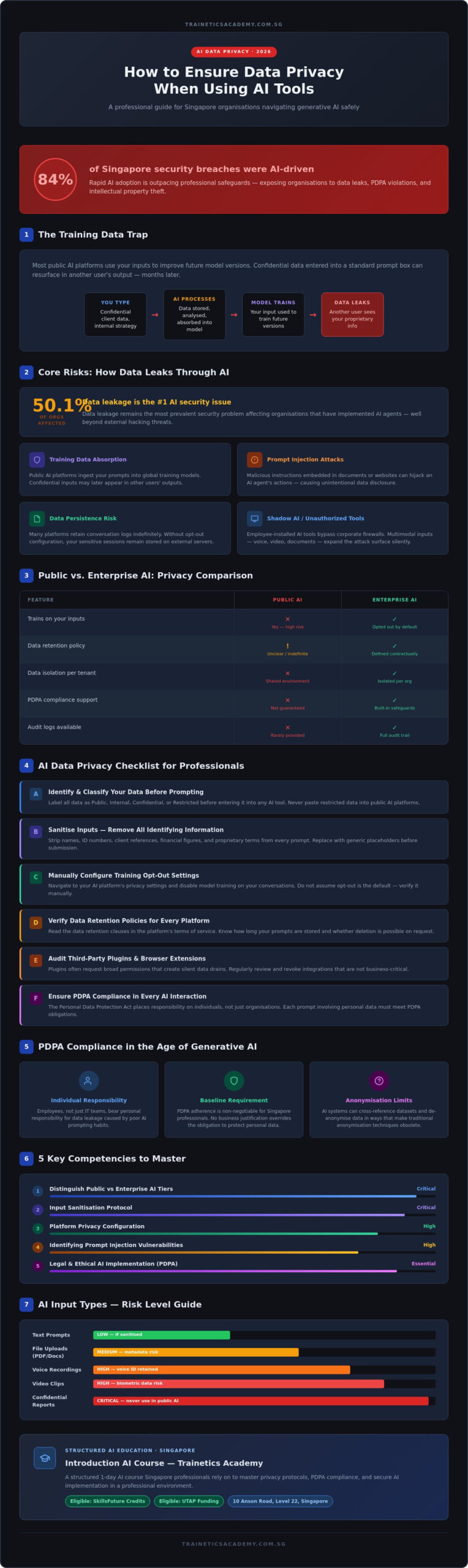
The Definitive AI Data Privacy Checklist for Singapore Professionals
Operationalizing your security strategy is the only way to move from fear to confidence. You must establish a repeatable workflow that guarantees every interaction with generative models remains within safe parameters. Professionals who master how to ensure data privacy when using ai tools don’t rely on luck; they rely on a disciplined checklist that prioritizes information integrity at every stage of the prompt cycle. This approach ensures that your use of technology remains scientifically grounded and professionally secure.
- Step 1: Sanitize Inputs. Scrutinize every prompt for personally identifiable information (PII) or proprietary trade secrets. Remove them before hitting send.
- Step 2: Verify Tool Settings. Access the settings menu of your chosen platform. Ensure that “Model Training” or “Chat History” is toggled OFF to prevent your data from being stored long-term.
- Step 3: Use Synthetic Data. When analyzing trends, replace real client names or specific financial figures with functional placeholders. This allows the AI to process the logic without seeing the actual data.
- Step 4: Audit Output. Review the generated content for “hallucinations” or traces of sensitive training data that might have leaked into the response.
- Step 5: Document Usage. Maintain a clear log of which tools were used for specific tasks. This documentation is essential for PDPA accountability and internal audits.
Proactive Data Anonymisation Techniques
Advanced practitioners use generalized prompts to extract value without revealing specifics. Instead of uploading a full contract, describe the specific clause structure you need analyzed. Use manual scrubbing or automated tools to clean datasets before they enter the AI environment. Data anonymisation involves the irreversible removal of identifiers to prevent individual re-identification under PDPA guidelines. This rigor separates top-tier professionals from those who merely use technology without understanding its risks.
Daily AI Safety Habits
Security is a mindset, not just a set of rules. You should treat every AI prompt as if it were a public post on a professional network. This shift in perspective naturally encourages higher standards of caution as you learn how to ensure data privacy when using ai tools in your daily tasks. Regularly clear your chat histories and revoke permissions for any third-party plugins that are no longer essential to your workflow. Cultivating a “Privacy First” culture within your team raises the collective benchmark for excellence. To gain the technical mastery required for this level of security, explore our AI Course Singapore and start your journey toward becoming a visionary industry leader.
Master AI Security with Professional Training at Trainetics Academy
While self-directed learning can offer a basic introduction to generative technology, it often misses the critical security nuances required for high-stakes professional environments. Navigating the complexities of model weights and data residency requires more than just curiosity; it demands a structured curriculum rooted in academic rigor. Without professional guidance, individuals may struggle to grasp how to ensure data privacy when using ai tools, leading to vulnerabilities that compromise both personal integrity and corporate assets. True technical mastery is achieved when you move beyond trial and error into a space of scientific validation and professional readiness.
Our AI Course Singapore is designed to bridge the gap between basic usage and industry-leading expertise. We provide a professional identity for those who value precision and continuous improvement. By choosing a structured learning path, you ensure that your implementation of AI agents follows the most stringent international benchmarks. This disciplined approach transforms AI from a potential risk into a powerful, secure asset for your career advancement.
Eligible Funding for Your AI Journey
The Introduction AI Course at Trainetics Academy is Eligible for SkillsFuture Credit and UTAP funding. These subsidies are designed to support lifelong learning and professional development within Singapore’s rapidly evolving tech sector. Investing in SkillsFuture AI courses allows you to master these protocols without the friction of high initial costs. For busy professionals, our 1 day AI course Singapore offers an intensive, high-impact curriculum that delivers immediate practical benefits. This program is one of the most comprehensive AI courses for beginners looking to establish a secure foundation in the field.
Why Choose Trainetics Academy?
At Trainetics Academy, we view AI training through the same lens of precision as sports science. Our curriculum is grounded in practical application and authoritative guidance, ensuring every student meets the highest standards of professional excellence. We don’t just teach software; we offer a gateway to a prestigious career as a visionary industry leader. Our physical training options are conveniently located at 10 Anson Road, Level 22, International Plaza, Singapore 079903, providing a dedicated space for collaborative learning and technical mastery. Join a community that is committed to raising professional benchmarks and securing the future of AI implementation in Singapore.
Elevate Your Career with Disciplined AI Integration
Mastering the intersection of innovation and security is the hallmark of a modern industry leader. You now understand that data privacy in the age of generative intelligence isn’t a passive setting; it’s a rigorous professional practice. By prioritizing enterprise-grade tools and implementing a strict sanitization protocol for every prompt, you protect your intellectual property from becoming public training data. Learning how to ensure data privacy when using ai tools is the first step toward achieving a standard of excellence that sets you apart in a competitive market.
The transition into a high-level AI career requires more than just technical awareness; it demands a professional identity rooted in scientific validation. Our AI training provides the authoritative guidance you need to navigate these risks with confidence. We offer an AI course Singapore professionals trust that’s Eligible for SkillsFuture Credit and UTAP funding, providing a practical path to career mastery. This professional development ensures you’re ready to lead with precision in a tech-driven landscape.
Secure your future and master AI privacy; Enrol in our professional AI course today!
Step forward with the ambition and security that only world-class education can provide. Your journey toward technical mastery begins with a single, disciplined choice.
Frequently Asked Questions
Is ChatGPT safe to use for sensitive work documents in 2026?
ChatGPT is only safe for sensitive documents if you are utilizing the Enterprise or Team tiers that explicitly exclude your inputs from model training. Public versions continue to use user data to refine their algorithms, which could lead to proprietary leaks. To maintain professional excellence, always verify that the “Chat History & Training” toggle is disabled before processing any confidential information.
Can my company see what I am typing into public AI tools?
Your employer can likely monitor your inputs if you are accessing these tools through a company network, a managed device, or a corporate-issued account. Many organizations have implemented “Shadow AI” monitoring systems to track unauthorized tool usage. If you are concerned about how to ensure data privacy when using ai tools, always use your organization’s approved, secure platforms rather than personal accounts for work tasks.
How does the PDPA apply to data I enter into a generative AI tool?
The Personal Data Protection Act (PDPA) mandates that organizations in Singapore protect any personal data they collect or process, including data entered into AI models. You must ensure that you have a valid purpose for processing this data and that the AI provider offers sufficient security safeguards. Failing to sanitize your inputs before processing can result in significant regulatory penalties under the PDPA frameworks.
What should I do if I accidentally paste sensitive data into an AI tool?
Immediately delete the specific chat session and contact your company’s Data Protection Officer (DPO) to report the potential breach. While deleting the history may remove the prompt from your view, the data may remain in server logs for a limited time. Most reputable providers offer a formal data deletion request process that you should initiate to mitigate long-term persistence risks.
Is there a specific AI course for beginners that covers data privacy?
The Introduction AI Course at Trainetics Academy is a premier choice for those seeking to master these security protocols from the ground up. This program focuses on professional readiness and scientific validation, ensuring you understand the technical nature of AI risks. It is a practical AI Course Singapore professionals use to raise their benchmarks and secure their professional identity in a tech-driven market.
How can I tell if an AI tool is “Enterprise Grade” for privacy?
An Enterprise Grade tool is characterized by SOC 2 Type II compliance and clear contractual language that guarantees your data will never be used for model training. Look for features like “Zero Data Retention” (ZDR) and the ability to host the model within a specific geographic region. These tools prioritize the pursuit of excellence by offering the security required for high-level corporate and legal environments.
What are the risks of using AI browser extensions for data privacy?
AI browser extensions often require broad permissions to read and change data on the websites you visit, creating a significant security vulnerability. These tools can unintentionally capture sensitive information such as passwords, financial records, or internal communications during your browsing session. You should audit your extensions regularly and revoke access for any tool that doesn’t meet your organization’s strict security benchmarks.
Does using an AI tool automatically mean my data is being used for training?
No, many modern platforms provide an “opt-out” mechanism or dedicated API access that excludes your data from their training sets. However, the default setting for most free public versions is still “opt-in,” meaning your inputs are actively utilized to improve the model. Achieving career mastery requires you to take a disciplined approach to configuring these settings as part of how to ensure data privacy when using ai tools.
Disclaimer
AI Content Disclaimer: Some articles on this website may be generated or assisted by AI-powered content creation tools. While we strive for accuracy and relevance, readers should independently verify information before relying on it. The content is provided for informational purposes only and does not constitute professional advice.