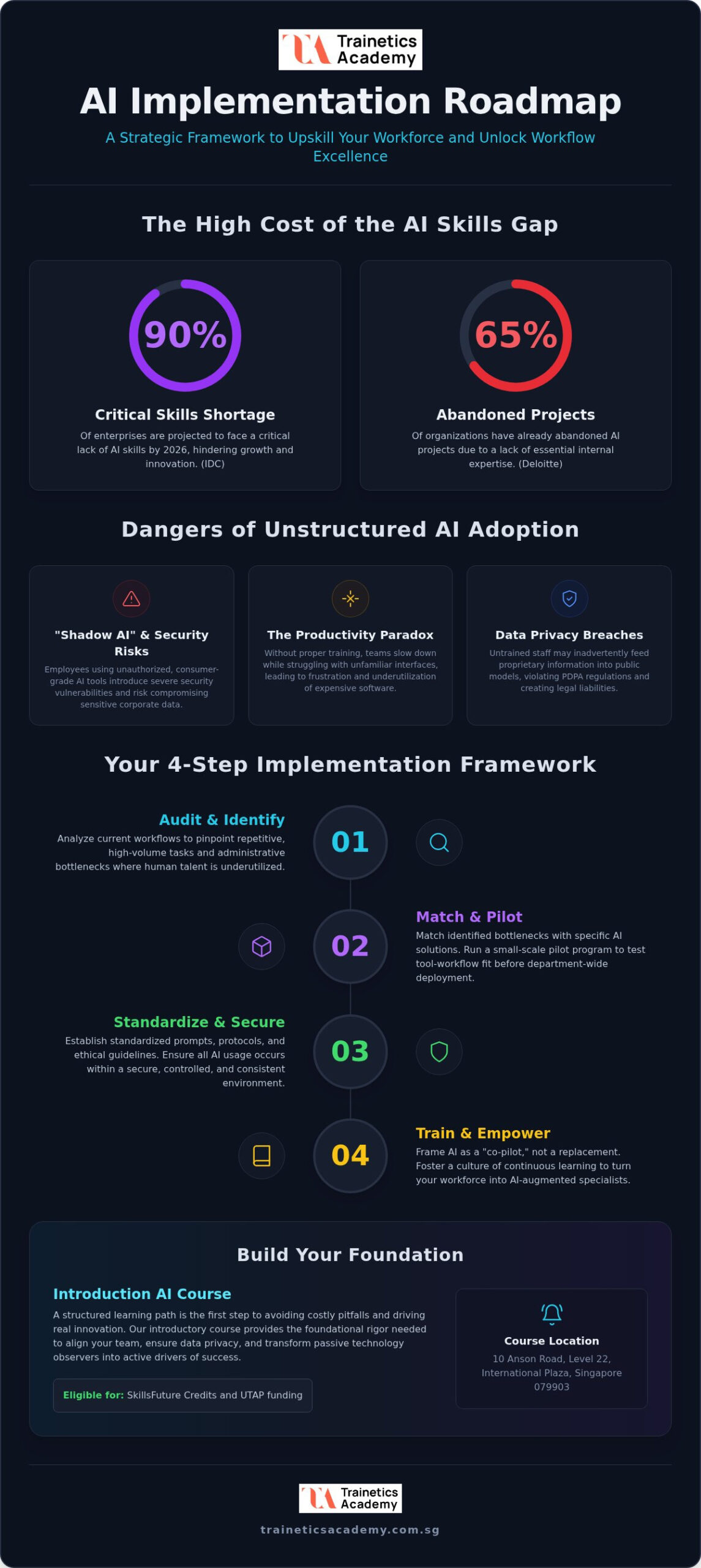
90% of enterprises are projected to face critical AI skills shortages by 2026 according to IDC data. While global AI spending hits $2.59 trillion this year, Deloitte reports that 65% of organizations have already abandoned projects due to a lack of internal expertise. These numbers prove that the real barrier to growth isn’t the software itself; it’s the strategy behind training your team for ai implementation. You’ve likely seen the hesitation in your own office, where employees worry about job security and leaders fear investing in tools that gather digital dust.
We agree that transitioning to an AI-driven workflow feels daunting when your team lacks a technical background. This guide promises to demystify that transition, offering a clear roadmap to upskill your workforce and secure a high ROI. We’ll examine how to boost productivity and morale while effectively maximizing government support. For those beginning their journey, our Introduction AI Course at 10 Anson Road, Level 22, International Plaza, Singapore 079903 is eligible for SkillsFuture Credits and UTAP funding. Let’s explore how to turn technical mastery into your company’s strongest professional asset.
Key Takeaways
- Mitigate security risks by replacing “Shadow AI” with a structured educational foundation that ensures long-term operational excellence.
- Implement a rigorous audit framework to pinpoint workflow bottlenecks and select the most effective AI tools for your specific business needs.
- Leverage a 1 day AI course Singapore to accelerate team alignment and ensure immediate practical application without disrupting daily operations.
- Bridge the gap between technology and human trust by training your team for ai implementation using a clear roadmap for ethics and data privacy.
- Elevate your corporate identity through professional training that prioritizes scientific validation and professional readiness across all departments.
Why Training Your Team for AI Implementation is the First Step to Workflow Excellence
Raw technology acts as a dormant asset until your workforce possesses the technical mastery to wield it. In the high stakes environment of 2026, simply purchasing software licenses doesn’t constitute a digital transformation. True excellence emerges when you prioritize training your team for ai implementation as a bridge between complex algorithms and daily operational efficiency. A “tool-first” approach often results in expensive software that remains underutilized or, worse, creates chaotic workflows that frustrate your best talent. By contrast, a “training-first” strategy ensures that every team member understands how to leverage these systems to raise professional benchmarks.
Singaporean firms face a unique challenge known as “Shadow AI.” This occurs when employees use unauthorized, consumer grade tools to complete tasks because they haven’t been provided with official training or sanctioned platforms. This behavior introduces severe security vulnerabilities and risks compromising sensitive corporate data. Establishing a rigorous AI Course framework allows leadership to regain control, ensuring that innovation occurs within a secure, scientifically validated environment. Professional excellence in the modern era requires more than just awareness; it demands a disciplined commitment to continuous upskilling.
The Cost of Unstructured AI Adoption
Adopting technology without a structured learning path leads to a “productivity paradox” where teams actually slow down while fumbling with unfamiliar interfaces. This lack of formal guidance often results in data privacy breaches under the PDPA, as untrained staff may inadvertently feed proprietary information into public models. AI literacy is the ability to critically evaluate and direct machine outputs. Without this skill, your team remains passive observers of technology rather than active drivers of innovation. Investing in an Introduction AI Course at 10 Anson Road, Level 22, International Plaza, Singapore 079903, which is eligible for SkillsFuture Credits and UTAP funding, provides the foundational rigor needed to avoid these costly pitfalls.
Aligning Human Talent with Artificial Intelligence
Leadership must frame these new tools as a “co-pilot” rather than a replacement to effectively reduce employee anxiety. This shift in perspective is vital for maintaining morale during periods of rapid change. The impact of artificial intelligence on workers is most positive when individuals feel empowered to evolve their professional identity. By fostering a culture of continuous improvement, you turn your workforce into AI-augmented specialists who can focus on high level strategy while machines handle repetitive data processing. This alignment doesn’t just improve the bottom line; it secures a prestigious career path for every member of your organization.
A Step-by-Step Framework for Implementing AI in My Company Workflow
Success in digital transformation requires a methodical approach that prioritizes human capability over software procurement. Many organizations falter because they skip the diagnostic phase, rushing to install tools without understanding the underlying logic of their own operations. A structured framework, often developed in collaboration with experts like SoTechnology who provide AI-enabled digital solutions, ensures that training your team for ai implementation results in a cohesive ecosystem rather than a collection of disjointed apps. Start by auditing your current Singapore office operations to identify repetitive, high-volume tasks. This isn’t about finding digital clutter; it’s about pinpointing exactly where human talent is being sidelined by manual data entry or administrative friction.
Once you’ve identified these bottlenecks, match them with specific solutions. Don’t just buy a chatbot; build a capability. This stage involves a pilot program to test tool-workflow fit on a small scale before department-wide deployment. Standardizing prompts and protocols across the team ensures consistency in output and security. As noted by Harvard Business Review, training and upskilling your team is the only way to ensure that your workforce remains competitive as these technologies evolve. Consider starting with a structured AI Course to build this internal capability from the ground up.
Phase 1: Identifying High-Impact Workflow Bottlenecks
Effective implementation begins with a clear distinction between ‘generative’ tasks, like drafting emails or creating reports, and ‘analytical’ tasks, such as market trend forecasting. Use a ‘Task Heatmap’ to visualize where your staff spends the most time on low-value cognitive labor. This data-driven approach reveals the specific areas where automation offers the highest ROI. Integrating the right productivity tools for business allows your team to reclaim hours previously lost to routine processing, shifting their focus toward high-level strategy and client engagement.
Phase 2: Upskilling Through a Specialized AI Course in Singapore
Foundational knowledge must always precede tool-specific training to ensure your team understands the ‘why’ behind the ‘how.’ Passive video learning often fails to translate into workplace efficiency because it lacks the nuance of real-world application. Selecting a targeted AI course Singapore provides your staff with the opportunity to engage in hands-on workshops. These sessions allow employees to practice prompting and data management in a controlled, professional environment. This practical rigor builds the confidence necessary to transition from cautious beginners to proficient users who can direct machine outputs with precision.
Evaluating Training Options: 1-Day Workshops vs. Long-Term Certification
Speed to market is the primary differentiator when choosing between immersive workshops and multi-month certifications. While advanced practitioners may require deep-dive engineering paths, the immediate goal of training your team for ai implementation is often rapid alignment across diverse departments. A 1 day AI course Singapore provides a high-intensity, focused environment where staff can master essential prompting techniques and workflow integration in a single session. This “just-in-time” learning model minimizes operational downtime while maximizing the immediate application of new skills. Organizations must balance this with “just-in-case” theory for their technical leads, ensuring a robust foundation that aligns with the AI Risk Management Framework.
Deciding when to invest in deep-dive paths versus short-form workshops depends on your specific operational bottlenecks. Beginners benefit most from curriculum structures that emphasize immediate utility, while advanced users require specialized modules on data architecture and model fine-tuning. This strategic distribution of educational resources ensures that your workforce remains agile. By focusing on rapid upskilling, you create a culture of professional readiness that can adapt to new technological benchmarks as they emerge. Training shouldn’t be a one-time event; it’s a continuous pursuit of excellence that defines your corporate identity.
Maximizing ROI with SkillsFuture AI Courses
Government support significantly lowers the financial barrier for local SMEs looking to upskill their workforce. Utilizing your skillsfuture credit allows you to reinvest capital into other areas of digital transformation while still receiving top-tier instruction. These subsidies ensure that professional readiness isn’t a luxury reserved for large corporations but a standard available to every ambitious business in the region. Reducing the cost of entry allows for broader participation, ensuring that your entire team gains the literacy needed to drive innovation from within.
Customizing Training for Non-Technical Teams
Specialized training for HR, marketing, and finance should prioritize “no-code” solutions that drive everyday productivity. Bridging the gap between complex jargon and practical business application is essential for building confidence in non-technical staff. When employees see AI as a practical tool for data visualization or document drafting rather than a nebulous threat, their resistance vanishes. This customized approach ensures that technical mastery becomes a shared professional identity across the entire company. Empowering every department with these tools transforms your workforce into a cohesive, AI-augmented specialist unit.
Overcoming Implementation Barriers: Ethics, Privacy, and Buy-in
Establish an internal ‘AI Ethics Charter’ to serve as the foundational pillar for your team’s digital conduct. This document ensures that every member of your Singapore team understands the weight of their professional responsibility when deploying automated systems. Technical mastery is incomplete without the ability to manage the ‘Hallucination’ risk through rigorous verification protocols. Because these models are probabilistic rather than deterministic, they occasionally generate patterns that lack factual accuracy. Training your team for ai implementation involves instilling a mindset where machine outputs are treated as sophisticated drafts requiring expert oversight. Incentivize this evolution by incorporating ‘AI efficiency’ into your annual key performance indicators. This strategy transforms a daunting technical shift into a structured pursuit of career excellence.
Ensuring Data Privacy in Singaporean Workflows
Maintaining the integrity of proprietary information is a non-negotiable standard in a professional environment. You must educate your staff on the critical distinction between ‘Open’ consumer tools and ‘Enterprise’ AI instances that guarantee data isolation. Failure to distinguish between these can lead to inadvertent leaks that violate PDPA standards. The PDPA requires organizations to implement reasonable security arrangements to protect personal data; unsanctioned AI use often bypasses these safeguards. A comprehensive building an ai-ready workforce singapore plan includes clear protocols for what data can be shared with machine models. Protecting your intellectual property is just as vital as increasing your operational speed.
Addressing the ‘AI Anxiety’ Gap
Employee resistance often stems from a fear of obsolescence rather than a lack of technical capability. Address this ‘AI Anxiety’ by framing these tools as sophisticated instruments that amplify human expertise. Create a ‘safe space’ within your department where team members are encouraged to experiment with new prompts and workflows without the pressure of immediate perfection. Fear is the enemy of innovation. When leaders provide a structured path for growth, they replace uncertainty with a sense of professional security. This visionary mentorship helps employees reclaim their professional identity as specialists who command technology rather than being replaced by it. If you need assistance in articulating this value to leadership, explore our guide on how to convince my boss to pay for ai training.
Take the first step toward organizational mastery by enrolling in our Artificial Intelligence Course today.
Scaling Success with Trainetics Academy: Your Partner in AI Transformation
Scaling your organization’s digital capabilities requires more than just a vendor; it demands a visionary mentor. At Trainetics Academy, our approach is rooted in academic rigor and scientific validation, ensuring that every lesson translates directly into operational efficiency. We don’t just teach tools; we offer a professional identity that empowers your staff to lead with confidence. By prioritizing training your team for ai implementation through our structured curriculum, you’re investing in a future where technical mastery is the baseline for every department. Our physical workshops at International Plaza provide the ideal environment for high-impact learning that drives immediate results. This face-to-face interaction allows for the kind of hands-on collaboration and real-time feedback that digital platforms simply cannot replicate.
Our AI Course is designed to jumpstart team productivity by stripping away the complexity of machine learning and focusing on actionable business outcomes. When you align your workforce with international benchmarks, you’re not just keeping pace with the market; you’re setting the standard for your industry. Booking a corporate consultation allows us to map out a customized roadmap that fits your specific workflow requirements and long-term ROI goals. We take a systematic approach to education, moving from foundational concepts to advanced applications to ensure a steady, predictable learning path for your employees.
Corporate Training Solutions for Singaporean SMEs
Generic platforms often fail to address the unique challenges of the local market. We specialize in tailoring our curriculum to specific sectors like Finance, Real Estate, and Logistics, ensuring that the examples used in class mirror the bottlenecks your team faces daily. Our expert mentors bring years of industry experience to every ai workshop for corporate teams singapore, providing a level of personalized guidance that digital-only platforms can’t match. This local expertise is vital for understanding regional educational frameworks and ensuring your training investment yields tangible results. We focus on raising professional benchmarks, turning your employees into sophisticated specialists who understand the nuances of the local business environment.
Future-Proofing Your Workforce for 2026 and Beyond
Professional readiness is a continuous journey rather than a destination. Trainetics Academy provides the ongoing support and advanced modules necessary to maintain your competitive edge as technology evolves. We’re committed to producing top-tier AI-ready professionals who possess both the technical skill and the ethical discipline to lead in a digital-first economy. By choosing a partner that values precision and hard work, you ensure that training your team for ai implementation remains a core pillar of your company’s growth strategy. Our academy’s mission is to produce top-tier AI-ready professionals who redefine excellence in their respective fields. This disciplined pursuit of knowledge ensures that your team remains supportive yet demanding of high standards within their own daily workflows.
While internal upskilling prepares your team for the future, maintaining an external presence is just as critical. Experts like ZeroClick.sg assist organizations in developing a comprehensive AI visibility strategy and managing brand citations, ensuring that your corporate identity remains clear and authoritative across all AI-driven platforms.
Secure Your Competitive Advantage Through Technical Mastery
The transition toward an AI-augmented workplace is a permanent shift in the professional landscape. Success depends on moving beyond software acquisition to focus on human capability and strategic workflow redesign. By establishing a clear framework for training your team for ai implementation, you protect your organization against security risks while fostering a culture of innovation. This disciplined approach ensures that every employee evolves from a passive user into a sophisticated specialist who can direct machine outputs with precision. You’ve already explored how to audit your current workflows, select the right tools, and overcome the psychological barriers that often hinder adoption.
Professional readiness is the ultimate safeguard for your business in 2026. Our curriculum provides a high-standards gateway to technical mastery, ensuring your workforce receives the elite training needed for career excellence. Enroll your team in our professional AI Course today and secure your place as a visionary industry leader. The pursuit of excellence starts with a single, decisive step toward continuous upskilling.
Frequently Asked Questions
How do I start training my team for AI implementation if we have no technical background?
Start by identifying repetitive workflow bottlenecks that don’t require complex reasoning. Training your team for ai implementation should focus on foundational literacy rather than coding skills. By understanding the logic behind machine outputs, non-technical staff can leverage “no-code” platforms to automate manual data entry. This transition turns employees into AI-augmented specialists who focus on high-level strategy while technology handles the routine processing.
What is the best AI course for beginners in a corporate setting?
The most effective programs for beginners are those that offer a blend of academic rigor and hands-on workshops. Look for an AI course Singapore that prioritizes practical business applications over abstract theory. These courses empower non-technical professionals to master prompt engineering and data visualization. A structured learning path ensures that your team builds the confidence necessary to integrate these tools into their daily professional identity.
Can I use SkillsFuture credits for my team’s AI training in Singapore?
Individual team members can leverage government subsidies to offset the cost of their professional development. Many specialized programs are eligible for regional grants, which significantly reduces the financial burden on SMEs. We recommend checking the official SkillsFuture portal for the most current list of qualifying courses. This financial support allows you to reinvest your capital into other critical areas of your company’s digital transformation.
How long does it take to see ROI after implementing AI in my company workflow?
Most organizations begin to see measurable ROI within three to six months of successful implementation. These gains typically manifest as a reduction in cognitive labor and faster turnaround times for generative tasks. According to Oxford Economics, professional services firms are expected to spend $3,470 per employee on AI in 2026. This investment pays off as teams reclaim hours previously lost to administrative friction.
To further reduce administrative burdens, many SMEs choose to outsource their corporate governance and payroll to specialists like DNA Accounting, ensuring compliance while their internal teams focus on high-level AI-driven projects.
What are the biggest mistakes to avoid when training staff on AI tools?
The most common error is adopting a “tool-first” strategy without first establishing a training foundation. Without disciplined training, employees may inadvertently leak proprietary data through unauthorized “Shadow AI” platforms. Another significant mistake is failing to verify machine outputs for “hallucinations.” Training your team for ai implementation must include a strong focus on ethics, data privacy, and critical verification to ensure long-term operational excellence.
Is a 1-day AI course enough to make my team proficient?
A 1 day AI course Singapore is highly effective for achieving rapid team alignment and foundational proficiency. It provides the essential skills needed to start using productivity tools immediately without disrupting daily operations. While deep-dive certifications exist for technical leads, a single day of intensive training is often enough to transform a non-technical department into a proficient, AI-ready unit capable of driving innovation.
How do I ensure our AI implementation stays compliant with Singapore’s data laws?
Compliance requires a strict adherence to the PDPA and the AI Risk Management Framework. Your team must be trained to use enterprise-grade instances that ensure data isolation rather than public models. Establishing an internal ‘AI Ethics Charter’ helps standardize protocols for handling sensitive information. Regular audits and a “training-first” approach ensure that your digital transformation remains both scientifically grounded and legally secure.
What AI tools should we focus on during initial team training?
Focus on generative AI tools that integrate seamlessly into your current office suites. Text-based models and image generators offer the most immediate benefits for departments like marketing, HR, and finance. By mastering these foundational tools first, your team can achieve quick wins that build morale and prove the value of the technology. This strategy creates a steady learning path toward more advanced analytical applications in the future.
Disclaimer
AI Content Disclaimer: Some articles on this website may be generated or assisted by AI-powered content creation tools. While we strive for accuracy and relevance, readers should independently verify information before relying on it. The content is provided for informational purposes only and does not constitute professional advice.