The most expensive mistake a Singaporean firm can make in 2026 isn’t ignoring artificial intelligence; it’s attempting to build a proprietary curriculum from scratch without a proven blueprint. You likely recognize the tension between the high cost of specialized talent and the urgent need to keep pace with regional competitors. To stay ahead, many firms leverage regional expertise such as Envolve Alliance for comprehensive organizational development and corporate training. Deciding between in-house vs outsourced AI training for Singapore companies requires more than a simple budget review; it demands a disciplined vision for professional mastery and technical excellence.
This guide provides a strategic framework to help you navigate data privacy concerns and maximize your investment through the Introduction AI Course, which is eligible for SkillsFuture Credits, at our center at 10 Anson Road, Level 22, International Plaza, Singapore 079903. You’ll discover a clear decision matrix to determine when to leverage external mentors and how to ensure this transition feels scientifically grounded for your team. We’ll show you how to utilize SkillsFuture AI courses to seed an internal culture of innovation before scaling your own programs. By the end of this article, you’ll have the roadmap to build a tech-ready workforce that meets international benchmarks with minimal disruption.
Key Takeaways
- Identify the critical urgency of AI literacy and how selecting the right training model defines your competitive edge in the 2026 digital economy.
- Assess the strategic trade-offs of in-house vs outsourced AI training for Singapore companies to balance proprietary data security with external pedagogical expertise.
- Utilize a structured roadmap that begins with a comprehensive skill gap audit to ensure your training investment aligns with specific corporate workflows.
- Empower internal ‘AI Champions’ through expert-led sessions to seed a culture of technical mastery and long-term professional development.
- Maximize your training budget by leveraging available government subsidies like the SkillsFuture Enterprise Credit (SFEC) to offset the costs of workforce transformation.
In-House vs. Outsourced AI Training: Defining the Strategic Choice
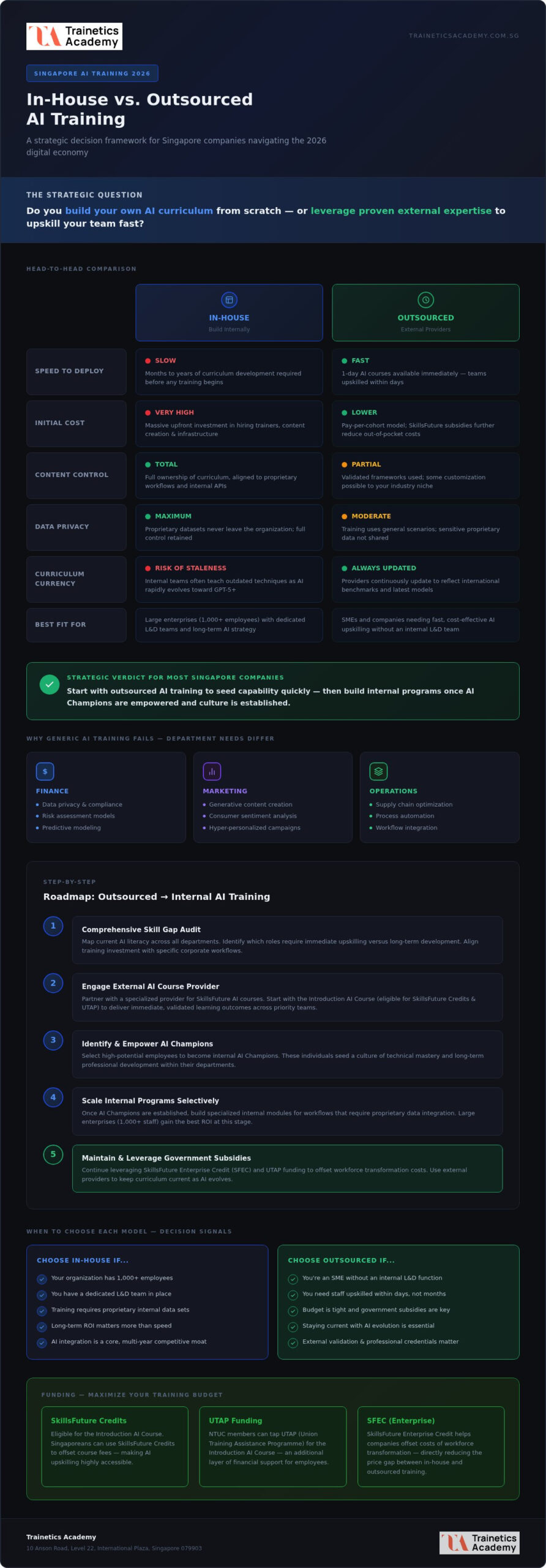
In 2026, Singapore’s digital economy has reached a tipping point where AI literacy is no longer a luxury; it’s the baseline for professional survival. Companies that hesitate to formalize their education strategy risk obsolescence as regional competitors integrate generative models into every workflow. When evaluating in-house vs outsourced AI training for Singapore companies, leadership must look beyond the immediate invoice. In-house training involves building proprietary curriculums from the ground up and hiring dedicated internal mentors to maintain them. Conversely, outsourced training means partnering with a specialized AI course Singapore provider to leverage pre-existing expertise and validated pedagogical frameworks.
A generic approach consistently fails in high-stakes environments. Different departments require specific technical mastery that a broad internal program might overlook:
- Finance: Focuses on data privacy, risk assessment, and predictive modeling.
- Marketing: Prioritizes generative content, consumer sentiment analysis, and hyper-personalized campaigns.
- Operations: Demands supply chain optimization and process automation.
Attempting to bridge these gaps with a single, unspecialized internal program often results in shallow learning. It doesn’t translate to the professional readiness required in a competitive market.
The Cost of Speed vs. The Cost of Control
Building custom internal AI modules requires a massive initial investment in both time and capital. For many organizations, the speed advantage of a 1 day AI course Singapore is far more attractive for immediate upskilling. While in-house programs offer total control over content, they struggle with long-term maintenance. As AI models evolve toward GPT-5 and beyond, internal teams often find themselves teaching outdated techniques. Outsourced providers solve this by constantly updating their curriculum to reflect international benchmarks and scientific advancements.
Singapore’s Talent Landscape in 2026
The current market faces a distinct scarcity of professionals who can both execute high-level AI tasks and teach them effectively. This talent gap is particularly punishing for SMEs that lack dedicated L&D teams. External providers bridge this divide, offering a gateway to a prestigious career for employees through external validation and professional readiness. Training at our facility at 10 Anson Road, Level 22, International Plaza, Singapore 079903, ensures your staff receives instruction that meets rigorous industry standards. Our Introduction AI Course is eligible for SkillsFuture Credits and UTAP, making it a strategic starting point for companies aiming for excellence without the overhead of an internal academy.
The Benefits of Building an Internal AI Training Program
Building an internal training ecosystem represents a significant commitment to organizational excellence. When evaluating in-house vs outsourced AI training for Singapore companies, the primary advantage of the internal route is the surgical precision it offers. You aren’t just teaching general concepts; you’re embedding AI directly into the unique operational rhythms of your business. This deep alignment ensures that every prompt and model output serves a specific corporate objective, utilizing proprietary data sets that no external provider can access. It transforms a standard tool into a bespoke engine for growth.
Customization and Workflow Integration
Mastery requires more than understanding theory. It demands the integration of internal APIs and specific software stacks into the learning modules. By tailoring use cases to your industry niche, you transform a generic technology into a specialized asset. Proprietary AI training acts as a powerful competitive moat in 2026, creating a barrier to entry that competitors using off-the-shelf solutions simply cannot replicate. This level of technical mastery allows your workforce to innovate with an agility that mirrors the highest standards of professional performance.
Large-scale organizations with over 1,000 employees often find that internal programs provide a superior return on investment over time. While the initial setup is intensive, the per-head cost drops significantly as the program scales. Fostering an “AI First” culture through peer-to-peer mentoring creates a self-sustaining environment of continuous improvement. This visionary approach transforms your staff into a community of practitioners who push one another toward international benchmarks. Before committing to a full-scale internal build, many leaders find value in establishing a baseline of excellence through a professional AI course to identify their future internal mentors.
Data Security and Intellectual Property
Security remains a paramount concern for any disciplined leader. Training on sensitive client data behind closed doors significantly reduces the risk of intellectual property leaks. By maintaining a strictly internal training environment, you ensure full PDPA compliance while minimizing reliance on third-party platforms for sensitive skill development. This total control allows you to develop high-level skills without compromising the integrity of confidential information. It provides the security necessary to experiment with advanced models while keeping your most valuable data assets protected from external exposure.
Why Most Singapore Companies Start with Outsourced AI Courses
The decision regarding in-house vs outsourced AI training for Singapore companies often begins with a pragmatic realization: internal resources are rarely equipped to match the pace of global innovation. External partnerships provide immediate access to cutting-edge pedagogical techniques and high-level experts who live and breathe algorithmic shifts. By choosing an external AI course Singapore, leadership eliminates the administrative burden of curriculum design and assessment creation. This allows your team to focus on application rather than architecture, accelerating your transition into an AI-enabled organization.
External benchmarking is a critical, often overlooked advantage. When your staff trains with a professional provider, they aren’t just learning tools; they’re seeing how other industry leaders apply these technologies. This exposure prevents the ‘echo chamber’ effect common in internal-only programs. High-impact, short-duration formats like a 1 day AI course Singapore offer a concentrated burst of technical mastery, ensuring professional readiness without the months of lead time required for an in-house build. It’s a disciplined approach to upskilling that prioritizes immediate results and scientific validation.
Accessing Specialized Expertise
Specialized trainers dedicate 100% of their bandwidth to tracking the volatile AI landscape, from large language model updates to emerging agentic workflows. This ensures your workforce learns from the most current models and ethical frameworks available. A recognized AI course provider offers a level of external validation that internal certificates cannot match. These programs provide a professional identity rooted in international benchmarks, ensuring your team is prepared for the rigorous demands of the 2026 economy. You gain a visionary mentor who guides your staff through technical mastery without the trial and error of a self-taught internal curriculum.
Leveraging Government Subsidies
Strategic fiscal management is central to any successful digital transformation. Singapore’s robust support for corporate upskilling ensures that external partnerships remain a highly viable entry point for companies of all sizes. By partnering with professional academies, firms can maximize their training budget while ensuring their staff receives a premium education. This approach allows your team to master advanced modules in a professional environment designed for focused learning. It’s the most efficient way to bridge the gap between current capabilities and future readiness through established government support frameworks that favor professional development.
How to Develop an Internal AI Training Program: A Step-by-Step Roadmap
Developing a robust internal training program is a visionary undertaking that moves beyond simple tool adoption toward true technical mastery. For many leaders, the journey of in-house vs outsourced AI training for Singapore companies isn’t a binary choice but a phased transition. It begins with a comprehensive AI Readiness Audit to identify specific skill gaps across departments, ensuring that your investment targets areas with the highest potential for impact. Once these gaps are mapped, you must select a core group of ‘AI Champions’, your most technically adept and motivated staff, to undergo advanced external training.
- Identify: Conduct audits to map current AI literacy levels across the organization.
- Seed: Select champions to lead the internal cultural shift and mentor others.
- Standardize: Use external experts for foundational consistency and quality control.
- Specialize: Create modules centered on proprietary data and internal software stacks.
- Sustain: Implement monthly hackathons or sharing sessions to keep skills sharp.
Phase 1: Foundation Building with External Partners
Quality control is the greatest risk when starting a new program. This is why initial AI courses for beginners should be outsourced to established professionals who track the latest scientific advancements. By utilizing external expertise, you establish a scientifically grounded baseline for all employees. Training in a professional environment signals the importance of this initiative to your workforce. Leveraging SkillsFuture AI courses at this stage reduces the financial burden while ensuring your foundation meets international benchmarks for professional readiness.
Phase 2: Customization and Scaling
As your internal ‘AI Champions’ return with high-level expertise, they begin documenting best practices into a corporate AI handbook. These mentors lead department-specific workshops that focus on your internal APIs and confidential workflows. At this stage, your focus shifts from general literacy to deep technical mastery of proprietary tools. It’s essential to measure the success of these initiatives; the true value of your internal program is best reflected in ROI through time-saved metrics across automated workflows. To start your journey toward this level of professional readiness, consider enrolling your leadership team in a professional AI Course to set the standard for excellence.
Navigating the 2026 Singapore Training Landscape
Professional readiness in 2026 demands a disciplined approach to resource allocation. When finalizing the debate of in-house vs outsourced AI training for Singapore companies, leadership must evaluate three critical vectors: cost efficiency, speed to market, and the depth of customization. While building an internal academy offers total control, the rapid evolution of generative models makes curriculum maintenance a heavy burden. Outsourcing foundational training to professional mentors ensures your team remains aligned with international benchmarks without the overhead of constant research and development.
- Cost: Outsourced training offers a lower barrier to entry; in-house requires significant initial capital for curriculum design and expert hiring.
- Speed: A professional course provides immediate upskilling; internal programs often face a long lead time before deployment.
- Customization: External providers offer broad industry insights; internal programs excel at integrating proprietary data sets.
Strategic Budgeting for 2026
Success involves maximizing every available fiscal tool for corporate upskilling. Organizations should look to utilize the SkillsFuture Enterprise Credit (SFEC) to offset the costs of workforce transformation. You’ll then be able to allocate your primary budget toward custom internal modules while external credits cover foundational literacy. Utilizing professional training facilities for off-site team building signals a commitment to excellence and provides an environment designed for focused learning. Adopting this strategy allows you to evaluate the current grant landscape while prioritizing practical application over theoretical knowledge.
Partnering with Trainetics Academy
We position our Artificial Intelligence Course as the cornerstone of your corporate transformation. It’s designed to provide the scientific validation your workforce needs to excel in a competitive market. For organizations ready to scale, we offer customized corporate group training options that ensure your entire department reaches a high level of professional readiness simultaneously. Partnering with experts guarantees that your transition into an AI-enabled company is both scientifically grounded and practically effective. Start your journey toward excellence by mastering the fundamentals in an environment dedicated to professional mastery.
Mastering Your Corporate AI Evolution
The choice between in-house vs outsourced AI training for Singapore companies defines your competitive trajectory in the 2026 economy. You’ve discovered that the most effective strategy involves a hybrid approach; starting with external expertise to seed a culture of technical mastery before scaling internal proprietary systems. By leveraging professional mentors, you ensure your workforce meets international benchmarks with professional readiness. This visionary path allows you to benefit from external pedagogical excellence while gradually building your own competitive moat through specialized internal workshops.
Our Introduction AI Course is Eligible for SkillsFuture Credit and UTAP, providing a high-value entry point for teams committed to raising their professional benchmarks. This program offers the intellectual rigor required to navigate complex digital shifts, ensuring your staff develops a professional identity rooted in excellence. It’s time to transition from observation to leadership and empower your organization with the technical mastery necessary to thrive in a global market.
Enroll your team in our professional AI Course today to future-proof your operations and secure your place as an industry leader. The future belongs to those who commit to continuous improvement and scientific validation.
Frequently Asked Questions
Is it cheaper to build an in-house AI training program or outsource it?
Outsourcing is generally more cost-effective for the initial phase of workforce upskilling. Building an internal program requires significant capital for curriculum development and hiring specialized talent, whereas an external AI Course allows companies to leverage existing pedagogical frameworks. This reduces the financial barrier when deciding between in-house vs outsourced AI training for Singapore companies.
Which AI courses for beginners are Eligible for SkillsFuture Credit in 2026?
Our foundational AI training module is Eligible for SkillsFuture Credit in 2026. These AI courses for beginners are designed to provide a scientifically grounded entry point into technical mastery. They ensure that Singaporean professionals can access high-level education that meets international benchmarks without a prohibitive upfront cost.
How long does it take to develop a custom internal AI training curriculum?
Developing a custom internal curriculum typically requires three to six months of intensive research and documentation. This process involves mapping specific workflows and integrating proprietary APIs into the training modules. In contrast, an outsourced 1 day AI course Singapore provides an immediate pathway to professional readiness for teams needing urgent upskilling.
Can we use SkillsFuture Enterprise Credit (SFEC) for outsourced AI workshops?
Yes, Singaporean firms can utilize the SkillsFuture Enterprise Credit (SFEC) to cover up to 90% of out-of-pocket expenses for corporate training. Partnering with a professional academy for an AI course Singapore allows organizations to transform their workforce while maintaining fiscal discipline. This makes external training an attractive option for SMEs aiming for rapid digital transformation.
What are the risks of relying solely on outsourced AI training?
The primary risk of relying solely on external providers is a potential gap in department-specific workflow integration. While an external provider offers elite foundational knowledge, the curriculum may not cover your unique proprietary data sets or internal software stacks. A hybrid approach ensures your team gains high-level skills that can later be applied to sensitive internal projects.
Where can I find a 1 day AI course Singapore for my management team?
We offer a high-impact 1 day AI course Singapore designed specifically for management teams at our professional training center. This program focuses on strategic decision-making and the technical mastery required to lead AI initiatives. It provides a concentrated learning path that fits the demanding schedules of industry leaders seeking immediate results.
How do I ensure our internal AI training stays updated with new technology?
Keeping internal training current requires a dedicated team to monitor the volatile landscape of generative models. Most visionary leaders choose to supplement internal efforts with periodic SkillsFuture AI courses from specialized providers. This ensures that your organization’s benchmarks for excellence remain aligned with the latest global scientific advancements.
Is the Introduction AI Course at Trainetics Academy Eligible for UTAP?
Yes, the Introduction AI Course is Eligible for UTAP funding for NTUC members. This provides an additional layer of financial support for professionals seeking a prestigious career through technical upskilling. It ensures that elite AI education remains accessible to those committed to professional mastery and continuous growth.
Disclaimer
AI Content Disclaimer: Some articles on this website may be generated or assisted by AI-powered content creation tools. While we strive for accuracy and relevance, readers should independently verify information before relying on it. The content is provided for informational purposes only and does not constitute professional advice.