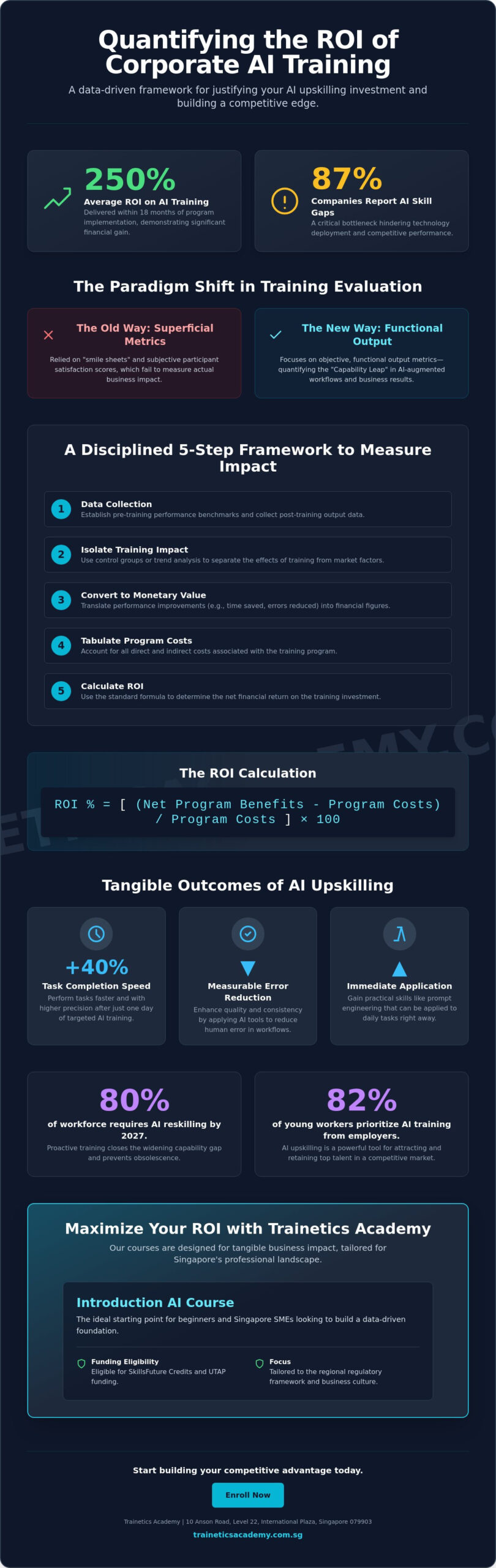
Did you know that structured AI training programs are now delivering an average ROI of 250% within just 18 months of implementation? While 87% of companies report significant skill gaps in AI competencies, many leaders feel the pressure to deploy these technologies without a clear framework for success. You likely agree that measuring the ROI of corporate training remains one of the most complex challenges in professional development, especially when management demands hard data over vague qualitative feedback. It’s difficult to isolate the true “capability leap” from standard market growth when your metrics lack scientific validation.
This guide promises to provide the technical mastery you need to quantify the tangible business impact of AI upskilling and justify your budget. By enrolling in an AI course Singapore leaders rely on, such as our Introduction AI Course which is eligible for SkillsFuture Credits and UTAP funding, you can start building a data-driven foundation. We will preview a clear ROI formula, specific KPIs for AI-enhanced productivity, and the exact steps to create a compelling stakeholder proposal. Whether you seek SkillsFuture AI courses, AI courses for beginners, or a targeted 1 day AI course Singapore, our mission at 10 Anson Road, Level 22, International Plaza, Singapore 079903 is to ensure your investment translates into a prestigious professional identity and a distinct competitive advantage.
Key Takeaways
- Shift your focus from subjective satisfaction scores to objective functional output metrics that quantify the “Capability Leap” in AI-augmented workflows.
- Implement a disciplined five-step framework to isolate training impact from seasonal market trends, ensuring your data remains scientifically grounded.
- Identify the tangible benefits of a 1 day AI course Singapore, focusing on immediate prompt engineering applications and measurable error reduction.
- Develop a high-impact proposal using the “Problem-Solution” format to address stakeholder concerns and demonstrate the high cost of maintaining manual workflows.
- Master the precise methodology for Measuring the ROI of corporate training to justify and strategically optimize your AI upskilling budget for 2026.
What is the ROI of Corporate Training in the AI Era?
In the context of 2026, Return on investment (ROI) is the measurable financial gain an organization realizes from upskilling its workforce compared to the capital expended on that education. For years, organizations relied on “smile sheets” or participant satisfaction scores to gauge success. However, the rapid acceleration of generative technologies has forced a pivot. To succeed today, leadership must transition from these superficial metrics to functional output metrics. This means tracking how an AI Course directly reduces operational latency or increases high-value output per employee. Mastering the methodology for Measuring the ROI of corporate training allows leaders to move beyond guesswork and secure a data-driven competitive edge.
To better understand the nuances of how these metrics are calculated in a corporate setting, watch this helpful video:
While ROI focuses on the bottom line, Return on Expectations (ROE) measures how well the training met the specific strategic goals set by stakeholders. In Singapore, the “AI Capability Gap” has become a critical bottleneck. As verified research indicates that 80% of the global workforce will require AI reskilling by 2027, the gap between manual execution and AI-augmented performance is widening. Bridging this gap isn’t just about software; it’s about the technical mastery of the human element. Companies that fail to address this gap risk obsolescence as competitors leverage automated decision-making and rapid content generation to outpace them.
The Evolution of Training Evaluation
Meaningful evaluation now skips past Level 1 reaction and focuses on Level 4 business results. Traditional metrics often fail because they don’t account for the exponential speed of AI-driven change. Trainetics Academy addresses this by setting professional benchmarks that align with global standards. We ensure that Measuring the ROI of corporate training is a data-driven process, moving beyond whether an employee liked the course to whether they can now perform tasks 40% faster with higher precision. This evolution reflects a shift toward academic rigor in professional development, where technical mastery is the only valid metric of success.
Why ROI is Critical for Singapore SMEs
For local small and medium enterprises, justifying the cost of an AI course Singapore professionals can trust is essential for survival. Our Introduction AI Course is specifically designed for this purpose and is Eligible for SkillsFuture Credits and UTAP funding. Training at 10 Anson Road, Level 22, International Plaza, Singapore 079903 ensures that your team receives instruction tailored to the regional regulatory framework and business culture. Beyond productivity, this investment serves as a powerful tool for talent attraction. Research shows 82% of younger workers prioritize AI training when choosing an employer, making upskilling a key factor in employee retention within the SG tech hub.
A Framework for Measuring Training Impact
Establishing a rigorous methodology is the cornerstone of professional accountability in learning and development. To move beyond anecdotal evidence, organizations must adopt a disciplined five-step process: data collection, isolation, conversion, costing, and calculation. This structured approach aligns with the Phillips ROI Model, which serves as a global benchmark for corporate accountability. By integrating A Framework for Measuring Training Impact, firms can move from speculative gains to scientifically validated results. Pre-and-post-training assessments are vital here. They don’t just measure memory; they track the actual acquisition of technical mastery and the closing of specific capability gaps.
Isolating the Impact of an AI Course
Isolating the effects of education from external market trends is often where many attempts at Measuring the ROI of corporate training falter. You must determine if a 40% productivity spike was caused by the training or simply a seasonal market upswing. Control groups offer the highest level of scientific rigor, allowing you to compare trained cohorts against those working with manual workflows. Trend-line analysis also helps by projecting performance without the intervention. Isolation of Variables is the analytical process of separating the effects of a specific training program from all other internal and external factors that influence business performance. This ensures your ROI claim is defensible in the boardroom. You should also watch for “spillover effects,” where a single employee who attends an AI course Singapore professionals value returns to upskill their entire department through informal knowledge sharing.
Calculating Total Investment Costs
Precision in costing is equally essential for a transparent evaluation. Your calculation must include the direct fees for an artificial intelligence course, but it shouldn’t stop there. Indirect costs, such as employee time away from work, facility fees, and administrative overhead, must be factored into the “Investment” variable. Fortunately, Singaporean firms can significantly lower this barrier. Our Introduction AI Course is Eligible for SkillsFuture Credits and UTAP funding, which reduces the net cost and immediately improves your ROI percentage. By accounting for these subsidies, you present a more accurate and attractive financial case to management. If you’re looking for an immediate impact, a 1 day AI course Singapore can provide the rapid upskilling needed to see returns in as little as one fiscal quarter.
If you’re ready to implement these standards in your organization, exploring a professional AI course is the next logical step toward raising your professional benchmarks.
Tangible vs. Intangible Metrics: The AI Difference
Distinguishing between hard data and soft data is essential for any leader tasked with Measuring the ROI of corporate training. In the context of rapid technological transformation, hard data refers to the concrete, numerical evidence of improvement, such as specific hours recovered or operational expenses slashed. Soft data encompasses the psychological and cultural shifts within a team, including increased confidence and a proactive innovation culture. While management often prioritizes the former, the synergy between both is what creates a sustainable competitive advantage. You can’t achieve exponential efficiency without a workforce that feels secure and capable in their new digital identity.
The concept of “Time-to-Value” serves as a primary differentiator for tech-based education. Traditional professional development often suffers from a significant lag between instruction and implementation. Conversely, a high-impact 1 day AI course Singapore focuses on immediate technical mastery. By the time participants leave our facility at 10 Anson Road, Level 22, International Plaza, Singapore 079903, they’ve already mastered prompt engineering techniques that they can deploy the very next morning. This rapid transition from theory to execution is what makes Measuring the ROI of corporate training so rewarding for modern enterprises, as the delta between investment and impact is drastically compressed.
Hard Metrics: Time and Cost Savings
To calculate the true ROI, you must translate time saved into a specific dollar value based on your organization’s unique labor costs. If a mid-level executive recovers five hours weekly through automated workflows, the organization essentially gains back over 250 hours of high-value productivity per year. This doesn’t even account for the massive reduction in rework costs. AI-driven quality checks minimize human error, ensuring that complex projects are completed accurately the first time. By integrating the Top AI Productivity Tools for Business in Singapore, firms can standardize these efficiencies across entire departments and eliminate costly operational latency.
Intangible Metrics: Morale and Agility
Beyond the balance sheet, AI courses for beginners play a vital role in maintaining psychological safety during periods of disruption. Many employees harbor a “fear factor” regarding automation, worrying about potential job displacement. Professional upskilling replaces this anxiety with a sense of technical mastery and professional readiness. When a team feels “Future-Ready,” their engagement scores typically rise, and turnover rates drop because they see a clear path for career growth. This cultural agility allows for faster decision-making because employees possess the data literacy required to interpret AI-generated insights without hesitation. Investing in a comprehensive AI Course is a commitment to building a resilient, visionary workforce that thrives on change.
How to Present an AI Training ROI Case to Management
Presenting a case for budget allocation requires more than a list of course features; it demands a clear problem-solution narrative. Management often views professional development as a cost center rather than a revenue driver. To shift this perception, frame your proposal around specific operational bottlenecks that currently hinder growth. Use visual dashboards to illustrate the projected versus actual delta in performance. Measuring the ROI of corporate training becomes a persuasive tool when you can demonstrate how a technical intervention solves a documented financial leakage. Align your request with the organization’s 2026 strategic goals to prove that upskilling is a prerequisite for achieving international benchmarks.
Address the common “no time” objection by highlighting the staggering cost of inaction. If your team continues with manual workflows while competitors undergo rapid reskilling, your firm’s market position will erode. Every hour spent on inefficient processes is capital lost. Frame the training not as an interruption, but as a necessary recalibration to ensure professional readiness and long-term viability. This disciplined approach ensures that the transition into AI-augmented execution feels both scientifically grounded and economically sound.
Translating Technical Skills to Business Value
Discard technical jargon that obscures the bottom line. Instead of discussing “LLM mastery,” highlight a “30% reduction in customer support response time.” Focus on how one AI Course Singapore leaders endorse can scale benefits across multiple departments. For example, a marketing team using generative tools can produce higher content volume without increasing headcount. For more tactical communication strategies, consult our guide on How to Ask for Training in Singapore. This clarity helps stakeholders see the professional identity your team will adopt after mastering these tools.
Leveraging Government Support
Demonstrate fiscal responsibility by presenting the net cost after available subsidies. Highlighting how SkillsFuture AI courses reduce the financial risk for the company makes the decision easier for stakeholders. By leveraging support for the Introduction AI Course, you transform a high-level educational investment into a practical success story. Our central facility at International Plaza provides a professional environment that reflects the high standards your team deserves. This strategic approach ensures that Measuring the ROI of corporate training reflects both cost-efficiency and technical excellence, positioning your firm at the forefront of innovation.
Secure your team’s future by enrolling them in a professional Artificial Intelligence Course today.
Maximizing ROI with Trainetics Academy AI Programs
Trainetics Academy doesn’t just offer courses; we provide a professional identity. Our approach to Measuring the ROI of corporate training is rooted in academic rigor and practical career outcomes. We understand that your capital must work as hard as your employees. By choosing a partner that values precision and continuous improvement, you ensure that every minute spent in our curriculum translates into a measurable business advantage. We position our academy as a gateway to excellence, reassuring leadership that their investment is backed by the highest standards of technical mastery.
Our interactive, professional-led curriculum is designed specifically for the high-stakes Singaporean market. We bridge the gap between complex science and practical coaching, ensuring that technical mastery is achieved quickly and effectively. Whether your team prefers the immersive experience of our physical facility or the flexibility of our virtual platforms, we maintain a steady, predictable pace that builds trust. This flexibility allows corporate groups to maintain operational continuity while undergoing a significant transformation in their internal capabilities. Whether you require a comprehensive AI course Singapore leaders trust or a targeted workshop, our mission is to raise your professional benchmarks.
Why Trainetics for Corporate AI Training?
We prioritize professional readiness by moving beyond surface-level theory to actual implementation. Our instructors are industry leaders who possess a deep understanding of the local regulatory and commercial landscape. This expertise ensures that your team isn’t just learning tools, but mastering the strategic application of AI within their specific roles. Our programs offer several distinct advantages:
- Scientifically grounded curriculum that aligns with international benchmarks.
- Hands-on technical mastery through real-world business scenarios and workflow integration.
- Flexible delivery models that accommodate both local and global teams without compromising depth.
- A focus on immediate, actionable business outcomes that justify your training budget.
For a deeper dive into the localized benefits and how we tailor our curriculum to meet the needs of the SG tech hub, explore our AI Course Singapore: The Ultimate 2026 Guide.
Next Steps for Your Organization
Contact Trainetics Academy to discuss your corporate AI training needs and begin your journey toward technical mastery today.
Elevate Your Professional Standards for 2026
Precision in Measuring the ROI of corporate training is the hallmark of a disciplined and visionary organization. You now possess the five-step framework and the analytical tools needed to isolate the true impact of upskilling from seasonal market fluctuations. By focusing on functional output metrics and the rapid “Time-to-Value” offered by AI-augmented workflows, you can confidently justify your development budget. This transition from theory to technical mastery ensures that your team doesn’t just adapt to change but leads it with authority and scientific rigor.
Trainetics Academy remains committed to providing the highest standard of education through our qualified professional instructors and interactive virtual and physical platforms. We don’t merely offer courses; we offer a professional identity rooted in excellence and professional readiness. It’s time to move beyond the fear factor of new technology and embrace a future defined by innovation and leadership. Your journey toward raising industry benchmarks starts with a single, strategic decision to invest in your team’s technical capability.
Empower your workforce with our Artificial Intelligence Course and secure your firm’s position as a prestigious industry leader. We look forward to helping you achieve the highest standards of professional success and measurable business impact.
Frequently Asked Questions
How long does it typically take to see a positive ROI from an AI Course?
Positive returns can be measured as early as the first fiscal quarter, although broader organizational impacts often stabilize over 18 months. Verified research suggests that structured upskilling delivers an average return of $3.70 for every dollar invested. This rapid “Time-to-Value” is a primary reason why 75% of executives plan to increase their training budgets to close the “AI Capability Gap” quickly.
Can I use SkillsFuture Credits for all corporate AI training at Trainetics?
Only the Introduction AI Course is identified as Eligible for SkillsFuture Credits and UTAP funding at our academy. While we offer a range of specialized programs, this specific foundational course is designed to maximize accessibility for Singaporean professionals. It’s an ideal starting point for those looking to build technical mastery and professional readiness without high initial overhead.
What are the most important KPIs to track after a 1 day AI course Singapore?
The most critical KPIs after a 1 day AI course Singapore include prompt engineering accuracy, reduction in task completion time, and the volume of high-value output per employee. You should also track the “spillover effect,” where trained individuals share techniques with their peers to raise the entire department’s benchmark. These functional metrics provide the hard data required for Measuring the ROI of corporate training.
How do I calculate the ROI of “soft skills” like AI ethics or risk management?
Calculating the ROI of intangible skills involves measuring the reduction in “cost of risk” and operational rework. This includes tracking a decrease in compliance incidents, potential legal fees, and the time saved by preventing biased or inaccurate outputs. By avoiding these high-stakes errors, Measuring the ROI of corporate training in ethics serves as a defensive investment that protects the organization’s long-term financial health.
What happens if we train our employees in AI and they leave the company?
The cost of maintaining an unskilled workforce is far greater than the risk of turnover in a competitive tech hub. Research shows that 82% of younger workers prioritize AI training when choosing an employer, meaning upskilling actually serves as a powerful retention tool. Training your team ensures your company remains “Future-Ready” while attracting top-tier professionals who value a culture of continuous improvement and technical mastery.
Is the ROI of virtual AI training comparable to in-person sessions?
The ROI of virtual training is highly comparable to in-person sessions when the curriculum maintains academic rigor and professional-led interactivity. Virtual platforms offer scalability for global teams, while in-person sessions at 10 Anson Road, Level 22, International Plaza, Singapore 079903 provide immersive networking and deep technical focus. Both delivery models are designed to achieve the same prestigious professional identity and business outcomes.
How can small SMEs in Singapore justify the cost of AI training with limited budgets?
Small SMEs can justify the investment by focusing on the massive productivity delta between manual and AI-augmented execution. By leveraging subsidies for an AI course Singapore professionals recommend, the net cost is significantly reduced, making the “Capability Leap” achievable even with limited capital. This strategic upskilling allows smaller firms to compete with larger enterprises by maximizing the output and efficiency of every individual team member.
Disclaimer
AI Content Disclaimer: Some articles on this website may be generated or assisted by AI-powered content creation tools. While we strive for accuracy and relevance, readers should independently verify information before relying on it. The content is provided for informational purposes only and does not constitute professional advice.