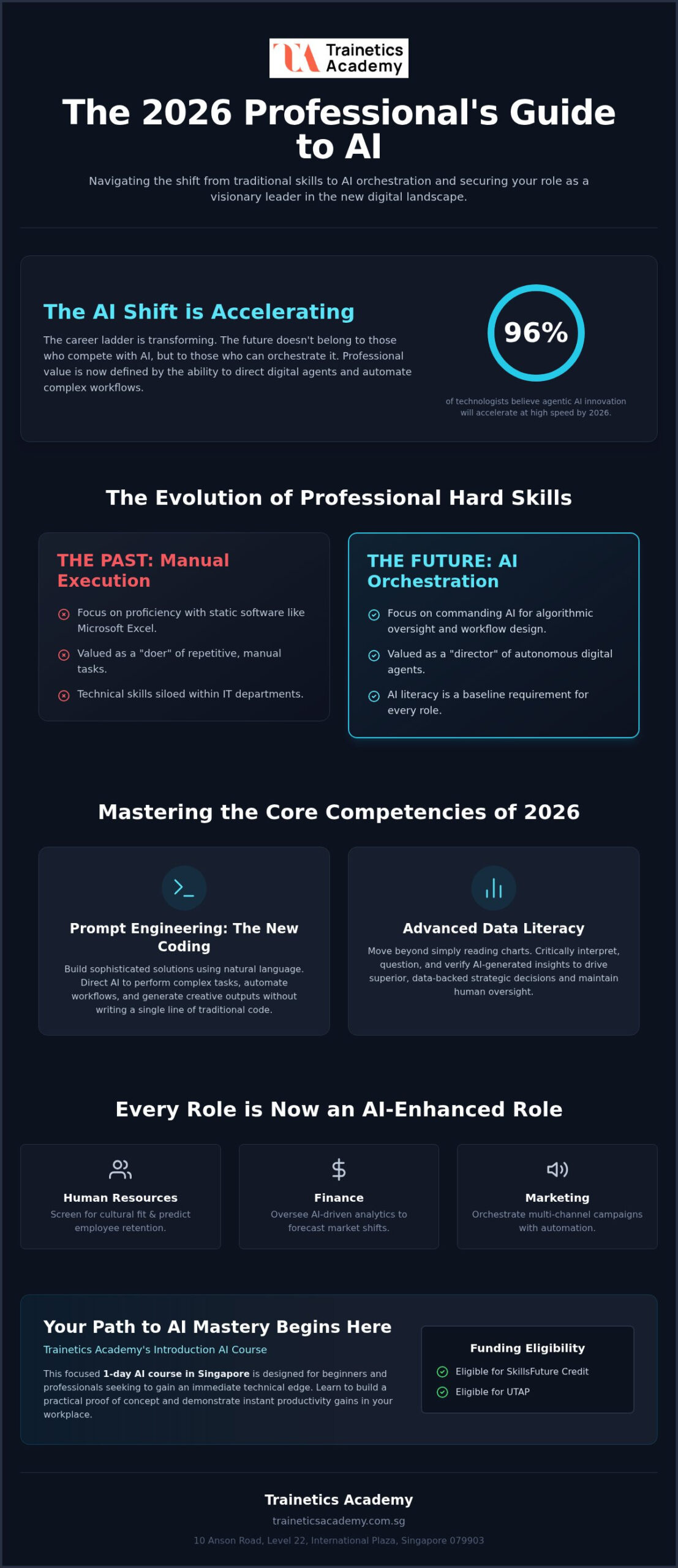
96% of technologists believe that agentic AI innovation will accelerate at a high speed in 2026, transforming the traditional career ladder into a shifting digital landscape. You’ve likely felt the pressure to adapt, yet the constant noise of new software often leads to more confusion than clarity. This guide serves as your strategic blueprint for technical skills development training, cutting through the information overload to identify which competencies truly drive professional value. We understand the anxiety that comes with watching AI agents become digital coworkers; it’s a common concern, but the goal isn’t to compete with the machine, it’s to orchestrate it.
Trainetics Academy exists to raise professional benchmarks, ensuring you aren’t just a participant in the workforce but a visionary leader. Our Introduction AI Course, located at 10 Anson Road, Level 22, International Plaza, Singapore 079903, is designed for those who demand excellence. This specific program is eligible for SkillsFuture Credit and UTAP, providing a scientifically grounded path to mastery. We’ll preview the essential SkillsFuture AI courses and AI courses for beginners that offer immediate utility. You’ll learn how a 1 day AI course Singapore format can provide the technical edge required to lead in this new era with absolute confidence.
Key Takeaways
- Redefine your professional value by shifting focus from traditional coding to the strategic orchestration of AI workflows and digital agents.
- Develop a high-impact roadmap for technical skills development training that identifies specific AI tools to automate your most repetitive daily tasks.
- Master the core 2026 competencies of prompt engineering and data literacy to drive superior decision-making in an AI-enhanced workplace.
- Utilize your funding effectively by enrolling in the Introduction AI Course, which is eligible for SkillsFuture Credit and UTAP.
- Learn to create a practical proof of concept at work to demonstrate immediate productivity gains and lead your team’s AI adoption.
What is Technical Skills Development Training in the AI Era?
Technical skills development training represents the systematic acquisition of hard skills required to execute specific professional functions with precision. Historically, this meant learning to code in languages like Python or mastering complex database management. By 2026, the paradigm has shifted. While specialized knowledge remains vital, the definition now encompasses the ability to command artificial intelligence to perform foundational tasks. This evolution aligns with the broader goals of Career and technical education, focusing on professional readiness and raising the benchmarks of industry-standard proficiency.
In the Singapore 2026 economy, technical mastery isn’t a silo. It’s interdependent with soft skills. A marketing manager doesn’t just need “creativity”; they need the technical skill to use generative AI to iterate on that creativity at scale. This synergy ensures that professionals don’t just work harder; they work with scientific precision. You aren’t just learning a tool. You’re adopting a professional identity rooted in continuous improvement and technical excellence.
The Evolution of Hard Skills for Professionals
A decade ago, proficiency in Microsoft Excel or basic word processing was the gold standard for office productivity. Today, these are mere utilities. AI orchestration has replaced static software proficiency as the new baseline for PMEAs (Professionals, Managers, Executives, and Associates). Training centers across the island are pivoting away from teaching manual inputs toward teaching algorithmic oversight. Mastering an AI Course is no longer an elective for the ambitious; it’s a requirement for the disciplined professional. This shift reflects a move from being a “doer” of tasks to being a “director” of digital agents. Similarly, in high-stakes fields like infrastructure logistics, Acquired Awareness Traffic Management demonstrates how specialized expertise and technical coordination are required to manage complex environments safely.
Why Every Role Now Requires an AI Skill Set
Technical skills are no longer the exclusive domain of the IT department. HR professionals now use AI to screen for cultural fit and predictive retention, while finance teams have transitioned from manual data entry to overseeing AI-driven predictive analytics that forecast market shifts. Marketing specialists orchestrate multi-modal campaigns across dozens of channels simultaneously using automated workflows. AI literacy is the ability to effectively prompt and manage AI agents. To reach this level of excellence, many seek a 1 day AI course Singapore to bridge the gap between their current capabilities and the rigorous standards of a 2026 workforce. This training ensures you remain an asset in a world where speed and accuracy are non-negotiable.
Identifying the Most In-Demand Technical Skills for 2026
The workforce of 2026 rewards those who can bridge the gap between human intuition and machine output. Identifying the right technical skills development training starts with recognizing that “technical” no longer implies a computer science degree. High-growth career paths are now dominated by “AI for non-coders,” where the ability to design workflows and manage autonomous agents outweighs the need for manual syntax. While international benchmarks like the U.S. Department of Labor skills training grants highlight global trends in technical funding, the Singaporean professional must focus on localized, high-impact competencies to remain competitive.
Data literacy has evolved from simply reading charts to interpreting AI-generated insights with a critical eye. You must understand the logic behind an algorithm’s output to maintain professional readiness. For those just starting, an AI course for beginners provides the necessary framework to navigate these complex systems without feeling overwhelmed. This foundational knowledge ensures you can verify AI results rather than following them blindly, which is a critical distinction for leadership roles.
AI Course Singapore: Choosing Your Specialization
Prompt engineering is the cornerstone of 2026 technical proficiency. It’s often called the “new coding” because it allows you to build sophisticated solutions using natural language rather than complex scripts. Mastering AI productivity tools for business is the next logical step. These tools allow you to automate repetitive administrative loads, freeing you for high-level strategy. To begin this journey, consider enrolling in a foundational Artificial Intelligence Course. This isn’t just about learning a tool; it’s about claiming a new professional identity at our campus at 10 Anson Road, Level 22, International Plaza, Singapore 079903.
Cybersecurity and Data Privacy for the Modern Worker
Developing technical proficiency also involves understanding the broader landscape of professional safety and accreditation. To see how these standards are maintained globally, you can discover Insight Security Training, an expert in accredited security industry education.
As AI tools become ubiquitous, the risk of data leakage increases exponentially. Every professional needs basic technical skills to protect sensitive company information in an AI-driven environment. This involves understanding how to sanitize inputs before feeding them into large language models and recognizing the ethical implications of AI-driven decisions. For a deeper dive into this specific domain, explore our Cyber Security in Singapore guide. Developing these skills ensures you’re an asset who protects the organization while innovating. You can start your transformation today by exploring our AI course Singapore options.
How to Build Your Technical Skills Development Roadmap
Success in the 2026 economy isn’t accidental. It’s the result of a rigorous, self-directed roadmap that prioritizes technical skills development training as a non-negotiable professional standard. Unlike traditional corporate structures where training is often a passive HR function, the modern leader takes personal initiative. You must move beyond simple observation and actively engineer your career path. Global initiatives like California’s GenAI Boot Camp demonstrate that structured, intensive training is the fastest route to technical fluency. By following a disciplined five-step plan, you can transform your professional identity from a legacy worker to an AI-orchestrator.
- Step 1: Conduct a skills gap analysis. Audit your current workflow to identify which tasks are repetitive, data-heavy, or prone to human error.
- Step 2: Identify automation targets. Select 1-2 AI tools that can automate at least 20% of your daily operational load.
- Step 3: Commit to intensive learning. Enroll in the Introduction AI Course at Trainetics Academy, which is Eligible for SkillsFuture Credit and UTAP. This 1 day AI course Singapore format provides the immediate, actionable knowledge you need to stay ahead.
- Step 4: Practice in a sandbox. Apply your new skills in a risk-free virtual environment before deploying them in live company projects.
- Step 5: Validate your expertise. Seek certification to signal your technical readiness and commitment to excellence to the market.
Assessing Your Current Technical Proficiency
Start by auditing your daily functions with a focus on “adjacent skills.” These are competencies that aren’t purely technical but can be supercharged by AI. For example, a project manager’s scheduling ability is an adjacent skill that becomes a technical powerhouse when combined with predictive AI models. You can use a 1-day skillsfuture ai course to bridge these gaps quickly. This focused approach ensures you don’t waste time on irrelevant theory but focus on what drives tangible results.
Selecting the Right Training Format
While virtual platforms offer convenience, the depth of an instructor-led training centre Singapore environment remains superior for complex technical mastery. Physical classroom settings at our location at 10 Anson Road, Level 22, International Plaza, Singapore 079903, provide the academic rigor and peer interaction necessary for deep learning. For a broader perspective on how these choices impact your trajectory, explore our guide on Upskill Singapore. Choosing the right environment is about more than just comfort; it’s about ensuring your transition into an AI-enhanced career is scientifically grounded and professionally secure.
Navigating SkillsFuture AI Courses and Funding in Singapore
Singapore’s workforce development framework is a global benchmark for professional readiness. Successfully navigating this ecosystem requires more than a cursory search; it demands a strategic approach to technical skills development training. By 2026, the national portal has become a sophisticated tool for professionals to identify high-impact learning paths. When you search for SkillsFuture AI courses, you should prioritize programs that emphasize practical orchestration over theoretical abstraction. This ensures your time investment translates directly into workplace productivity and career security in a competitive market.
The process of claiming subsidies is designed to be seamless for the disciplined learner. By minimizing out-of-pocket expenses, you can focus entirely on the academic rigor of the curriculum. Lifelong learning is the cornerstone of the Singaporean identity in the digital age. It’s not merely about attending a class; it’s about the relentless pursuit of excellence and the mastery of tools that define the modern economy. Your goal should be to emerge from training not just with a certificate, but with a professional identity that is future-proof and scientifically grounded.
Maximizing Your SkillsFuture Credit
Checking your balance regularly is essential for long-term career planning. The strategic advantage of using credits for short, intensive professional courses cannot be overstated. Instead of long-form academic programs, many PMEAs find that an AI course Singapore provides the specific hard skills needed to manage AI agents effectively. You can find detailed strategies in our guide on Maximizing Your SkillsFuture Credit. These credits act as a gateway to prestigious training, allowing you to bridge technical gaps with the precision that the 2026 economy demands.
Understanding UTAP and Other Support Schemes
NTUC members can further leverage the Union Training Assistance Programme (UTAP) to support their upskilling. This scheme provides significant relief on unfunded course fees, ensuring that elite AI courses for beginners remain accessible to the wider workforce. Selecting a provider with a proven track record is critical; you need mentors who value precision and hard work, mirroring the high standards of the industry itself. By choosing an intensive 1 day AI course Singapore professionals trust, you commit to a rapid but thorough transformation through targeted technical skills development training. This methodical approach to training ensures you are prepared to lead in an AI-driven landscape with absolute confidence.
Ready to elevate your professional benchmark? Master AI tools in one day and secure your place in the 2026 economy.
Implementing Your New Technical Skills in the Workplace
Transitioning from a student to a practitioner requires a disciplined, strategic approach. The most effective way to demonstrate the value of your technical skills development training is by creating a “Proof of Concept” (PoC) at work. Select a high-visibility, repetitive task, such as automating meeting synthesis or generating predictive project timelines. By deploying an AI-driven solution to a real-world problem, you move beyond theoretical knowledge and provide tangible evidence of increased efficiency. This proactive stance establishes you as a visionary leader who doesn’t just adapt to change but actively orchestrates it.
Your evolution into an “AI-First” practitioner involves more than individual productivity. It requires you to mentor others. Teaching your team about AI productivity tools for business raises the professional benchmark of your entire department. Position yourself as the internal subject matter expert who bridges the gap between legacy processes and modern innovation. In the high-speed 2026 economy, the drive to upskill Singapore is a continuous journey. Staying ahead of tech trends demands a commitment to lifelong learning and the relentless pursuit of technical mastery.
Measuring the ROI of Your Technical Training
Leadership demands hard data. To justify your upskilling efforts, you must track the return on investment through concrete metrics. Start by measuring the specific hours saved through AI automation and the qualitative improvements in your deliverables. Advanced prompt engineering techniques often lead to higher accuracy and more sophisticated output, which are key indicators of professional growth. If you’re looking to secure further support for your development, consult our guide on How to Ask for Training. Presenting a clear correlation between your training and company profitability is the fastest way to accelerate your career trajectory.
Advancing Your Career with Trainetics Academy
Trainetics Academy serves as the gateway to a prestigious, AI-enhanced career. Our curriculum is deeply rooted in academic rigor and professional readiness. Unlike passive learning platforms, our Introduction AI Course is interactive and instructor-led, ensuring you receive the highest standard of education available. We focus on immediate workplace application, giving you the confidence to implement complex AI workflows the moment you return to the office. Our highly qualified professionals provide the mentorship required to navigate the technical nature of these tools. We don’t just offer courses; we offer a new professional identity built on precision, excellence, and the technical edge required to lead in 2026.
Lead the 2026 Economy with Technical Mastery
The digital landscape of 2026 rewards those who treat upskilling as a disciplined pursuit of excellence. Throughout this guide, we’ve identified how the orchestration of AI agents has redefined traditional hard skills and provided a clear roadmap for your career transition. Successfully navigating these shifts requires more than just awareness; it demands a commitment to technical skills development training that is both scientifically grounded and professionally secure. By prioritizing professional readiness today, you position yourself at the forefront of the Singaporean economy.
Trainetics Academy serves as your gateway to this prestigious professional identity. Our Introduction AI Course is delivered by highly qualified professionals who focus on immediate workplace application. We provide the academic rigor you need to lead with absolute confidence, ensuring you are prepared to raise industry benchmarks. It’s time to move beyond observation and start orchestrating your own success in the AI era.
Master AI in just one day, enroll in our Introduction AI Course today!
Your future in the AI-driven workforce starts with a single, decisive step. Embrace the high standards of the industry and secure your place as a visionary leader with the technical edge required to succeed.
Frequently Asked Questions
What are the most important technical skills to learn in 2026?
The most critical competencies include prompt engineering, AI orchestration, and advanced data literacy. In 2026, technical skills development training focuses on directing AI agents rather than manual coding. Professionals must master the ability to interpret AI-generated insights and integrate predictive analytics into their specific workflows. This ensures you remain a high-value asset capable of leveraging automation to drive organizational excellence and maintain a competitive edge in a fast-paced economy.
Can I learn AI skills if I have no background in coding?
You don’t need a computer science degree to excel in the current digital landscape. The shift toward natural language processing means that an AI course for beginners focuses on how you communicate with machines using clear, logical instructions. Non-coders can now build complex workflows and automate 20% or more of their daily tasks by mastering orchestration tools. This democratizes technical mastery, allowing professionals from HR to Finance to lead with innovation.
Is the Introduction AI Course at Trainetics Academy eligible for SkillsFuture Credit?
Yes, our flagship Introduction AI Course is Eligible for SkillsFuture Credit and UTAP funding. This ensures that your pursuit of professional excellence is supported by national frameworks for upskilling. Located at 10 Anson Road, Level 22, International Plaza, Singapore 079903, our academy provides a prestigious environment where you can master high-demand tools. We prioritize professional readiness, ensuring our curriculum meets the rigorous standards required by the 2026 Singaporean workforce.
How long does it take to see results from technical skills development training?
Practical results are often visible immediately following an intensive 1 day AI course Singapore professionals rely on for rapid upskilling. By focusing on actionable tools rather than abstract theory, you can implement automation scripts and AI-driven workflows the very next morning. The goal of technical skills development training is to provide a rapid return on investment. You’ll see measurable improvements in task speed and output quality as you begin to orchestrate digital agents to handle repetitive administrative loads.
What is the difference between an online AI course and in-person training in Singapore?
While online platforms offer convenience, in-person training at a dedicated center provides academic rigor and real-time instructor feedback. Our AI course Singapore format emphasizes interactive, hands-on learning that is difficult to replicate in a virtual silo. Engaging with industry leaders and peers in a professional setting fosters deeper understanding and builds a network of like-minded practitioners. This structured environment is essential for mastering the nuances of AI compliance and governance.
How can I stay updated with rapidly changing AI technology after my course?
Staying updated requires a commitment to lifelong learning and active participation in professional communities. After completing your initial AI Course, you should follow reputable industry reports and attend advanced workshops to refine your skills. The 2026 economy moves quickly, so establishing a routine of “micro-learning” helps you stay ahead of emerging trends. Trainetics Academy also offers a path for continuous improvement, helping you maintain your status as an industry leader.
Are there specific technical training programs for senior professionals in Singapore?
Senior professionals can benefit from specialized SkillsFuture AI courses that focus on strategic oversight and AI-augmented leadership. Instead of deep-diving into technical execution, these programs teach you how to manage AI-driven teams and evaluate the ethical implications of automated decision-making. Mastering these high-level technical skills ensures that experienced leaders can effectively guide their organizations through digital transformation while raising professional benchmarks across their entire department or enterprise. For a comprehensive overview of the top options available, explore this roundup of professional AI certification Singapore programs designed for career growth in 2026.
How do I justify the cost of an AI course to my employer?
Justify the investment by presenting a clear case for increased productivity and cost savings. Explain how an AI Course will allow you to automate time-consuming processes, freeing you for high-value strategic work. Highlight the immediate ROI of learning to use AI productivity tools for business. By demonstrating a link between your technical mastery and the company’s bottom line, you position the training as a necessary investment in the firm’s future competitiveness.
Disclaimer
AI Content Disclaimer: Some articles on this website may be generated or assisted by AI-powered content creation tools. While we strive for accuracy and relevance, readers should independently verify information before relying on it. The content is provided for informational purposes only and does not constitute professional advice.