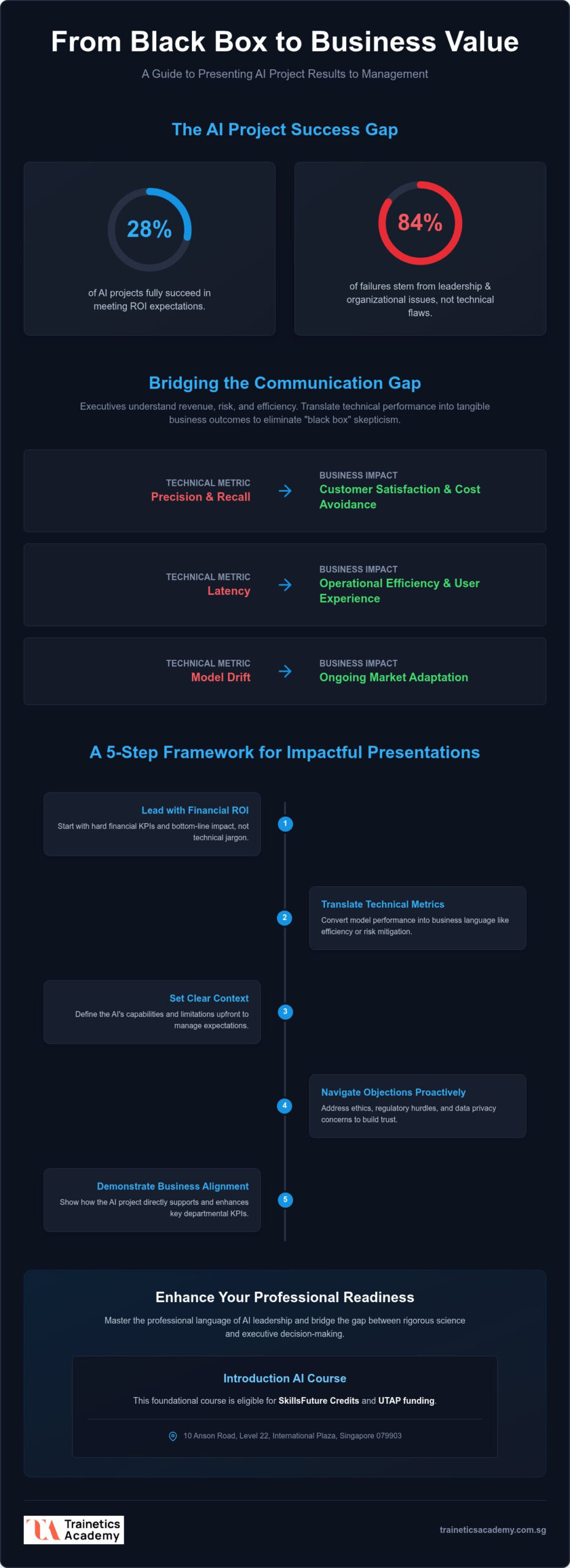
Did you know that as of early 2026, only 28% of AI projects fully succeed in meeting ROI expectations? According to Gartner research, a staggering 84% of these failures stem from leadership and organizational issues rather than technical flaws. If you have ever watched an executive’s eyes glaze over during a discussion on F1 scores or precision-recall curves, you know the stakes. Presenting AI project results to management requires more than just a data dump. It’s a process that demands a sophisticated translation of technical probability into business certainty.
We understand the frustration of seeing a brilliant model rejected because it feels like a “black box” to those holding the budget. You deserve to be recognized as a visionary leader who drives growth. This guide provides the framework to bridge the gap between rigorous science and executive decision-making. You’ll learn to align your outputs with hard financial KPIs and secure the S$ investment needed for scaling. For those starting this journey, our Introduction AI Course at 10 Anson Road, Level 22, International Plaza, Singapore 079903, is the foundational step. This specific module is eligible for SkillsFuture Credits and UTAP funding, helping you master the professional language of AI leadership.
Key Takeaways
- Bridge the linguistic gap between technical metrics and strategic objectives to eliminate the “black box” skepticism often held by executives.
- Master a structured 5-step framework for presenting AI project results to management that leads with hard financial ROI and bottom-line impact.
- Navigate 2026 regulatory hurdles and data privacy concerns with proactive transparency to build long-term trust and secure organizational buy-in.
- Transition from reporting simple model performance to demonstrating measurable business impact that aligns with key departmental KPIs.
- Enhance your professional readiness with our Introduction AI Course, which is eligible for SkillsFuture Credits and UTAP funding to support your growth as a tech-forward leader.
Why Traditional Reporting Fails for Artificial Intelligence Projects
Traditional reporting structures are designed for linear milestones and predictable software rollouts. However, AI development is inherently iterative and probabilistic. This mismatch creates the “Black Box” problem, where management views AI results with deep skepticism because they cannot see the logic behind the output. When you are presenting AI project results to management using standard project update formats, you risk triggering budget cuts. Executives often perceive the experimental nature of machine learning as a lack of discipline rather than a technical necessity. You must set the stage by defining AI capabilities and limitations before diving into data, ensuring leaders view the model as a dynamic asset rather than a static tool.
The Misalignment of Metrics and Meaning
There is a significant linguistic gap between the data science lab and the boardroom. Most executives don’t care about F1 scores, Mean Squared Error, or precision-recall curves. They care about revenue growth, risk mitigation, and operational efficiency. A common mistake is over-promising on predictive accuracy, which destroys executive trust the moment the model encounters real-world data variance. Instead, frame your AI as a sophisticated system for decision support. By integrating principles of Explainable AI (XAI), you can demonstrate the “why” behind a model’s behavior. This shifts the focus from technical performance to how the AI empowers the organization to make faster, more accurate strategic choices.
Setting Context in the Singapore Corporate Landscape
In 2026, local management expectations are shaped by rigorous digital transformation benchmarks. Aligning your AI project outcomes with national initiatives like Smart Nation 2.0 is essential for securing high-level buy-in. Leaders in Singapore prioritize professional readiness and scientific validation. They want to see that your technical mastery translates into measurable economic agility. Building this departmental credibility requires a professional identity rooted in excellence. Our Artificial Intelligence Course at Trainetics Academy prepares you for these exact challenges. The Introduction AI Course, delivered at 10 Anson Road, Level 22, International Plaza, Singapore 079903, serves as the foundational step for managers. This specific module is eligible for SkillsFuture Credits and UTAP funding, ensuring you lead your organization with a globally recognized standard of expertise.
The Translation Layer: Technical AI Metrics vs. Executive ROI
Success in the boardroom hinges on your ability to convert statistical probabilities into financial certainties. Presenting AI project results to management is not a reporting task; it is a strategic negotiation. You must move past the “output” of the model and focus entirely on the “outcome” it facilitates. If your model achieves 95% accuracy, management needs to know if that 5% error margin represents a negligible inconvenience or a S$100,000 liability. Executives are increasingly skeptical of “black box” metrics, demanding a clear line of sight from technical performance to the balance sheet.
A Metrics Translation Framework
To build executive trust, you must speak the language of business value. Use this translation framework to bridge the gap between the lab and the office:
- Precision and Recall: Map these to Customer Satisfaction and Cost Avoidance. High precision ensures you don’t alienate customers with irrelevant automated actions. High recall ensures you capture every potential risk or revenue opportunity before it escapes the system.
- Latency: Frame this as Operational Efficiency. A 200ms reduction in inference time isn’t just a technical win; it’s a direct improvement in User Experience that prevents churn and speeds up transaction cycles.
Model Drift is essentially the system’s ongoing Market Adaptation to changing consumer behaviors and environmental variables.
Quantifying the intangible requires assigning a dollar value to these shifts. Research from 2026 indicates that hard financial measures, such as top-line revenue and bottom-line profitability, have nearly doubled in importance to 21.7% as primary ROI metrics. For instance, an AI-driven risk reduction strategy might save a Singaporean firm S$50,000 in annual compliance penalties. Applying principles from a 1 day AI course Singapore can help you distill these complex logic chains into narratives that resonate with non-technical directors.
Visualizing AI Success for Non-Technical Stakeholders
Spreadsheets are often where AI initiatives go to die because they fail to communicate the “why” behind the data. Instead, utilize heatmaps and impact matrices to show where the AI is creating the most value across the organization. The “Before vs. After” narrative is your most potent tool; visualize the delta in human productivity by showing how many hours were reclaimed for high-value strategic work. Linking these results to the rigorous standards taught by the best AI course Singapore SkillsFuture providers establishes a baseline of professional credibility. This transition from data scientist to business leader is the core of professional AI readiness.
A 5-Step Framework for Presenting AI Results with Impact
Transitioning from technical milestones to a structured business case requires a disciplined approach that mirrors the rigorous standards of professional project management. Presenting AI project results to management is most effective when you follow a sequence that prioritizes strategic outcomes over model architecture. This framework ensures that your presentation remains focused on what matters to the board: financial viability, risk mitigation, and long-term scalability. By following a logical path, you reassure stakeholders that the project is a scientifically grounded asset rather than an experimental risk.
- Step 1: The Executive Summary: Lead with the bottom line. Executives prioritize the S$ impact, so start with the projected ROI or cost avoidance figures. This immediately frames the AI as a driver of business value.
- Step 2: The Logic: Explain the “why” behind the AI’s decision-making process simply. Demystify the system by highlighting the primary variables that drive the model’s predictions, building trust in the model’s reliability.
- Step 3: The Evidence: Use validated results from your pilot phase. Compare these against established business benchmarks to prove the model’s practical efficacy in a real-world corporate environment.
- Step 4: The Risk Assessment: Proactively address limitations and data privacy. Discussing model constraints and compliance with international standards demonstrates professional maturity and foresight.
- Step 5: The Roadmap: Define the path forward for scaling. Outline the resource requirements and the projected timeline needed to integrate the AI solution across the organization effectively.
Crafting the Narrative Arc
Successful presentations are built on a narrative that connects the technical solution to the business challenge. Employ the “Hero’s Journey” to frame your AI project; the model is the tool that allows the “hero”, your team, to overcome a significant operational hurdle. Apply the “So What?” test to every slide in your deck. If a data point doesn’t directly inform a strategic decision or impact the balance sheet, it serves as noise rather than signal. Refining this delivery is a key part of building a professional identity that commands respect in the technology space.
Handling Technical Deep-Dives
You’ll inevitably encounter a technical skeptic in the room who wants to probe the underlying mechanics. To maintain momentum, keep the main deck focused on strategy and move granular specifications to an Appendix. This allows you to pivot to details like data lineage or hyperparameter tuning only when specifically requested. This balanced approach ensures you satisfy the intellectual curiosity of technical leads without losing the attention of the C-suite. For a comprehensive look at leading these initiatives, see our AI Course Singapore: The Ultimate 2026 Guide. This resource helps professionals align their project execution with the high-level expectations of the Singaporean corporate sector.
Navigating Objections: Ethics, Risk, and the Future of AI Implementation
Objections from leadership are often misread as resistance. In reality, they are a request for security. When you’re presenting AI project results to management, you’ll inevitably face questions regarding “black box” risks and ethical boundaries. Proactive transparency is your strongest defense. Admitting where a model falls short, such as acknowledging the 20% total failure rate reported by Gartner in April 2026, builds more trust than presenting an unrealistic narrative. By identifying these limitations early, you position yourself as a disciplined leader who prioritizes scientific validation over marketing hype.
The data privacy hurdle is particularly high in 2026. With the EU AI Act now applying to most organizations and the US NIST releasing new documentation templates in July 2026, Singaporean firms must align with international governance benchmarks. Explain your project’s compliance in terms of data lineage and lineage tracking. This ensures management that the S$ investment is protected against future regulatory shifts. Demonstrating that your project adheres to ethical AI frameworks isn’t just about fairness; it’s about mitigating the long-term financial risk of biased outputs.
The Ethics Conversation
Leadership often harbors a silent fear regarding replacement versus augmentation. Address this by showcasing the human-in-the-loop safeguards integrated into your workflow. The June 2026 PMI standard for AI in project management emphasizes human oversight as a primary source of value. It’s about empowering your team, not replacing them. For many directors, AI courses for beginners are essential for understanding these nuances. These programs bridge the gap between technical capability and ethical responsibility.
Cost Justification and Resource Planning
Scalability often leads to the question of whether the organization can actually afford to run the system long-term. You must explain technical debt and maintenance costs in business terms rather than technical jargon. Propose a phased rollout to mitigate financial risk, allowing the organization to see incremental ROI before committing to a full-scale deployment. If your team lacks the internal expertise to manage this transition, it’s time to advocate for professional development. Learn how to ask for training in Singapore to ensure your department remains at the forefront of the 2026 technological landscape. Securing a professional AI certification is the most effective way to validate your team’s readiness for these high-stakes implementations.
Elevating Your Career with an AI Course in Singapore
In the 2026 corporate environment, the ability to architect a model is a prerequisite, but the ability to lead a department is a distinction. While technical mastery provides the foundation, your upward mobility depends on your capacity to navigate stakeholder expectations and departmental politics. Presenting AI project results to management effectively serves as the ultimate test of this leadership capability. It’s the bridge between being a high-level individual contributor and a strategic decision-maker who shapes the future of the organization. As firms in Singapore move toward deeper integration of automated systems, the demand for leaders who can justify these investments with scientific rigor continues to rise.
The Introduction AI Course: A Manager’s Essential Tool
Leadership requires a transition from the “how” of technology to the “why” of business value. An AI Course designed for professionals focuses on this specific pivot. By mastering the vocabulary of the boardroom, you can confidently discuss algorithmic bias, data lineage, and model scalability without alienating non-technical directors. This professional readiness is what allows you to raise industry benchmarks and establish yourself as an authority in the field. A dedicated AI course Singapore curriculum helps you adopt a professional identity that commands respect, ensuring that your technical insights are always viewed through the lens of strategic growth. It empowers you to move beyond project execution and into the realm of strategic AI leadership, where your voice influences the long-term direction of the company.
Short-Term Training for Long-Term Impact
Busy professionals in the local market often struggle to balance operational duties with the need for continuous upskilling. A 1 day AI course Singapore provides a concentrated learning experience that fits into a demanding schedule. These AI courses for beginners and managers alike are designed to deliver immediate utility, focusing on the practical application of technology in a corporate setting. By engaging with SkillsFuture AI courses, you demonstrate a commitment to the Singaporean digital economy and the national push toward AI literacy. This proactive approach to education ensures that you remain relevant in an industry that evolves at a relentless pace.
Professional training at Trainetics Academy prepares you for high-level stakeholder management by simulating real-world boardroom scenarios. This ensures that when you are presenting AI project results to management, you speak with the authority and precision expected of a top-tier professional. Elevating your career through formal education is not merely about adding a line to your resume; it’s about securing your legacy as a tech-forward leader who can translate innovation into measurable success. Your ability to lead these complex initiatives will define your professional standing for years to come. By becoming a disciplined and visionary mentor, you ensure your organization remains competitive in an increasingly automated world.
Leading the Future of Strategic AI Integration
Success in the 2026 corporate landscape requires a shift from technical execution to strategic leadership. You’ve learned that bridging the linguistic gap between model performance and financial ROI is the only way to secure long-term budget scaling. By employing a disciplined five-step framework and addressing ethical risks with transparency, you position yourself as a tech-forward leader. Presenting AI project results to management is no longer just a reporting duty; it’s an opportunity to define your professional identity as a visionary mentor within the Singaporean market.
Ready to elevate your departmental credibility? Our professional curriculum provides the scientific validation you need to excel in high-stakes environments. Master the language of AI with our Introduction AI Course. This program focuses on professional readiness, ensuring your growth is backed by recognized industry standards. By refining your ability to translate data into impact, you secure your role as an indispensable asset in the digital economy. Your journey toward technical mastery and leadership excellence begins today.
Frequently Asked Questions
What are the most important KPIs to show management in an AI project?
When you are presenting AI project results to management, the most critical KPIs focus on hard financial impact rather than technical performance. You should prioritize metrics like top-line revenue growth, bottom-line profitability, and cost avoidance. Executives in 2026 demand to see how a model’s precision translates into S$ savings or reclaimed employee hours. Avoid showing raw error rates. Instead, demonstrate how the AI-driven improvements in efficiency directly align with your department’s strategic goals and broader corporate benchmarks.
How do I explain AI model “accuracy” to a non-technical CEO?
Avoid using statistical percentages like 98% precision when speaking to a CEO. Instead, explain accuracy in terms of “Decision Certainty” and “Risk Mitigation.” Describe the model’s performance by showing how often it provides the correct strategic path compared to manual processes. This framing helps management understand the model as a reliable asset for market adaptation rather than a confusing mathematical formula that lacks clear business context. It focuses on the reliability of the outcome for the business.
How should I address the risk of AI hallucinations during a presentation?
Address hallucinations by emphasizing a “human-in-the-loop” approach. Explain that the AI acts as a source of value that requires human oversight for final verification. This alignment with the June 2026 PMI standard reassures management that there are robust safeguards in place. Show the specific error-handling protocols you’ve integrated to catch anomalies before they impact the business. This proactive transparency builds significantly more trust than ignoring potential model flaws or over-promising on the system’s autonomy.
Can I use SkillsFuture Credits for an AI Course at Trainetics Academy?
Yes, the Introduction AI Course qualifies for available credits for eligible Singaporeans. This foundational module is designed to help professionals master the technical vocabulary needed for leadership. Investing in professional certification is the most effective way to build the departmental credibility required for high-level stakeholder management. Our curriculum prioritizes professional readiness, ensuring that your skills align with the rigorous expectations of the 2026 technological landscape through scientifically grounded training and expert-led sessions.
What is the best way to visualize AI project ROI?
Visualizing ROI is most effective when you show a clear “Before vs. After” delta in human productivity. Use impact matrices and heatmaps to demonstrate where the AI is creating the highest value across your workflows. Avoid raw data tables that obscure the bottom line. By presenting AI project results to management through intuitive visuals, you make the S$ benefits tangible and easier to justify during budget scaling discussions. This approach highlights the direct link between technology and profitability.
How much detail should I include about the AI model architecture?
Keep the main presentation focused on high-level logic and business strategy. Detailed model architecture, such as layer configurations or specific hyperparameters, should be relegated to an appendix for technical skeptics. Most executives only need to understand the “Why” behind the AI’s decision-making process. Providing too much technical detail can distract from the ROI narrative and lead to unnecessary skepticism about the project’s complexity and maintenance costs. Focus on the strategic “What” and “How much” instead.
Is the Introduction AI Course eligible for government subsidies?
The Introduction AI Course is the only foundational module in our curriculum that qualifies for regional government subsidies. This ensures that career-driven individuals can enhance their professional readiness while managing costs effectively. By completing this course, you gain the scientific validation and technical mastery needed to lead AI initiatives in the 2026 digital economy. We focus on raising industry benchmarks through interactive learning and expert-led instruction, preparing you to speak the language of the boardroom with confidence.
What should I do if management is skeptical about AI data privacy?
Counter skepticism by referencing current 2026 governance frameworks like the NIST Zero Draft for public-facing AI documentation. Demonstrate that your project includes full data lineage tracking and adheres to local privacy regulations. Explaining these compliance measures in business terms shows that you have secured the organization against legal and reputational risks. This professional readiness is essential for gaining executive buy-in and proving that the project is a safe long-term investment for the company’s data assets.
Disclaimer
AI Content Disclaimer: Some articles on this website may be generated or assisted by AI-powered content creation tools. While we strive for accuracy and relevance, readers should independently verify information before relying on it. The content is provided for informational purposes only and does not constitute professional advice.