By 2026, 86% of workers in Singapore reported using AI at work, yet only 37% had attended AI-related training in the past year, according to IMDA’s Singapore Digital Economy Report 2026. Using AI is becoming familiar; knowing how to apply it well is a different skill. If you’re unsure which capabilities employers value or whether a course will build practical ability, start with the tasks you need to do, not the latest tool trend. AI career upskilling Singapore professionals can use begins with a clear connection between learning and work.
A useful learning plan links AI skills to relevant job tasks and produces evidence of what you can do. Tool familiarity alone may not show how you solve a problem, assess an output or improve a workflow. To make your learning transferable, practise on a suitable task, review the result and record what you changed.
This guide explains the 2026 Singapore employment and technology context without relying on unsupported predictions. It will help you identify role-relevant AI capabilities, turn learning into demonstrable work and choose a manageable next step. You’ll also see how a structured AI course can fit into a broader plan, so you can measure progress through practical application rather than a list of tools explored.
Key Takeaways
- Assess how AI may assist with specific tasks and workflows, rather than relying on fixed predictions about job losses.
- Compare AI literacy, prompt design, output evaluation, workflow integration and data awareness against your role’s needs.
- Build an AI career upskilling Singapore plan by choosing a work goal, identifying a task, practising a relevant skill and reviewing the result.
- Use practical evidence, such as a tested workflow or evaluated output, to show what you can apply at work.
- Consider an AI course for structured foundations or guided practice, then connect what you learn to real tasks.
AI Upskilling: Singapore’s 2026 Tech Job Market Changes
It’s understandable to wonder whether AI will change your role, which skills are worth learning and whether a course will translate into better work. Broad claims about jobs being lost or created can’t answer those questions for every profession. A more useful starting point is to examine how AI affects tasks in your field and what employers ask candidates to do. That gives you a practical basis for AI career upskilling Singapore professionals can connect to their experience, without treating a national trend as a personal forecast.
AI career upskilling means learning to use, evaluate and apply AI in ways that support specific work tasks and professional judgement. It can include understanding what AI systems can do, checking their outputs and deciding when human review is needed. This builds on the broader concept of Artificial Intelligence, but workplace capability is measured by how thoughtfully and effectively you apply AI to a real task.
For a short introduction to workplace AI use in Singapore, watch this video:
What does AI career upskilling mean for a working professional?
For most professionals, practical AI literacy differs from specialist work building AI systems. You might use an AI tool to organise information, draft material or support analysis, then assess whether its output is accurate and suitable. An AI specialist, by contrast, may develop, train or deploy systems. Both paths require care, but they call for different depths of technical knowledge.
Start with work you already understand. A finance professional might practise checking AI-generated summaries against source documents; a manufacturing professional might consider how AI-supported analysis could fit into an existing process. These are illustrative task areas, not claims about a specific employer’s requirements. Relevance depends on your role, sector, the decisions involved and workplace policies for handling information and using AI tools.
Which Singapore job-market signals are worth watching?
Singapore’s technology economy provides useful context, but it can’t guarantee demand for a particular occupation. IMDA’s Singapore Digital Economy Report 2026 states that the digital economy contributed S$144.1 billion, or 19.3% of GDP, in 2025. It also reports a tech workforce of 222,200, with 59% working outside the traditional tech sector. These figures show the breadth of digital work across the economy; they don’t establish that every sector or job needs the same AI skills.
National strategy points in a similar direction. Singapore’s May 2026 update to its National AI Strategy identified missions in Advanced Manufacturing, Financial Services, Connectivity and Healthcare. Treat these as areas of national focus, not proof that a particular AI job title is expanding or that every worker needs specialist expertise.
To make these signals relevant to your career, review current Singapore job descriptions for roles you hold or aspire to. Note responsibilities and AI-related requirements that recur across several listings. Distinguish explicit requirements from broad phrases such as “AI-enabled” or “digital skills,” then compare them with tasks you perform. Current Ministry of Manpower or MyCareersFuture material can add context when it addresses your occupation or sector. Once you’ve identified a specific skill gap, a structured AI course in Singapore can help you build relevant foundations.
How AI is reshaping tech work in Singapore: tasks, workflows, and human judgement
AI’s effect on work is easier to assess task by task than through predictions about entire occupations. A role combines different activities. AI may assist with some, while others still depend on specialist knowledge, communication and accountability. This distinction gives professionals a practical basis for deciding what to learn.
For example, an AI tool might help draft a routine technical update, summarise research for an initial review, organise data for analysis or suggest next steps in a workflow. These are possibilities, not guarantees that a particular tool will suit every team. The result depends on the task, the quality of available information, the tool’s capabilities and the organisation’s rules.
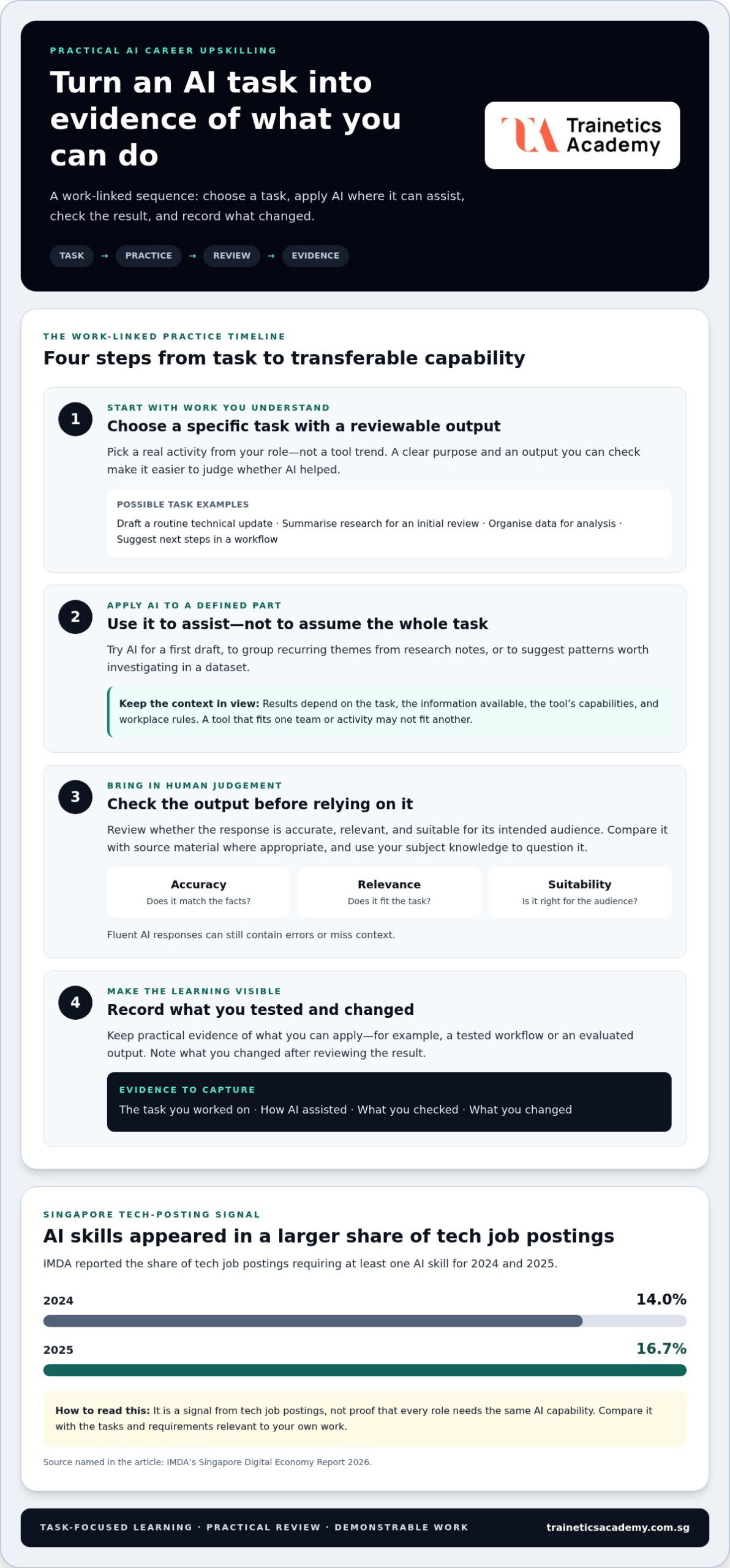
Singapore’s tech job data offers a useful signal, but it needs careful interpretation. IMDA reports that the share of tech job postings requiring at least one AI skill rose from 14.0% in 2024 to 16.7% in 2025. The AI Skills Demand in Singapore Tech Hiring report points to growing mention of AI skills in tech postings. It doesn’t show that every role requires the same capability or that one AI tool is essential across all employers.
Which work tasks may benefit from AI assistance?
Look for tasks with a clear purpose and an output you can review. You might use AI to create a first draft of a project update, group recurring themes from research notes or suggest patterns to investigate in a dataset. In each case, check that the response is accurate, relevant and suitable for its intended audience before using it.
Subject knowledge is an important safeguard. A software professional can assess whether a suggested explanation reflects the system’s actual behaviour; a data analyst can question whether a proposed interpretation follows from the data. AI can produce fluent answers that contain errors or miss context. Treat outputs as material to examine, not verified conclusions.
Why do judgement, communication, and responsible use still matter?
People define the problem before an AI tool can assist. They decide what information is appropriate to provide, add context the system may lack and determine whether the result is fit for purpose. Privacy, confidentiality and organisational rules also shape which tools and inputs are suitable. Follow your workplace’s guidance rather than assuming every task or dataset can be used with AI.
Clear communication turns assistance into usable work. A concise summary should distinguish verified facts from suggestions; a workflow recommendation should explain its assumptions and identify what needs review. This helps colleagues assess the result and take responsibility for decisions. For professionals planning AI career upskilling Singapore-wide, practising the complete process, from selecting a task to reviewing the output, can be more useful than simply learning to generate a response. A structured Artificial Intelligence course can help you build a foundation and apply it thoughtfully.
Which AI skills should Singapore professionals compare before choosing a learning path?
Choose skills by looking at the work you need to improve, not by assuming every professional should follow the same AI curriculum. A role involving frequent writing may call for stronger prompt design and output evaluation, while a role that handles data may benefit more from data awareness. Coding can matter for some technical paths, but it isn’t a universal starting point.
Use this comparison to identify a capability worth practising. The evidence column suggests a small demonstration you can adapt to your work; it doesn’t guarantee that an employer will require that skill.
| Skill area | Typical task need | Beginner-friendly evidence |
|---|---|---|
| AI literacy | Understand what an AI tool can and can’t do for a task. | Explain a suitable use case and one limitation. |
| Prompt design | Give clear instructions, context and output requirements. | Show how a revised prompt improves a draft or summary. |
| Output evaluation | Check generated content for accuracy, relevance and gaps. | Annotate an example with corrections and reasons. |
| Workflow integration | Fit AI assistance into a repeatable process with human review. | Map the steps, including where you verify the result. |
| Data awareness | Recognise how data quality and sensitivity affect AI use. | Describe what information is appropriate for a task and why. |
How should you match AI skills to your current role?
Start with tasks you can describe precisely. Note recurring activities, quality challenges and bottlenecks, such as preparing routine summaries or checking a draft against source material. Then map each task to a capability: unclear instructions may point to prompt design; inconsistent responses may call for output evaluation; repeated hand-offs may suggest workflow integration.
Next, compare your shortlist with current Singapore job descriptions for roles you hold or want to pursue, as well as your workplace’s needs. Look for repeated responsibilities rather than treating a single listing as a universal standard. This makes AI career upskilling Singapore professionals undertake more deliberate and role-relevant.
What evidence can demonstrate practical AI capability?
Create a small, work-relevant example that shows the task, your process, how you reviewed the output and what changed as a result. For instance, demonstrate how you structured instructions for a sample report, checked the generated summary against source information and revised unclear points. Explain the limitations and human checks involved. Naming a tool alone says little about your judgement.
Keep examples safe to share. Remove confidential, personal and employer-sensitive information, and use sample or suitably anonymised material instead. If you want to build foundational knowledge before practising a task, consider a structured AI course in Singapore as one step in your learning path.
How to build an AI upskilling plan around your Singapore career goals
A useful plan doesn’t begin with a list of popular tools. It begins with a work goal you can describe and a skill you can practise. This keeps learning manageable and makes it easier to judge whether a new capability is useful in your current role or a future one.
Build your plan in sequence:
- Name the work goal. Choose a responsibility you want to handle more effectively, or a capability you want to demonstrate in a role you’re pursuing.
- Inspect the task. Break it into steps. Identify where time is spent, where quality is difficult to maintain and which decisions depend on your expertise.
- Select one skill. Match the gap to a capability such as writing clearer prompts, evaluating outputs, understanding AI limitations or fitting a tool into a workflow.
- Practise on a suitable task. Start with a low-risk example and follow your workplace’s processes for tools and information.
- Review the evidence. Record what improved, what needed correction and which decisions still required your judgement.
How can you turn a career goal into a focused learning objective?
Make the objective narrow enough to test. “Learn every new AI tool” is too broad to guide your next step. An objective such as “use AI to prepare a first draft of a routine internal summary, then check it against source material” gives you a task, a capability to practise and a clear review point. Compare your chosen capability with current Singapore job descriptions and your workplace’s priorities so your effort addresses a real skills gap, not just general curiosity.
Before committing, take a brief self-assessment. How confident are you using and checking AI outputs? What suitable task can you practise on? What limits your learning time or access to tools? Your answers can help you choose a realistic next step, whether guided learning, independent practice or both.
How can you practise while protecting work quality?
Start with practice material that doesn’t put important decisions or sensitive information at risk. Use only tools and inputs that fit your organisation’s processes, especially when information is confidential, personal or employer-sensitive. Review every output before using or sharing it. Check factual claims, missing context and whether the response suits its intended audience.
Keep a simple learning record: note the task, the approach you tried, what the AI produced, what you corrected and what remained human-led. This turns practice into evidence of your method and judgement, rather than a list of tools you’ve tested. For another perspective on applying learning to workplace tasks, see Applying AI Skills to Your Job After Certification.
This focused approach makes AI career upskilling Singapore professionals pursue more purposeful and measurable. If structured learning would help you build a foundation for your chosen task, explore Trainetics Academy’s Artificial Intelligence course as one step in your plan.
Where an AI course fits into a career-upskilling plan in Singapore
A course can help once you know what you want to learn. Structured AI learning may suit you if the foundations are unfamiliar, you’d benefit from guided practice or you want a clear sequence instead of assembling lessons from different sources. An AI course is one part of professional development, not a guarantee of employment or promotion. Its value depends on how you connect what you learn to your work.
What should you expect from structured AI learning?
Look for learning that builds understanding and gives you opportunities to apply concepts. Interactive learning can help you examine ideas through practice, while qualified professionals can guide the process. Trainetics Academy delivers courses through physical and virtual platforms.
Bring a task from your role into your learning. Consider how a concept might apply, what you would need to review and where your professional knowledge remains important. This helps make an AI course relevant to your goals. When comparing AI courses for beginners or searching for SkillsFuture AI courses, focus on the learning approach and how well it matches the capability you want to develop. Trainetics Academy’s Introduction AI Course is eligible for SkillsFuture Credit and UTAP.
A structured course may be useful if you:
- Want guided foundations before deciding whether to pursue a specialist direction.
- Prefer interactive practice and an organised learning sequence.
- Need help connecting AI concepts to a professional task you’ve identified.
Self-directed learning can also help you explore a specific capability. If you’re considering a 1 day AI course Singapore professionals may fit into a busy schedule, consider whether its learning scope aligns with your goal, then plan how you’ll continue practising afterward. The right approach depends on your current knowledge, preferences and intended application.
How can you continue learning after an AI course?
Choose a suitable task and apply one capability from your learning. Review the result, note any changes you made and consider what you learned from the process. Follow your organisation’s expectations for tools and information, especially when work involves confidential material. Regular reflection helps keep your practice relevant as tools and workplace needs change.
Build on each learning step by checking whether the capability still serves a real need and whether your approach remains appropriate. If guided foundations are your next step, explore Trainetics Academy’s structured Introduction AI Course and consider how its concepts could support your professional goals.
Turn Your Next Learning Step Into Practical Progress
Your next move doesn’t need to be a major career change. Choose one capability that fits a genuine work need, then set a clear way to practise and assess it. Revisit that choice as your responsibilities evolve. The most useful learning plan is one you can adapt, not a checklist of every new tool or trend.
With a focused approach, AI career upskilling Singapore professionals pursue can build on existing expertise and strengthen how they apply judgement at work. Treat each learning step as a chance to improve your practice and produce evidence of what you can do, rather than as a promise of a particular job outcome.
If structured AI learning would help you take that step, explore AI learning options at Trainetics Academy and choose a starting point that aligns with your professional goals. Begin with one deliberate learning step, then apply it to a task that matters in your work.
Frequently Asked Questions
Is AI upskilling useful if I do not work in a technical role?
Yes. AI skills can be useful in non-technical roles when they support relevant work. A human resources professional, for example, might use AI to organise draft interview questions, then check that they are appropriate for the role and hiring process. The value lies in applying AI thoughtfully within your expertise, not becoming a programmer. Start with a recurring responsibility and consider whether AI learning could help you handle it more effectively.
Can AI skills help me move into a technology career in Singapore?
They can strengthen your preparation, but AI learning alone doesn’t guarantee a move into tech. Identify target roles in Singapore and compare their stated requirements with your current experience. Your industry knowledge may be relevant to technology teams serving that sector, while the role may also call for technical foundations or project experience. Build evidence against those requirements and treat AI career upskilling Singapore as one part of a broader transition plan.
Do I need coding skills to start learning about AI for work?
No. You can begin learning practical AI use without coding, especially if your goal is to apply existing tools to everyday work. Coding becomes more relevant if you want to build AI applications, work with models directly or pursue roles that specify programming skills. Check the requirements of your intended role before choosing a technical path. For a first step, focus on understanding AI capabilities, limitations and appropriate use in your professional context.
How can I show employers that I can use AI effectively?
Prepare a concise example you can explain in an interview, using public or fictional information rather than sensitive workplace material. Describe the original challenge, how you used AI, what you checked and why you accepted or changed the result. Be ready to discuss limitations and alternatives. This helps employers assess your reasoning and communication, not just familiarity with a tool, while keeping your example clear and safe to share.
How often should I update my AI skills for work?
There’s no single schedule that fits every role. Review your learning when your responsibilities change, your organisation introduces new processes or the tools you use behave differently. You can also revisit your skills during regular professional development planning. Ask whether you understand the tools relevant to your work, can judge their outputs and know which workplace expectations apply. Update your learning when you identify a meaningful gap, rather than chasing every new release.
Can a short AI course replace practical experience?
No. A short course can help you build foundational understanding and practise in a structured setting, but it can’t replace applying skills to real responsibilities. Use course concepts in an appropriate task, review the work carefully and reflect on what you would do differently next time. That combination builds stronger evidence of capability. Trainetics Academy offers AI learning in Singapore as a structured starting point, not a promise of employment or promotion.
Disclaimer
AI Content Disclaimer: Some articles on this website may be generated or assisted by AI-powered content creation tools. While we strive for accuracy and relevance, readers should independently verify information before relying on it. The content is provided for informational purposes only and does not constitute professional advice.