Knowing the names of popular AI tools won’t make you the most credible person in the room. What will? Explaining where AI can help, where it can fall short, and how to check its output. If you want to impress my colleagues with AI knowledge, focus on sound judgement rather than trying to sound like a technical expert.
It’s understandable to feel unsure about which AI concepts matter in everyday work conversations. You may also wonder whether a confident-sounding answer from an AI tool is accurate. You don’t need to master every new model or use technical jargon to contribute. A few clear ideas, relevant examples, and careful questions can help you speak about AI with confidence while staying honest about what you know.
This guide covers essential AI concepts in plain language, practical workplace examples, and sensible checks to make before relying on AI-generated content. You’ll also learn how to build your knowledge through thoughtful practice. If you’re ready to go beyond informal experimentation, structured learning through an AI course can help you develop a stronger foundation. The goal isn’t to claim expertise; it’s to make useful, well-informed contributions.
Key Takeaways
- Use clear explanations of prompts, context, and AI hallucinations to make workplace discussions easier to follow.
- Choose familiar tasks, such as summarising non-sensitive material, to demonstrate AI’s potential and the need for human review.
- Follow a simple practice process: select a task, test it, inspect the result, and share what you learned.
- To impress my colleagues with AI knowledge, focus on useful applications and thoughtful judgement rather than tool name-dropping.
- Consider structured AI learning when you want guidance beyond informal experimentation.
Why AI knowledge can help you contribute more confidently at work
You may want to join a conversation about AI without pretending to know how every system works. That’s a sensible standard. Workplace AI literacy means recognising where a tool could assist, understanding its limitations, and checking whether its output is fit for purpose. It doesn’t require memorising product names or technical terms.
Confidence comes from being specific. Instead of saying an AI tool will “transform productivity,” describe a task it might support, what a useful result would look like, and what still needs a person’s judgement. AI knowledge can inform your professional decisions, but it doesn’t replace the role-specific expertise you bring to the work.
For a quick visual introduction to discussing AI in meetings, watch this video:
What colleagues usually mean when they talk about AI
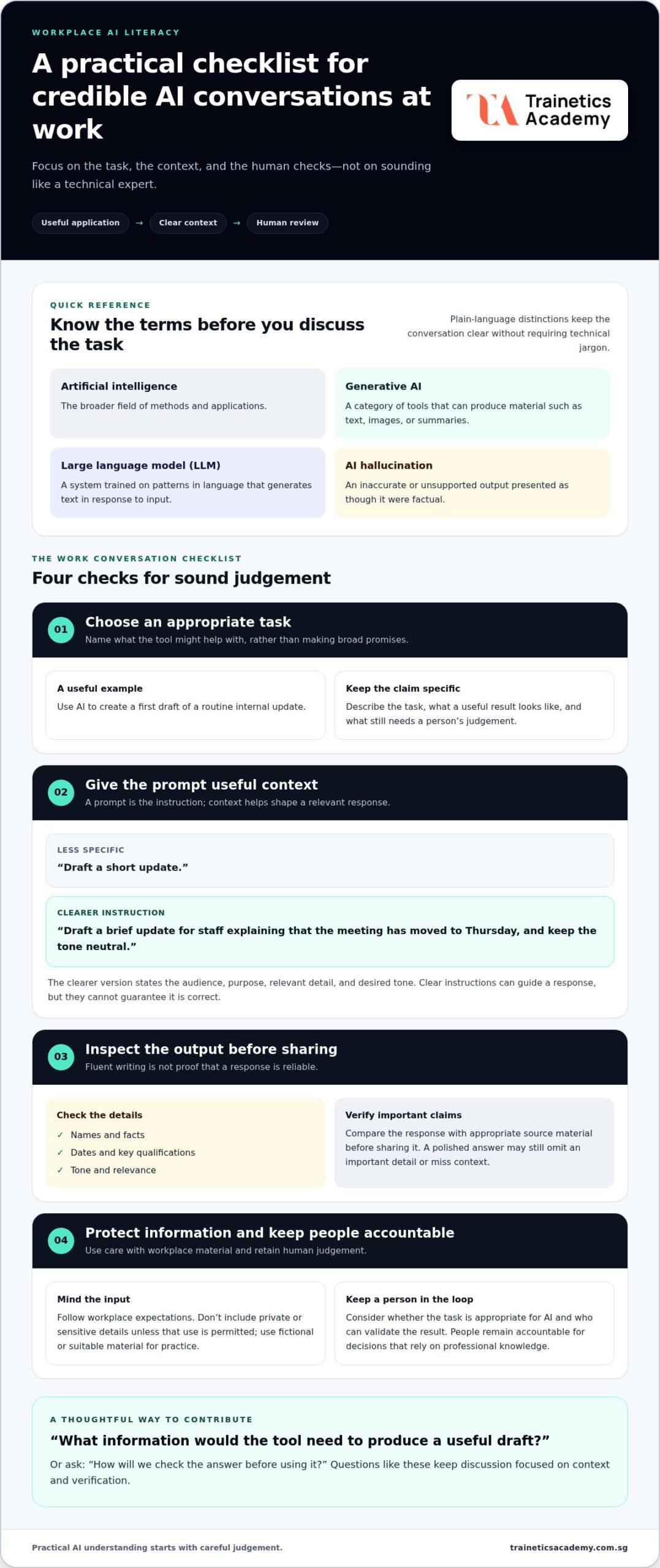
Artificial intelligence is a broad field that includes different methods and applications. Generative AI is a category of tools that can produce new material, such as text, images, or summaries. A large language model (LLM) is a system trained on patterns in language that generates text in response to input. For wider context on the field and its subfields, see this Artificial Intelligence Overview.
An LLM can sound polished without being correct. It may give an inaccurate answer, omit an important detail, or miss context that a colleague would know. Treat fluency as a feature of the response, not proof that its claims are reliable.
Why practical understanding matters more than technical showmanship
Make your contribution concrete: name the task, explain how AI might help, and state what a person should review. For example, a tool could create a first draft of a routine internal update. The employee responsible would still need to check names, facts, tone, and relevance before sharing it. That explanation is more useful than listing tools or making confident predictions.
Good questions also signal thoughtful understanding. Ask, “What information would the tool need to produce a useful draft?” or “How will we check the answer before using it?” These questions focus discussion on context and verification without implying that you have all the answers.
If your aim is to impress my colleagues with AI knowledge, demonstrate sound judgement rather than certainty. Consider whether the task is appropriate for AI, whether the material is suitable to enter, and who can validate the result. Follow workplace expectations, and use non-sensitive examples when practising. AI can support analysis and communication, but people remain accountable for decisions that rely on professional knowledge.
When informal experimentation leaves you unsure how the concepts fit together, structured study can provide a more guided foundation. Trainetics Academy offers an Artificial Intelligence course to help learners develop their understanding beyond trying tools independently.
Understand the AI basics that make workplace conversations clearer
Shared terminology helps colleagues discuss AI without assuming that every tool works alike. Generative AI refers to systems that create content, while artificial intelligence is the broader field of methods and applications. A large language model, or LLM, generates text based on patterns learned from language. These plain-language distinctions can help you clarify what a colleague means before discussing whether a tool fits a task.
Keep the limits in view, too. A fluent response doesn’t prove that a system understands the subject or has verified its claims. Features and terminology vary across tools, so describe what a specific system did rather than presenting its capabilities as universal.
How to explain generative AI and large language models simply
You might compare an LLM to an autocomplete function that can produce a longer response. The analogy helps explain why it generates likely text, but it doesn’t capture the full complexity of how the system works. Nor does generating a plausible answer mean the system has checked whether that answer is true.
For instance, a generative tool might suggest a short subject line for a routine email. That could be useful as an idea to consider, but the sender still needs to judge whether it communicates the right purpose and tone.
How prompts, context, and verification work together
A prompt is the instruction or question given to a tool. Context is background that helps shape a relevant response, such as the intended audience or desired format. An AI hallucination is an inaccurate or unsupported output presented as though it were factual. A clear prompt can guide a response, but it can’t guarantee that the result is correct.
For example, “Draft a short update” leaves the purpose open. “Draft a brief update for staff explaining that the meeting has moved to Thursday, and keep the tone neutral” gives a clearer goal and relevant details. The person sharing the draft should still check that the date and message are accurate.
Be deliberate about the information you provide. Follow your organisation’s expectations, and don’t include private or sensitive workplace details unless that use is permitted. If you’re practising, use fictional material or information suitable for the setting. This keeps the exercise focused on how instructions shape the output without exposing work content unnecessarily.
For important claims, compare the response with appropriate source material before sharing it. Check names, dates, figures, and key qualifications, and involve a subject-matter colleague if the answer could affect a work decision. In discussion, ask, “What source supports this point?” or “Which details might our team know that the tool hasn’t been given?” Such questions make verification part of the conversation rather than an afterthought.
Show AI knowledge through useful examples, not tool name-dropping
A useful example starts with a team task, not a list of apps. Choose something recurring and low-risk, such as sorting public feedback into themes or preparing a first draft of a routine message. Describe the task first, then explain what AI might contribute and what a colleague would still need to assess. That keeps the discussion relevant even if your team uses different tools.
Frame examples as possibilities, not promises. A tool may produce a helpful starting point, but it could also miss a detail, need substantial editing, or prove unsuitable for the material. A credible example makes both the potential use and the limits clear.
Choose examples that connect to real team tasks
Start small. A narrow task is easier to test and evaluate than a sweeping claim about automating a whole workflow. Before discussing tools, identify the work involved, who uses the result, and what a good outcome would need to include. For a broader look at matching tools to workplace tasks, use this guide to AI productivity tools for business.
Task: Organise non-sensitive notes from a team meeting.
Possible AI contribution: Group points into topics or draft a list of follow-up actions.
Human review needed: Check whether decisions, owners, and deadlines are captured accurately.
Discussion point: “Could this help us structure notes, provided someone checks them against the original?”
Task: Prepare a first draft of a routine internal announcement.
Possible AI contribution: Suggest a clear structure or adapt wording for a specified audience.
Human review needed: Confirm details, tone, and whether the message reflects the team’s intent.
Discussion point: “Would a draft be useful if the sender remains responsible for editing it?”
Task: Answer a question that requires reliable, source-backed information.
Possible AI contribution: Help organise questions to investigate or outline what information is needed.
Human review needed: Verify claims against appropriate source material before acting or sharing.
Discussion point: “Can we trace each important claim to a source we trust?”
Share benefits and limitations in the same breath
Be precise about what you know. Separate a result you personally tested from something you’ve only read or heard about. You might say, “I tried this with sample notes, and it grouped the topics clearly, but I had to check whether the categories matched the original.” That is more credible than presenting a possible benefit as proven for every team or situation.
AI may be a poor fit when a task depends on confidential information, exact facts without verifiable sources, or specialist judgement the tool can’t reliably supply. Consider how the team would define an acceptable result before relying on it. To impress my colleagues with AI knowledge, explain what you observed, what remains uncertain, and what would need review before the example could inform real work.
Use this practical process to talk about AI with colleagues
A well-prepared example gives colleagues something concrete to discuss. Before raising an idea, decide what you want feedback on: whether the task is suitable, what a useful result would look like, or where human review belongs. This keeps the conversation collaborative and shows that you’re interested in learning from the team, not presenting a finished solution.
Prepare one example before raising AI at work
Choose a task you understand well and define what a good result would need to contain. Test your instruction using information appropriate for the setting, then compare the response with your intended outcome. Note what you had to change, what the tool handled adequately, and which decisions you would keep with a person. Follow your organisation’s guidance when selecting a tool or using work-related material.
Invite discussion without overstating your expertise
Keep your explanation grounded in what you actually tested. Instead of saying AI can solve a broad workplace problem, describe the small task you tried and ask colleagues how it might fit their process. Specific language makes it easier for others to respond with relevant expertise or point out considerations you may have missed.
- Pick a task. Choose a familiar activity and decide what a useful result would look like. Keep the scope narrow enough to assess.
- Test an example. Write an instruction that states the task and desired format. Use only information suitable for the setting.
- Inspect the result. Compare the response with your goal. Record what required correction and what you wouldn’t delegate, such as a decision that depends on professional judgement.
- Explain what you learned. Share the task, the tool’s contribution, the human check, and one open question for the group.
A concise conversation structure can help: “The task was ____. I tested AI for ____. I checked ____. Where would our team’s context or review matter most?” This format separates your observation from a broader claim and gives colleagues a clear way to contribute.
You can also acknowledge uncertainty without dismissing the potential: “I tested this for an initial draft. It gave me a useful starting point, but I needed to revise parts of it. I’d be interested in where this might help our process and what we’d need to review.” That phrasing is open about limitations while leaving room to explore a practical use.
To impress my colleagues with AI knowledge, focus on being accurate about your experience and curious about what the team can add. A useful discussion doesn’t require a perfect answer. It requires a clear example, honest observations, and a willingness to refine your view.
Build your AI knowledge with a structured learning path
Self-directed practice can be a useful starting point. If you’re exploring a tool for a simple task, you can learn by trying different instructions, reviewing the response, and noting where it falls short. But experimentation can leave gaps: you may know how to get an answer without understanding the concepts behind it or how to judge its reliability.
Structured learning can offer a more guided way to build those foundations. It may suit you if you want clear explanations, practical examples, and a chance to connect AI concepts with your work. You don’t need to take a course to discuss AI responsibly, though. The aim is to keep developing your understanding at a pace that makes sense for you.
What to look for in beginner AI learning
Choose learning that explains essential ideas in plain language and connects them to practical situations. Examples should help you assess what an AI tool might contribute, what needs human judgement, and how to verify important material. Opportunities to engage with the concepts can also help you move beyond memorising terminology and apply it to tasks relevant to your role.
Keep expectations grounded. Review course information for details about content, duration, credentials, and any funding eligibility. Avoid assuming that a course guarantees specific workplace results. The value of learning is in building understanding you can continue to apply and refine.
Explore AI learning in Singapore
For some learners, occasional practice and independent reading may be enough. If you prefer a more organised learning experience, Trainetics Academy offers an Artificial Intelligence course in Singapore, with online and offline learning options. The academy’s interactive approach and experienced instructors provide a structured setting for engaging with AI concepts.
As you consider learning options in Singapore, focus on how a programme explains the fundamentals and helps you relate them to real tasks. An AI course in Singapore can help you build a stronger foundation, but it isn’t a substitute for continued practice or your own professional judgement. The concepts you learn are most useful when you keep testing them thoughtfully and recognise where human review remains essential.
You can continue to develop your AI knowledge through self-directed exploration, structured study, or a combination of both. Choose the approach that fits your learning needs, then put new ideas into practice carefully. Exploring a course is one possible next step, not a requirement for contributing to workplace conversations.
Explore Trainetics Academy’s Artificial Intelligence course in Singapore to build your understanding through structured study.
Keep building confidence through thoughtful practice
Strong professional judgement grows through small, deliberate steps. Stay curious, keep learning, and make room to revise your view as AI tools and your understanding develop. You don’t need to have every answer before contributing. A well-considered question or an honest observation can move a team discussion forward.
If you want to impress my colleagues with AI knowledge, aim to be the person who brings clarity, not certainty for its own sake. Keep testing what you learn against real work needs, and let your experience deepen your perspective over time. There’s no need to wait until you feel like an expert to take that next step.
Structured learning can help you continue developing your AI knowledge. Explore AI learning with Trainetics Academy and take a practical next step in your learning. Every thoughtful step counts.
Frequently Asked Questions
Can I impress colleagues with AI knowledge if I cannot code?
Yes. You can contribute without presenting yourself as a developer. Focus on how AI might assist with a task in your role, what you’d need to review, and what decisions should remain with a person. For example, a project coordinator could discuss using AI to sort a public project brief into themes, then explain how the team would check those themes against the source material. Be clear about what you’ve tried and what you’re still learning.
How can I talk about AI at work without sounding like a know-it-all?
Keep your comments specific and invite colleagues to add their perspective. A practical way to impress my colleagues with AI knowledge is to explain one observation, then ask where the team’s expertise should guide the result. For instance: “I tested this with a sample task, and the output gave me a useful starting point. What would we need to check before using something like this in our workflow?” This makes room for discussion rather than claiming authority.
Is it safe to put work information into an AI tool?
Don’t assume every work input is appropriate. Follow your organisation’s guidance and consider the tool’s settings before entering information. Avoid sharing confidential, personal, or sensitive material unless your organisation explicitly permits that use. If you’re unsure, practise with a fictional scenario, such as a made-up project update, or use information already available publicly. Responsible handling matters even during experimentation, because the prompt itself may contain information your workplace expects you to protect.
What should I do if an AI tool gives me an incorrect answer?
Pause and verify the claim before using or sharing it. Compare it with the source that governs the task, such as the current project brief, an internal procedure, or a relevant official document. If you’ve already shared the answer, correct the record clearly and explain what you checked. For a decision that affects other people or work, use your team’s normal review process and involve someone with the right subject knowledge.
Do I need to know every AI tool to be knowledgeable?
No. Knowing how to assess an unfamiliar tool is more useful than trying to memorise every product name. If your team introduces a new tool, start by understanding what task it is intended to support and what information it uses. Try a suitable sample, then compare its output with the expected result. Keep your claims specific: distinguish what you observed firsthand from features or performance you’ve only read about.
How can I start learning about AI for my job?
Begin with a task you understand well, so you can judge whether an AI-generated result is relevant. You might explore whether a tool can organise a fictional set of project feedback, then note which categories need clearer definitions. Check workplace guidance before using work material, and keep a record of questions your experiment raises. To develop beyond independent practice, consider whether a structured AI learning programme would suit your goals.
Disclaimer
AI Content Disclaimer: Some articles on this website may be generated or assisted by AI-powered content creation tools. While we strive for accuracy and relevance, readers should independently verify information before relying on it. The content is provided for informational purposes only and does not constitute professional advice.