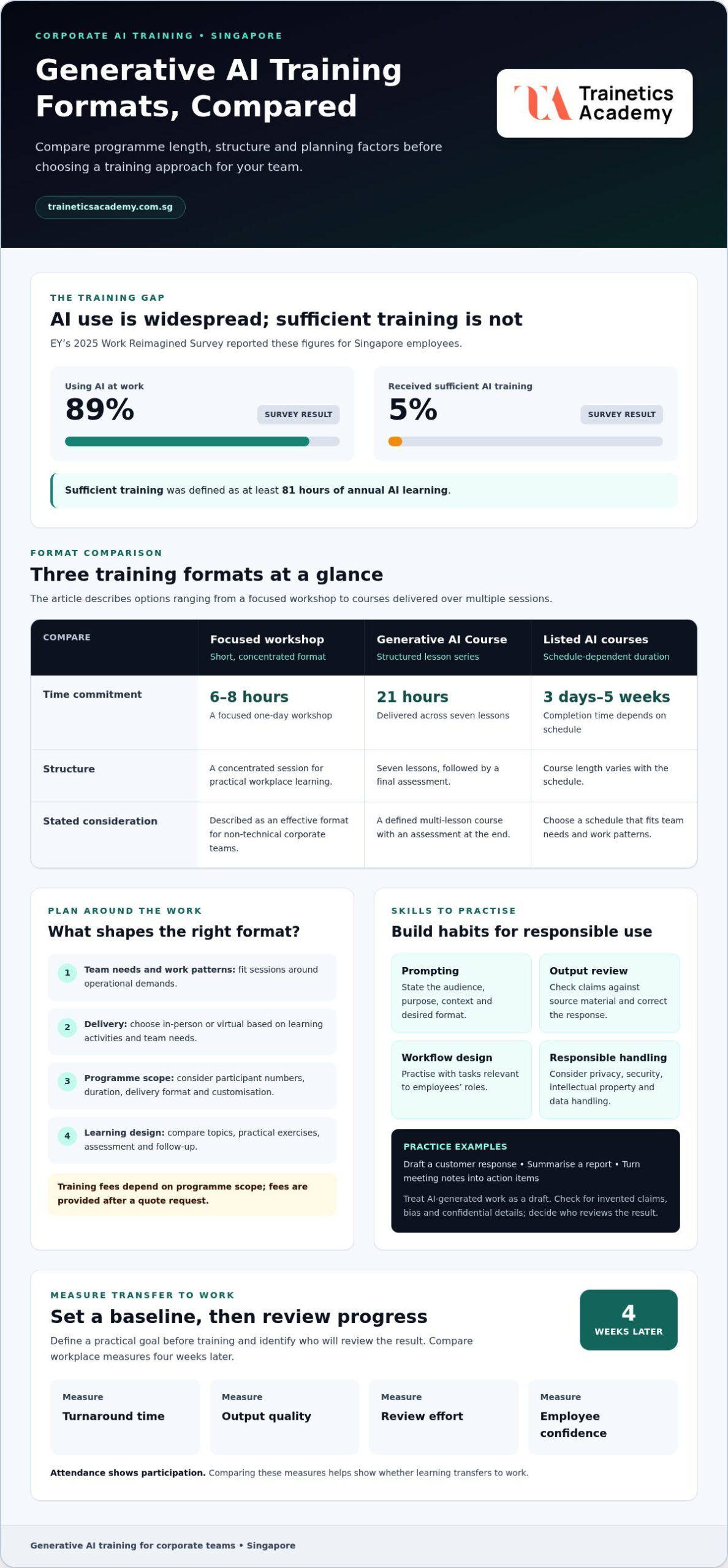
According to EY’s 2025 Work Reimagined Survey, 89% of Singapore employees were using AI at work, but only 5% received sufficient AI training, defined as at least 81 hours of annual AI learning. That gap makes generative AI training for corporate teams in Singapore a practical priority: employees need skills to use AI tools effectively and review their outputs responsibly.
Adopting AI is only the first step. Teams also need practical ways to apply it to everyday tasks, protect sensitive information and recognise when human review is essential. This guide covers the skills and tools to consider, ways to practise with relevant tasks, and the factors that shape generative AI training for corporate teams in Singapore.
Training fees depend on the programme scope and are provided after a quote request. Factors include team size, delivery format, session length and how closely the learning is tailored to workplace workflows. Read on to choose a suitable training approach and prepare your team to use generative AI with confidence.
Key Takeaways
- Choose a training schedule and delivery format that fit your team’s work patterns and learning goals.
- Build practical skills in prompting, output review and responsible handling of workplace information.
- Give employees realistic tasks to practise, then assess the quality and usefulness of their AI-assisted work.
- Match tools and training to each role, existing systems, data risks and the workflows you want to improve.
- Compare training options by scope, delivery and customisation to understand what shapes the final cost.
Why Generative AI Corporate Training Matters?
Workplace access alone doesn’t build sound AI judgement. EY’s 2025 Work Reimagined Survey found that 89% of Singapore employees used AI at work, while 5% received sufficient AI training, defined as at least 81 hours of annual AI learning. Structured learning helps employees practise useful workflows and recognise when human review matters.
Organising generative AI training for a Singapore company starts with identifying priority tasks, employee roles, data risks and learning objectives. Then choose a format, schedule sessions around operational demands and decide how to evaluate progress. This preparation helps keep training focused on real work rather than generic demonstrations.
Formats range from a focused workshop to a structured, multi-session course. A focused one-day workshop of 6-8 hours is described as an effective format for non-technical corporate teams. A Generative AI Course in Singapore runs for 21 hours across seven lessons, followed by a final assessment. Listed AI courses may take 3 days to 5 weeks to complete, depending on schedule. Choose in-person or virtual delivery based on team needs, work patterns and learning activities.
Funding can affect the organisation’s net training cost. Eligible Singapore SMEs may receive up to S$10,000 through the SkillsFuture Enterprise Credit to offset training costs. The credit can offset up to 90% of remaining training fees after the SSG subsidy. Employers can also claim absentee payroll at $4.50 per training hour for each eligible employee. These schemes have eligibility conditions, so assess the company and course before including support in a budget.
Training fees depend on the programme scope and are provided after a quote request. Cost factors include participant numbers, course duration, delivery format and customisation. To compare programmes, review the topics covered, how practical exercises are structured, and whether assessment or follow-up is included. Don’t compare courses by duration alone: a shorter workshop may focus on immediate tasks, while multiple sessions allow more time to practise and refine skills.
Use learner testimonials as evidence of experience, not as a substitute for course details. Look for specific examples of skills practised, workplace tasks addressed and feedback received. To assess business impact, set a baseline before training, then compare turnaround time, output quality, review effort and employee confidence four weeks later. Attendance shows participation; these measures help show whether learning transfers to work.
For teams planning generative AI training for corporate teams in Singapore, define success before booking. Set a practical goal, such as producing a reliable first draft or safely summarising internal material, and decide who will review the result. Clear expectations help employees practise responsibly and give managers useful evidence of progress.
Practical generative AI skills for workplace use
Singapore teams need skills in prompting, output review and workflow design. Training should also address privacy, security, intellectual property and cross-border data handling. Employees need to practise deciding what information belongs in a prompt, how to assess a response and when a person must take responsibility for the final work.
Role-based exercises connect these skills to familiar responsibilities in finance, marketing and operations. Teams can practise with realistic examples and build consistent review habits.
Generative AI for Work Tasks
Workplace tasks offer a practical way to build prompt-writing skills. Employees can practise drafting a customer response, summarising a report or turning meeting notes into action items. They should state the audience, purpose, context and desired format, then compare outputs, revise instructions and check claims against source material. This builds judgement beyond copying prompts and helps staff recognise where human input improves the result.
Role-based workshops should use exercises that reflect employees’ actual responsibilities. A finance team might test a plain-language explanation of a report, while marketing staff refine a campaign draft. Operations employees could summarise a process document. For each exercise, define the task, expected output and review criteria. Participants can discuss which instructions improved the response and where it needed correction.
Privacy, Security, and IP Risks
Singapore’s Personal Data Protection Act 2012 should inform workplace discussions about personal information. The PDPC’s AI governance resources offer a reference point for responsible deployment and accountability. Teach employees to pause before entering customer records, confidential plans or internal documents. They should consider whether information is suitable for the chosen system and follow their organisation’s guidance for sensitive material.
Intellectual property exercises can ask employees to review AI-generated text, images or summaries before using them externally. Check for invented claims, biased wording, confidential details and material requiring human oversight. Training should clarify who reviews the output and who remains accountable for work shared under the organisation’s name. Treat generated content as a draft, not a verified source.
Security and jurisdiction questions also belong in practical scenarios. Ask employees which tool they are using, what information they plan to provide and which internal rules apply. Systems may handle data differently, so teams need clear guidance on permitted tools and inputs. Employees should avoid entering sensitive information unless organisational policy allows it.
Singapore’s Model AI Governance Framework, Second Edition, provides guidance for responsible AI deployment. Use it to structure discussions about oversight, accountability and appropriate use. For example, employees can review an AI-generated summary with an inaccurate statement, identify and correct the error, then determine who should review the final version.
- Prompting: State the task, audience, context and desired format.
- Review: Check accuracy, bias, confidentiality and suitability before use.
- Workflow design: Decide what AI can assist with and who reviews its output.
Connect exercises to each team’s operations, so employees can adapt their judgement to real responsibilities. A structured artificial intelligence learning pathway can help teams build these capabilities through purposeful study and practical application.
Applying learning through practical tasks and projects
Training becomes useful when employees apply new skills to actual work. A small, well-scoped project can turn a prompt exercise into a repeatable workflow.
Start with a clear view of the AI landscape. Machine learning systems identify patterns in data; generative AI creates new text, images or other content. Because these capabilities differ, employees should match the tool to the task. One myth to challenge: fluent output is not automatically accurate. Ask staff to check answers against source material before using them.
Choose a task that is frequent, low-risk and easy to review. For example, a team could use AI to draft an internal process summary, then compare it with the original document. Keep a person accountable for the final version. Record the prompt, input type, review steps and corrections. This simple record helps colleagues repeat the process and spot errors.
Managers can make practice part of the organisation’s routine. Before a pilot, set expectations about permitted tools, information employees may enter and who reviews the output. Team agreements should also clarify accountability and appropriate uses. A manager can model a prompt, discuss a weak response and invite staff to improve it. This builds practical judgement without requiring every employee to have technical expertise.
Make learning available on demand as well as during formal sessions. Employees can practise on the job with short exercises tied to operations, such as turning a meeting summary into action points. Managers can hold brief coaching sessions to address questions that arise during real work. Refresher clinics can revisit common mistakes, including unsupported claims or prompts that lack context. Each exercise should produce something employees can examine and improve.
Use a staged project rather than asking a team to change its whole workflow at once. First, document the current steps. Next, identify where AI may help and where human review remains essential. Then test the prompt using sample material, assess the output and revise the workflow. This sequence helps teams distinguish useful applications from tasks that require direct human judgement.
Define a success measure before practice begins. A practical adoption target is 70% or more of trained staff using AI tools weekly within 30 days. Pair usage with a quality check, such as whether reviewers need fewer corrections or employees follow the team agreement. A 30-day follow-up check-in can surface barriers, reinforce safe habits and identify the next workflow to test.
Choosing role-specific AI training and tools
A useful programme connects each role’s tasks with suitable AI tools and review practices. Before selecting training, compare workforce needs, data risks, existing systems, objectives and follow-up support.
Start by mapping tasks across departments. Marketing employees may need help shaping campaign concepts or adapting copy for different audiences. Presentation teams can practise turning provided source material into slide outlines, then checking every claim. Operations teams might explore summarising process documents. Finance employees can practise explaining complex information in plain language, with careful human review. These examples help identify which skills deserve time in training.
Choose tools based on actual work, not popularity alone. ChatGPT and Microsoft Copilot are familiar examples for a tool discussion, but training should focus on transferable skills. Employees need to write clear prompts, provide suitable context, assess outputs and revise instructions. Compare how each tool fits the organisation’s workflows, access rules and data-handling expectations. Demonstrations should use sample or permitted information, not sensitive business material.
For presentations and marketing, build exercises around a defined brief. Ask employees to generate an outline, refine its tone and verify claims against supplied source material. Then have them identify missing context or unsupported suggestions. This teaches staff to treat generated text as a draft and shows whether the selected tool supports the team’s process without replacing editorial judgement.
Funding belongs in programme planning, but it shouldn’t determine the learning design. Eligible Singapore SMEs may use the SkillsFuture Enterprise Credit to offset up to 90% of remaining training fees after the SSG subsidy. That funding figure is separate from the value of a tool or programme. Assess course eligibility, employee roles, delivery needs and practical exercises before building a budget. Don’t assume every course or tool qualifies for the same support.
Use a simple selection sequence to compare options:
- Define the task: Name the workflow employees should improve, such as preparing presentation drafts.
- Set the boundary: Identify permitted inputs, review responsibilities and relevant data risks.
- Test the fit: Have a small group try the exercise with suitable sample material.
- Review the result: Compare output quality, required edits and ease of use.
- Plan reinforcement: Set follow-up practice around the chosen tool and workflow.
This process helps organisations select training for capabilities, not just software familiarity. A role-based approach gives employees relevant practice and helps managers judge whether ChatGPT, Copilot or another tool fits the intended application. Keep the programme focused: teach the workflow, make review expectations explicit and use practice to guide the next step.
Corporate AI training prices in Singapore
Corporate AI training fees depend on more than participant numbers. A useful budget compares the programme’s scope with the workplace outcomes it needs to support. Fees depend on the programme and are provided after a quote request; key factors include participant numbers, duration, delivery format, customisation, tools and follow-up support.
Start with the delivery model. A shared workshop for one team has different planning needs from separate sessions for finance, marketing and operations. In-person, virtual and blended schedules also shape preparation and facilitation. Ask what each option includes, such as practical exercises, sample materials, assessment or post-course support. These details help explain what the fee covers without treating every course as equivalent.
Customisation affects both effort and relevance. A programme using general examples differs from one built around an organisation’s workflows, permitted tools and role-specific tasks. For example, marketing participants may practise reviewing AI-generated campaign drafts, while operations staff examine process summaries. Clarify whether the training uses supplied scenarios or develops customised exercises. That distinction helps teams judge whether a lower-cost option delivers the practice they need.
Tool requirements can also shape the total budget. Establish which AI tools participants will use, whether the organisation already provides access and whether training time includes setup. Separate course fees from any tool subscription costs. GST applies to the programme fee at prevailing rates, so include tax when comparing total costs. A written breakdown helps procurement teams assess the full commitment.
Singapore funding schemes may affect eligible organisations’ net training expenses. The SkillsFuture Enterprise Credit can offset up to 90% of remaining training fees after the SSG subsidy. The Enterprise Innovation Scheme offers businesses either a 400% tax deduction or a 20% cash payout based on the net fee. These mechanisms differ, so budget projections should distinguish course charges from potential support and tax treatment.
Compare proposals against a consistent checklist:
- Scope: Identify topics, practice activities and intended outcomes.
- Participants: Confirm the group size and whether roles need separate sessions.
- Delivery: Compare schedules, formats and any disruption to normal workflows.
- Support: Review assessment, follow-up learning and implementation guidance.
- Total cost: Account for GST, tools and any eligible funding separately.
For enterprise planning, define success before selecting a programme. Compare the proposed fee with measurable needs, such as completing a workflow exercise or assessing AI outputs. Request a clear scope that connects each cost component to a learning activity. To plan practical AI training, align the course content with the tasks employees need to perform.
Trainetics Academy: Artificial Intelligence Course
Trainetics Academy offers an Artificial Intelligence Course for individuals and organisations building practical AI knowledge. Its interactive learning approach and in-person and virtual formats give teams options for developing skills relevant to workplace priorities. The course can be a natural next step when your organisation is ready to move from exploring generative AI to building a stronger foundation in artificial intelligence.
Use the course as a starting point for structured learning, then connect new knowledge to the tasks and tools your team uses. For companies planning generative AI training for corporate teams in Singapore, the next step is to align learning goals with employees’ roles and intended applications.
Contact Trainetics Academy or visit traineticsacademy.com.sg to learn more about the Artificial Intelligence Course.
Build AI learning into everyday work
Generative AI training for corporate teams in Singapore can be the start of sustained capability, not a one-off event. Give employees a clear way to share useful prompts, record review practices and flag workflows that need adjustment. A living team playbook helps preserve learning as tools and responsibilities change.
Set clear ownership for keeping that playbook practical. Managers can invite staff to contribute examples, identify recurring errors and suggest improvements to workplace guidance. This creates a deliberate path from individual practice to organisational knowledge while keeping people accountable for their work.
Trainetics Academy’s Artificial Intelligence Course offers a learning route for individuals and organisations developing AI knowledge. If your team is ready to strengthen its foundations, contact Trainetics Academy to discuss the course. Take the next step with purpose and build the confidence to apply AI thoughtfully at work.
Frequently Asked Questions
Are there government subsidies available for AI training?
Eligible Singapore SMEs may use the SkillsFuture Enterprise Credit (SFEC) to offset training costs. The credit provides up to S$10,000, and can offset up to 90% of remaining training fees after the SSG subsidy. The stated eligibility criterion includes at least three Singapore Citizen or Permanent Resident employees in the last 12 months. Check how the course and company meet funding conditions before building subsidies into your training budget.
Do I need a technical background or coding experience?
No. Many workplace applications rely on clear instructions, review and judgement rather than coding. For example, an employee can ask an AI tool to draft a meeting summary, then check it against the original notes. Useful starting skills include defining the task, providing relevant context and spotting unsupported details. Technical teams may explore advanced applications, but everyday generative AI use can begin with familiar work tasks.
Does it address data security and compliance?
Responsible training should cover safe handling of information, organisational rules and human review. In Singapore, the Personal Data Protection Act 2012 is relevant when personal data is involved, and the PDPC provides AI governance resources. For example, employees can practise deciding whether customer details belong in a prompt, then use anonymised material instead. Teams should also consider confidential information, inaccurate outputs and accountability before using generated content.
Does it include a framework for ongoing use?
A practical framework can give employees shared rules for selecting tasks, using prompts and reviewing outputs. For instance, a team playbook might record permitted tools, information employees can enter, review responsibilities and examples of useful prompts. Assign an owner to maintain it as workflows change. Managers can also schedule short discussions where staff raise recurring errors and refine the team’s approach to AI-assisted work.
How long are the courses and can I study alongside a full-time job?
Course duration and scheduling vary by programme. A Generative AI Course in Singapore runs for 21 hours across seven lessons, followed by a final assessment. Listed AI courses may take 3 days to 5 weeks, depending on schedule. Physical and virtual learning formats can help teams plan around work commitments. Before enrolling, map lesson times against employee availability and consider how assessment fits existing workloads.
How much does corporate AI training cost in Singapore?
Fees depend on the programme and are provided after a quote request. Cost factors include participant numbers, course duration, delivery format, customisation, tools and follow-up support. For example, a team needing role-specific practice may require a different scope from employees attending a shared introductory session. Compare what each programme includes, then build a budget around learning objectives and the time employees can commit.
What generative AI training programs are available for corporate teams in Singapore?
Options include focused workshops, structured multi-session learning and role-based programmes built around workplace tasks. Trainetics Academy offers an Artificial Intelligence Course in in-person and virtual formats. Organisations can choose a learning direction by first identifying priority roles, tools and workflows. This helps employees practise relevant applications, whether they need to draft communications, interpret documents or review AI-generated material before use.
How much does corporate generative AI training cost in Singapore?
Corporate generative AI training costs vary with programme scope, participant group, delivery approach and degree of customisation. Fees depend on the programme and are provided after a quote request. To compare options, connect each cost component to a practical outcome, such as completing a workflow exercise or assessing AI outputs. Include employee time and any separate tool requirements in internal budget planning.
Disclaimer
AI Content Disclaimer: Some articles on this website may be generated or assisted by AI-powered content creation tools. While we strive for accuracy and relevance, readers should independently verify information before relying on it. The content is provided for informational purposes only and does not constitute professional advice.