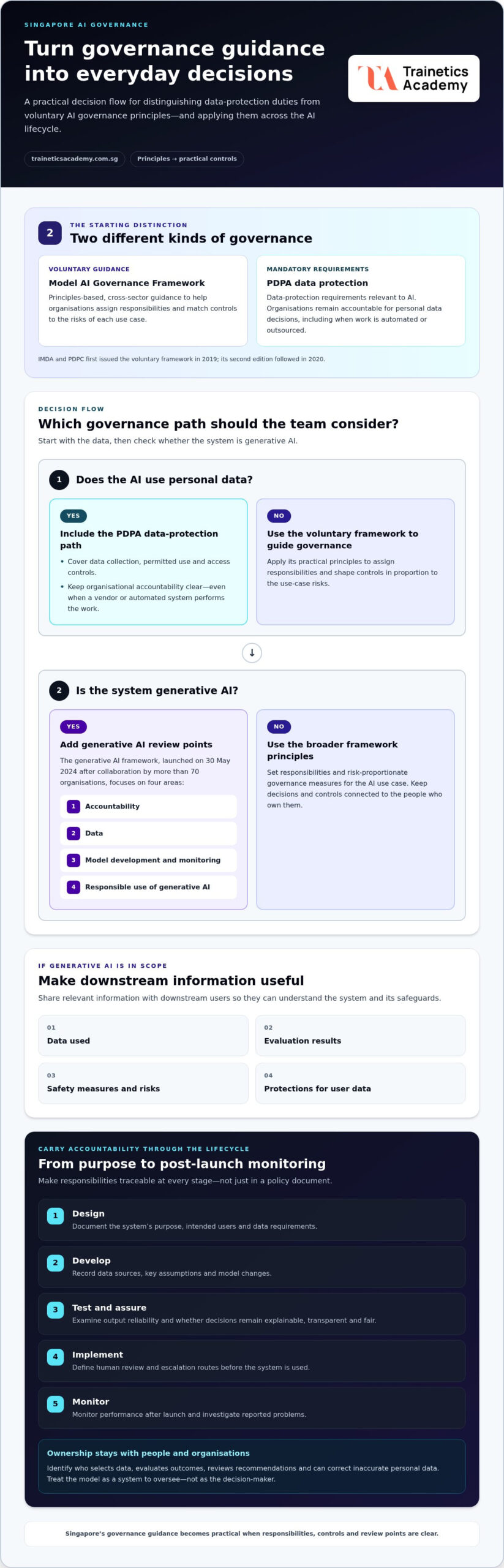
Treating AI governance as a policy document alone misses the point. For AI governance framework training in Singapore, start by distinguishing the voluntary, principles-based Model AI Governance Framework from the mandatory data-protection requirements relevant to AI under the PDPA. Effective training makes the principles practical through clear accountability, proportionate controls, human oversight, data governance, safety evaluation, incident reporting and acceptable-use rules.
Knowing which framework applies is only the starting point. Teams also need to understand how governance shapes everyday decisions: what data may be used, when human review matters and who responds if an AI system causes harm. Structured learning helps employees connect these responsibilities to their roles instead of treating governance as a document to read once.
This article explains Singapore’s main AI governance frameworks, additional considerations for financial institutions, and how to turn guidance into implementation phases, staff training and acceptable-use policies. It also explains how an AI course can build the foundational knowledge teams need to engage with these requirements confidently.
Key Takeaways
- Understand how Singapore’s voluntary, principles-based AI framework guides risk-proportionate governance, especially for generative AI.
- Map accountability across the AI lifecycle, including data use, human oversight, system evaluation and incident response.
- Recognise why financial institutions must consider sector-specific expectations alongside broader governance principles.
- Build training and acceptable-use policies around staff roles, approved use cases, sensitive information and escalation routes.
- Compare the purpose of Singapore’s governance frameworks with AI Verify’s role in testing system attributes such as fairness and transparency.
Model AI Governance Framework and generative AI guidance
Singapore’s approach pairs a voluntary, principles-based Model AI Governance Framework with mandatory data-protection requirements relevant to AI. For generative AI, training should connect those principles to model development, deployment, user disclosures and safety controls.
Singapore’s Model AI Governance Framework
Singapore’s Model AI Governance Framework gives organisations practical principles for responsible AI use, including generative AI. IMDA and PDPC first issued the voluntary, cross-sector framework in 2019, and released its second edition in 2020. It matters because teams can use its principles to assign responsibilities and match governance measures to the risks of each use case.
The generative AI framework extends that focus across the AI system’s stakeholders, assigning responsibility according to each party’s level of control. Singapore launched it on 30 May 2024, following collaboration by more than 70 organisations. Its four focus areas are accountability, data, model development and monitoring, and the responsible use of generative AI.
Training should turn those principles into practical review points. For example, a team deploying a customer-support model can document its intended use, evaluate outputs, set human escalation routes and explain limitations to users. The framework also recommends sharing relevant information with downstream users, including data used, evaluation results, safety measures, risks and protections for user data.
Laws, Frameworks, and Governance Risks
For Singapore, AI governance training should cover the PDPA’s mandatory data-protection requirements, the voluntary Model AI Governance Framework, and relevant generative AI guidance. Legal professionals should also understand the proposed guide for using generative AI in the legal sector, which the Ministry of Law opened for public consultation in September 2025.
The proposed legal-sector guide encourages law practices to establish internal policies, evaluate tools, train staff and maintain oversight. These steps address risks such as confidential information entering a public model, fabricated legal authorities, biased outputs and unclear responsibility for errors. A practical exercise could ask staff to check an AI-generated legal summary against source documents before using it.
Safety practices for generative models should include data-quality controls, systematic evaluation of front-end performance and back-end safety, and channels for reporting vulnerabilities. Retrieval-augmented generation, few-shot learning and reinforcement learning from human feedback can guide outputs, reduce hallucinations and improve accuracy. Digital watermarking and cryptographic provenance can help users identify content sources and assess misinformation risks.
The H-GenAIGF organises generative AI governance into 15 processes, 25 subprocesses and 9 guiding principles, grouped under Data, Model, Content Generation and Ethics. In AI governance framework training in Singapore, these provide a structure for scenario-based learning: trace a model’s data, assess alignment and output risks, clarify ownership, then practise reporting and remediation. Together, these topics help teams apply governance to real decisions rather than treating it as a policy document alone.
Accountability across the AI system development life cycle
Accountability must span data selection and development, testing, deployment and monitoring. Singapore’s guidance keeps organisations responsible for decisions involving personal data, even when automated systems or external vendors perform the work.
Accountability Across Development Stages
Lifecycle accountability means assigning responsibility for each AI system decision and control. This matters because defects can arise before launch, during use or after a model changes. For example, a team developing a recruitment tool should record who selects training data, evaluates outcomes and approves deployment.
At the design stage, document the system’s purpose, intended users and data requirements. During development, record data sources, key assumptions and model changes. Testing and assurance should examine output reliability and whether decisions remain explainable, transparent and fair. Before implementation, define human review and escalation routes. After launch, monitor performance and investigate reported problems.
These records help teams trace a decision instead of treating the model as the decision-maker. A business using an AI recommendation system, for instance, should identify which staff review recommendations and who can correct inaccurate personal data. The organisation remains responsible for personal data even when a vendor supplies the model and handles technical work.
PDPC Guidance on Recommendation and Decision Systems
In March 2024, Singapore’s PDPC issued Advisory Guidelines on the Use of Personal Data in AI Recommendation and Decision Systems. The guidance states that organisations remain accountable for personal data when AI decisions are automated or outsourced. Training should therefore cover data collection, permitted use, access controls and how staff handle requests or errors involving personal data.
Use a recommendation example to make the principle concrete. If a system ranks customers for a service, staff should understand what personal data informs the ranking, how the output affects the customer and which team handles corrections. Documenting the decision path supports review and distinguishes an AI-generated recommendation from a final human decision.
Governance for Autonomous AI
Agentic AI refers to systems that can reason, plan and act without human intervention at each step. Singapore’s Model AI Governance Framework for Agentic AI was unveiled at the World Economic Forum in Davos on 22 January 2026. This matters because a system that takes actions requires controls around its authority, not only the content of its responses.
A standard chatbot that only answers user queries is not agentic under Singapore’s framework description. An agent that can plan tasks and trigger actions, by contrast, needs defined boundaries, human oversight and a way to intervene. For each workflow, specify permitted actions, approval points and who reviews outcomes. Test those limits before implementation, then reassess them when the system or its assigned tasks change.
MAS financial-sector AI governance and FEAT principles
Financial institutions need to consider sector-specific AI expectations alongside Singapore’s broader, voluntary governance framework. MAS’s AI Guidelines impose mandatory requirements on financial institutions, while its 2025 consultation paper addressed AI risk management. Training should help teams distinguish these expectations from general principles and apply controls to actual financial decisions.
FEAT stands for fairness, ethics, accountability and transparency. Use these principles as a review lens, not as a substitute for applicable MAS requirements. For a credit-scoring model, teams can examine whether relevant customer groups receive fair treatment, who owns the decision, how staff can challenge an output and what information supports an explanation.
Turn that review into operational standards. A financial institution can document the model’s purpose, data inputs, decision limits, testing results and approval responsibilities. For a fraud-alert system, testing should examine whether alerts are useful and whether staff have a clear process for reviewing questionable cases. Records should let teams trace the model version, evidence considered and human action taken.
Transparency needs to serve both customers and internal reviewers. Staff should be able to explain, in suitable terms, how an AI-assisted decision informs a service outcome. Model documentation should identify assumptions, limitations and known failure conditions. Provenance records can help trace data sources and model changes, supporting investigations when a decision is disputed or performance shifts.
- Fairness: examine how outcomes affect different customer groups and whether testing reveals uneven results.
- Ethics: assess whether the use case respects customer interests and has clear limits.
- Accountability: assign owners for model risk, review, escalation and corrective action.
- Transparency: document explanations, limitations and the evidence behind decisions.
Apply these checks across model selection, development, deployment and ongoing monitoring. A bank adopting an external AI tool, for instance, still needs to understand its intended use, review evidence and assign internal responsibility. The AI Verify Foundation has more than 90 member organizations, reflecting broader collaboration around AI testing and governance. That ecosystem does not replace financial-sector obligations; it can inform how teams discuss testing and assurance.
MAS published its consultation paper on AI risk management for financial institutions in 2025. Training can use that development to prompt practical discussion: which models affect customers, what controls apply, and how teams record changes as standards evolve. This helps staff connect FEAT principles with documented governance processes rather than treating them as abstract values.
AI governance training and acceptable-use policies
Effective training connects Singapore’s AI governance guidance with staff decisions, deployment controls and data protection. An acceptable-use policy turns responsible AI principles into clear rules for tools, information and human review.
Training Course Formats and Curricula
Compare Singapore AI governance courses by duration, format and the work learners practise. A focused session may introduce frameworks and policy concepts, while a longer programme may allow more time for case analysis and implementation planning. Check whether the curriculum covers personal data, risk assessment, testing, oversight and generative AI. These topics indicate how training can prepare staff for specific responsibilities.
Learning formats may include in-person or virtual classes. Choose based on how participants need to practise, such as assessing a sample AI output or drafting an acceptable-use rule. Role-based scenarios help teams connect governance concepts to everyday decisions.
Training Providers for Businesses and Professionals
In Singapore, IMDA and PDPC issued the Model AI Governance Framework. Their guidance can inform internal learning, while training can help businesses translate principles into workflows. For example, a data team could examine personal-data handling while managers practise escalation and approval decisions.
When comparing learning options, match the curriculum to participants’ roles and the AI systems they use. A professional handling customer data needs practical data-protection scenarios, while a leader may focus on accountability and deployment oversight.
Certifications and Credentials
Singapore’s Model AI Governance Framework is guidance, and AI Verify is a testing toolkit, not a professional credential. They help organisations structure governance and examine AI systems, but do not by themselves certify an individual’s competence.
Assess a course credential by its learning outcomes and applied work. For example, a participant should be able to explain a risk review or draft a policy rule, not just recall framework terminology. This distinction helps employers separate evidence of course participation from demonstrated capability.
Build an acceptable-use policy around the tools and tasks staff actually handle. State which uses are permitted, which require review, and what information staff must not enter into external systems. For example, a policy can require staff to remove personal data before using an AI tool, verify generated content against reliable records, and obtain human review before consequential decisions.
Include ownership and escalation procedures. Name the team that approves new use cases, the person who handles suspected data exposure, and the process for reporting inaccurate outputs. Singapore’s PDPA sets mandatory data-protection requirements relevant to AI, so training should explain how those obligations affect staff handling personal information.
Use AI Verify as a reference for discussing system testing, not as a replacement for organisational review. In a practical exercise, employees can assess a generated response for accuracy, disclose AI assistance where appropriate, and record issues for follow-up. Review the policy when tools, tasks or deployment conditions change.
What AI governance frameworks are used in Singapore, including IMDA’s Model AI Governance Framework and AI Verify?
Singapore uses complementary resources rather than one horizontal AI law. The Model AI Governance Framework sets voluntary, cross-sector principles, while the PDPA provides mandatory data-protection requirements relevant to AI. AI Verify offers a practical way to test selected system attributes.
IMDA and PDPC first issued the Model AI Governance Framework in 2019, then released its second edition in 2020. Organisations can use its principles to structure governance across human involvement, operational management and responsible AI use. Because the framework is voluntary and principles-based, businesses can adapt controls to their AI use cases instead of treating it as a single fixed compliance checklist.
AI Verify is a government-developed, open-source toolkit for testing AI systems against governance attributes such as fairness, transparency and robustness. A team might use it to organise evaluations, document evidence and identify areas for further review. It supports testing and discussion, but does not replace organisational accountability or establish compliance with every applicable requirement.
The AI Verify Foundation brings together more than 90 member organisations. Its role in the wider ecosystem is distinct from the framework itself: the framework provides governance principles, while AI Verify supplies testing tools. For procurement or internal review, a business can use both as reference points, then record how its chosen controls relate to the system’s purpose and risks.
Singapore’s PDPA remains relevant when AI systems use personal data. Teams should connect data-protection practices with model governance by documenting what personal data supports a use case, who can access it and how outputs are reviewed. For example, an organisation assessing an AI-powered recommendation tool can examine its data handling alongside fairness and transparency testing.
In September 2025, Singapore launched the Singapore Digital Gateway, consolidating more than 30 digital and AI governance resources. Its AI domain features National AI Strategy 2.0. This gateway helps teams locate related material across governance topics, while the Model AI Governance Framework and AI Verify remain practical reference points for organisational implementation.
Use these resources according to their different functions:
- Model AI Governance Framework: apply principles to internal roles, processes and risk controls.
- PDPA: address mandatory data-protection requirements when AI involves personal data.
- AI Verify: organise testing against attributes such as fairness, transparency and robustness.
- Singapore Digital Gateway: explore a consolidated collection of governance resources.
For a new AI deployment, identify the system’s purpose and data use first. Then select relevant governance principles, plan appropriate testing and document responsibilities. This clarifies the distinction: Singapore’s voluntary framework guides governance, while applicable legal obligations still need to be met.
Trainetics Academy: Artificial Intelligence Course
Trainetics Academy offers an Artificial Intelligence Course for learners seeking a practical understanding of AI. It can provide a useful foundation as teams develop internal governance processes, assess AI use cases or set acceptable-use rules.
For professionals working with AI systems, foundational knowledge helps clarify how models generate outputs and where human review matters. This learning can complement organisation-specific training on Singapore’s frameworks, data-protection responsibilities and risk controls. It does not replace legal advice or an organisation’s governance procedures, but it can help learners contribute to those discussions with greater confidence.
If you’re building your AI knowledge before applying governance principles at work, explore the Artificial Intelligence Course. Visit Trainetics Academy online to learn more.
Turn AI Governance Into Everyday Practice
Governance lasts when teams apply it to routine decisions, not just formal reviews. Choose a practical next step: identify one AI-supported workflow, clarify who oversees it, and decide how staff should raise concerns. Revisit those arrangements as the workflow changes.
For teams seeking AI governance framework training in Singapore, building shared AI literacy can help employees take part in governance discussions with greater confidence. Trainetics Academy’s Artificial Intelligence Course offers a starting point for developing that foundational understanding. Learning can help teams apply governance principles within their own roles and processes.
Take the next step at a pace that suits your learning goals. Contact Trainetics Academy to discuss training, and continue building the knowledge to use AI thoughtfully and responsibly.
Frequently Asked Questions
What AI governance training courses are available in Singapore?
Options include general AI learning and governance-focused training for workplace responsibilities. An AI course Singapore learners consider can build foundational understanding, while internal learning can focus on how the organisation uses AI. To choose a suitable direction, identify whether your priority is understanding AI concepts, interpreting governance guidance, or preparing teams to make consistent decisions about AI use.
What topics and skills are covered in Singapore AI governance training programmes?
Useful programmes help learners assess proposed AI uses and communicate their limits. For example, participants can practise writing a short briefing that explains an AI tool’s intended purpose, where its output needs human judgement and what colleagues should avoid assuming. This skill helps teams discuss AI decisions clearly, even when participants have different levels of technical knowledge.
Who should take AI governance training in Singapore, and what prerequisites are required?
Training can suit staff who recommend, select, oversee or rely on AI-supported work, including managers and operational teams. Start with familiarity with your own role and the decisions AI might influence. Deep technical expertise is not essential for every learner: participants can contribute their professional perspective, while technical specialists explain model design and system behaviour.
How can a Singapore organisation implement an AI governance framework after training?
Turn learning into a governance record that staff can maintain as AI use evolves. For each system, record its business owner, intended users, current status and who reviews changes. Set review triggers for events such as a new use case, a material system change or a reported issue. This provides a practical way to keep governance aligned with actual use.
Disclaimer
AI Content Disclaimer: Some articles on this website may be generated or assisted by AI-powered content creation tools. While we strive for accuracy and relevance, readers should independently verify information before relying on it. The content is provided for informational purposes only and does not constitute professional advice.