Qualifying SMEs in Singapore may receive enhanced course-fee support of up to 90% for eligible training. But that rate alone doesn’t determine whether a foreign hire qualifies: eligibility also depends on the specific support scheme and course. Understanding how corporate training grants and subsidies in Singapore apply to the business and the individual is essential before planning staff development.
It’s reasonable to want a clear answer on whether support covers Singapore Citizens, Permanent Residents and foreign employees. Singaporeans and Singapore Permanent Residents can use SkillsFuture Credit and NTUC UTAP funding for self-sponsored learning, while employer-funded subsidies have separate eligibility conditions. Understanding the difference between individual learning support and a company’s course-fee subsidy can help shape a training budget.
This guide explains how enhanced course-fee subsidies for SMEs work, what support may cover and how employee status affects eligibility. It also explains how to assess an AI course as part of a workforce upskilling plan, helping you make a more informed decision for your team.
Key Takeaways
- Qualifying SMEs may receive enhanced course-fee support of up to 90% for eligible training, but the applicable scheme and course matter.
- Employee eligibility differs across funding routes, so distinguish company-funded training support from individual learning credits.
- Individuals may have access to support for self-sponsored learning and skills upgrading, depending on the applicable funding route.
- According to the Ministry of Manpower, eligible employers receive a one-time SkillsFuture Enterprise Credit of S$10,000 per company to cover up to 90% of qualifying out-of-pocket expenses for eligible government programmes.
- Understand the Training Partners Gateway application process and the information employers need to prepare before applying.
Enhanced course-fee subsidies for SME training
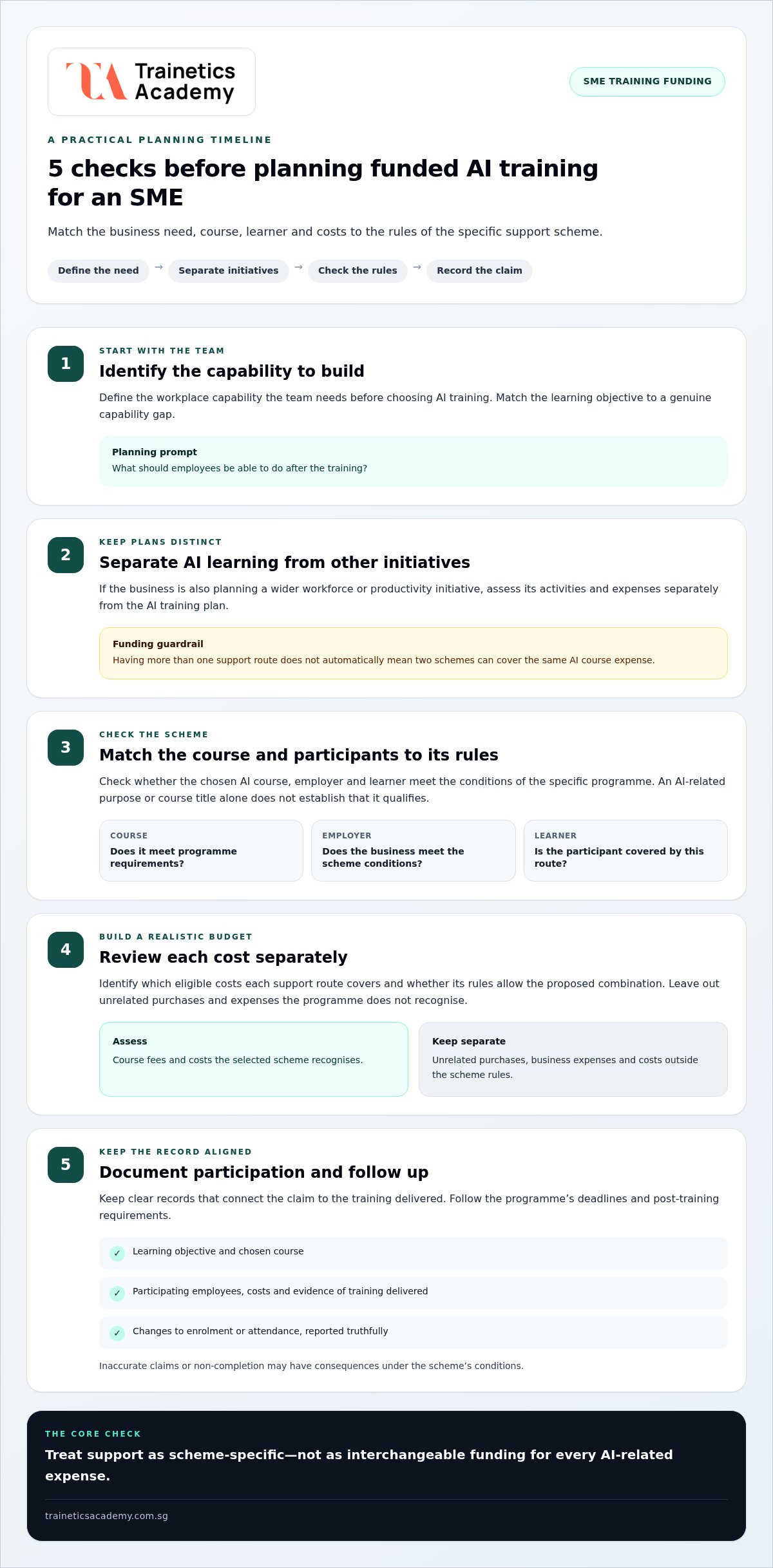
For an SME considering AI training, start by identifying the capability the team needs to build. Enhanced course-fee support may make eligible training more accessible, but the course must meet the relevant programme’s requirements before an employer includes it in a funded plan.
Combining Training Subsidies
Combining subsidies means using more than one funding route in a training plan. Singapore employers may receive additional support alongside existing schemes, but that does not automatically allow two schemes to cover the same AI course expense.
First, separate the planned AI learning from other workforce or business initiatives. Then identify which eligible costs each support route covers and whether its rules allow the proposed combination. For example, an employer might plan AI training alongside a broader productivity initiative, but should assess the activities and expenses separately. This helps prevent the funding plan from treating all AI-related spending as one interchangeable claim.
The key question is not simply whether two grants exist. It is whether the AI course, employer, learner and expense meet the conditions of each scheme. Treat additional support as scheme-specific rather than assuming subsidies automatically stack.
Excluded Training Costs and Courses
AI training costs or courses may be excluded if they fall outside the selected funding programme’s eligibility conditions. Assess the course and each cost separately: an AI-related purpose alone does not make every item eligible.
For an AI course, start by matching its content to a genuine workplace capability need. Separate the course from unrelated purchases or business expenses, and leave out costs the scheme does not recognise. A course that supports the team’s AI learning goals may still need to meet the programme’s specific criteria. This helps employers prepare a realistic budget without treating every AI initiative as subsidised training.
Use the scheme’s eligibility rules to determine what belongs in a claim. Do not infer coverage from a course title or from the fact that AI supports innovation.
Claim Documentation and Follow-Up
For an AI training claim, keep clear records of the learning objective, chosen course, participating employees and costs. Follow the relevant programme’s deadlines and post-training requirements, and retain evidence linking the claim to the training delivered.
Inaccurate claims or non-completion may have consequences under the scheme’s conditions, so employers should report participation and outcomes truthfully. For a team studying AI, recording changes to enrolment or attendance helps keep the claim aligned with what actually took place.
These records also help an SME assess whether AI learning addressed its intended capability gap. Use that evaluation to guide future training choices instead of assuming one funded course will suit every team or business objective.
Eligibility for Singapore Citizens and Permanent Residents
Individual learning support in Singapore depends on the learner’s status, age and chosen course. Individual support may be available for self-sponsored learning, while employer funding follows separate routes. These routes serve different purposes, so first identify whether the employee or the business is funding the learning.
SkillsFuture Credit and age-based support
The SkillsFuture Level-Up Programme is for Singapore Citizens aged 40 and above. Its SkillsFuture Mid-Career Enhanced Subsidy can provide course-fee subsidies of up to 90% for eligible supported courses. The course must fall within the scheme’s eligible options; age alone doesn’t establish that a particular course qualifies.
For example, a Singapore Citizen aged 42 considering a supported course can assess both available personal credit and the applicable course-fee subsidy. These are distinct forms of support, so the learner should understand how each applies before budgeting. A Permanent Resident shouldn’t assume the citizen-only age-based credit applies to them.
Support for Permanent Residents and foreign hires
Individuals may have access to personal support for self-sponsored learning and skills upgrading, depending on their eligibility. This can help individuals invest in career development while building capabilities for their current roles, career conversion or a move into another industry.
This distinction matters in mixed workforces. The stated personal credit routes cover Singaporeans and Permanent Residents, not every employee. A foreign hire should not be assumed eligible for these personal schemes just because their employer operates in Singapore. Company-level training support is a separate matter, assessed under employer funding rules.
For a team planning learning across different employee groups, separate self-sponsored applications from enterprise training plans. Record each learner’s residency status and intended course, then match the learner to the relevant support route. This helps employers distinguish individual assistance from workforce funding without assuming they share the same criteria.
SkillsFuture support can contribute to career development, but course eligibility and learner status remain central. For employers, this distinction helps shape a workforce plan that invests in Singapore Citizens and Permanent Residents while assessing foreign hires through the applicable company training-funding route.
What are the eligibility criteria for Singapore companies to claim training grants?
Singapore companies should assess eligibility by considering the business, employee, course and expense separately. These factors matter because course-fee support and salary funding address different training costs. Qualifying for one support route does not automatically make every employee or course eligible under another.
Assess the funding route and employee group
Start by identifying whether the claim concerns course fees, manpower costs, or both. Enhanced Training Support for SMEs may provide qualifying SMEs with course-fee support of up to 90% for eligible training. Absentee Payroll helps employers defray manpower costs when employees attend certifiable skills training. Each route has its own purpose, so match the expense to the relevant support.
Employee status is also important. Eligible Singapore businesses can receive up to 90% salary funding for hiring and training Singapore Citizens and Permanent Residents. This fact applies to those employee groups; it doesn’t establish the same salary funding for foreign hires. For a mixed workforce, identify which employees the funding route covers before building the claim around their training.
Match the course to the business need
A company should connect each proposed course to a clear workforce capability or productivity need. For example, an SME planning staff training—whether in emerging tech tools or recognised project management methodologies through accredited specialists like Yellowhouse—should identify the course, participating employees and intended work application. This gives the employer a practical basis for assessing whether the training meets the scheme’s eligible course requirements.
Eligibility depends on the specific support programme, not simply on a company’s decision to invest in learning. Before committing funds, distinguish eligible course fees from other business costs, and employee training from hiring support. These categories affect how the company interprets available assistance and plans its own contribution.
Use a simple internal assessment before making a funding request:
- Identify the support route and the expense it addresses.
- Classify participating employees by Singapore Citizen, Permanent Resident, or foreign hire status.
- Match the selected course to the relevant eligibility conditions.
- Keep the course-fee and manpower-cost calculations separate.
For example, an SME training Singapore Citizen employees may assess eligible course-fee support and salary funding as separate components. A Permanent Resident may fall within the stated salary-funding group, while a foreign hire should not be assumed to qualify for the same route. Employers should evaluate each employee and expense against the specific programme, rather than treating corporate training support as one universal grant.
How does the SkillsFuture Enterprise Credit work, and what expenses does it cover?
The SkillsFuture Enterprise Credit (SFEC) is a one-time credit for eligible employers in Singapore. It encourages businesses to invest in enterprise and workforce transformation, with additional support alongside existing funding schemes. It can help a company manage qualifying costs, but does not replace the employer’s responsibility to plan and fund training.
According to the Ministry of Manpower, eligible employers receive a one-time SkillsFuture Enterprise Credit of S$10,000 per company to cover up to 90% of qualifying out-of-pocket expenses for eligible government programmes. The credit is company-level support, rather than an individual SkillsFuture Credit balance. That distinction matters when an employer plans staff learning: the business assesses its eligible programme expenses, while individuals use separate support routes for self-sponsored learning.
For supported skills training, eligible Singapore employers can use the credit to offset up to 90% of out-of-pocket costs. The relevant expenses must relate to qualifying activities under eligible government programmes. An employer should therefore distinguish the course or programme cost from other business spending. The fact that an activity supports workforce development does not, by itself, make every associated expense eligible.
Use this framework to understand the expense categories:
- Potentially covered: qualifying out-of-pocket expenses for eligible government programmes, including supported skills training.
- Not automatically covered: costs that are outside the relevant programme’s qualifying expenses or conditions.
- Separate funding: other training or transformation support, which has its own eligibility and expense rules.
For example, an employer planning staff training can identify the government programme and its qualifying out-of-pocket expenses first. The employer can then assess how much eligible support applies, up to the stated limit. Other expenses connected to the same business plan should not be included automatically. This helps companies avoid treating the credit as a general-purpose training or operating budget.
SFEC is part of a wider funding landscape. Eligible employers may receive additional support alongside existing schemes, but each programme has its own purpose and criteria. A company considering both course-fee assistance and enterprise transformation support should classify each expense separately. This makes it easier to identify which scheme supports staff learning and which applies to another eligible business activity.
In practice, the credit is most useful when employers connect funding decisions to a defined workforce or enterprise objective. Identify the training purpose, the eligible government programme, and the associated out-of-pocket expense. Then assess the credit against those qualifying costs, rather than assuming the full S$10,000 applies to any training purchase. This approach keeps the funding calculation tied to the programme’s scope.
How do employers apply for SkillsFuture Singapore training grants through the Training Partners Gateway?
Employers can use the Training Partners Gateway (TPG) to find relevant training information, then follow the application process for the specific funding scheme. Before committing to training, match the employer, course, employee and expense to the grant’s requirements.
Prepare the training plan
Start by identifying the capability the business wants to build. For example, an employer planning digital marketing or communication programmes through providers like clickacademyasia.com should identify the intended learners and how the learning relates to their work. A defined objective makes it easier to compare course content with workforce needs.
Next, use TPG to find relevant course and training-partner information. Compare the course description with the intended learning outcome, and note the course name, provider, format and scheduled dates. These details help keep a funding enquiry or application consistent with the actual training plan.
Match the course to the funding route
Before submitting an application, identify the SkillsFuture Singapore grant or support scheme relevant to the planned training. Course-fee assistance and Absentee Payroll cover different costs, so record them separately. For instance, an employer sending staff for certifiable skills training should distinguish course fees from manpower costs.
Check the selected scheme’s conditions against the course and participating employees. A course appearing in TPG does not automatically meet every grant condition. Compare its details with the funding scheme’s eligibility rules and application instructions.
Submit and retain the claim records
Follow the application instructions for the relevant SkillsFuture Singapore scheme, using the course and employer details gathered through TPG. Prepare records that connect the training plan to the claim, such as course information, enrolment details, attendance records, invoices and completion evidence.
Application timing and post-training requirements depend on the scheme. Note the applicable deadline in its instructions, then track employee attendance and completion. Keep the submitted information and supporting records together so the employer can reconcile the claim with the training delivered.
A clear sequence helps prevent avoidable mismatches: define the capability, find relevant course information in TPG, identify the funding route and follow that scheme’s application steps. If a course changes after planning, compare the revised details with the grant conditions before relying on the original application information. Accurate course, employee and expense records give the employer a clear basis for managing SkillsFuture training support.
Trainetics Academy: Artificial Intelligence Course
Trainetics Academy offers an Artificial Intelligence Course for learners developing professional AI knowledge. If you’re comparing AI courses in Singapore, consider how the course content aligns with your current skills and intended work. Learners considering an introductory course can use their learning goals to identify the foundational knowledge they need.
For employers, connect AI learning to a defined capability gap before choosing training. This gives employees a clearer purpose for their studies and helps organisations consider how new knowledge could support their work.
To discuss your learning goals, contact Trainetics Academy or visit traineticsacademy.com.sg.
Turn training support into workforce capability
Funding is only one part of a strong training plan. Its lasting value comes from choosing learning that addresses a real capability gap and gives employees opportunities to apply it. For Singapore businesses, corporate training grants and subsidies in Singapore should support purposeful development, not dictate course selection.
Consider which skills will matter as your team’s work evolves, then connect that priority to a clear learning objective. If AI knowledge is relevant to your organisation’s next stage, include it in the discussion. A deliberate approach helps employers focus on workforce readiness while tying training decisions to business needs.
Trainetics Academy offers an Artificial Intelligence Course for learners developing AI knowledge. To discuss training options, contact Trainetics Academy about your learning goals. Take the next step with a clear purpose and build skills your team can put to work.
Frequently Asked Questions
What About WSG Funding?
WSG-related support depends on the specific workforce or career objective, rather than one blanket training subsidy. For example, Singapore’s Workfare Skills Support scheme for companies encourages low-wage workers to undertake training linked to more impactful employment outcomes. Employers should distinguish this workforce support from course-fee subsidies, then identify the programme that aligns with the employees and training purpose involved.
What corporate training grants and subsidies are available to Singapore businesses in 2026?
Singapore businesses may consider enhanced course-fee support for qualifying SME training, Absentee Payroll, SkillsFuture Enterprise Credit and Workfare Skills Support for companies. EDGE supports broader business activities, so it is not solely a course-fee grant.
What is the SkillsFuture Singapore course fee subsidy for employer-sponsored training?
For qualifying SMEs, enhanced course-fee support can cover up to 90% of eligible training costs. This isn’t a universal rate for every employer-sponsored course: the applicable support depends on the company’s eligibility and whether the course qualifies under the relevant scheme. Employers should distinguish the course-fee subsidy from Absentee Payroll, which helps defray manpower costs for employees attending certifiable skills training.
What is the Enhanced Training Support for SMEs, and which companies qualify?
Enhanced Training Support for SMEs provides higher course-fee funding and Absentee Payroll to help eligible Singapore SMEs train employees. Qualifying SMEs may receive up to 90% course-fee support for eligible training. The scheme’s support applies to qualifying businesses and training, rather than every company or course automatically. Employers should assess the SME’s status and the selected course against the relevant programme conditions.
How much funding can employers receive per employee or per course for training in Singapore?
There isn’t one fixed per-employee or per-course amount across Singapore’s schemes. Qualifying SMEs may receive up to 90% course-fee support for eligible training, while eligible businesses can receive up to 90% salary funding for hiring and training Singapore Citizens and Permanent Residents. Separately, the SkillsFuture Enterprise Credit is a one-time S$10,000 per company, with support tied to qualifying out-of-pocket expenses.
Disclaimer
AI Content Disclaimer: Some articles on this website may be generated or assisted by AI-powered content creation tools. While we strive for accuracy and relevance, readers should independently verify information before relying on it. The content is provided for informational purposes only and does not constitute professional advice.