A beginner AI course suits people who want to learn AI from scratch in Singapore, including learners with no technical background who need a clear starting point. Choose a learning path that introduces core concepts before moving into practical generative AI exercises. The goal is to understand how AI works and where it may be useful, not to arrive with specialist knowledge.
It’s reasonable to want a technical subject taught accessibly, with structured learning and opportunities to apply what you learn. This guide explains who beginner courses are for, how learning and assessment can work, and what AI foundations and generative AI practice may involve.
You’ll also see how these elements fit together, from building core understanding to exploring practical applications. This overview can help you decide whether this learning path suits your starting point and what you want to gain from studying AI in Singapore.
Key Takeaways
- AI beginners can build understanding step by step without starting with specialist knowledge.
- Course duration and classroom or virtual delivery shape how learning fits into your schedule.
- Written assessments and case studies can help connect foundational concepts with practical application.
- Explore how generative AI tools support hands-on practice, while learning to use them thoughtfully.
- Use the course content and learning format to decide whether this path matches your goals.
Course duration, classroom delivery and assessment
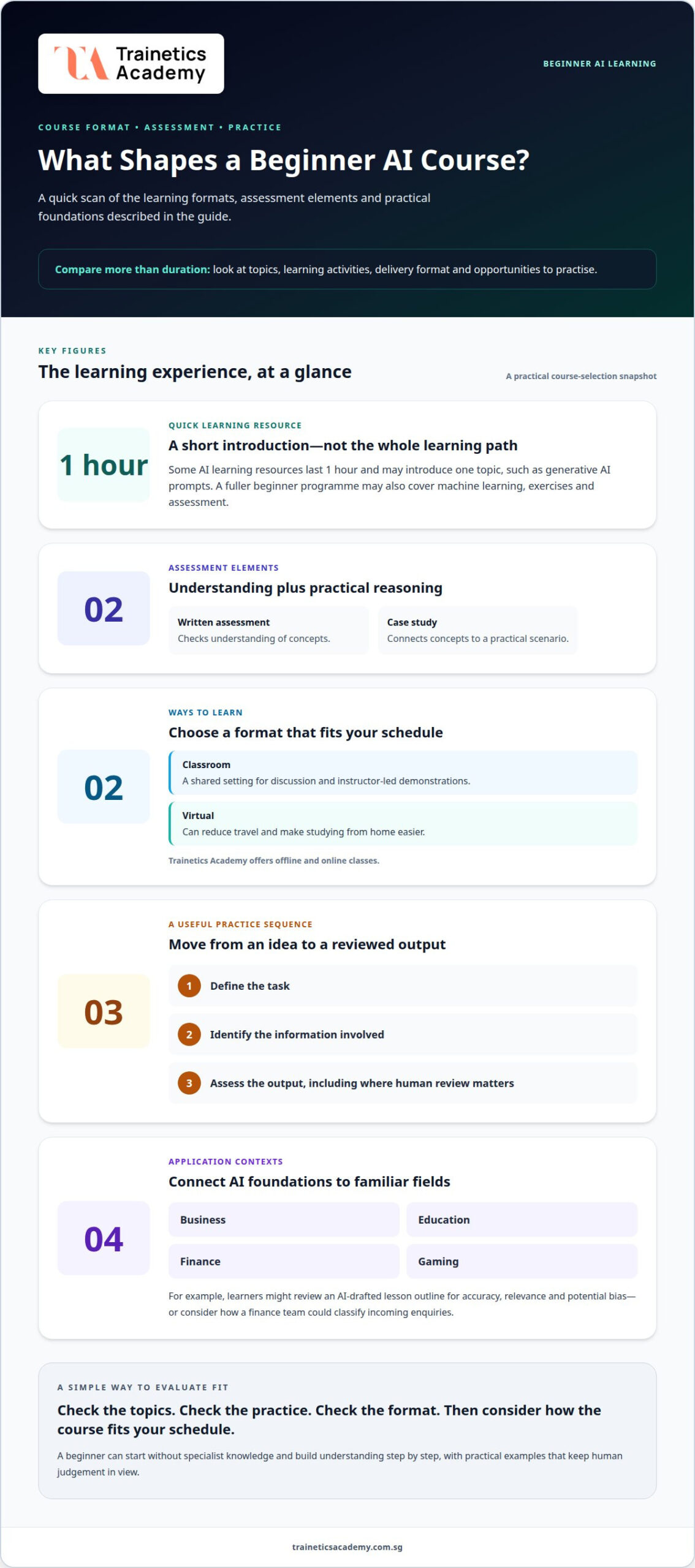
Start with the course schedule, because duration determines how study fits around work and family commitments. Some AI learning resources include quick courses lasting 1 hour, while fuller beginner programmes divide learning across lessons and practice. A short session can introduce one topic, such as generative AI prompts. It won’t provide the same depth as a course that also covers machine learning, exercises and assessment. Compare the topics and learning activities, not duration alone.
Assessment can add structure to an adult learner’s study plan. This course includes a written assessment and a case study, connecting concepts with a practical scenario. For example, a case study might ask learners to consider how an organisation could apply an AI tool to a task. The written component assesses understanding, while the case study encourages reasoned application. Treat both as part of the learning process, not just a final hurdle.
Classroom and virtual learning can suit different schedules. In-person lessons offer a shared setting for discussion and instructor-led demonstrations. Virtual lessons can reduce travel and make it easier to study from home. Trainetics Academy offers both offline and online classes. Before enrolling, consider how the teaching format fits your schedule and preferred way of learning. An adult learner balancing a full-time job may value planned sessions, while another may prefer online learning.
What are the best free online resources to learn AI from scratch? Start with introductory AI explainers, then use Python notebook exercises to explore simple machine-learning examples. Add generative AI tool documentation when you want to practise prompts and review outputs. A useful sequence is concept, worked example, independent exercise. Keep a short record of what each model did well and where its response needed human review.
Which beginner AI courses in Singapore are online, part-time, or in-person? Beginner courses may use virtual lessons, classroom teaching or a mix, while suitability for part-time study depends on the timetable and practice required outside class. For example, online evening lessons may fit around office hours, while classroom sessions may suit learners who benefit from live discussion. Compare delivery format, assessment and practice time together.
Course fees and funding in Singapore depend on the course and the learner’s eligibility. Review the payable fee after any applicable support and GST rather than assuming every AI course qualifies for the same subsidy. This matters to adult learners planning a career transition, since funding conditions can shape the final budget. Generative AI courses emphasise tool use, while machine-learning courses focus more on data, patterns and model behaviour.
What AI jobs can beginners pursue in Singapore, and what skills do employers require? Entry-level paths may include data support or AI operations work, where basic data handling, clear communication and careful output evaluation are useful. A beginner can build evidence through small projects, such as documenting a prompt test or explaining a simple classification example. An AI course can develop foundational skills, but career readiness also depends on role-specific practice. For learners interested in applying new tech skills to freelance work or remote ventures, EarnOnlineGuides provides practical resources on developing digital capabilities and online income streams.
Consider virtual lessons if you want to study around office hours, classroom-based learning for live discussion, or a mix of formats. Whether a course suits part-time study depends on its timetable and the independent practice required.
Foundational learning through real-world application
AI foundations become clearer when each concept connects to a familiar task. In Singapore, learners can explore applications in business, education, finance and gaming. For example, consider how a finance team might classify incoming enquiries, then discuss where human review remains necessary. This moves study beyond terminology, showing how organisations identify a task, assess an AI use case and consider its practical limits.
A useful beginner exercise follows three steps: define the task, identify the information involved, then assess the output. For an education example, learners might explore how generative AI drafts a lesson outline, then review its accuracy, relevance and potential bias. This approach introduces governance as part of responsible use, rather than an afterthought. Successful application means addressing a suitable problem while recognising where human judgement still matters.
Maritime operations offer another context for applying AI concepts. For example, learners can discuss how an organisation might use AI to summarise vessel schedules or organise maintenance records. These are illustrative scenarios, not a claim that every programme covers maritime systems. They help beginners ask practical questions: What information is available? What decision could the output support? Who reviews it before action? Those questions connect AI foundations to Singapore’s maritime context.
Eligibility depends on the specific programme. The Fresh Graduate AI Bootcamp is for Singapore fresh graduates who completed their studies in 2025 or 2026 and haven’t started their first full-time employment. Separately, Singapore Citizens must be at least 18 years old to qualify for the SkillsFuture AI Subscription initiative. These are distinct conditions. Applicants should match their circumstances to the relevant programme, rather than assume one eligibility rule applies to every learning opportunity.
The Fresh Graduate AI Bootcamp runs from 2 to 23 December 2026. Candidates are scheduled to receive an offer by 8 January 2027. Those dates provide a concrete planning frame for applicants considering a structured programme. Before applying, prepare a concise account of your education, interests and intended AI use cases. For instance, a graduate interested in finance could describe a workflow they want to understand, without claiming technical expertise.
Connect each practical example to evidence of learning. A short case analysis can record the task, the AI output, the review criteria and the human decision. This gives a clearer account of applied skills than a certificate alone. For a Singapore business scenario, note how governance affects data handling and output review. This discipline helps learners assess opportunities realistically and explain how AI can support work without replacing responsible judgement.
Hands-on practice with generative AI tools
Generative AI practice starts with a clear task, not a complicated prompt. For example, ask a tool to turn rough meeting notes into a concise project update. Specify the audience, purpose and preferred format. Then check the draft for missing details, invented claims and unsuitable tone. This simple cycle builds applied AI skills: describe the task, assess the response and revise your instructions.
Prompting improves through comparison. Give a tool the same task twice, changing one instruction each time. For example, request a customer-service reply first in a neutral tone, then in a more formal tone. Compare whether each version addresses the customer’s actual concern. This exercise builds judgement about how instructions shape outputs, rather than treating the first generated response as final.
Workplace exercises can focus on productivity without assuming AI should make decisions. A learner might use a tool to organise a public project brief into action items, then correct omissions manually. Another exercise could turn a long report into a short summary for a colleague. In both cases, keep the original material available and check names, dates and key meaning.
Build a repeatable review routine for each task. First, state the intended outcome. Next, provide only the context needed. Then compare the output with the original request. For a draft email, check the facts, tone and next steps. Finally, revise the prompt or edit the text yourself. This method helps learners distinguish useful assistance from polished but unreliable wording.
Generative AI can also support idea development. Ask for several campaign themes for a Singapore community event, then assess each for relevance and clarity. Treat the suggestions as starting points, not ready-made decisions. Explain which idea best fits the audience and why. This demonstrates stronger AI skills than simply collecting generated options.
Practise careful information handling. Use a fictional customer profile or public sample text rather than entering confidential workplace records. For example, replace real names with invented labels before testing a summarisation prompt. This keeps the exercise focused on prompt design and output review, while helping learners recognise that workplace use needs thoughtful boundaries.
Eligible Singapore Citizens aged 18 and above enrolled in selected SkillsFuture-funded AI courses may receive 6 months of complimentary access to one premium AI tool. This can give learners time to practise beyond class, such as refining a report summary or testing alternative prompts. Access supports continued exploration, while careful review remains essential for every generated result.
AI concepts and foundational literacy
Begin by distinguishing artificial intelligence, machine learning and generative AI. AI describes systems performing tasks that usually require human judgement. Machine learning finds patterns in examples, while generative tools create new text or images. For instance, a spam filter classifies messages, while a writing assistant drafts a reply. These examples give learners practical vocabulary for discussing innovation without treating every digital feature as AI.
What maths and programming skills are needed to start learning AI? For introductory courses and generative tools, clear reasoning and basic number sense are useful starting points. Advanced mathematics and coding aren’t necessary for every beginner. Learners exploring machine learning in more depth can build their knowledge of statistics, probability and Python as they progress.
One foundational idea is training data: examples used to help a model identify patterns. Imagine a system sorting fruit photographs by type. If its examples show mostly red apples, it may perform poorly on green apples. This illustrates why the quality and range of examples matter, and gives beginners a concrete way to understand how data influences a model’s output.
Next, distinguish a model’s output from a verified fact. A generative system can produce a fluent answer containing errors or unsupported details. For example, ask it to summarise a policy, then compare the summary with the original document. This two-step practice builds foundational literacy: use the tool, then check its response against reliable information.
Evaluation starts with a clear criterion. For a draft email, check whether it answers the request, preserves key details and uses the intended tone. For a classification task, compare the predicted label with the known example. These checks help learners assess usefulness rather than assume a polished response is correct. They also show how carefully selected tasks can support productivity.
AI literacy also means recognising limits and context. A model may reflect patterns in its training examples, so different inputs can produce uneven results. For instance, test a summarisation prompt on two versions of a report and note what gets omitted. Discussing those differences introduces bias, reliability and human oversight as practical concepts, not abstract terms.
A strong learning sequence moves from concepts to application. First, identify whether a task uses classification, prediction or generation. Then examine the input, review the output and explain its limitations. A learner with a non-technical background can apply this sequence to a meeting summary or customer enquiry. Each exercise develops a more precise understanding of AI and prepares learners to explore more advanced courses.
Beginner-friendly AI foundations
A structured start helps beginners connect artificial intelligence concepts with useful tasks. Begin with examples of classification, prediction and generation, then consider what information each task needs. Sorting customer messages demonstrates classification, while drafting a reply shows generative AI. This foundation helps learners discuss AI solutions clearly, even without a technical background.
What is a step-by-step roadmap to learn AI as a beginner? Start with core AI concepts, practise evaluating generative AI outputs, then explore data and basic machine learning. Finish by applying those skills to a small, relevant task and explaining your process.
Use this sequence to develop your knowledge deliberately:
- Define the task. Choose a familiar example, such as summarising a meeting agenda or sorting product feedback.
- Identify the AI approach. Decide whether the task involves generating content, finding patterns or assigning categories.
- Inspect the inputs. Note what information the system receives and whether the example contains enough context.
- Review the result. Compare the output with the original task, checking accuracy, relevance and missing details.
- Explain the limits. Record where human judgement remains necessary, such as approving a customer-facing response.
Each step builds on the previous one. A learner testing a meeting-summary prompt can first assess whether the summary preserves key decisions. Next, revise the instruction to request action items. Finally, explain which details still need human review. This exercise links concepts to workplace use without requiring a complex technical project.
Employers value more than familiarity with AI tools. A beginner can demonstrate clear reasoning by documenting the task, input, output and review process. For example, a short portfolio entry might show how an AI tool organised sample feedback, then describe how the learner checked its categories. This evidence makes foundational skills visible and gives interview discussions a concrete focus.
As confidence grows, add basic data concepts before exploring machine learning. Compare labelled examples, such as messages marked “urgent” or “routine,” and consider how inconsistent labels could affect a model’s results. Then progress to simple Python exercises if your chosen learning path requires coding. This gradual progression keeps AI learning grounded in evidence rather than tool familiarity alone.
Choose an Artificial Intelligence Course when you want structured guidance connecting core concepts with practical learning. A defined curriculum can help you move from introductory ideas toward applied tasks, while keeping each stage connected to the skills you aim to develop.
Trainetics Academy
Trainetics Academy can support your move from AI basics to practical understanding. Its Artificial Intelligence Course offers a focused way to develop foundational knowledge and explore how AI applies to work. Consider this path when self-study leaves gaps or you want guided learning that connects concepts with real-world examples. The right starting point depends on your current knowledge and goals, whether you’re exploring generative tools or building broader AI literacy. Contact Trainetics Academy to discuss your learning goals and the course.
Take your next step with confidence
Turn curiosity into a deliberate learning goal. Choose an area where AI could support your work or interests, then build your understanding around practical, responsible use. Progress comes from asking clear questions, evaluating outputs and strengthening your judgement as you learn.
If you’re ready to learn AI from scratch in Singapore, Trainetics Academy’s Artificial Intelligence Course offers a structured next step. It can help you develop your foundations and connect them with practical applications.
Contact Trainetics Academy to discuss your learning goals and take your next step with confidence.
Frequently Asked Questions
Who is this course for?
A beginner AI course suits working adults, career changers and professionals who want to understand AI without starting with advanced technical study. It can also benefit organisations building employees’ familiarity with artificial intelligence. For example, an operations executive might want to assess where AI could assist routine tasks. Learners with coding experience can also take introductory study to strengthen their understanding of AI applications and responsible use.
What can you learn here?
You can build a working understanding of artificial intelligence and explore its applications in everyday and workplace tasks. A useful learning outcome is being able to describe a task clearly, consider whether an AI tool fits, and review its output critically. For example, assess whether a generated summary preserves the important points in a project brief. Course content and practice depend on the programme.
How can beginners learn AI from scratch in Singapore?
Start by choosing a practical goal, such as understanding AI-generated writing or learning how machine learning uses data. Then follow a structured course or learning sequence, practise with non-confidential examples and record what you learn. For instance, compare an AI-generated draft with its source material and note any omissions. This creates a useful learning record and helps you explain your reasoning when applying new skills at work.
What AI courses for beginners are available in Singapore?
Options include introductory artificial intelligence courses, generative AI learning and more technical study covering machine learning. Choose based on whether you want broad AI literacy, practical tool use or a pathway into coding and data. Trainetics Academy offers an Artificial Intelligence Course for learners seeking a foundation before exploring a more specialised area.
Which Singapore universities and polytechnics offer beginner AI courses?
Universities and polytechnics may offer AI learning through different formats, including academic study and short courses. The right choice depends on whether you want a formal academic pathway or practical introductory training. Compare each programme’s intended audience, curriculum and assessment style. Trainetics Academy offers an Artificial Intelligence Course for learners seeking course-based training, rather than an academic degree programme.
How much do beginner AI courses in Singapore cost?
Course fees vary by programme, duration, delivery format and eligible funding support. For a practical comparison, consider the full course fee, learning hours and whether assessment or hands-on activities are included. The payable amount can also depend on an individual’s eligibility for applicable support. Contact Trainetics Academy for details about its Artificial Intelligence Course fees.
Can Singaporeans use SkillsFuture Credit or subsidies for AI courses?
Singaporeans aged 25 and above can use SkillsFuture Credit for eligible courses. Eligibility depends on the specific course, so it shouldn’t be assumed for every AI programme. The Introduction AI Course is the course identified as eligible for SkillsFuture Credit and UTAP. Other subsidies may have separate eligibility conditions, which can depend on the learner and programme.
How long does it take to learn AI and build beginner projects?
The timeframe depends on the project’s scope, your starting knowledge and how regularly you practise. A simple project using sample text can focus on testing prompts and reviewing outputs; a machine-learning project may also require data preparation and coding. Set a clear outcome first, then divide the work into learning, building and review. A project is ready to share when you can explain its method and limitations.
Disclaimer
AI Content Disclaimer: Some articles on this website may be generated or assisted by AI-powered content creation tools. While we strive for accuracy and relevance, readers should independently verify information before relying on it. The content is provided for informational purposes only and does not constitute professional advice.