Can SkillsFuture Credit help pay for AI courses? It may, but funding depends on whether the specific course is eligible. For freelancers developing AI skills in Singapore, that distinction matters: training should connect practical AI use to the work you deliver, from shaping research and content workflows to evaluating AI-generated outputs.
It makes sense to consider funding before committing to training, especially when you need skills you can apply directly to client projects. SkillsFuture Credit or another subsidy may help with eligible training costs, but it does not automatically apply to every AI programme. First identify the skills useful in your freelance work, then check the course’s eligibility and funding rules.
This guide covers practical AI skills for freelancers, including prompt writing, output evaluation and workflow integration. It also explains how SkillsFuture Credit and UTAP may apply to eligible training, what to consider when choosing an AI course in Singapore, and how structured learning can help you use AI with sound judgement.
Key Takeaways
- Prioritise practical AI literacy, prompt writing and the ability to assess AI-generated results for freelance work.
- Choose learning that connects generative AI and other AI concepts to tasks you actually deliver for clients.
- Funding depends on course eligibility; the Introduction AI Course is identified as eligible for SkillsFuture Credit and UTAP.
- Build human judgement into AI workflows so you can refine outputs, protect quality and decide when a task needs your expertise.
- Trainetics Academy’s Artificial Intelligence Course can support a structured next step in developing your AI capabilities.
Can I use SkillsFuture to pay for AI courses?
Potentially. In Singapore, SkillsFuture Credit can offset remaining course fees after subsidies for Singaporeans aged 25 and above. However, eligibility depends on the specific course: the Introduction AI Course is the course to identify as eligible for SkillsFuture Credit and UTAP. Don’t assume that every programme in AI literacy, generative AI, data science or machine learning qualifies. Before choosing a course, compare its learning outcomes with your freelance work and consider whether the stated funding applies to that course.
Choose a course that follows a useful progression. Start with AI literacy to understand what common AI tools can and cannot do. Then practise generative AI for tasks such as drafting a client brief or organising research notes. Data science and machine learning offer a deeper path for freelancers who need to analyse datasets or develop predictive models. Each area builds different capabilities, so match your learning to the work you want to deliver.
For technical AI projects, focus on machine learning, natural language processing and data science. A freelancer building a text-classification model, for example, needs to understand how training data shapes its outputs. Python can help with data preparation and model experimentation, while statistical reasoning helps assess whether results are meaningful. These skills go beyond chatbot use, but can support specialist project work.
Which AI skills are most in demand for freelancers in Singapore? Employers value AI literacy, prompt engineering, output evaluation and applying AI tools in business contexts. For example, a writer can prompt an AI tool to produce a first draft, then check factual claims and adapt the tone for the client’s audience. Combining tool proficiency with communication and decision-making skills helps you explain recommendations, manage expectations and keep the work aligned with the brief.
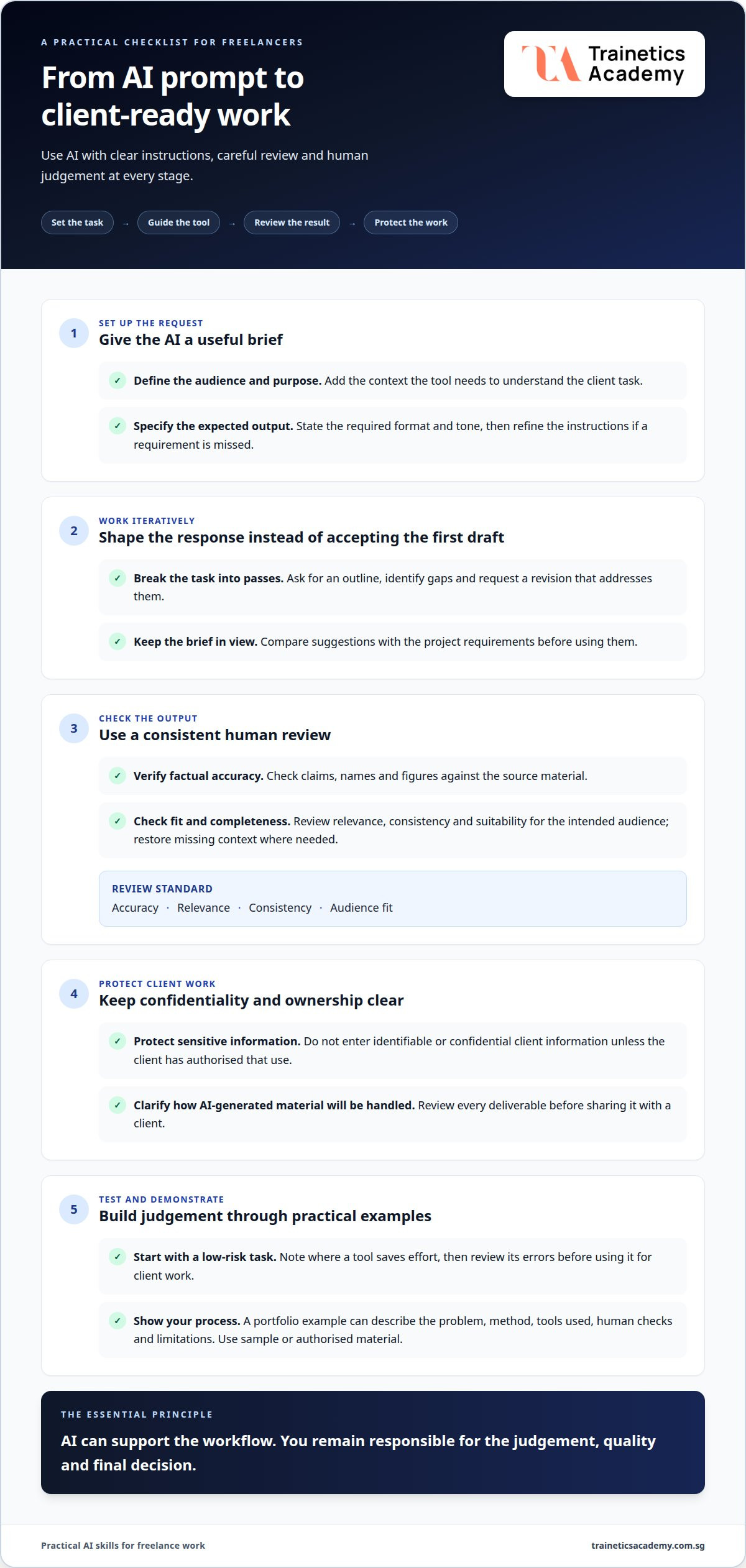
Singapore’s PDPA and copyright considerations make client data and ownership important parts of an AI workflow. Do not enter identifiable or confidential client information into an AI tool unless the client has authorised that use, and clarify how AI-generated material will be handled. Tool access alone may not distinguish you from other freelancers, and unreliable outputs can take substantial effort to correct. Protect confidentiality and review every deliverable before sharing it.
Adaptability matters because AI tools and processes change. Test one tool on a low-risk task, note where it saves effort, then review its errors before applying it to client work. For example, compare an AI-generated outline with the project brief before drafting from it. This builds judgement alongside technical ability and helps you recognise when a task calls for human analysis instead.
Freelancers working in AI and machine learning may combine Python, data science, model evaluation and natural language processing with client communication. A specialist might build a text-analysis prototype, explain its limitations and revise it after feedback. Developing AI skills for freelancers in Singapore is not just about learning tools. It also means continuing to learn, adapting to project needs and applying careful oversight.
What Skills Do You Need for AI Jobs in Singapore?
AI roles combine practical tool use with sound judgement. For freelance work, build your capabilities in AI literacy, prompt engineering and output evaluation, then demonstrate them through clear project examples.
AI Literacy and Output Evaluation
AI literacy means knowing what a tool can do, where its answers may fail and how its output fits a business task. For example, if you use a chatbot to summarise a client brief, compare the summary with the original, check names and figures, and restore missing context. Employers value people who evaluate AI-generated outputs rather than accepting them at face value.
Use a consistent review process: check factual accuracy, relevance to the request, consistency and suitability for the intended audience. This matters especially when AI supports research or customer-facing content. Singapore employers also value applying AI tools in business contexts, so explain the task and your review process, not just which tool you used.
Prompt Engineering and Human-AI Interaction
Prompt engineering means giving an AI system clear instructions, useful context and a defined output format. A useful prompt might specify the audience, the purpose of a draft and the required tone. Refine it if the response misses a requirement. This structured approach helps you guide AI while retaining responsibility for the final decision.
Effective human-AI interaction involves iteration, not just a single command. For example, ask for an outline, identify gaps, then request a revision that addresses them. You still need to verify claims and make the final content fit the brief. Strong communication skills help you translate a client’s goals into instructions the tool can follow.
Building a Freelance AI Portfolio
Start with a small portfolio of practical demonstrations. Show a sample workflow, such as turning a sample brief into an outline, and document how you reviewed the AI’s suggestions. Describe the problem, your method, the tools used and the human checks. Use sample or authorised material rather than exposing confidential client information.
To get started, define one service you can deliver reliably, prepare a relevant example and describe its limits clearly. A freelance marketplace profile can connect that example to a specific client need. Keep your portfolio focused: a content workflow, data analysis demonstration or text-classification prototype says more than a broad claim of AI expertise.
When hiring an AI engineer through a freelance marketplace, define the scope precisely. Specify the business problem, required inputs, expected output and how success will be assessed. For a text-analysis project, ask candidates to explain their approach to data preparation, model evaluation and error handling. Review relevant portfolio examples and communication skills, not just familiarity with a particular tool. Python, machine learning and natural language processing may matter for technical builds, while a workflow task may need different expertise.
Freelance AI engineer hourly rates in Singapore vary across marketplace profiles and reflect differences in services and expertise. An AI engineer, a senior AI engineer and an AI automation freelancer may offer distinct types of work, so one profile’s rate is not a universal benchmark. Before agreeing to an hourly arrangement, define whether the work covers prompt engineering, model development, testing or revisions. A clear scope makes it easier to assess the proposed rate against the deliverables.
Singapore course subsidies and SkillsFuture Credit
Singapore freelancers can study AI literacy, generative AI, data science and machine learning, but funding depends on course eligibility. The Introduction AI Course is eligible for SkillsFuture Credit and UTAP. Singaporeans aged 25 and above can use SkillsFuture Credit to offset remaining course fees after subsidy. Course fees, funding and any credential depend on the specific programme, so distinguish course content from funding eligibility.
For eligible AI training, UTAP can offset 50 per cent of the unfunded portion of course fees for NTUC union members, subject to annual caps. The available annual support varies by age and membership category: up to S$500 for members aged 40 and above, up to S$250 for those aged 26-39, and up to S$200 for members aged 18-25 with NTUC Starter Membership. These are caps, not guaranteed reimbursements.
To estimate your out-of-pocket fee, identify the course’s eligibility, applicable subsidy, remaining fee and any available SkillsFuture Credit or UTAP support. Apply each scheme according to its rules, rather than assuming the same percentage applies to every AI course. If you are choosing training for writing workflows, automation or innovation, compare the course’s stated outcomes with the skills needed in your sector or organisation.
Course requirements can affect whether a programme fits your schedule and preparation. For example, the AI for the Workforce course requires learners to be at least 18 years old and have WPLN Level 4 proficiency in reading, writing, listening and speaking. It runs for 13 hours over 2 days, with in-person classes at MacPherson, and requires English proficiency.
That course also illustrates why assessment details matter. Its practical exam lasts 15 minutes, its written exam lasts 35 minutes, and oral questioning lasts 10 minutes. Learners must attend all sessions, with 100% attendance required to pass, and achieve a 100% competency score. These conditions belong to this specific course, not every AI training programme.
Course format and class size also shape the learning experience. The AI for the Workforce course has a maximum class size of 20 participants, while AI learning options more broadly range from quick courses lasting 1 hour to comprehensive programmes. A freelancer balancing client deadlines can use duration, delivery mode and assessment requirements to judge whether a course suits their working routine.
AI courses and any credentials they lead to are course-specific; a subject label alone does not establish a particular certification. Before enrolling, compare the published learning outcomes, assessment format, duration and funding eligibility. For freelance work, choose a course whose practical learning supports a defined service, such as responsible use of generative AI or understanding data science methods.
Generative AI skills for productivity and creativity
Freelancers can use generative AI to speed up defined tasks and develop ideas while retaining control over accuracy and client fit. Its value depends on matching the tool to the task and reviewing the output.
Generative AI for Content and Research
For content work, use generative AI to draft outlines, suggest alternative headlines or organise research questions. Specify the audience and purpose, then treat the response as a working draft. For research, use AI outputs to identify topics to investigate, not as evidence. Verify factual claims against reliable material before including them in a client deliverable.
A useful workflow separates generation from judgement: define the brief, request a specific output and review the result against the client’s requirements. For example, ask for three ways to structure an article, choose an approach, then revise it using verified research. This makes creative work more deliberate and reduces the risk of submitting generic writing that misses the brief.
Large Language Models for Productivity
Large language models generate text in response to prompts and can support tasks such as summarising supplied material or drafting email variations. Clear inputs and a defined purpose make their outputs more useful. For example, request a concise meeting summary with decisions and follow-up actions, then compare it with the original notes.
Singapore’s task analysis estimates that high-AI-potential tasks can be suitable for immediate automation using commercial off-the-shelf AI products, with minimal or no engineering knowledge from users. For these tasks, using a chatbot interface alone can provide more than 50% time savings. This is potential, not a promise for every project or freelancer.
Moderate-AI-potential tasks are estimated to allow 30%-50% time savings. A freelancer might use a model to produce a first-pass content outline, then add specialist insight and confirm every claim. Low-potential tasks are estimated to allow 10%-30% time savings. These ranges describe task categories, so they shouldn’t be treated as guaranteed productivity gains for a particular client job.
Generative AI can also support creative exploration. A designer might ask for alternative campaign concepts, while a researcher could use a model to group themes from non-sensitive notes. You still need to select, adapt and validate the ideas. That human contribution turns a model’s suggestions into work shaped by context, audience and professional standards.
Singapore’s task analysis covers 38 sectors and around 2,000 job roles, helping frame AI potential by task rather than by job title alone. For freelancers, that distinction is practical: assess whether a particular activity benefits from automation, assistance or human-led work. Build repeatable prompts for suitable tasks, keep review steps in the workflow, and refine the process as project needs change.
AI tools, workflow customisation and human oversight
In 2026, Singapore freelancers can prioritise generative AI chat interfaces, document assistants and workflow automation features. Select tools by the task they support, such as organising project notes or preparing a first-pass client report. Employers seek hands-on ability to apply AI tools in daily workflows, so practise integrating them into real work rather than learning features in isolation.
Developing AI skills for freelancers in Singapore starts with mapping a repeatable process. For example, a researcher can sort source notes, draft a summary and compare every claim with the original material. Record which steps the tool handles and where human review changes the result. This helps you judge whether the tool improves the workflow or simply adds steps.
Adapt each workflow to the client’s task and industry. A content specialist might generate alternative report structures, while an analyst could classify non-sensitive feedback into themes. Define what the AI handles, what a person reviews and which decisions require professional judgement. A process that works for one client or industry may not suit another, even when both use similar tools.
Build human oversight into the workflow rather than treating it as a last-minute fix. Before sharing a deliverable, check its figures, names, tone and completeness against the project requirements. For example, compare an AI-assisted proposal with the client’s brief and restore any missing constraints. Keep a person responsible for the final decision, especially when an output could shape a recommendation or reach a customer.
Protect the material used in each workflow. Do not enter confidential client information into a tool without permission, and use fictional or public examples when testing a process. Keep prompts, outputs and revisions together. This record helps you explain how the work was produced and repeat useful steps without exposing sensitive project details.
Strong AI skills for freelancers in Singapore include improving workflows through disciplined testing. Change one element at a time, such as the prompt or review checklist, then compare the result against the same project requirements. Save templates for recurring tasks, but adapt them to each audience and brief. This builds a practical process while keeping professional judgement in control.
Structured learning can help freelancers strengthen their approach to tool selection, workflow design and oversight. Explore AI course learning to develop a more deliberate foundation for applying these methods in professional work.
Singapore freelancers can learn to use generative AI chat interfaces, document assistants and workflow automation features, choosing tools to match the tasks they need to support.
Trainetics Academy
Trainetics Academy offers an Artificial Intelligence Course for freelancers building practical AI capability. Structured learning can help you develop confidence in AI concepts, use tools thoughtfully and connect new skills to your professional work.
Effective AI use in freelance projects involves more than generating output. It requires clear instructions, careful review and sound judgement about where automation fits. A focused course can help you build that foundation and approach AI applications with greater discipline, whether you work in writing, research or another field.
To discuss your AI learning goals, contact Trainetics Academy.
Turn AI learning into a deliberate next step
Choose one recurring freelance task and define what better performance would look like: clearer client communication, a more useful first draft or a smoother handover. Then map where AI can help and where your own judgement must lead. This gives your learning a practical direction and helps you build AI skills for freelancers in Singapore around the work you want to improve.
Keep a simple record as your process develops. Note the task, the tool’s role, the checks you applied and the changes you made. Over time, these examples can help you explain your approach to clients precisely and show how you combine technical fluency with professional responsibility.
Trainetics Academy offers an Artificial Intelligence Course for learners who want to build a structured foundation in AI. If you’re ready to discuss your training goals, contact Trainetics Academy about AI training. Take the next step with purpose, and keep strengthening the skills that make your work distinct.
Frequently Asked Questions
Can AI skills help you land a higher-paying job?
AI skills can strengthen your case for higher-value work when they solve a clear business problem. For example, a freelancer who automates a repetitive reporting step can explain the time saved and the checks used to protect accuracy. Pair tool proficiency with sound judgement, clear client communication and evidence of project outcomes. Employers and clients can then assess the value you bring, rather than just your familiarity with AI terminology.
Do I need a tech background to get an AI job in Singapore?
No. Some applied AI work does not require a technical background. Roles involving AI-assisted writing, research or workflow support can build on existing professional skills. More technical work, such as developing machine-learning models, calls for programming and data expertise. In Singapore, the AI for the Workforce course does not require prior AI or coding experience, illustrating one accessible entry point for practical learning.
What AI skills are employers looking for?
Employers value AI literacy, prompt engineering, output evaluation and the ability to apply tools in business contexts. They also look for people who can explain their decisions and collaborate effectively. For example, a project coordinator might use AI to sort incoming feedback, identify themes and explain which findings warrant action. Combining these capabilities with critical thinking and adaptability helps make your contribution clear across teams and industries.
What do AI freelancers earn in Singapore by skill and experience?
These are individual profile rates, not a standard market scale. Experience, technical depth, project scope and demonstrated results all shape what a freelancer can charge for a particular engagement.
Where can freelancers in Singapore find AI-related projects and clients?
Freelancers can find AI-related work through freelance marketplaces, professional networks, referrals and direct outreach to businesses. Focus your search on a defined service, such as AI-assisted content production or workflow automation, rather than presenting yourself as an all-purpose specialist. A concise portfolio example can show the task, your method and the human review involved. Tailor each proposal to the client’s need and industry.
Which AI skills are most useful for Singapore freelance writers, designers, marketers, and developers?
Writers can use AI for research assistance, structured drafting and fact-checking. Designers can explore concepts with generative tools, then apply their own visual judgement. Marketers can practise prompt design and audience-specific content review. Developers may need Python, data science and machine-learning skills for technical projects. Across all four fields, clear client communication and careful handling of project information help turn AI capabilities into dependable professional work.
Disclaimer
AI Content Disclaimer: Some articles on this website may be generated or assisted by AI-powered content creation tools. While we strive for accuracy and relevance, readers should independently verify information before relying on it. The content is provided for informational purposes only and does not constitute professional advice.