What if an AI workshop began with your team’s actual work, not a tour of tools they may never use? A corporate AI workshop Singapore teams can apply in practice should connect learning to everyday tasks, role-specific needs and responsible use of company information.
Training is more useful when it reflects how employees work. Teams may have different levels of experience, schedules and priorities, so a generic approach can leave people unsure what to do next. A little preparation helps clarify learning goals and shape practice around relevant workplace tasks.
This guide explains how to plan a corporate AI workshop that builds practical capability and supports responsible adoption. You’ll learn how to identify skills that matter across roles, choose a format that suits your team, and plan how employees can apply their learning afterwards. Trainetics Academy provides customised corporate group training in Singapore, delivered in person or virtually, to connect AI education with organisational needs.
Key Takeaways
- Identify the tasks your team wants AI to support before choosing workshop topics.
- Build learning from core AI concepts to guided practice with relevant workplace tasks.
- Compare facilitated, self-paced and blended formats by flexibility, interaction, role-specific practice and feedback.
- Set clear objectives and prepare non-sensitive examples so employees can practise responsibly and review how they apply their learning.
- A corporate AI workshop Singapore organisations customise around team needs can align learning format, practical exercises and follow-through.
Why a Corporate AI Workshop in Singapore Should Start With Team Needs
Which tasks in your organisation could benefit from AI support? What should employees learn first: how to write clearer instructions, assess generated content, or recognise when a task needs human judgement? Each question points to a different learning need. A corporate AI workshop Singapore teams can use effectively should identify those needs before selecting topics or tools.
Start by exploring three areas. Capability gaps show what employees need to understand or practise. Workflow opportunities identify recurring tasks where AI might assist, such as preparing a first draft or organising information. Responsible-use questions surface concerns about accuracy, sensitive company information, review processes and appropriate human oversight. Keeping these areas distinct helps you set priorities without assuming every challenge calls for training.
For context on Singapore’s AI governance landscape, watch this overview:
Map AI learning needs to roles and workflows
Review recurring tasks, handoffs and information-heavy work across the roles attending. Ask managers and employees where repetitive steps take up time, where drafting slows progress, and which outputs require frequent checking. A finance team and a customer support team may use AI differently, so shape examples around their work rather than relying on broad demonstrations.
Use the discovery process to distinguish learning needs from operational decisions:
- Immediate learning: Practise framing a request, inspecting an AI-generated response and revising it.
- Workflow opportunity: Identify a task that may be suitable for guided experimentation.
- Longer-term decision: Assess whether a process, tool or internal guideline needs further review.
Use non-sensitive examples that resemble real tasks in workshop exercises. Keep confidential information out of practice materials unless your organisation has established guidance for handling it.
Set realistic outcomes before the workshop
Write learning aims as actions participants can demonstrate, not broad promises. For example, participants might practise improving a prompt, compare an AI response with source material, or identify information that needs human review. These aims help you choose activities and assess learning without claiming productivity gains that haven’t been measured in your organisation.
Trainetics Academy provides customised corporate group training to address organisational learning needs, with interactive learning that connects AI education to relevant work. Explore the Artificial Intelligence Course for a structured foundation in AI.
Signals your team may benefit from structured AI learning:
- Employees are unsure which tasks are suitable for AI assistance.
- Teams use AI inconsistently or lack confidence in checking its output.
- Managers and employees have questions about sensitive information or human review.
- Different roles need practical examples tied to their day-to-day responsibilities.
What a Practical Corporate AI Workshop Should Teach
A useful workshop moves from understanding AI to practising tasks employees recognise, then develops the judgement needed to review results responsibly. For a corporate AI workshop Singapore teams can put into practice, the learning sequence matters: introduce essential concepts, demonstrate a task, let participants try it, and examine the output together. This gives beginners a clear starting point without reducing the session to a catalogue of tools.
Start with plain-language foundations. Generative AI creates new content, such as text or summaries, in response to instructions. A large language model (LLM) is a type of AI trained to recognise patterns in language and generate text based on the input it receives. It can produce fluent responses, but fluency alone doesn’t prove that an answer is accurate or complete.
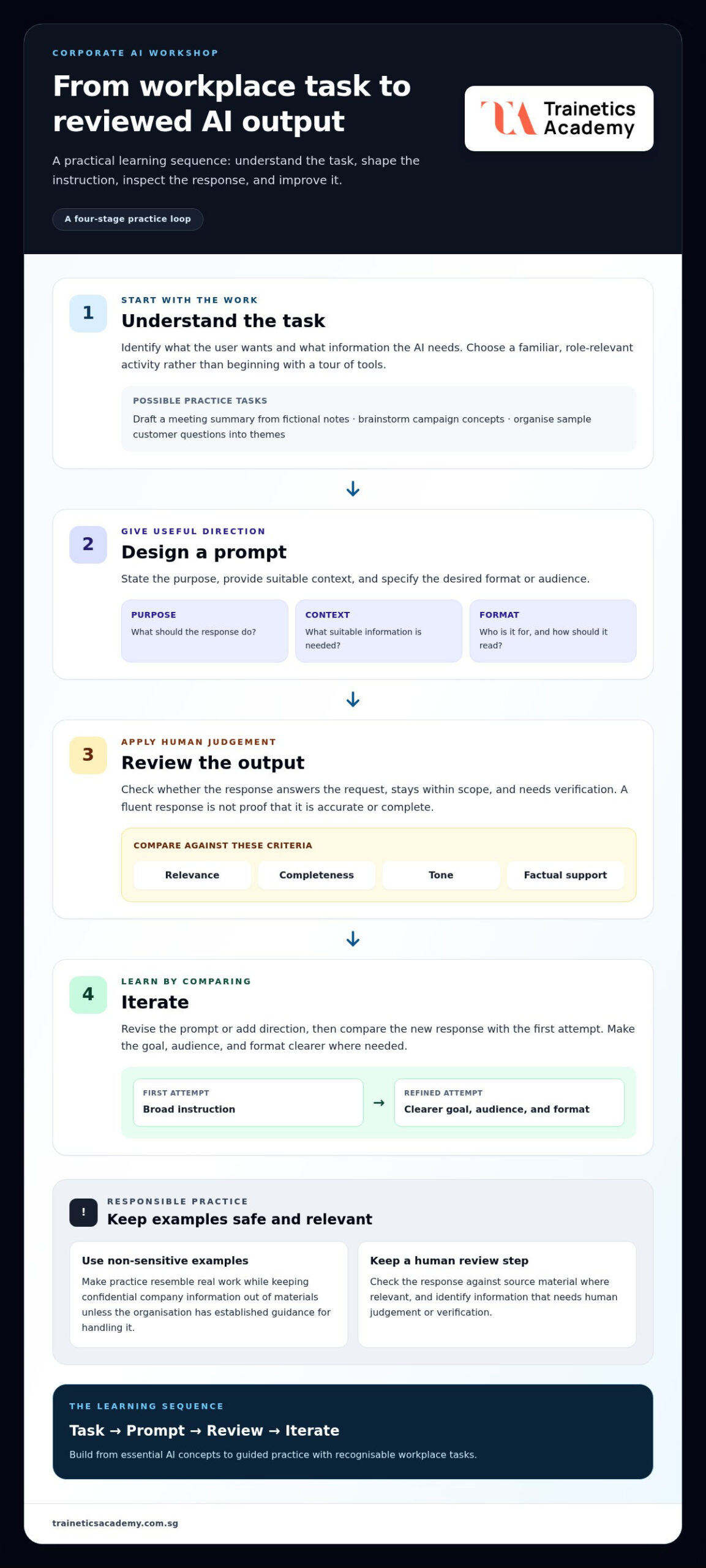
From there, build a progressive learning path:
- Understand the task: Identify what the user wants and what information the AI needs.
- Design a prompt: State the purpose, provide suitable context, and specify the desired format or audience.
- Review the output: Check whether it answers the request, stays within scope, and needs verification.
- Iterate: Revise the prompt or add direction, then compare the new response with the first attempt.
Choose exercises that reflect real work
Use familiar activities such as drafting a meeting summary from fictional notes, brainstorming campaign concepts, or organising a sample list of customer questions into themes. Adapt each scenario to participants’ roles while keeping demonstrations free of confidential company data. A useful exercise gives learners enough context to make realistic decisions without exposing sensitive material.
Ask participants to try a broad first prompt, inspect the response, then rewrite the instruction with a clearer goal, audience and format. They can compare both results against simple criteria: relevance, completeness, tone and factual support. For instance, a team preparing an internal update might check whether a draft preserves key points from supplied sample notes, rather than judging it only by how polished it sounds.
Balance tool practice with judgement
Different tool categories can support activities such as drafting, summarising and organising information. Connect tool practice to a defined task instead of treating tool familiarity as the learning outcome. The Artificial Intelligence Course offers a starting point for building foundational AI understanding.
Generated content needs human review before it is relied on or shared. Responses can miss context, vary between attempts, or include details that aren’t supported by the information provided. Teach learners to verify important claims against reliable source material, check that the response suits its intended audience, and revise or reject it when it falls short.
Responsible practice belongs in the exercises, too. Discuss what kinds of information should stay out of prompts, how employees should handle uncertain outputs, and where human judgement must remain central. A well-designed AI course builds both practical skill and disciplined review habits, so employees learn not only how to generate a response, but how to decide what to do with it.
Corporate AI Workshop or Self-Paced Learning: Which Fits Your Team?
The right format depends on what employees need to learn, how closely their roles overlap and how much flexibility their schedules require. A corporate AI workshop Singapore organisations choose should suit those conditions, rather than assume live training or independent study is always the better option. Use the comparison below to identify the format that supports your team’s learning objectives.
| Format | Interaction | Flexibility | Role-specific practice | Feedback |
|---|---|---|---|---|
| Facilitated workshop | Live discussion and shared activities | Set time for participants | Can be shaped around team roles | Immediate, through discussion and guidance |
| Self-paced learning | Mostly individual | High, learners progress independently | Depends on available examples and materials | May be limited or delayed |
| Blended learning | Shared sessions plus individual practice | Combines scheduled learning with flexible study | Can pair common foundations with role-based application | Available during shared activities and review |
When a facilitated workshop can help
A facilitated workshop can suit teams with shared priorities, such as building a common understanding of AI use or discussing how employees should approach similar tasks. A shared session lets participants compare perspectives across roles. Live discussion can surface questions that one department might not raise alone, while guided activities give learners a chance to practise and receive feedback as they work.
Group reflection also helps teams identify where their needs differ. A common foundation doesn’t require identical applications: participants can consider how a shared principle applies to their distinct responsibilities. Choose this format when discussion, alignment and coached practice matter more than letting each learner set an individual pace.
When self-paced or blended learning may fit
Self-paced study is useful when employees need greater control over when they learn, or when participants are developing foundational knowledge at different speeds. Its trade-off is fewer opportunities for immediate discussion. A blended approach can pair shared instruction with independent study, giving teams a common starting point while preserving time for individual practice and reflection.
For example, employees might review course material independently, then use a facilitated session to discuss how the learning applies to their responsibilities. This can work well when schedules vary but the organisation still wants a shared conversation. Professionals comparing learning approaches can use the AI course guide for Singapore professionals to explore how course choices relate to their development goals.
Make the decision against the learning objective. If employees need to discuss common questions and practise together, a facilitated format may be a strong fit. If flexible access is the priority, self-paced learning may be more practical. If both matter, consider blending them. The Artificial Intelligence Course can also help learners build a structured foundation for AI learning.
How to Prepare Your Team for an AI Workshop and Apply Learning Afterwards
Preparation turns an AI workshop into a defined learning process, while follow-through gives participants a way to reflect on what they’ve learned. For a corporate AI workshop Singapore teams can apply thoughtfully, connect the session to a specific workplace need, then make room to review how the learning translates into practice. The aim isn’t to force immediate change. It’s to help employees carry useful questions and considered habits into their next task.
- Identify needs: Gather work challenges that participants want to understand or address.
- Set objectives: Decide what learners should be able to demonstrate or explain.
- Prepare examples: Create practice material that represents work without exposing sensitive details.
- Practise: Give participants time to apply workshop concepts and discuss their choices.
- Review: Capture reflections, outstanding questions and potential next steps.
Prepare participants and learning materials
Share the session’s purpose, learning objectives and planned activities in advance. Let participants know what prior knowledge, if any, will help them take part, and invite them to suggest challenges they encounter at work. Ask them to describe the task or difficulty without submitting confidential company material or personal information.
Team leads and facilitators can use those descriptions to shape neutral practice scenarios. Before the session, align on what each activity is intended to teach and how it relates to participants’ roles. Agree on boundaries for practice, including what information should not be entered into AI tools and how participants should assess outputs. Clear expectations help employees focus on learning rather than guessing what is appropriate.
Reinforce learning after the session
Encourage participants to keep a short record of approaches they want to revisit, review steps they found helpful and questions that still need answers. Notes are most useful when they explain the purpose of an approach and the checks needed before relying on an output. This gives learners a practical reference to refine, rather than treating a single example as a universal template.
A manager check-in or team discussion can invite participants to share where an exercise felt relevant and where their own judgement changed the result. Ask what they would adapt before applying the learning to a real task. Choose a small number of appropriate application goals, then give employees a chance to discuss progress and raise concerns. Keep any practice consistent with the organisation’s expectations for AI use.
Separate learning observations from claims about business performance. Participant reflections can indicate whether an exercise was clear or relevant, but they don’t establish that training caused a change in speed, quality or consistency. If the organisation wants to evaluate workplace outcomes, decide on suitable measures and gather evidence over time. A deliberate review process helps the team build on the learning while staying realistic about what one workshop can demonstrate.
Plan a Customised Corporate AI Workshop With Trainetics Academy
Turn your planning into a concise brief that makes the purpose of the workshop easy to understand. A clear brief helps distinguish the questions employees want to explore from broader decisions about tools, processes or company policy. It also gives everyone involved a shared reference point when shaping the learning experience.
Shape the learning around organisational priorities
Describe the work context participants bring, including their main responsibilities and how familiar they are with AI. Then state the priority the workshop should address. Is the aim to build shared understanding, help employees assess generated material, or examine where AI may be useful in a particular kind of task? Naming the priority helps keep planning focused without assuming every role needs the same depth or examples.
For a team with varied experience, distinguish foundational questions from role-specific ones. Participants new to AI may need clear explanations of key terms, while those already using AI may want to examine how they judge and refine results. Include both needs in the brief, then shape the customised corporate group training around your organisation’s priorities and participants’ roles.
Take the next step with a clear brief
Prepare a short outline that captures the purpose of the workshop and the context behind it. Useful details include:
- Audience: The roles involved and their general experience with AI.
- Priority: The main learning question the organisation wants to address.
- Boundaries: Any topics or types of information that should be excluded from practice.
- Evaluation: What participants should be able to explain, assess or discuss afterwards.
Keep the brief focused on learning, not promises about business results. For example, you can state that participants should practise assessing AI-generated material without claiming the session will improve output quality. This distinction keeps expectations realistic and gives the planning conversation a useful point of reference.
A thoughtful brief also helps identify open questions before training begins. Note any areas where the team needs further internal guidance, so the workshop can distinguish learning activities from decisions that require separate consideration. This gives the organisation a sound basis for choosing its next step.
Trainetics Academy delivers customised corporate group training in Singapore, with physical and virtual learning formats to support organisational needs.
Turn AI Learning Into a Deliberate Next Step
Building your team’s AI capability doesn’t require solving every challenge at once. Start by choosing a learning priority that matters to your organisation, then create space for employees to develop sound judgement as they explore how AI may support their work. A focused corporate AI workshop Singapore organisations plan around real needs can be a practical step towards a more confident, thoughtful approach to adoption.
Keep the next move clear. Bring your team’s priorities into the planning conversation and shape learning around the capabilities employees need to build. Trainetics Academy’s customised corporate group training connects AI education to your organisation’s context through interactive learning in a physical or virtual format.
Contact Trainetics Academy to plan customised corporate AI training for your team in Singapore.
Frequently Asked Questions
What is a corporate AI workshop?
A corporate AI workshop is guided employee learning that combines relevant AI concepts with practice. For example, a communications team might examine how an AI draft changes when its audience and purpose are specified, then discuss what needs editorial review. Unlike a product demonstration, a workshop helps participants build understanding they can transfer across tasks, rather than only watching a tool perform one example.
How do I choose a corporate AI workshop for my team in Singapore?
Choose a corporate AI workshop Singapore team members can connect to their actual responsibilities. First, consider whether the priority is basic familiarity, a shared approach to reviewing AI output, or practice with a particular type of task. Then compare the format, opportunities for discussion and relevance of the exercises. Define what participants should be able to explain or demonstrate afterwards so you can assess the learning design against a clear aim.
Can a corporate AI workshop help employees with no technical background?
Yes. A workshop can introduce AI in accessible language and build understanding through guided examples rather than technical prerequisites. For instance, participants might compare two summaries of the same sample text and identify which better preserves the source’s meaning. Exercises like this help beginners practise evaluating results without needing to understand how an AI model is built. Human judgement remains essential, especially when content will inform a decision or be shared externally.
What should employees learn in a corporate AI workshop?
Employees should learn skills that match their responsibilities and the organisation’s learning priorities. A team that handles reports, for instance, may benefit from practising how to check whether a generated summary reflects the source accurately. Other useful areas include core AI concepts, clear instructions for AI tools, and recognising when an output needs correction or should not be used. The right emphasis depends on participants’ roles and experience.
How can a company measure whether an AI workshop was useful?
Assess learning against an observable task, such as whether participants can explain why a response needs verification or identify missing context in a generated draft. A short exercise before and after training can help show what learners understand, while participant feedback can reveal which material felt relevant. Keep learning measures separate from business performance measures. If the company later evaluates workplace impact, use its own evidence rather than attributing change to training alone.
Should a company choose an in-person or virtual AI workshop?
Choose the format that best supports your participants’ location, schedules and learning activities. In-person learning may suit a team that benefits from shared discussion around a screen or sample task. Virtual delivery can make participation more practical for employees working in different locations. Trainetics Academy offers physical and virtual learning formats. Before deciding, consider how participants will ask questions, follow demonstrations and contribute to group activities in either setting.
How should a team prepare for an AI workshop?
Give participants a short briefing that explains the workshop’s purpose, expected activities and any useful preparation. Ask them to describe a work challenge without including names, customer details or internal documents. A team lead can turn those descriptions into neutral scenario prompts, such as “summarise a long update for a new audience.” This preparation gives learners relevant material to discuss while reducing the chance that sensitive information enters practice examples.
What should happen after a corporate AI workshop?
After the session, give participants a way to share questions that surfaced during practice and identify topics that need further learning. A manager might use a regular team discussion to review whether an AI-assisted task produced a suitable result, what needed correction and which review steps helped. Keep any experimentation within the organisation’s expectations for responsible use. Continued reflection helps teams refine their approach instead of assuming one session answers every question.
Disclaimer
AI Content Disclaimer: Some articles on this website may be generated or assisted by AI-powered content creation tools. While we strive for accuracy and relevance, readers should independently verify information before relying on it. The content is provided for informational purposes only and does not constitute professional advice.