Salary expectations for AI-skilled roles in Singapore therefore depend not just on having AI knowledge, but on the role, experience and depth of specialist capability.
Strong pay prospects are understandable in a field where employers need people who can apply AI to real business problems. But headline salary ranges do not tell the whole story. This guide compares AI pay with Singapore’s wider wage picture, maps compensation across roles and experience levels, and explains how market demand and PhD requirements may shape top-end earnings. Use the benchmarks to assess where your skills may fit and plan your next career step.
Key Takeaways
- Compare AI pay with Singapore’s overall wage growth to see whether salary gains in the field stand out.
- Use role and experience benchmarks to frame realistic expectations, from entry-level positions to senior specialist work.
- Assess hiring demand alongside candidate supply to understand why employers compete for particular AI skills.
- See how PhD qualifications can relate to senior opportunities, while recognising that top compensation also reflects leadership scope and expertise.
- Build practical AI knowledge through an Artificial Intelligence Course when you’re preparing to strengthen your skills for an AI-focused career.
1. AI salary growth compared with overall wage growth
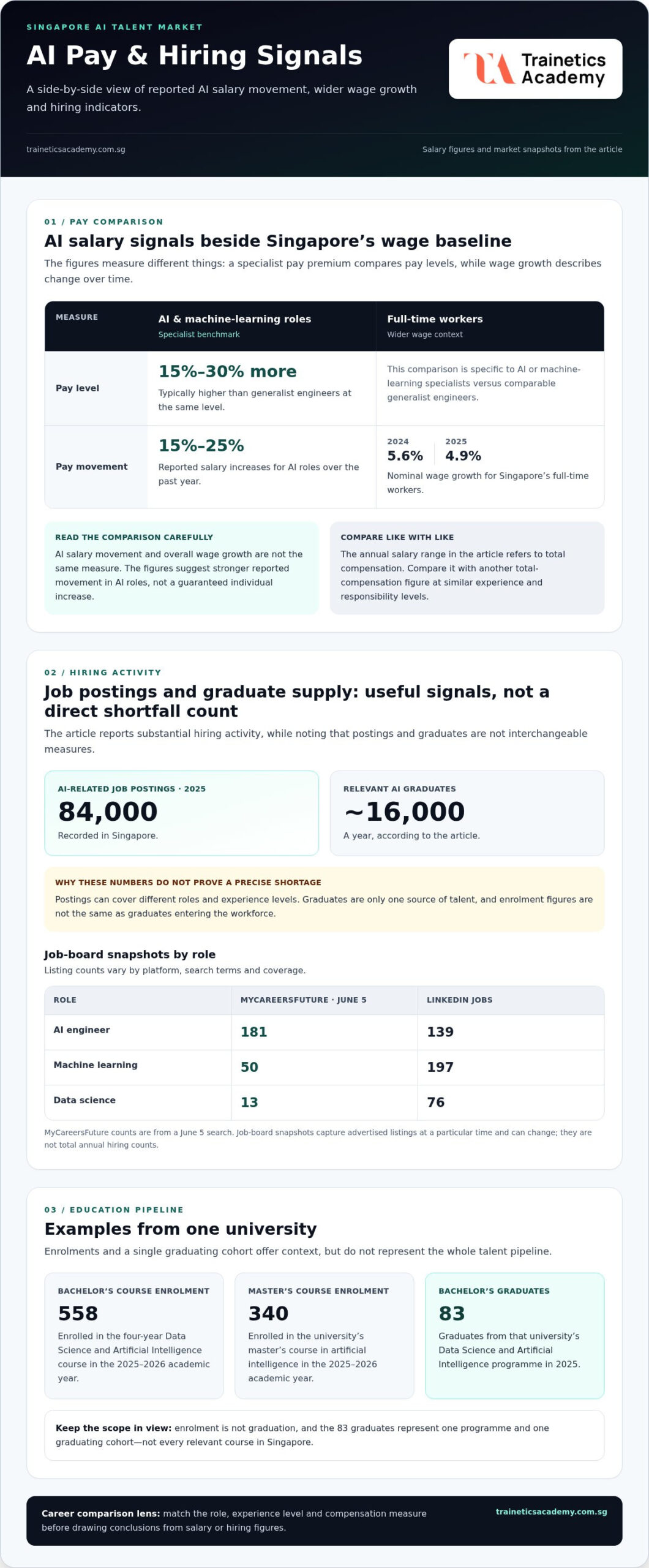
AI and machine-learning specialists in Singapore typically earn 15% to 30% more than generalist engineers at the same level. AI roles also saw salary increases of 15% to 25% over the past year. These figures suggest stronger gains than the broader wage trend, though they measure different things.
For comparison, nominal wages for Singapore’s full-time workers rose 5.6% in 2024 and 4.9% in 2025. Those figures describe overall wage growth, not AI salary increases. The AI figures refer specifically to salary movement within AI roles and the specialist premium over comparable generalist engineers.
How do Singapore AI salaries compare with other technology roles? AI specialists may earn more than generalist engineers at the same level, but the comparison depends on the role, experience and compensation structure.
This is a useful annual benchmark, but it should not be compared directly with a growth percentage. One describes pay received over a year; the other describes how pay changed over time.
When assessing an offer, separate base salary from total compensation. The annual range provided is for total compensation, so compare it with another figure measured on the same basis. Check, too, that both figures reflect similar experience and responsibilities. This prevents a headline number from distorting your assessment.
The 15% to 30% specialist premium is also a relative comparison, not a guaranteed increase for every AI role. It compares AI or machine-learning specialists with generalist engineers at the same level. A junior AI specialist and a senior generalist are not equivalent comparisons, even if both work in technology.
Growth and pay level answer different career questions. The 4.9% overall rise in 2025 provides a broad wage context, while AI’s 15% to 25% increase signals stronger reported movement in the field. Neither percentage tells you an individual’s future increment or starting salary.
Use these benchmarks in three steps: identify the role, match the experience level, and compare annual total compensation. Salary expectations for AI-skilled roles in Singapore are more grounded when you compare like with like.
For career planning, treat the wage figures as context rather than a promise. A 15% to 30% specialist premium highlights the value associated with AI expertise, while 2025’s 4.9% overall growth sets a wider reference point. Your strongest comparison is a role-specific one, using consistent pay measures and equivalent experience.
2. Demand for AI talent and candidate shortages
Singapore recorded 84,000 AI-related job postings in 2025, against roughly 16,000 relevant AI graduates a year. That comparison points to substantial hiring activity, but it doesn’t prove a precise shortfall. Postings can cover different roles and experience levels, while graduates represent only one source of talent. The figures still show why employers may compete for candidates with skills that match specific vacancies.
Job-board snapshots offer another view of demand. A MyCareersFuture search on June 5 found 181 AI engineer listings, 50 machine-learning listings, and 13 data-science listings in Singapore. These counts capture advertised roles at a particular time, not total annual hiring. They can change as employers publish, fill, or remove vacancies.
LinkedIn Jobs showed a different mix in its search results: 139 AI engineer posts, 197 machine-learning posts, and 76 data-science posts in Singapore. The platform’s machine-learning count exceeded its AI-engineer count, while MyCareersFuture showed the reverse. Different job titles, search terms, and listing coverage can shape these snapshots, so avoid treating them as a direct ranking of total demand.
Singapore’s graduate pipeline is also developing. In the 2025 to 2026 academic year, 558 people enrolled in Nanyang Technological University’s four-year Data Science and Artificial Intelligence course. Another 340 enrolled in its master’s course in artificial intelligence. These enrolment numbers show educational participation, but they don’t equal graduates entering the workforce that year.
One completed cohort provides a useful counterpoint: Nanyang Technological University had 83 graduates from its Bachelor of Science in Data Science and Artificial Intelligence in 2025. That figure covers one programme and one graduating cohort, not every relevant course in Singapore. It therefore shouldn’t be compared as a full measure against the 84,000 job postings.
For candidates, the practical takeaway is to focus on the specific role. The examples show demand for AI engineers, machine-learning specialists and data scientists. Read job descriptions for the work and capabilities required rather than relying on the title alone. Responsibilities reveal whether an employer needs model development, data analysis or another applied skill set.
For employers, posting volume and graduate supply are indicators, not interchangeable counts. A posting may seek experienced specialists, while a graduate pipeline includes people at different stages of study. The 2025 job-posting figure, June 5 listing snapshots, and university enrolments each illuminate a different part of Singapore’s AI talent market. Together, they help explain strong recruitment activity without implying every AI candidate faces the same prospects.
3. PhD requirements and top-end compensation
What factors most influence AI salary expectations in Singapore? The Ministry of Manpower says salaries depend on sector, experience and market conditions, not just AI proficiency. For top-end roles, consider leadership responsibilities and specialist demands alongside academic qualifications.
A PhD can matter for some advanced AI positions, but the salary examples do not establish it as a universal requirement. That example signals competition for doctoral expertise, not a standard offer in Singapore.
This is a top-end benchmark, not a typical salary for every AI professional or PhD holder. Leadership responsibilities distinguish these positions from individual-contributor roles focused on implementing models or analysing data.
The figures describe different contexts: one covers AI leadership compensation in Singapore, while the other concerns the recruitment of Singapore-based PhD holders to work in China. They are not directly equivalent job offers.
If you are weighing doctoral study, start with your target role. Research-heavy work may place greater value on advanced research training, while applied roles may focus on demonstrable technical capability and delivery. The examples show that PhDs can attract substantial recruitment interest, but not that every employer requires one.
Next, distinguish qualifications from role scope. A doctorate describes academic preparation; leadership compensation reflects the remit of a senior position. Compare the responsibilities, sector, experience expectations and location attached to each opportunity. The Ministry of Manpower’s factors provide a practical framework for understanding differences between offers.
Finally, read compensation figures carefully. Neither number alone explains the full package or the exact experience required. Match each benchmark to its stated context before using it in salary discussions.
For salary expectations for AI-skilled roles in Singapore, treat a PhD as one factor, not a guaranteed route to a particular salary. The examples point to demand for doctoral expertise abroad and substantial potential at Singapore’s AI leadership level. Sector, experience, market conditions and role scope remain essential comparison points.
4. AI salary growth in Singapore
This broad range gives candidates a reference point, not a fixed rate for every engineering position. To assess where a role may fit, consider its responsibilities, seniority and stated compensation basis. A job title alone does not show how demanding or specialised the position is.
Experience offers another point of comparison. Keep this monthly figure distinct from annual salary ranges. Match experience and responsibilities first, then check that both figures use the same pay period.
This shows why AI pay is not a single, uniform benchmark. A role combining business analysis with AI differs in focus and responsibilities from an engineering position. Compare the work described in the job posting rather than relying on “AI” in the title.
Learning choices can support a career plan, but they aren’t salary categories. Whether considering SkillsFuture AI courses or AI courses for beginners, connect the learning objectives to the capabilities employers request. A 1 day AI course Singapore option may suit a focused learning goal, while a longer learning pathway may address broader objectives. The course label alone doesn’t establish a salary outcome.
For a practical comparison, note each role’s title, experience requirements, pay period, and whether the figure refers to base salary or total compensation. For example, compare a monthly mid-level benchmark with another monthly figure for a role at a similar experience level. This avoids mixing monthly and annual figures or comparing jobs with different scopes.
If you are considering an AI course in Singapore, start with the work you want to pursue. Compare its required skills with the course’s learning objectives and the responsibilities listed in relevant job descriptions. This connects your learning decisions to your career direction without assuming that training guarantees a salary increase.
Keep experience, pay period and role scope aligned. This gives candidates a disciplined basis for evaluating salary growth and planning their next professional step.
5. How do AI salaries compare across Singapore industries and employers?
Employer figures show notable variation for data scientists in Singapore. These are employer-specific reference points, not guaranteed salaries for every data scientist at those companies.
That difference makes employer context important when assessing compensation. It does not mean one employer always pays more for every role or experience level. The figures concern data scientists, so they should not be treated as direct comparisons across different AI job titles.
DBS also illustrates how compensation can vary by seniority. The VP figure reflects a senior level, so comparing it with an overall median without accounting for role scope would be misleading.
The Ministry of Manpower says salaries depend on factors beyond AI proficiency, including sector, experience and market conditions. Apply these factors when comparing the Grab, DBS, UOB and OCBC examples. Experience and responsibilities affect which benchmark is relevant, while employer and sector provide additional context.
Build a fair comparison by matching like with like. First, check that both figures describe data scientists. Next, confirm whether each is annual and based on total compensation. Then account for seniority, especially when comparing DBS’s general median with its VP-level figure. This makes the employer examples more useful than ranking companies by a single number.
Compare the roles’ experience requirements and responsibilities, too. The figures alone do not show whether the jobs have equal scope, so role details matter alongside compensation.
Use the four employer figures to frame questions about role level, sector and pay structure. Together, they help ground salary discussions in Singapore examples rather than a single market-wide assumption.
Trainetics Academy: Artificial Intelligence Course
Trainetics Academy’s Artificial Intelligence Course offers a learning opportunity for readers who want to develop AI knowledge in line with their career plans. Salary benchmarks can clarify possible roles, while building relevant skills is a separate part of preparing for them.
Consider the course if you’re exploring AI work or strengthening your understanding before pursuing roles in the field. Use the salary comparisons in this guide to identify the positions that interest you, then focus your learning on the capabilities those roles require. Practical, structured learning can help connect AI concepts with professional development goals.
Contact Trainetics Academy to learn more about its Artificial Intelligence Course.
Turn your AI career goals into a learning plan
Use salary expectations for AI-skilled roles in Singapore as one input to career planning, not as the destination. Choose the kind of work that interests you, then identify the capabilities and practical knowledge needed to pursue it. A deliberate learning plan can help you move from exploring AI careers to building professionally relevant skills.
If you are ready to strengthen your AI foundations, Trainetics Academy offers an Artificial Intelligence Course. Consider how structured learning could support your next step, whether you are preparing for a new role or developing expertise for your current work.
Explore Trainetics Academy’s learning options and take the next step toward your AI career goals with focus and confidence.
Frequently Asked Questions
What do AI jobs in Singapore pay?
AI jobs in Singapore do not share one salary because roles involve different responsibilities and seniority levels. An AI product manager, for example, has different responsibilities from an engineer or data scientist. Use the closest role category when comparing opportunities, and match responsibilities and experience requirements before assessing pay.
What is the average salary for AI-skilled roles in Singapore in 2026?
There isn’t one average that represents every AI-skilled role in Singapore in 2026. The figures are organised by job family and experience, so combining them into one number would obscure important differences. For example, a data-science benchmark shouldn’t stand in for an engineering or product-management role. Narrow your comparison to the same job family and seniority to get a more relevant reference.
What are typical Singapore salaries for machine learning engineers?
Machine-learning engineers are grouped with AI engineers in the available 2026 salary benchmark, rather than assigned a separate range. For a specific vacancy, examine whether the work centres on building machine-learning systems, applying existing models, or another engineering responsibility. Compare its scope and experience requirements with similar roles, and make sure the salary figure uses the same annual or monthly basis as your comparison.
What do AI engineers and generative AI engineers earn in Singapore?
The available salary benchmark groups AI and machine-learning engineers; it does not provide a separate figure for generative AI engineers. Assess a generative AI vacancy by its actual duties rather than assuming its title creates a distinct pay band. Compare the expected engineering work, seniority and compensation basis with the closest listed role category before setting a salary expectation.
What are salary ranges for data scientists with AI skills in Singapore?
This senior range is useful when the role calls for comparable experience. Check the responsibilities and whether the figure is total compensation before comparing it with another data-science position or using it to assess an offer.
How do AI salaries vary by experience level in Singapore?
Experience can shift the relevant salary benchmark, so compare your career stage with the level specified in a vacancy. For example, the 2026 table places senior data scientists with six or more years of experience in a distinct range from broader data-science benchmarks. Review required experience alongside the role’s scope, and avoid comparing a senior position with an entry-level or mid-level opportunity.
Are AI salary figures in Singapore quoted as base salary or total compensation?
The figures use different descriptions, so check the basis for each benchmark. Some are explicitly stated as total compensation, while others are presented as salary ranges without that label. When comparing offers, first identify the stated salary basis and period. Then compare like with like rather than treating base salary and total compensation as interchangeable.
Disclaimer
AI Content Disclaimer: Some articles on this website may be generated or assisted by AI-powered content creation tools. While we strive for accuracy and relevance, readers should independently verify information before relying on it. The content is provided for informational purposes only and does not constitute professional advice.