AI courses can help managers understand how artificial intelligence supports business decisions without replacing human judgement. A practical AI course introduces how AI can identify patterns, generate content, and synthesise long documents, while people remain responsible for deciding what to do with its output. Managers can learn how businesses use these capabilities to support research, prepare action plans, and automate parts of complex workflows.
AI courses also help managers consider both the opportunities and the risks. AI can produce inaccurate or irrelevant responses. Using it responsibly means considering data privacy, setting appropriate limits, and maintaining human oversight when decisions require judgement.
This guide covers the topics managers can learn in an AI course, from the basics of machine learning and language models to practical applications across business functions. It also explores where AI falls short and how to assess whether a use case is worthwhile, what safeguards it needs, and when a person should remain in control. The aim is to support informed decisions grounded in business needs, not hype.
Key Takeaways
- Learn how AI courses teach you to use generative AI for content creation, report summaries and business workflows.
- Practise reviewing AI-generated responses and applying human judgement before relying on them for decisions.
- Explore data privacy and safeguards to consider when learning to use AI with business information.
- Build an understanding of how AI courses explain machine learning patterns, predictions and task-specific decisions.
- Choose AI courses that match your business needs, team capabilities and requirements for oversight.
Generative AI applications across industries
In an AI course for managers, industry examples show how generative AI can help with everyday information work. Managers can use it to draft customer replies and meeting summaries, extract themes from reports, prepare action plans, and support customer service teams. These applications span marketing, operations, finance, human resources, and client support. A marketing team, for example, can generate campaign variations from a brief, while an operations manager can turn meeting notes into assigned actions. Course activities can help managers practise setting goals for these tasks and assessing the results.
Large Language Models, or LLMs, generate text by predicting the next word from the preceding context. Their training uses varied text, including books, articles, websites, and social media. Managers learning to use LLMs can request a concise summary, then ask for risks and follow-up actions. The model generates a response based on the prompt and its learned language patterns. It does not automatically retrieve a verified answer. Practising clear instructions about the audience, purpose, format, and source material helps managers shape a useful draft.
A generative AI system may combine a language model with other components. Retrieval Augmented Generation, or RAG, connects the model to information held in knowledge sources. The retrieval component finds relevant material, and the language model uses it to form a response. Moody’s Research Assistant is one example: its RAG system retrieves information from a controlled repository of validated information. In an AI course, managers can explore how a similar architecture could ground answers to internal policy questions in company reference materials rather than relying only on general training.
Applications vary by industry, depending on the information and decisions involved. In customer service, a generative tool can draft responses based on a support conversation. In finance, it can synthesise a lengthy report into key themes for review. In human resources, it can help structure interview questions around a role description. In operations, it can turn process notes into a draft action plan. In marketing, it can propose alternative messages for different customer groups. Course examples help managers practise reviewing these outputs as starting points for staff, not automatic decisions.
Managers can assess a proposed use by tracing its information flow: identify the task, select relevant source material, generate an output, and review it against the intended purpose. An AI course can use this sequence to help managers decide whether a general LLM is sufficient or whether retrieval from company knowledge sources matters. Singapore teams developing practical AI literacy can explore AI learning in Singapore alongside these workplace examples. The key distinction is functional: generation creates or transforms content, while retrieval supplies relevant information that can ground the response.
The course covers extracting and synthesising information from long documents or reports to support decision-making, helping managers assess complex material.
AI course learning: limitations and human oversight
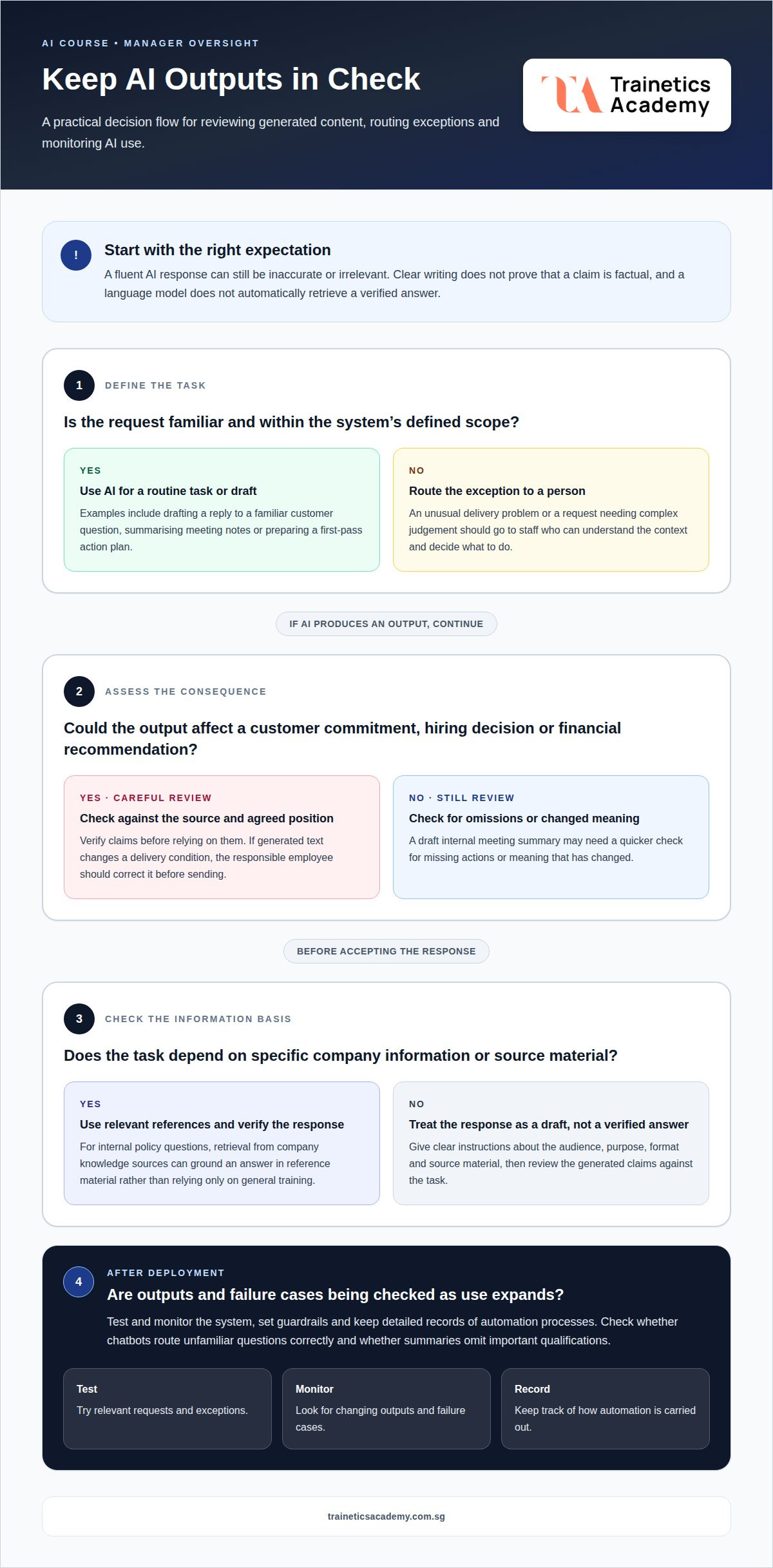
In an AI course, learners examine why a fluent answer can still be wrong. An AI hallucination occurs when a language model generates content that is not entirely accurate or relevant. For example, a manager might ask for a project report summary and receive a plausible claim the report never made. Clear writing does not prove that a response is factual. Learners practise treating generated claims as material for review, especially when they could affect a customer commitment, hiring decision, or financial recommendation.
AI courses also cover how chatbots and virtual assistants use scripted responses and pattern analysis to handle familiar requests. A chatbot might answer a routine question about an order but struggle when a customer describes an unusual delivery problem. Learners study why queries outside the norm should be escalated to a person, since chatbots cannot make complex decisions. They explore how to define that handoff clearly: identify the requests the system can handle, then route exceptions to staff who can understand the context and decide what to do.
As part of learning about AI oversight, learners consider how review should match the consequences of a task. A draft internal meeting summary may need a quick check for missing actions or changed meaning. A response affecting a client agreement deserves careful review against the source documents and agreed position. For instance, if generated text changes a delivery condition, the responsible employee should correct it before sending. Learners explore how to set a level of review that fits the decision and its impact, rather than reviewing every output in the same way.
AI course content also covers oversight after deployment. As an AI tool handles new requests or receives updated information, its outputs and failure cases can change. Learners examine how organisations test and monitor AI as its use expands, set guardrails, and keep detailed records of automation processes. A team can examine whether a chatbot routes unfamiliar questions correctly, whether a summariser omits important qualifications, and whether staff can trace how an automated response was produced. These checks show how isolated errors can provide evidence for improving the system.
For managers taking an AI course, a practical oversight model links each use case to an owner, a review point, and an escalation route. For example, a service team can assign a supervisor to review disputed chatbot answers and record recurring failure patterns. A report-writing workflow can require staff to compare key statements with the original document before sharing a summary. When a system cannot answer reliably, the process should let a person pause it or take over. Learners see how this makes human judgement part of the workflow, not an afterthought.
Data, algorithms, models, responses and ethics in AI courses
In an AI course, learners explore how artificial intelligence involves programming computers to perform tasks that normally require human intelligence. Harvard Kennedy School Ash Center for Democratic Governance and Innovation describes artificial intelligence in these terms. For a manager, the basic sequence is straightforward: data enters a system, an algorithm processes it, and a model produces an output such as a prediction, classification, or draft. A sales forecast, for example, might estimate demand from past order records.
AI courses also cover how an AI workflow collects, uses, shares, and retains personal data. For managers in Singapore, a key legal consideration is how these activities relate to applicable Singapore requirements before deployment. The relevant considerations depend on the data and its purpose. For example, a team using customer messages to generate service replies should identify what information enters the tool and who can access the resulting records.
Data quality is another concept covered in AI courses: it shapes what a model can learn and return. If a company’s historical records contain duplicate customer entries, inconsistent product names, or gaps in complaint categories, these weaknesses can affect analysis. A manager reviewing a sales summary should distinguish insights based on complete records from those drawn from partial inputs. Documenting the source, intended use, and known limitations helps teams interpret model outputs in context.
AI courses explain that an algorithm is a set of computational instructions for processing inputs, while a model is a system produced or configured to perform a task using data and those instructions. For example, a recruitment tool might sort applications according to selected criteria. If those criteria reflect past patterns that disadvantage a group, the ranking can reproduce that pattern. Managers should examine which inputs influence the result and whether the criteria fit the legitimate business purpose.
Responses also depend on how a task is framed, a practical topic in AI courses. A broad prompt asking for customer analysis may produce an answer that mixes relevant details with assumptions. A more precise request can specify the data to use, the audience, and the required format. For instance, a manager could ask for themes from a defined set of feedback records, with recommendations listed separately. That distinction makes it easier to see where evidence ends and generated interpretation begins.
AI courses address ethical use by connecting data handling, model design, and business decisions. A team applying AI to staff evaluations should consider whether its data is relevant, whether the criteria are explainable, and how affected people can raise concerns. In customer support, managers can review whether the system treats similar requests consistently. These checks make accountability practical: assign responsibility for the use case, record its purpose, and revisit the model when the data or business process changes.
Machine learning and pattern recognition in AI courses
In an AI course, learners explore how machine learning enables computers to learn from data, identify patterns, and make decisions without explicit programming for each task. A retailer in Singapore, for example, could use a model to examine past sales records and identify products often purchased together. The result reflects patterns in the available data, not a full understanding of customer needs. Managers should connect each pattern to a business question before using it to guide action.
AI is a broad field that includes machine learning, generative AI, and automation. In AI courses, learners can study how machine learning identifies patterns or predicts outcomes, generative AI creates content, and automation carries out defined tasks, sometimes using AI results. For example, a system could predict a likely stock shortage and alert an operations team. Understanding these distinctions helps learners match a method to the task.
In AI-course learning, pattern recognition begins with examples. A team might label past support requests by topic, such as billing, delivery, or account access. A model learns relationships between request details and those labels, then classifies new submissions. If customers describe delivery problems in unfamiliar ways, the model may misclassify them. Reviewing those cases helps learners assess whether the examples reflect how customers actually describe their issues.
AI courses can also introduce methods that reveal groups without predefined labels. A clustering approach might organise customer feedback by recurring themes, giving a service team material to investigate. The resulting groups are not explanations in themselves. Learners need to examine what distinguishes each group and decide whether those distinctions offer useful insight for a business question.
Learning depends on the examples and task selected. If historical sales records cover only established products, a model may struggle with a new launch. Inconsistent product names can also make identical items appear separate. These examples show why AI-course learners should understand the data behind a result. A sound understanding of AI starts with asking what a model learned to recognise and whether its inputs fit the current situation.
In an AI course, learners can apply a structured review to each proposed use. Define the decision the model should inform, such as prioritising service requests. Identify representative records and the result employees need. Then compare model suggestions with actual cases, including unusual examples. A support team can review misclassified requests and improve its labelled examples. This practical approach connects AI-course learning with a clear assessment of whether pattern recognition supports the workflow.
The book describes AI as encompassing machine learning, chatbots, robots, and agents. AI courses can explore how, in customer service, AI-powered chatbots and virtual assistants use scripted responses and pattern analysis. Queries outside the norm need to be escalated to a person because chatbots cannot make complex decisions. Learners can study why managers should make that escalation route clear, so requests beyond the chatbot’s scope receive human attention rather than an unsupported automated decision.
Strategic AI adoption and decision-making through AI courses
Traditional automation follows fixed instructions for predictable tasks, such as routing a completed form. AI can interpret varied inputs, helping staff classify unfamiliar requests or analyse unstructured information. AI courses help learners understand when a stable rule can handle a task and when context or changing language may call for AI. A hybrid workflow can use AI to sort unusual submissions and automation to route standard cases.
In Singapore, AI implementation costs depend on the selected tools, data preparation, integration with existing systems, staff training, and ongoing monitoring. AI courses can help teams learn to scope these factors before comparing options, from using an existing platform for a bounded task to connecting a custom system across several business processes. This helps managers compare options without assuming that a more complex model will create greater value.
AI courses for managers can cover AI capabilities, data limitations, prompt design, privacy considerations, and output evaluation. Demystifying artificial intelligence for managers through structured learning means developing enough fluency to ask focused questions and assess an AI-supported recommendation. For example, a manager reviewing a draft forecast should understand its source data, intended use, and uncertainty before using it in a planning decision.
AI courses can help learners practise beginning adoption with a defined business problem. A logistics team might want to organise delivery queries, while a finance team may need help extracting themes from lengthy reports. Describe the current workflow, the decision that needs support, and the employee accountable for the outcome. This frames the project around operational needs rather than a general desire to introduce AI.
Then assess whether AI is the right method. AI courses can teach learners to evaluate task variability, available information, workflow fit, and consequences of error before selecting an approach. If a fixed rule can route every request accurately, traditional automation may be simpler to operate. If requests vary in wording or context, AI may assist with classification while staff handle exceptions.
Plan how the system will be managed throughout its use. AI courses can help teams understand how an AI agent may coordinate several workflow steps while clarifying ownership of decisions and exceptions. For example, a service workflow could sort incoming requests while an employee resolves unusual cases. Set review points for deployment and maintenance, and monitor whether the system remains effective and unbiased as business conditions change.
Managers can build the judgement to lead adoption through structured AI courses and practice. A disciplined approach to demystifying artificial intelligence for managers connects technical concepts with business choices, helping teams define suitable use cases and assess their limits. Involve employees who understand the workflow, identify the evidence needed to support a decision, and establish who can adjust or pause the process. This creates a clear basis for responsible progress.
Trainetics Academy: Artificial Intelligence Course
Trainetics Academy offers an Artificial Intelligence Course for managers seeking structured learning to support practical adoption decisions. Consider it when you want a stronger grasp of AI concepts, workplace applications, and the judgement needed to assess potential uses. This foundation can help you frame business questions, interpret AI outputs, and contribute with greater confidence to discussions about oversight and implementation. Build your understanding before choosing where AI belongs in your team’s workflows. To discuss the Artificial Intelligence Course, contact Trainetics Academy.
Make your next AI decision with purpose
Turn insight into a deliberate leadership practice. Choose one business decision where better analysis or faster access to information could help, then involve the people closest to that work. Their experience can reveal practical requirements that a technology plan alone may miss.
Demystifying artificial intelligence for managers is an ongoing discipline: keep developing the judgement to distinguish a useful application from an attractive distraction. As your organisation’s priorities evolve, revisit which decisions need human ownership and what evidence would show that an AI-enabled approach is serving its purpose. This keeps adoption connected to business intent and gives teams a clearer basis for learning.
Trainetics Academy offers an Artificial Intelligence Course for developing practical understanding. Discuss your AI training goals with Trainetics Academy, and take your next step with clarity and confidence.
Frequently Asked Questions
What Can I Learn About Real-World AI Applications in an AI Course?
In an AI course, learners can explore how AI supports work with information in different business settings. For example, an insurance team could use a model to group incoming claim documents by topic, while a property manager could analyse maintenance notes for recurring equipment issues. A procurement team might use generative AI to draft a tender summary from supplied material. Course learning can help participants assess these examples and consider whether an AI output is suitable for a particular task.
How Can an AI Course Help Me Identify and Prioritize AI Opportunities?
An AI course can help learners start with a recurring task that takes staff time and has a clear business purpose. For example, a manager could assess whether AI might help organise product feedback before a planning meeting. Learners can practise prioritising opportunities by weighing the task’s business value, information quality, workflow fit, and consequences of error. A use case with clear boundaries and accessible source material is easier to evaluate than a broad goal such as “use AI to improve the department.”
How Can I Apply AI Course Learning to Adopt AI Successfully?
Course knowledge can help learners define a business need, identify an accountable owner, and set criteria for a useful result before selecting a tool. They can then map the information and systems involved, agree on access controls, and test the workflow with representative tasks. Gather feedback from employees who will use the output, record issues, and refine the process before expanding it. Learners can also consider how staff can report problems and pause use if the tool behaves unexpectedly.
What AI Risks Should I Learn to Identify in an AI Course?
AI course learning can cover risks such as inaccurate outputs, unfair patterns, exposure of sensitive information, and security weaknesses in connected workflows. For example, entering identifiable customer details into a tool without suitable safeguards could create a privacy concern. Learners can practise limiting information to what the task requires, controlling who can access inputs and outputs, and reviewing results for errors or unequal treatment. They can also consider how the tool connects to company accounts, files, and systems.
How Can I Apply AI Course Learning to Measure AI Project Results?
AI courses can teach learners to establish a baseline before introduction, then compare equivalent tasks after deployment. They can track measures such as time spent, staff corrections, completeness of work, and whether employees use the tool appropriately. For example, a team testing AI-assisted document sorting could compare handling time and misclassified files. Learners can assess return on investment by weighing demonstrated business benefits against implementation, integration, training, review, and maintenance costs, using the organisation’s own financial assumptions rather than generic industry estimates.
Disclaimer
AI Content Disclaimer: Some articles on this website may be generated or assisted by AI-powered content creation tools. While we strive for accuracy and relevance, readers should independently verify information before relying on it. The content is provided for informational purposes only and does not constitute professional advice.