What separates useful generative AI training from a quick tour of impressive tools? For professionals, it’s the ability to connect what they learn to real workplace tasks. A generative AI course for professionals in Singapore should help learners understand how the technology works, practise applying it, and judge where its outputs need human review.
It’s reasonable to want clear details before choosing a course, especially when you need to fit learning around work. This guide explains what to consider about eligibility, duration and classroom format, and what practical tools, modules and learning outcomes may matter for professional development. You’ll also find a framework for assessing whether a course’s structure and hands-on focus align with your role, experience and goals. Use these points to make a more informed choice about the AI skills you want to build and how you want to apply them at work.
Key Takeaways
- Understand which eligibility criteria and completion requirements can affect your course pathway.
- Compare classroom and online learning formats against your schedule and preferred learning environment.
- Identify how practical exercises can help connect generative AI concepts to professional tasks.
- Learn what to look for in hands-on tool practice, including opportunities to evaluate AI-generated outputs.
- Assess whether a course’s modules and learning outcomes align with the capabilities you want to develop at work.
Eligibility and course completion requirements
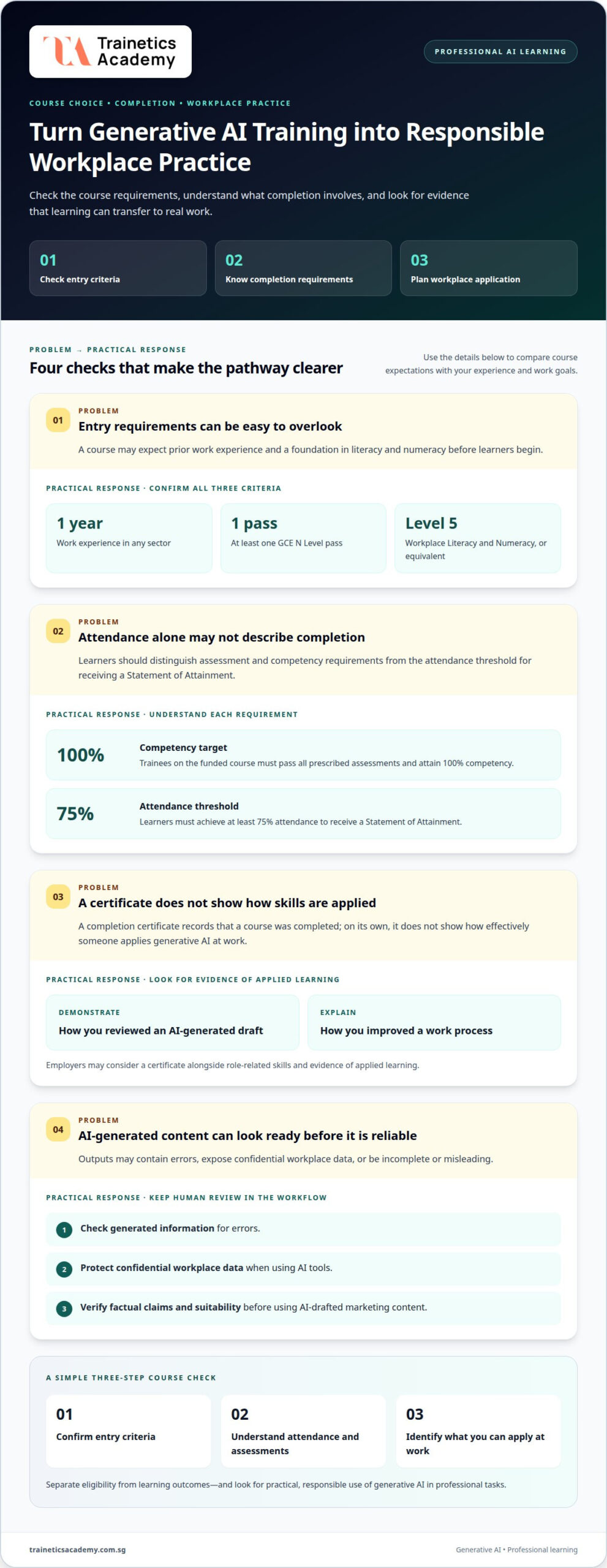
A generative AI course for professionals in Singapore may set entry requirements around work experience, literacy and numeracy. The stated prerequisites for this course include one year of work experience in any sector, at least one GCE N Level pass, and Workplace Literacy and Numeracy Level 5 or equivalent. These requirements provide a foundation for working through technical concepts and applying them to professional tasks.
Completion involves more than attending lessons. Trainees on the funded course must pass all prescribed assessments and attain 100% competency. Learners must also achieve at least 75% attendance to receive a Statement of Attainment. Before enrolling, compare the course’s entry criteria and assessment format with your experience and availability. For example, a professional applying AI skills to marketing should be prepared to demonstrate how they assess outputs, not just describe ChatGPT.
A completion certificate records that you completed a course. Employers may consider it alongside role-related skills and evidence of applied learning. For example, you could demonstrate what you learned by explaining how you reviewed an AI-generated draft or improved a work process. A certificate alone does not show how effectively someone applies generative AI at work.
Funding eligibility depends on the particular course and the learner’s circumstances. Relevant factors include citizenship or permanent-resident status, age, and whether training is employer-sponsored. SkillsFuture Credit and UTAP eligibility applies only to the Introduction AI Course, so don’t assume those funding options apply to every generative AI programme. Check the applicable course terms before treating a subsidy or credit as part of your plan.
Singapore Citizens must be aged 18 or above to qualify for the SkillsFuture AI Subscription initiative. This is a separate eligibility condition from course entry requirements. Being eligible for the initiative does not replace prerequisites such as work experience, literacy, numeracy, attendance or assessments.
Responsible AI learning should cover risks as well as useful applications. Important skills include checking generated information for errors, protecting confidential workplace data and recognising that outputs may be incomplete or misleading. For example, when drafting marketing content, verify factual claims and suitability before using the result.
Assess a course with a simple three-step check: confirm entry criteria, understand attendance and assessment requirements, then identify what you can apply at work. This helps distinguish eligibility from learning outcomes and choose training that supports practical, responsible AI use.
Course duration and classroom format
In Singapore, generative AI courses are offered online or in classroom settings. Compare the learning schedule, delivery format and intake dates with your work commitments before choosing.
Course Duration and Daily Schedule
Compare total learning hours, session timing and the gaps between lessons. These details show how the course fits around meetings and deadlines. A concentrated schedule may work for those able to set aside focused learning time; spaced sessions may leave room to apply ideas between classes. Review the timetable to plan your attendance.
Look beyond the overall course length. Check session start and end times, breaks, and whether activities run across a full day or shorter periods. A professional with client meetings, for example, may prefer sessions outside peak work hours. The timetable also helps you judge whether you can stay engaged during practical exercises.
Delivery and Classroom Formats
Online learning lets you participate from a suitable study environment, while classroom learning offers an in-person setting. Either can support structured learning. Choose based on how you focus, participate and manage work interruptions. Consider whether you need a predictable place to practise or greater flexibility to fit learning around your schedule.
For classroom learning, consider travel time and whether the location works for your schedule. For online learning, consider your device, internet access and ability to participate without interruptions. In either format, look at how lessons balance instructor explanations, demonstrations and practice. That balance matters when applying generative AI concepts to a task such as drafting a workplace summary.
To compare course timing, use three practical steps:
- Review the total duration and session timetable.
- Match each class time against recurring work commitments.
- Confirm the intake start date and delivery format before planning attendance.
Start dates and daily schedules determine when you can begin and how learning fits into your working week. Use the published intake date to plan leave or workload adjustments. If there are several dates, compare them with project deadlines and the time you can reserve for lessons and practice. This makes it easier to attend consistently and connect learning with your career goals.
Singapore courses offer online and classroom formats. Compare the timetable, opportunities to interact and time for practical learning, rather than choosing by format alone. Focused participation can help you build skills for applying AI to workplace tasks.
Practical generative AI for business professionals
The right course depends on your role and the task you want to improve. Business leaders, developers and non-technical professionals benefit from examples relevant to their responsibilities.
Workplace and Business Scenarios
Begin with a familiar workflow, such as summarising meeting notes or drafting a project update. A course can show how a precise prompt shapes a response and how review makes it more useful. In a marketing exercise, for example, participants might generate campaign ideas and refine copy for a specific audience. These examples connect prompt design to everyday business tasks.
Custom AI applications go beyond one-off prompts. A business might design an assistant that answers staff questions using selected internal materials. Course content can explain how an application receives a request, uses relevant information and produces a response. This helps learners assess where AI could support an existing workflow, rather than treating every task as a reason to build a new tool.
Retrieval-augmented generation, or RAG, connects a generative AI system to selected source documents. A team might use an internal policy library to support answers about company procedures. A practical lesson should explain how source relevance affects responses and why people still need to review them. This helps learners distinguish general model knowledge from answers grounded in business data.
When assessing practical content, look for a clear sequence: define the task, provide context, review the output and refine the workflow. A sales team summarising customer feedback needs different examples from a finance team preparing an internal briefing. Relevant scenarios help learners identify where AI may save effort and where human expertise remains essential.
Courses for Different Professional Roles
Business leaders need a strategic view of opportunities, risks and workflow priorities. Useful learning connects AI concepts to decisions, such as choosing a process for a pilot. For instance, leaders can consider whether summarising routine reports would improve productivity while retaining necessary review.
Developers may want deeper coverage of application design, data retrieval and system behaviour. RAG examples can show how a system uses selected business documents to answer questions. Look for learning that explains how inputs and source material shape outputs, not just examples of prompts.
Non-technical professionals can focus on practical prompt skills and role-specific uses. Someone in human resources might explore drafting interview questions, while a marketing specialist tests alternative campaign wording. A suitable course explains concepts accessibly and provides structured practice with realistic tasks.
Choose based on your intended outcome, not your job title alone. Identify a workflow you want to improve, then compare the course content with the skills it requires. A business leader may value decision frameworks, a developer may prioritise application concepts, and an operations professional may focus on repeatable document workflows. This narrows your options to training with direct workplace relevance.
Hands-on use of generative AI tools
Practical learning turns generative AI concepts into workplace skills you can repeat. Assess how exercises help you work with tools and outputs, and practise reviewing the results.
Hands-On Workshops and Assessments
A useful workshop gives participants a defined task, a tool and a clear outcome. Learners might turn a rough project brief into a structured summary, then check whether the key details remain accurate. This is more meaningful than simply watching a demonstration. Look for activities that include testing, revision and discussion.
Assessments can test both process and judgement. A learner might submit a draft, explain the prompt they used and identify changes made after reviewing the output. This shows whether they can apply what they learned, rather than just reproduce a sample. Exercises comparing responses to different instructions can also show how specificity and context shape results.
Instructor-Led Practical Learning
Instructor guidance helps learners understand tool behaviour step by step. In a writing exercise, an instructor can demonstrate how adding an audience, purpose and format changes a response. Participants can then adapt the approach to a task in their own role. This connects demonstration and practice to professional application.
Effective guidance also makes room for questions about unexpected outputs. If a tool produces an incomplete summary, an instructor can show how to refine the request and inspect the revised answer. Learners can observe each adjustment, then apply the same review process to another exercise. This goes beyond accepting the first result.
Practical sessions can cover several stages of tool use:
- Define the task and the output required.
- Provide relevant context without sharing sensitive material.
- Test instructions and compare the generated responses.
- Review accuracy, tone and missing details before using an output.
These steps help professionals use generative AI with purpose. Someone in human resources might check whether a draft onboarding checklist covers each required topic. A project coordinator could compare a generated action list with meeting notes. In both cases, AI assists the work, while the learner judges relevance and completeness.
To compare hands-on learning, examine the balance of instructor demonstrations, individual practice and feedback. A session focused only on tool features may not develop workplace judgement. Exercises are more valuable when participants explain their choices, revise outputs and connect tasks to professional needs. This builds reliable habits rather than isolated prompts.
Strong practical training treats tool use as an iterative skill: test an instruction, inspect the output and make a deliberate improvement. Repeating this cycle with a report, checklist or client-facing draft helps build a disciplined approach. The aim is not to automate every task, but to use AI thoughtfully where it supports quality work.
Generative AI course modules and learning outcomes
A well-structured curriculum progresses from core concepts to professional application. Learners might move from understanding how generative systems produce text to assessing their outputs in a workplace task. This connects technical foundations with practical judgement, rather than treating tool demonstrations as complete training.
Look for modules that explain generative AI’s capabilities and limits, then show how to use it responsibly. A sample learning path might cover model fundamentals, prompt design, output evaluation and business applications. Each stage should prepare learners for the next: prompt design relies on understanding the context a system needs, while evaluation means checking whether its response meets the task.
Application-focused modules connect learning to professional work. A participant might turn a project brief into a structured summary, then check whether it preserves the key decisions. Another exercise could involve reviewing an AI-generated report outline for missing sections. Such activities show whether training develops transferable skills, rather than familiarity with one feature.
Useful outcomes are observable. By the end of a course, learners should be better prepared to:
- Explain key generative AI concepts in clear workplace language.
- Shape requests with relevant context and a defined output.
- Review generated material for accuracy, relevance and omissions.
- Identify tasks where human judgement remains necessary.
Course descriptions may use broad terms such as “AI transformation,” but professionals should look for the activities behind the claim. Does a module ask learners to map a process, identify a suitable task and assess how AI might change the workflow? A concrete exercise makes transformation an applied business question, not just a slogan.
Consider who a curriculum is designed for. A university programme may emphasise theory and research, while professional training may prioritise workplace applications. A certificate records completion; exercises and assessed work show what learners practised. Compare those outcomes with the skills your role needs, such as evaluating summaries or planning an AI-supported process.
For a final check, trace each outcome to a module and an exercise. If a course aims to build evaluation skills, look for an activity in which learners identify errors or missing context. If it covers business applications, look for a work-related case. This alignment helps you judge whether the curriculum supports practical development.
Explore the Artificial Intelligence Course to consider how structured AI learning can support your professional goals.
Trainetics Academy: Artificial Intelligence Course
Trainetics Academy offers an Artificial Intelligence course for professionals who want structured learning in AI concepts and applications. Qualified professionals deliver interactive training through physical and virtual learning platforms. It can suit learners seeking guided instruction and practical understanding for workplace use.
Consider this course if you want to develop your AI knowledge through structured learning rather than occasional, informal experimentation. The right fit depends on your goals, preferred learning format and the skills you want to strengthen.
For details about the Artificial Intelligence Course, contact Trainetics Academy to discuss your learning needs.
Make your next AI learning step count
Build your professional development around a capability you want to strengthen, not a trend you feel pressured to follow. A generative AI course for professionals in Singapore can help you approach these tools with greater purpose. Its lasting value comes from connecting learning to the decisions, standards and responsibilities of your role.
Before you begin, identify the work you want to approach differently. You might want to communicate more clearly, assess AI-generated material more carefully or understand how AI could support a team workflow. That focus gives your learning practical direction and helps you recognise progress beyond new terminology.
Professional confidence grows through deliberate practice and sound judgement. Take the next step when you’re ready to explore structured AI learning for your goals. Contact Trainetics Academy to discuss the course, and move forward with a clear focus on developing your capabilities.
Frequently Asked Questions
What generative AI courses for working professionals are available in Singapore?
Professionals in Singapore can pursue structured training in generative AI concepts and workplace applications. Trainetics Academy offers an Artificial Intelligence course through physical and virtual learning platforms. To judge whether it fits your needs, identify a task you want to improve, such as preparing clearer internal reports, and consider whether the course approach matches your experience and goals.
How much do generative AI courses in Singapore cost before and after subsidies?
Course fees and the amount payable after funding vary by programme and eligibility. There is no single price for generative AI courses across Singapore. Relevant factors include the course fee, delivery arrangement, learner eligibility and any employer sponsorship. Use the price for the specific programme rather than relying on general estimates.
Are SkillsFuture Credit, SSG funding, or company training grants available for generative AI courses?
Funding depends on the course and the applicant’s circumstances. SkillsFuture Credit, SSG support and company training grants have different eligibility conditions and are not interchangeable. Individual learners can consider personal funding options, while employers may assess support for workforce training. Review the applicable terms alongside your enrolment plans.
What are the entry requirements and recommended skills for professional generative AI courses?
Entry criteria vary by course. The requirements described in this guide include work experience, prior educational attainment, and literacy and numeracy capabilities. It also helps to be able to describe a work task clearly and judge whether a written result meets its purpose. For example, explaining the audience and desired format makes it easier to assess an AI-generated draft.
What topics and practical projects do Singapore generative AI courses cover?
Course coverage may include generative AI concepts, prompt design, workplace applications and output review. Practical projects let learners apply these ideas to a defined task. For example, participants might group customer enquiries by theme, draft a response framework and assess whether the output is clear and suitable. Treat project examples as possible learning activities, not a promise that every programme uses the same exercises.
How long do the courses take, and are they available online, part-time, or in person?
Course duration and schedules vary. Generative AI training in Singapore may be online or classroom-based, and part-time arrangements depend on the timetable. Review session times, start date and format together. Someone managing rotating shifts may need a schedule that supports consistent attendance; another learner may prioritise classroom participation.
How can professionals apply for a generative AI course in Singapore and claim available subsidies?
Start by choosing a course that fits your professional goals, then follow its application process and review the relevant funding conditions. Individual applicants should prepare their learner details; employer-sponsored applicants can align the request with their organisation’s training plans. Keep application steps organised and use the course terms to understand what applies before deciding to enrol.
Disclaimer
AI Content Disclaimer: Some articles on this website may be generated or assisted by AI-powered content creation tools. While we strive for accuracy and relevance, readers should independently verify information before relying on it. The content is provided for informational purposes only and does not constitute professional advice.