AI courses help learners build relevant skills when lessons connect to clear learning goals, not just theory. Choosing an AI Course starts with identifying the tasks you want to understand, the skills you hope to develop, and the level of guidance that suits your experience.
It is reasonable to seek practical, engaging learning without taking on more than you need. A structured course gives learners opportunities to explore where AI can help, understand where human review matters, and reflect on what they have learned through examples and exercises.
This guide explains how AI courses can help learners explore customer support, project management, employee training, and everyday business operations. It also covers learning about AI tools, understanding sensible safeguards, and building the capability to use AI with confidence and care.
Key Takeaways
- Choose an AI course that builds practical skills and connects learning to clear outcomes.
- Learn how to use ChatGPT to organise support requests, draft responses and flag cases for human attention.
- Practise turning AI-generated content into clear project tasks by specifying the format, owner and next action.
- Build confidence through role-specific practice, clear data boundaries and human review.
- Develop skills to connect AI with existing business systems gradually and assess its usefulness.
1. Customer support triage, responses, and escalation
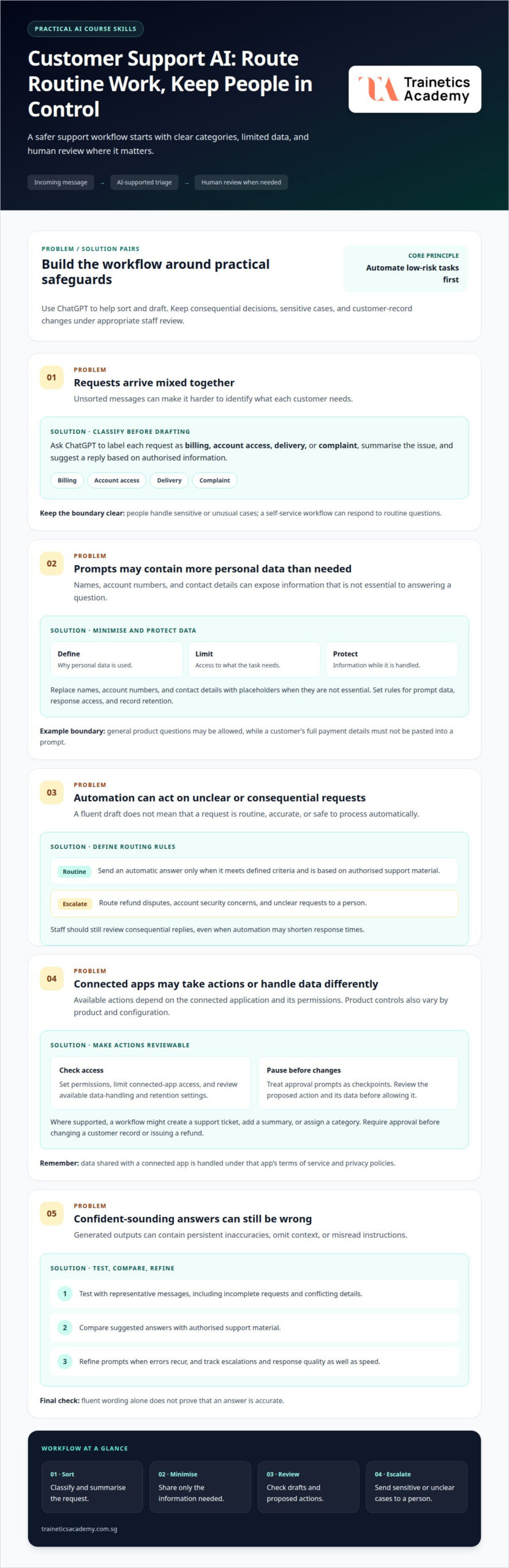
Build a support pipeline that sorts incoming messages before drafting replies. For example, label each request as billing, account access, delivery, or complaint. ChatGPT can summarise the issue, identify its likely category, and suggest a reply based on authorised information. A staff member can handle sensitive or unusual cases. A self-service workflow can respond to routine questions at any time, while people manage complex requests.
For Singapore operations, apply your organisation’s PDPA responsibilities at every step: define why personal data is used, limit access, and protect it while it is handled. Send only the information needed to answer the customer. Replace names, account numbers, and contact details with placeholders when they are not essential. Set clear rules for what data can go into prompts, who can view responses, and how long records remain available.
ChatGPT’s business controls vary by product and configuration, so do not assume a particular safeguard is active. Set access permissions, limit connected-app access, and review the available settings for data handling and retention. Data shared with a connected app is handled under that app’s terms of service and privacy policies. Treat approval prompts as checkpoints: review the proposed action and its data before allowing it.
To protect confidential information, give support staff a short, clear rule for what they can enter. For instance, allow general product questions but prohibit pasting a customer’s full payment details. Give ChatGPT access only to information needed for the task, such as an authorised troubleshooting guide. Use role-based permissions for shared resources and keep records of important actions. These boundaries reduce unnecessary exposure without blocking routine assistance.
Automate low-risk responses first. A prompt might ask ChatGPT to classify a message, find the relevant policy excerpt, and draft a concise reply. Send routine answers automatically only when they meet defined criteria. Route refund disputes, account security concerns, and unclear requests to a person. Automation may shorten response times, but staff should still review consequential replies.
Available app actions depend on the connected application and its permissions. Where supported, a workflow might create a support ticket, add a summary, or assign a category. Require approval before actions that change a customer record or issue a refund. Keep the generated response separate from the action so staff can correct the wording before the system updates a case.
Test the pipeline with representative messages, including incomplete requests and conflicting details. Springer Nature notes that large language model outputs can contain persistent inaccuracies, known as AI hallucinations. Compare suggested answers with authorised support material, then refine prompts when errors recur. Track escalations and response quality as well as speed. Fluent wording alone does not prove that an answer is accurate.
2. Building practical skills through AI courses
Use an AI course to practise turning a meeting transcript into a draft summary, action list, and task descriptions. Ask ChatGPT to identify each task’s title, owner role, deadline field, and dependency. Keep the output in draft status until you check names, dates, and commitments against the source. This exercise helps learners understand how to use generated text without treating it as final.
Start with one repeatable document, such as a weekly campaign brief. In an AI course exercise, provide the conversation context, audience, verified facts, and required format in the prompt. Then ask ChatGPT to return fields such as objective, deliverable, status, and review notes. Check the content before using it, and note where the prompt or output could be improved.
A practical AI course exercise can explore how a ChatGPT-assisted SEO blog pipeline might cut content production time by 70%. Treat that figure as a potential workflow result, not a guaranteed outcome for every team. Learners can also practise adapting one blog article into a week of social media posts. Give the prompt channel requirements, audience, tone, and source material. Then review each draft before publication.
Practise categorisation with fixed labels and clear limits. For example, ask ChatGPT to assign an article to three categories chosen only from an authorised taxonomy. Include short category definitions and request a label with a brief reason. Map those fields to tags as part of the exercise. If the content does not fit, identify it for manual classification instead of creating a new tag automatically.
Accuracy remains a key learning point: generated copy can omit context, misread instructions, or state unsupported details. Check factual claims, brand terminology, links, and meeting decisions against source documents before using the output. A polished response is not evidence that the underlying information is correct.
Use an AI course exercise to practise setting review stages for generated content. A task might move from “Draft” to “Editorial review” and then “Ready to publish.” Keep the original source available so learners can compare claims with the brief. Review corrections, missed deadlines, and returned drafts. If a prompt repeatedly produces incomplete tasks, revise its required fields before trying more automation.
Learn to use AI for predictable tasks, not editorial judgement. For example, ChatGPT can draft a task description and suggest a category, while a learner checks the wording and publication status. AI courses can help learners build practical knowledge for these workflows.
As a repurposing exercise, use ChatGPT to draft a week of social media posts from a single blog article. Ask it to keep each post tied to claims supported by the article while adapting the opening, emphasis, and call to action for each channel. Require a source passage or claim note alongside every draft, and review wording that goes beyond the article. Varied phrasing is not proof that a claim has been verified.
Keep the article and drafts together during the exercise, with a clear status and reviewer for each item. Record requested changes rather than silently replacing copy, so learners can see what remains unresolved. After review, use only the checked version. If the article changes, review affected drafts again.
3. AI courses for employee training and pilot projects
AI courses can teach learners to identify high-impact workflows, such as drafting internal summaries or finding onboarding guidance. Before a pilot project begins, learners can practise defining the task, users, and acceptable data. They can record the existing process as a baseline, then compare it with the AI-assisted version. A focused exercise shows where ChatGPT helps and where clearer instructions are needed.
Hands-on AI courses use realistic, low-risk examples to build practical skills. Learners might practise summarising a fictional customer service conversation or drafting a welcome message from authorised documentation. Role-specific exercises show how prompts vary by task. Courses can also teach learners to separate confidential information from general instructions and avoid entering personal or sensitive details unnecessarily.
AI courses can explain how internal assistants use a clearly defined source library. For example, an assistant can answer routine questions using existing policy documents and onboarding guides. Learners can study why source material should be current, document owners identified, and access set according to employee roles. If an answer is missing from the library, the assistant should say so or direct the user to the relevant team rather than inventing a policy.
A course can teach learners to build onboarding exercises around practical tasks. A new employee could use an internal assistant to find the leave-request process, locate team documentation, or summarise a role-specific procedure. Learners can compare each response with its source document. This develops prompt skills and reinforces that generated guidance must be traceable to current material.
AI education can cover the importance of human review throughout a pilot. Learners can practise inspecting samples for accuracy, inappropriate disclosure, and confusing outputs. They can consider whether responses save time and answer the intended question, and study measures such as time saved, satisfaction, and deflection rate, which indicates whether an assistant resolves requests without transferring them to a person.
Use pilot results as learning material to explore what to change next. If employees repeatedly receive incomplete answers, learners can consider improving the source library or narrowing the assistant’s scope. If prompts produce inconsistent results, examples of effective instructions and expected formats can help. Courses can cover permitted uses, escalation routes, and data boundaries. Internal AI champions can demonstrate these practices and help colleagues apply them consistently.
AI courses can teach learners to scale a pilot only after it performs reliably for its intended task. Training should continue as workflows and documentation change. Regular reviews can identify outdated sources, recurring errors, and new staff questions. This measured approach builds AI skills while keeping decisions, sensitive tasks, and policy interpretation under appropriate human control. For a broader approach to planning ongoing employee learning, see how to develop an internal AI training program.
4. AI courses and building practical AI capabilities
If you are deciding how to build AI capabilities, start with one defined learning goal. An AI course can help learners understand how to use AI tools for a specific task. For example, learners can practise giving a language model relevant context and reviewing its draft response. They should check the result before relying on it, rather than assuming AI output is always accurate.
Choose the AI course that fits the intended use. Some courses introduce AI concepts, while others focus on applying AI tools to workplace tasks. An AI course can help learners practise using models to generate and review content within a familiar workflow. Decide whether learners need foundational knowledge or practical experience with AI tools.
Map the learning needs before choosing a course. Identify which AI concepts learners need, what experience they already have, and how they will apply their new skills. For example, a learner might practise providing relevant context and reviewing a draft account note. Focus on the skills that support the intended learning goal and clarify what learners should be able to do after the course.
Keep generated content separate from decisions that require human judgement. Learners can explore how AI might explain a stock discrepancy, but they should understand that an explanation does not verify inventory figures. They might also practise drafting a task description, while deciding whether it is suitable for use. Teach learners to define appropriate uses and review points before applying AI at work.
AI models can return incomplete or incorrectly formatted content. Learners should practise requesting specific output fields, such as summary, source record, and recommended next step. They can check that required fields and permitted values are present before accepting a response. If a result fails these checks, they should review it rather than relying on it.
Practise with representative examples and edge cases. Include missing fields, conflicting descriptions, and requests outside the model’s intended scope. Confirm that learners can identify when an AI tool has not provided enough information. Reviewing the prompt, model output, and any edits can help learners understand and address errors.
A practical AI course also helps learners understand their responsibilities when using AI. Encourage them to review outputs, follow relevant workplace processes, and update their approach when tasks or requirements change. Keep a manual alternative for situations where an AI tool is unavailable or its response is unsuitable. Build on the initial learning once learners can apply the skills and checks reliably.
AI courses can be useful when learners want to build AI capabilities they can apply in their work. An AI course can introduce ways to use AI tools for specific tasks. Learners can explore how AI supports activities across different applications and practise applying the same skills to familiar work.
A practical approach is to learn how AI can support existing processes rather than assume it will replace them. An AI course can show learners how to provide relevant context to an AI tool and review its response before use. This keeps practice focused on the task and gives learners a result they can check. Apply AI skills where they support the current process, while leaving effective methods in place.
5. AI courses for workplace skills
An AI course can help employees learn how to use ChatGPT to draft, summarise, classify, and extract information for routine business tasks. HR examples can include preparing interview questions from a role description or drafting an employee update. Marketing exercises can focus on adapting product information into campaign messages. Sales learners can practise summarising meeting notes, while finance learners can explore extracting fields from invoices. Courses can also teach learners to keep consequential decisions with accountable employees.
In an AI course, HR learners can practise using prompts to create consistent first drafts, rather than decide who gets hired. For example, they can provide a role description and request structured interview questions tied to its stated responsibilities. A recruiter should check each question for relevance and fairness before use. For onboarding, learners can practise turning procedures into a draft checklist, which HR reviews against current documentation.
Marketing-focused AI courses can show learners how to turn a campaign brief into channel-specific copy. They can specify the audience, message, tone, and source material, then check every claim against the original brief. For SEO content, learners can use ChatGPT to organise headings or suggest topic groupings, while an editor checks search intent, factual accuracy, and brand language before publication. This teaches learners to keep generated material useful and grounded.
AI courses for sales staff can cover using AI to summarise CRM notes and prepare follow-up drafts. Learners can give the model relevant, authorised context, such as a prospect’s stated priorities and the last meeting’s agreed actions. A salesperson should correct omissions and confirm commitments before sending. Training can also emphasise that generated messages should not promise delivery dates, discounts, or product capabilities absent from sales materials.
Finance-focused AI learning can introduce extracting invoice fields, such as supplier name, invoice date, and total. ChatGPT invoice data extraction has accuracy rates exceeding 95% for standard invoice formats. Teach learners to treat this as an extraction aid, not payment authorisation. They can compare extracted fields with the source invoice, flag missing or conflicting values, and retain the existing process before recording or paying an invoice.
Across these topics, an AI course can help learners define which tasks may run automatically and which need human review. A marketing draft may enter an editorial queue, while an invoice value should remain pending validation. Learners can monitor corrections, missing fields, and rejected drafts, then use these patterns to update prompts and source material. This helps teams understand recurring errors before expanding automation.
Build practical capability in AI workflows by exploring AI learning options. A clear grasp of prompt design, output review, and task boundaries helps employees apply ChatGPT appropriately across workplace tasks. An AI course can provide a structured way to develop these skills.
Trainetics Academy
Trainetics Academy can help your team build a stronger understanding of AI before adopting ChatGPT across its workflows. Its Artificial Intelligence Course supports learners in exploring where AI fits into workplace tasks and how to use it thoughtfully. This can help employees move beyond isolated experiments toward a more considered approach to AI in their roles. Training complements a pilot by building understanding of AI concepts and their careful application. Contact Trainetics Academy to discuss the Artificial Intelligence Course.
Build Your Team’s Next Step with Confidence
Make AI adoption a deliberate capability, not a one-off experiment. Assign clear ownership for decisions about where AI fits, which standards apply, and how teams will develop their skills as workflows evolve. This keeps future improvements aligned with business priorities and employee readiness.
Deciding how to integrate ChatGPT into our company workflow is also a learning decision. Teams need the judgement to identify appropriate uses, write effective prompts, and assess AI-generated work. Trainetics Academy offers an Artificial Intelligence Course for people and organisations seeking to build their understanding of AI and its practical applications.
Start the next phase by identifying the knowledge your team needs to use AI thoughtfully. Contact Trainetics Academy to plan training and take a purposeful step towards building your team’s AI capability.
Frequently Asked Questions
How do companies connect ChatGPT to existing apps, databases, and internal tools?
Companies typically connect these systems through an API or approved connector, with access limited to the required data. For example, a sales application could send a customer’s product interest to an AI model and receive a follow-up draft for review. A technical team maps the fields, configures authentication, and tests the connection with sample records before using live data. Read-only access can help limit unintended changes.
Disclaimer
AI Content Disclaimer: Some articles on this website may be generated or assisted by AI-powered content creation tools. While we strive for accuracy and relevance, readers should independently verify information before relying on it. The content is provided for informational purposes only and does not constitute professional advice.