The cost of a lunch and learn AI workshop for staff in Singapore depends on the session format, duration and group size; the price is given after a quote request. Workplace lunch talks can run from 30 to 120 minutes and are designed for groups of 10 to 1,000 or more participants, so the right format depends on how much time your team has and how broadly you want to involve staff.
Before setting aside staff time, it helps to understand the workshop’s scope and practical value. A well-planned lunch and learn AI workshop for staff in Singapore should match your team’s familiarity with AI, connect to relevant workplace tasks, and leave time for participation rather than simply fill a lunch break with a presentation.
This guide explains what shapes workshop costs, what a session can cover, and how to build an agenda around practical activities. You’ll also learn how to match the format to staff needs and when an AI course can support learning beyond a single workshop.
Key Takeaways
- Compare in-person and virtual delivery by considering how each format supports participation and your team’s practical learning needs.
- Shape workshop content around workplace productivity, using generative AI and digital tools in relevant tasks.
- Identify staff capability gaps before setting the learning focus, so the session connects with your business context.
- Build an agenda that balances concise instruction with discussion and hands-on activities.
- Match the group format to your team’s size and learning goals, then explore an AI course for more structured learning.
How Much Do Lunch and Learn Sessions Cost in Singapore?
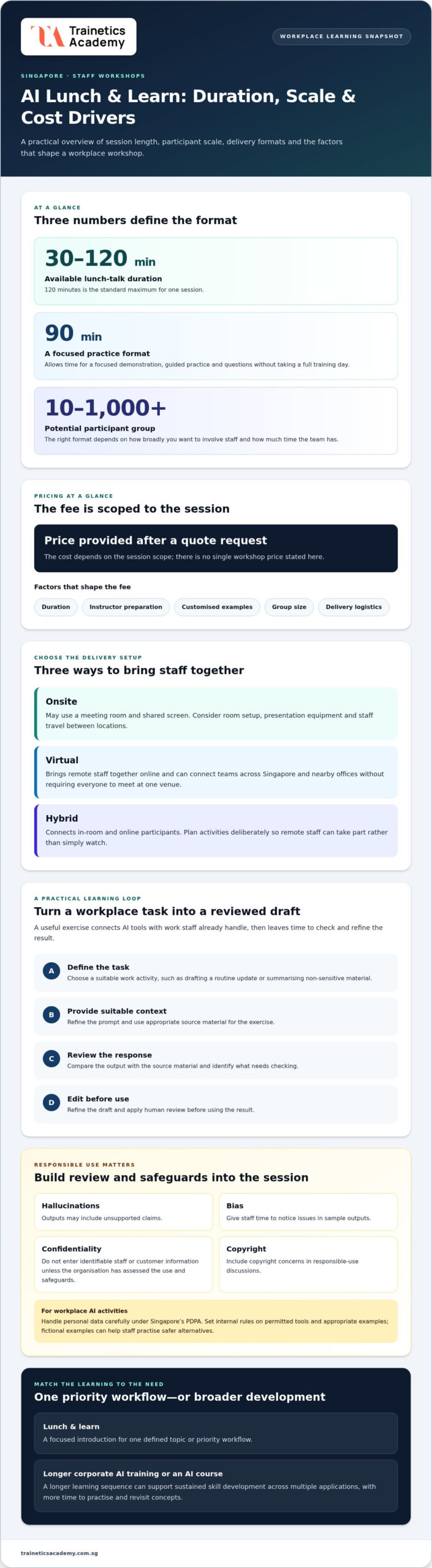
In Singapore, lunch-and-learn pricing depends on duration, group size, customisation, and delivery format. Workplace talks can run from 30 to 120 minutes, with 120 minutes the standard maximum for one session. A 90-minute format gives staff time for a focused demonstration, guided practice, and questions without taking a full training day.
In-person, virtual, and hybrid formats each involve different planning. An onsite session may use a meeting room and shared screen, while a virtual format brings remote staff together online. Hybrid delivery can connect both groups, but the facilitator needs to plan activities that include people in the room and online.
For a practical introduction to learning AI from scratch, watch this video:
The fee depends on the session scope and is provided after a quote request. Key factors include duration, instructor preparation, customised examples, group size, and delivery logistics. An onsite workshop may require different arrangements from a virtual session. An exercise based on a team’s work processes also takes different preparation from a general introduction.
For in-person corporate training, consider room setup, presentation equipment, and staff travel between locations. Virtual training can bring together teams across Singapore and nearby offices without requiring everyone to meet at one venue, but discussion and practice still need to be planned. Hybrid sessions need clear facilitation so remote participants aren’t left watching from the sidelines.
For teams comparing options, a lunch and learn AI workshop for staff in Singapore should have a defined objective. A short session can introduce a tool or demonstrate a workflow. A 90-minute session allows more time to practise a task, review outputs, and discuss responsible use. For a larger group, plan how staff will ask questions and participate, whether they attend onsite or virtually.
Handle personal data carefully under Singapore’s PDPA when planning workplace AI activities. Don’t enter identifiable staff or customer information into an AI tool unless your organisation has assessed the use and safeguards. Set clear internal rules about which tools staff may use and what kinds of examples are appropriate for the session.
SkillsFuture Credits and UTAP eligibility applies to the Introduction AI Course. These funding options don’t automatically apply to every standalone staff workshop, so distinguish course enrolment from a corporate session when planning training.
Before requesting a quote, note the session objective, preferred format, expected group size, and suitable duration. Then choose a work task for staff to practise, such as drafting a routine update or summarising non-sensitive material. These details help shape a session around your team’s actual needs.
What’s Included in a Lunch and Learn or 2-Hour Workshop?
A practical AI session connects workplace tools with tasks staff already handle. Strong content combines a clear demonstration with practice, discussion, and guidance on meaningful, responsible use.
Session length and delivery format
Singapore workplace lunch talks can run from 30 to 120 minutes. A 2-hour workshop allows more time to demonstrate a generative AI task, let staff practise, and discuss where outputs need human review. Sessions can be held onsite, virtually, or in hybrid format, depending on staff locations and the planned activities.
Choose the format to suit the learning task. An onsite group might discuss a sample workflow together, while virtual participants follow a shared screen. Hybrid sessions need a deliberate way to include remote staff, such as collecting questions in chat and inviting both groups to review the same draft.
Lunch-and-learn and longer course formats
A lunch-and-learn workshop gives staff a focused introduction to a defined topic. Longer corporate AI training can support a broader learning sequence, with more time to build skills, practise, and revisit concepts. Choose a shorter session for one priority workflow; consider a longer course when staff need sustained development across multiple applications.
Singapore workshops may cover generative AI, productivity, time management, or business effectiveness. Some workplace programmes include 2-hour business and personal effectiveness workshops, including time-management content presenting 6.5 ideas. Provider curricula differ, so compare the stated learning outcomes and activities, not just session labels.
For a practical productivity exercise, a facilitator might demonstrate how to turn a rough outline into a structured first draft. Staff can refine the prompt, compare the AI output with the source material, and identify what needs checking. This builds a repeatable process: define the task, provide suitable context, review the response, and edit it before use.
Staff should also learn to recognise hallucinations, bias, confidentiality risks, and copyright concerns. An AI-generated summary, for example, may include unsupported claims, while a prompt may expose sensitive business information. A useful workshop gives employees time to spot these issues in sample outputs and practise safer alternatives, such as using fictional examples.
Available sessions in Singapore range from short workplace talks to 2-hour workshops. Training providers may address AI fundamentals, productivity tools, prompt writing, or responsible use. Compare each provider’s topic outline, practice activities, and intended staff outcomes. Ask whether the agenda includes a relevant work example, such as summarising a non-sensitive report or drafting an internal update.
Make the learning actionable by asking each participant to identify a suitable task and a review step. A team could leave with a draft prompt, a human-checking routine, and a clear boundary around information they should not enter into AI tools.
Customising training to business context and capability gaps
Customise activities around the work staff actually do. A retail team, for example, might practise drafting product responses, while a logistics team organises non-sensitive delivery updates. Match each exercise to a clear learning objective, such as producing a useful first draft or finding errors before sharing an AI-assisted response.
Shape the session with a simple sequence: identify a task, assess staff familiarity, select a practice example, and define the review standard. A manager might find that employees can write prompts but struggle to assess generated answers. In that case, focus practice on checking facts, tone, and missing context instead of repeating basic tool demonstrations.
Skills gaps can vary within one organisation. New users may need guided prompt examples, while experienced users may need practice adapting outputs for specific audiences. A flexible agenda can begin with a shared introduction, then offer separate exercises for different needs. Keep the business objective consistent while varying the level of support and complexity.
Connect training objectives to customer experience and service recovery. Staff could use a fictional complaint about a delayed delivery to draft a calm response, then assess whether it acknowledges the issue, explains the next step, and avoids unsupported promises. This exercise develops customer service skills while keeping human judgment central.
For service teams, build resilience with realistic scenarios rather than idealised scripts. Ask participants to compare an AI-generated reply with the organisation’s tone and service standards. They can revise the wording, identify missing information, and decide when a case needs escalation. Make clear that a generated draft supports staff but does not replace their responsibility.
Customise examples for an industry without putting confidential material into prompts. Replace real customer names, account details, or internal figures with fictional equivalents. A finance team might practise explaining a generic process, while a retail team handles a sample return request. These examples stay relevant without exposing actual records.
Carry out a short needs analysis before planning the agenda. Ask team leads which recurring tasks take the most attention, where errors commonly appear, and what staff should do differently afterward. Then choose a priority workflow and a review method. For example, a team could assess a draft for accuracy, clarity, and required next steps.
During a 90-minute workshop, a facilitator can introduce the chosen workflow, demonstrate an example, and guide staff through practice and review. The exact balance depends on the team’s starting capability and objective. End by asking participants to name one task for appropriate AI assistance and one point requiring human review. That creates a practical bridge from training to daily work.
Practical lunch talk agenda and activities
An effective lunch talk gives participants one clear AI skill to practise. Singapore workplace sessions range from 30 minutes for quick insights to 90 minutes for deeper discussion and practice. Most organisations choose 45 to 60 minutes, which can combine a focused demonstration with interaction. Set one outcome before planning activities, such as helping staff assess an AI-generated draft.
Organise a session by choosing a workplace objective, identifying the participants, selecting a suitable duration, and preparing a relevant example. Then decide whether to run it onsite, virtually, or in a hybrid format. For instance, a team could practise improving a generic meeting summary without using sensitive information.
A 30-minute talk suits one concise insight, such as showing how a well-scoped prompt can shape an output. A 45-minute format allows focused learning and key strategies. Use a 60-minute session for interaction, or a 90-minute workshop when staff need deeper discussion and practice. Each duration calls for a distinct scope, not simply a faster or slower presentation.
Build the agenda around a work task. Start with the task and its limits, demonstrate an AI-assisted approach, and invite participants to review the result. Staff might compare an AI-generated project update with a fictional source brief, identifying missing context, unsupported statements, and wording that needs revision.
Activities make the session more engaging when they require a decision, not passive observation. Participants can refine a prompt, compare two drafts, or explain which response better suits a customer. A 90-minute workshop called “An Executive’s Guide to Critical Thinking with AI” focuses on critical thinking with AI, providing a named example of a longer workshop format.
For teams in Singapore, a shared case can encourage discussion across departments. Use a fictional customer enquiry and ask participants to draft a response, assess its tone, and flag details that need human review. A virtual discussion can also gather feedback from regional staff on the same sample output.
End with a practical next step. Ask each participant to name a suitable task for AI support and a review action to take before using the output. Staff should leave with a method they can apply, such as checking a summary against its source instead of accepting fluent wording at face value.
Keep the agenda aligned with the stated objective and the chosen duration. A 45-minute session can focus on one workflow and key strategies; a 90-minute workshop can add guided practice and discussion. This planning helps employers organise a focused AI lunch-and-learn for staff in Singapore, with activities suited to the team’s work and format.
Lunch and Learn pricing and group size
In Singapore, workplace lunch talks are designed for groups of 10 to 1,000 or more participants. That range affects how an organiser plans discussion, questions, and practical exercises. A small team can work through one shared case together. A large audience may need structured prompts, moderated questions, and activities that remain clear across the room or online.
The fee depends on the session scope and is provided after a quote request. Relevant factors include duration, group size, delivery format, preparation, and how closely the topics need to match workplace tasks. A general introduction and a workshop built around a company’s internal workflow, for example, require different preparation.
Group size affects the learning design as well as the room arrangement. In a smaller group, employees can discuss how an AI response handles a scenario and explain their reasoning. With a large group, a facilitator can use a shared example and collect responses through moderated questions. Both formats can support collaboration, but each needs a different way to involve participants.
Set expected attendance before finalising the agenda, then match the activities to the audience. A team exploring generative AI might critique one sample output together. A larger corporate audience could compare examples before discussing accuracy, bias, or confidentiality. The goal is meaningful participation without assuming every employee can speak individually.
Duration also shapes what a session can reasonably cover. Singapore workplace lunch talks can run from 30 to 120 minutes. A shorter talk may introduce one topic, such as prompt writing. A longer workshop can allow more time for guided practice and discussion. Choose a focused learning outcome first, then avoid packing unrelated subjects into the same agenda.
Delivery format affects planning for onsite, virtual, and hybrid groups. An onsite event may centre on discussion in a shared room; a virtual session can include employees across Singapore locations. Hybrid delivery needs a way for both remote and in-room participants to contribute. For regional teams, shared examples and a clear process for questions can support collaboration across locations.
Before requesting a quote, prepare these details:
- The expected number of employees and their roles.
- The preferred duration and onsite, virtual, or hybrid format.
- The AI topics and workplace tasks the session should address.
- The activity style, such as guided practice or group discussion.
These details clarify the scope and support a more useful pricing discussion. Decide whether the priority is broad awareness, practical skill-building, or stronger critical thinking about AI outputs. A clear objective makes it easier to assess whether a session plan meets your employees’ needs.
Trainetics Academy: Artificial Intelligence Course
Trainetics Academy offers an Artificial Intelligence Course for learners seeking structured AI education beyond a single staff session. Consider this option when your team wants to develop its understanding beyond one focused workplace topic. The course offers a more sustained learning path for people who want to build knowledge and explore how artificial intelligence applies to their work.
For staff, the choice depends on the learning objective: a lunch-and-learn can introduce a specific idea, while a course suits broader, continuing development. Visit traineticsacademy.com.sg to explore the Artificial Intelligence Course.
Turn AI learning into a lasting workplace practice
Staff training is most valuable when it connects to everyday decisions. Before planning a lunch and learn AI workshop for staff in Singapore, identify the work habits you want to strengthen. Consider how employees will assess AI-generated information, decide when human judgment is needed, and share useful practices with colleagues. These choices can help carry learning beyond a single event and into thoughtful, responsible use.
Keep the next step focused: define the capability your team wants to build, then choose a learning path that supports it. Trainetics Academy offers an Artificial Intelligence Course for learners seeking further AI education. It may suit your team when its goals extend beyond an introductory workplace session.
Contact Trainetics Academy to discuss your AI training goals and take a purposeful step toward building your team’s confidence with AI.
Frequently Asked Questions
What Is This Lunch Talk About?
An AI lunch talk introduces staff to practical ways of applying artificial intelligence at work. It can explain how generative AI responds to instructions, where its outputs may help, and why employees should review results before using them. For example, participants could compare an AI-produced meeting action list with the original notes to spot omissions or incorrect details.
Who Should Attend?
An AI learning session can benefit staff who use written information, handle routine processes, or make decisions. Participants may include administrative employees, team leaders, customer-facing staff, and professionals who prepare reports. Attendees don’t need identical experience levels, but organisers should clarify the session’s starting point. Asking participants to bring a recurring, non-sensitive work task can make discussion more relevant.
How much does an AI lunch-and-learn workshop in Singapore cost?
The fee depends on the session scope and is provided after a quote request. Factors include duration, participant numbers, delivery format, and preparation for customised workplace examples. To define the requirement, record the intended learning outcome, staff roles, preferred format, and topic. A session introducing AI, for instance, requires different preparation from one built around a team’s specific workflow.
What generative AI tools and workplace use cases are typically covered?
Workshop topics may include chat-based generative AI, prompt writing, drafting, summarising, and brainstorming. For example, staff could ask a tool to reorganise a fictional project brief into clear sections, then check whether it preserves the source’s meaning. The specific tools depend on the organisation’s working environment. Staff should practise evaluating outputs rather than treating fluent AI-generated text as automatically accurate.
How can employers choose an AI workshop suited to staff skill levels and industries?
Start by identifying a workplace task and the capability staff need to perform it well. A team new to generative AI may need foundational concepts, while experienced users could benefit from exercises assessing output quality. Then compare the proposed learning objectives with relevant industry scenarios. A useful agenda makes clear what participants will practise and how they can apply the learning afterward.
Which Singapore providers offer workplace AI workshops, and what topics do they cover?
Trainetics Academy is named in connection with its Artificial Intelligence Course. Workplace sessions may cover AI fundamentals, generative AI, productivity tools, prompt writing, and responsible use; other workshop topics include time management and business effectiveness.
Disclaimer
AI Content Disclaimer: Some articles on this website may be generated or assisted by AI-powered content creation tools. While we strive for accuracy and relevance, readers should independently verify information before relying on it. The content is provided for informational purposes only and does not constitute professional advice.